Support groups offer a lifeline for parents of addicts, creating a confidential space where you can finally connect with people who just get it. These aren't clinical settings; they are communities designed to help you navigate the crushing emotional weight of loving someone with an addiction, offering shared experience and a genuine sense of belonging.
The Unspoken Weight of Loving an Addict
Parenting a child with a substance use disorder is an experience often lived in silence. It’s a unique storm of fear, gut-wrenching love, and profound exhaustion. You know the sleepless nights spent wrestling with worry, the constant knot of anxiety, and the heavy cloak of isolation that makes you feel utterly alone.
This emotional burden is a reality for millions, yet it's a topic we rarely discuss openly.
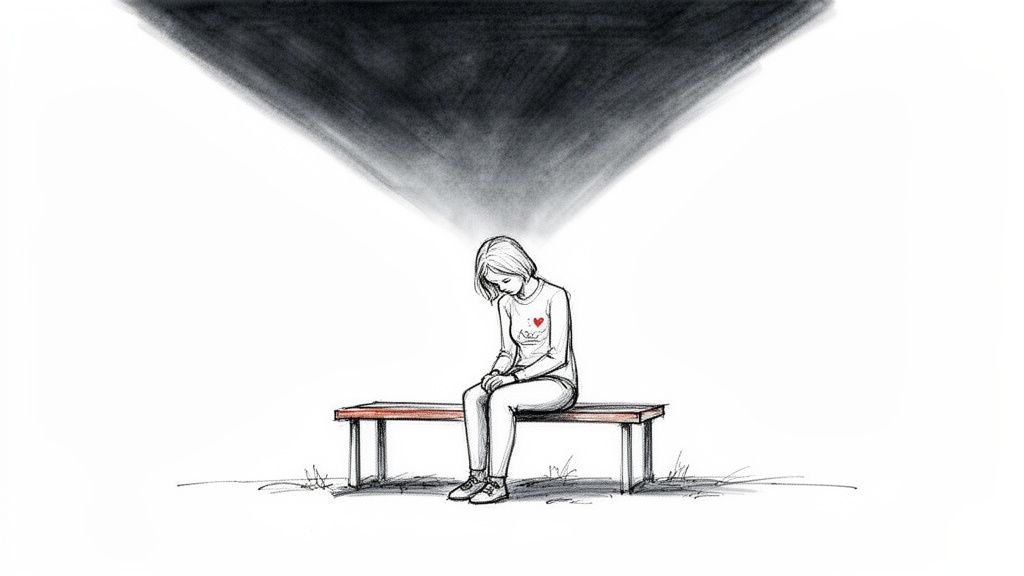
This journey isn't just about your child's fight; it's about yours, too. You've likely felt the dizzying confusion of trying to help while terrified you might be enabling. That complex dynamic, which can strain every relationship in the family, is incredibly draining. If this sounds familiar, our guide on dealing with an alcoholic spouse shares additional insights that may hit close to home.
Finding Your Lifeline
Before you can be an effective support for anyone else, you have to find your own emotional footing. This is where support groups for parents of addicts become so much more than a resource—they become a lifeline.
Think of them less as a formal solution and more as a circle of peers who understand the complicated map of your life without needing a single explanation. They've walked a similar path and can offer the one thing you can't get anywhere else: true, unfiltered empathy.
In these groups, the realization that you are not alone hits you almost immediately. The shared stories validate your own feelings, chipping away at shame and building a sense of belonging that is often the very first step toward healing.
This article is your practical guide. We're moving past just acknowledging the problem and diving into actionable solutions that put the power back in your hands. The focus here is on your well-being, because a stronger, healthier you is far better equipped for the challenges ahead.
What You Will Learn
This guide is designed to help you find strength, learn to set healthy boundaries, and begin your own process of recovery. We’ll walk through:
- The real, tangible benefits of joining a support group.
- The different kinds of groups out there, from 12-step programs to professionally-facilitated models.
- Practical, step-by-step advice for finding a community that fits your needs, both locally and online.
- Tips for participating in meetings so you can get the most out of every single session.
Your journey is real, your feelings are valid, and seeking support is a sign of incredible strength.
How Parent Support Groups Create a Lifeline
When you're caught in the relentless storm of a child's addiction, a support group is the safe harbor you've been desperately searching for. It’s so much more than just another meeting. It's a place to finally anchor yourself, share survival strategies with people who actually get it, and learn to navigate the overwhelming emotional waves instead of being capsized by them.
These communities offer tangible, life-altering benefits that get to the root of the pain and confusion so many parents face in silence. They are built on a foundation of shared experience, creating a unique environment where healing can truly begin.
Finding Validation in a Judgment-Free Zone
One of the most immediate and powerful benefits of walking into a support group is the feeling of being truly understood. For so long, you may have felt the need to hide your reality, worried about what friends, family, or your community would think if they knew the truth about the chaos of addiction.
In a room full of parents who have fought the same battles, that fear just dissolves. When you share a story about a sleepless night, a gut-wrenching decision, or a moment of pure despair, you’re met with knowing nods, not looks of pity or confusion.
This shared understanding is called emotional validation. It's the profound relief that comes from hearing someone say, "I've been there," and knowing, deep in your bones, that they mean it. This validation dismantles the shame and isolation that addiction feeds on, creating space for hope to grow.
This experience is a critical first step. It confirms that your feelings are normal and justified, which is an essential foundation for building resilience and starting your own journey of recovery.
Gaining Practical Tools for Daily Challenges
Beyond the emotional comfort, support groups for parents of addicts are invaluable sources of practical wisdom. These aren't theoretical discussions; they are real-world workshops on survival and self-preservation.
You'll learn from the firsthand experiences of others who have navigated the same impossible situations you're facing right now.
- Setting Healthy Boundaries: Discover how to say "no" with love and stop enabling destructive behaviors without cutting off your child.
- Effective Communication: Learn new ways to talk to your child that are less confrontational and more productive, fostering connection instead of constant conflict.
- Coping Mechanisms: Pick up new strategies for managing your own stress, anxiety, and grief—all essential for your own well-being.
- Navigating the System: Gain insights on dealing with treatment centers, the legal system, or healthcare providers from parents who have already been through it.
To help you see the advantages at a glance, here’s a breakdown of what these groups truly offer.
Table: Key Benefits of Joining a Parent Support Group
| Benefit | What It Means for You |
|---|---|
| Emotional Validation | You'll realize your feelings are normal and justified, reducing shame and self-blame. |
| Reduced Isolation | Connecting with others ends the loneliness, reminding you that you aren't on this journey alone. |
| Practical Coping Skills | You gain real-world strategies for managing stress, setting boundaries, and communicating effectively. |
| Shared Wisdom | Learn from the experiences of other parents who have faced similar challenges with the legal, medical, and treatment systems. |
| Renewed Hope | Seeing others who have found peace and stability provides powerful motivation and a sense of possibility for your own family. |
| Focus on Self-Care | The group reinforces the critical importance of taking care of yourself, which is essential for your own health and resilience. |
Ultimately, these practical skills empower you to shift from a state of constant crisis reaction to one of thoughtful, strategic action. This is where you begin to reclaim a sense of control over your own life. Some parents find that working one-on-one with a professional can help put these new strategies into practice. You can learn more about this by exploring the role of a recovery coach in our detailed guide.
The Power of Reducing Isolation
The impact of addiction on a family isn't just an emotional theory; it's a measurable public health issue. Research from sources like Recovery Answers shows that having a family member with an addiction is directly linked to poorer personal health and higher rates of depression.
In fact, 14% of adults report having a family member struggling with addiction, which just underscores how widespread this battle really is. Peer support has proven to be a vital tool in building the resilience needed to counteract these effects and start healing.
Joining a group directly fights the crippling isolation that fuels these negative outcomes. It helps you build a new social network—a community that understands, supports, and holds you accountable for your own self-care. This connection is your lifeline, reminding you that you are not alone on this difficult journey.
Exploring Different Types of Parent Support Groups
Finding the right support group isn’t a one-size-fits-all deal; it’s more like finding the right key for a very specific, personal lock. The world of support groups for parents of addicts is surprisingly varied, with each type offering its own philosophy, structure, and feel. Getting a handle on these differences is the first real step toward finding a community where you can finally breathe, feel understood, and start to heal.
Just as a doctor wouldn't prescribe the same medicine for every illness, the best support group for you will be one that clicks with your personality, your needs, and your comfort level. Let's break down the main options so you can make a choice that feels right.
12-Step Fellowships: Nar-Anon and Al-Anon
You’ve probably heard of Nar-Anon (for loved ones of those with narcotics addiction) and Al-Anon (for those affected by alcoholism). These 12-Step fellowships are the most widely recognized and are peer-led, meaning they’re run by members who’ve been where you are, not by professional therapists.
The entire program is built on a set of spiritual principles called the Twelve Steps, designed to guide you toward your own recovery and peace of mind. A central idea is accepting your lack of control over your child's addiction and shifting the focus back to your own well-being.
Meetings usually involve members sharing their "experience, strength, and hope." There’s no cross-talk or advice-giving—the power comes from listening and seeing your own story in someone else's words.
A core principle here is anonymity. This creates a truly safe, confidential space where you can share your deepest fears and frustrations without worrying about judgment or gossip, which is often what holds parents back from seeking help in the first place.
These groups are free, though they pass a basket for voluntary contributions to cover basic expenses, making them incredibly accessible. If a structured, spiritual path and the wisdom of shared experience resonate with you, a 12-Step group could be a perfect fit.
The infographic below really nails the core benefits you'll find in almost any good support model—validation, new coping skills, and a strong sense of community.
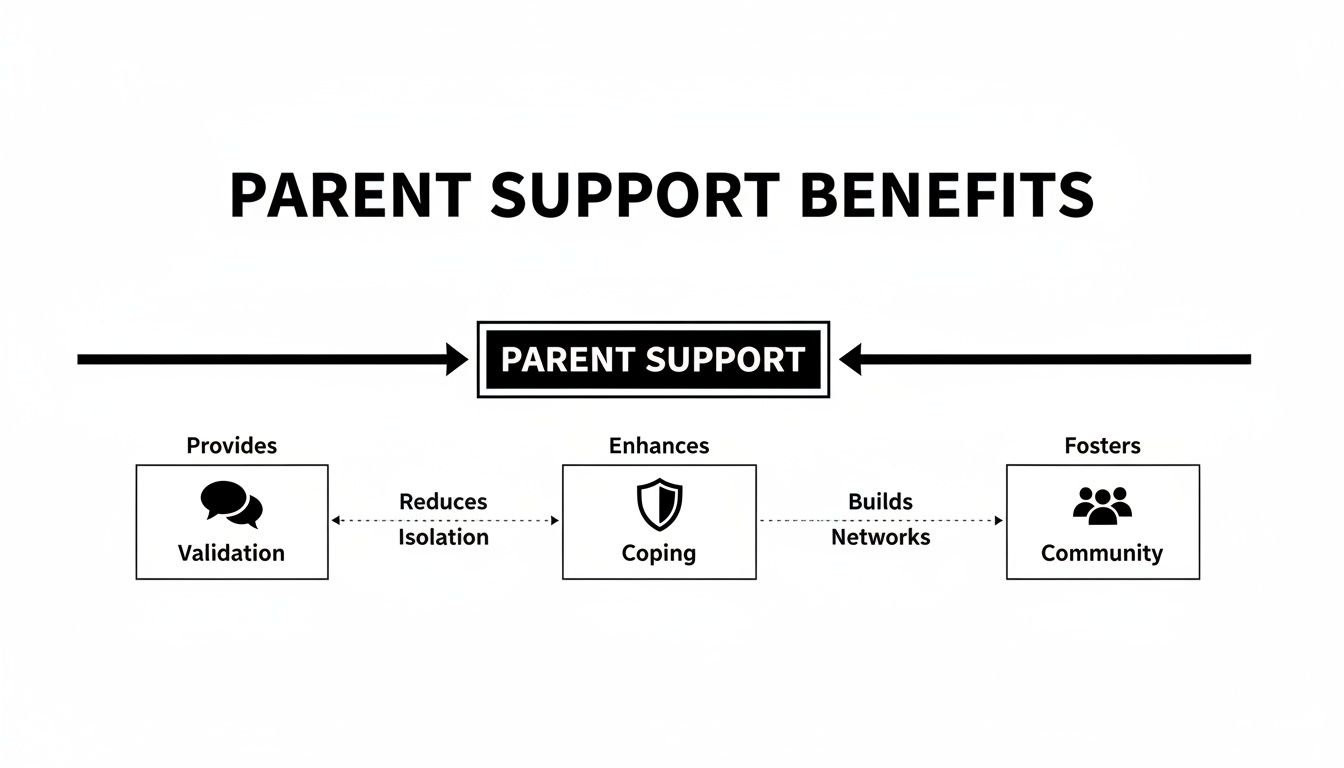
Think of these as the three legs of a stool. Each one is a pillar helping you rebuild your own stability, even when your child's addiction feels like a constant earthquake.
Professionally Facilitated Groups
Another path is a support group led by a licensed therapist, counselor, or social worker. You'll often find these connected to treatment centers, hospitals, or private practices. Unlike the peer-run fellowships, these groups offer a blend of support and structured education.
The facilitator steers the conversation, introduces specific topics like setting boundaries or understanding codependency, and might even incorporate therapeutic tools from approaches like Cognitive Behavioral Therapy (CBT). It’s a mix of peer connection and professional guidance.
Here’s what sets them apart:
- Structure: Meetings are less free-form and often follow a specific theme or curriculum.
- Guidance: A professional keeps the discussion on track and ensures it stays productive.
- Cost: Because a licensed professional is involved, these groups usually have a fee.
If you’re looking for a more educational setting with expert moderation and direct feedback, a professionally led group could give you the framework you need to move forward.
Informal Peer-Led Communities
Finally, there’s a whole universe of informal support networks out there, especially online. These can be anything from private Facebook groups and specialized forums to casual local meetups organized by parents who just need to connect. They are far less structured than 12-Step programs and offer a more flexible, on-demand kind of support.
These communities are all about real-time interaction. You can post a question at 2 AM when you can’t sleep and get immediate replies from other parents who are awake and worrying, too. While they might not have the formal structure or professional oversight of the other models, their accessibility is a game-changer. They provide a powerful sense of solidarity and are an excellent addition to more formal groups.
The emotional weight on parents is staggering, and these support networks have been a vital lifeline for decades. Back in the late 1980s and 1990s, 71.6% of child welfare professionals cited substance abuse as the top reason for the rise in child maltreatment cases. The need is just as urgent today, with data showing about 1 in 8 children lives with a parent struggling with a substance use disorder. You can explore more about the historical family impact in this report from Project Lifeline.
Actionable Steps to Find a Group Near You
Knowing you need a support group is a powerful first step, but the process of actually finding the right one can feel overwhelming. How do you go from knowing you need help to walking through the right door? It takes a clear plan. With a few focused strategies, you can locate a community that feels safe, supportive, and right for you.

The goal isn’t just to find any group. It’s to find your group—a community where the philosophy clicks with you and the logistics fit into your already complicated life.
Start with Trusted Online Directories
Your search can begin right from your computer. Reputable national organizations maintain huge, searchable databases of meetings, and they are excellent starting points because they’re consistently updated and vetted.
Here are a few of the most reliable resources:
- Nar-Anon Family Groups: Their website offers a meeting locator for groups specifically designed for the friends and family of those struggling with drug addiction.
- Al-Anon Family Groups: Similarly, Al-Anon provides a search tool for meetings focused on supporting those affected by someone else’s alcoholism.
- SAMHSA: The Substance Abuse and Mental Health Services Administration has a National Helpline that can provide referrals to local support groups and treatment facilities.
These organizations are the gold standard for finding legitimate support groups for parents of addicts. Their online tools let you filter by location, meeting type (in-person or virtual), and other needs, which makes the whole process much more efficient.
Connect with Local Professionals
Sometimes the best recommendations come from people who work in the addiction and recovery field every single day. They have firsthand knowledge of the local landscape and can often point you toward high-quality, effective groups.
Consider reaching out to:
- Local Addiction Treatment Centers: Call the family services or admissions department at a nearby recovery center. They often host their own parent support groups or can recommend respected ones in the community.
- Therapists or Counselors: If you or another family member is in therapy, ask your provider for a referral. Mental health professionals usually keep a list of trusted local resources.
- Your Primary Care Physician: Doctors are increasingly aware of the family impact of addiction and may be able to direct you to hospital-affiliated or community-based support programs.
These professionals have a vested interest in giving you sound advice. Their endorsement can help you bypass the trial-and-error phase and add a layer of confidence to your search.
Vet Potential Groups Before You Attend
Once you have a short list of potential groups, taking a few minutes to vet them can save you time and make sure your first experience is a good one. Before you commit to a meeting, it’s smart to gather a little more information.
Think of this as a brief, informal interview. You are looking for a community that aligns with your personal needs and comfort level. A few simple questions can clarify whether a group is the right place for you to begin your healing journey.
Here is a simple checklist of questions to ask yourself or a group facilitator:
- What is the group's core philosophy (e.g., 12-Step, faith-based, secular)?
- Is the group peer-led or facilitated by a professional?
- Are meetings open to newcomers, or is it a closed group?
- How large are the typical meetings?
- Do the meeting times and location (or virtual platform) work with my schedule?
Answering these questions beforehand helps set clear expectations and makes it much more likely that your first meeting will be a positive, supportive experience. This simple prep work empowers you to walk in feeling informed and confident.
Knowing When to Seek Professional Family Support
Peer support groups are an incredible source of strength, validation, and practical wisdom. They provide a safe space where you can finally feel seen and understood by people who get it.
But it’s important to recognize that while these groups are a vital piece of the puzzle, they aren't a substitute for professional mental health care—especially when the family system is under extreme stress.
Think of it this way: a support group is like a community first aid station. It’s perfect for patching up daily wounds, offering comfort, and providing essential supplies for the journey. But sometimes, the injuries are too deep or complex. They require the specialized care of a surgeon or a doctor.
This doesn't mean the first aid station failed; it just means you need a higher level of care working in tandem with it.
Recognizing the Signs You Need More Help
So, how do you know when it's time to add a professional to your support network? The signs often show up in your own well-being and in the atmosphere at home. Peer support can help you cope, but if your emotional state or family dynamics are worsening despite your best efforts, it's a clear signal to seek professional intervention.
Look for these key indicators:
- Overwhelming Anxiety or Depression: Your worry goes beyond normal concern and becomes a constant, paralyzing force. It might be interfering with your daily life, your sleep, or your ability to function.
- Symptoms of Trauma: You experience flashbacks, nightmares, severe emotional numbness, or hyper-vigilance related to your child's addiction and the chaos it has caused.
- Unmanageable Home Environment: The conflict, tension, and unpredictability at home have become so intense that the environment feels unsafe or is harming other family members.
- Physical Health Decline: The stress is taking a visible toll on your body. Maybe it's showing up as high blood pressure, chronic headaches, or digestive problems.
If these signs resonate, it doesn't mean your support group isn't working. It simply means the situation has evolved to a point where specialized therapeutic tools are necessary to help you and your family truly heal.
How Professional and Peer Support Work Together
Engaging a professional isn’t about abandoning your support group. It’s about building a comprehensive safety net. Family therapy and individual counseling are designed to address the deep-seated issues that peer groups are not equipped to handle.
A therapist can help you unpack trauma, learn clinical coping skills, and mediate family conflicts in a structured, safe setting.
For instance, you might discuss a boundary-setting technique in your Nar-Anon meeting. Then, in a session with a family therapist, you can role-play that exact conversation with a professional guiding you. One provides the "what," and the other provides the "how." For an in-depth look at how this works, you might be interested in our guide on experiential family therapy, which explores these kinds of hands-on therapeutic approaches.
The combination is powerful. Your support group offers the ongoing empathy and shared experience you need day-to-day, while therapy provides the targeted, clinical intervention required to heal deeper wounds and restructure family dynamics.
This dual approach ensures you have support on all fronts. The heartbreaking reality is that addiction’s impact ripples through entire families. Research from the NIH reveals a staggering crisis: in 2023, 1 in 4 kids under 18 lived with a caregiver battling a substance use disorder. You can learn more about these findings on how substance use disorders affect families. Seeking professional help is a proactive step toward breaking that cycle and restoring stability.
Common Questions About Parent Support Groups
Taking that first step into a support group can feel incredibly intimidating. It's often clouded by a long list of "what ifs" and genuine worries. If you're feeling that way, please know it's completely normal.
Let's walk through some of the most common questions and hesitations parents have. My hope is to give you clear, reassuring answers so you can feel more confident about getting the support you deserve.
What If I See Someone I Know?
This is a huge, and very common, fear. But here’s the thing: confidentiality is the bedrock of all reputable support groups for parents of addicts. Anonymity isn't just a suggestion; it's a core principle that ensures what’s shared in the room, stays in the room.
Most people in that room understand the immense courage it takes just to show up, and they deeply respect each other's privacy. Honestly, seeing a familiar face can sometimes be a powerful reminder that addiction doesn't discriminate—it touches all walks of life, reinforcing that you are truly not alone in your own community.
Do I Have to Share My Story Right Away?
Absolutely not. There is no pressure to speak until you feel ready. Many people go to their first few meetings just to listen, get a feel for the environment, and absorb the sense of shared experience.
The main goal is for you to feel safe. You’re encouraged to participate at your own pace. Sometimes, just hearing other parents voice the exact same fears and frustrations you’ve been holding inside is an incredibly healing and validating experience on its own.
Are Online Groups as Effective as In-Person Ones?
Yes, they absolutely can be. Online support groups are a fantastic option, especially for parents with demanding schedules, mobility challenges, or for those who live in areas with limited local resources. They often provide some unique advantages.
Virtual meetings offer incredible accessibility, a much wider range of meeting times, and a degree of anonymity that many people find comforting as they begin their journey. The most effective group is simply the one you attend consistently and feel connected to, regardless of the format.
Will These Groups Teach Me How to Fix My Child?
This is a critical point. The focus of these groups is not on "fixing" your child but on your own healing and well-being. The goal is to shift the focus back to you.
You'll learn healthier ways to communicate, practical strategies for setting boundaries, and how to detach with love. You will discover how to stop enabling behaviors that may be unintentionally prolonging the chaos. It’s about reclaiming your own life. This personal growth is often the most powerful catalyst for positive change within the entire family. Exploring different approaches to family healing, such as those found in various forms of addiction therapy, can be a great complement to what you learn in your group.
At Altura Recovery, we know that supporting your child has to start with supporting yourself. Our family workshops and outpatient programs are designed to work alongside peer groups, providing the clinical guidance needed to heal together. If you're ready to build a stronger foundation for yourself and your family, visit us at Altura Recovery to learn more.