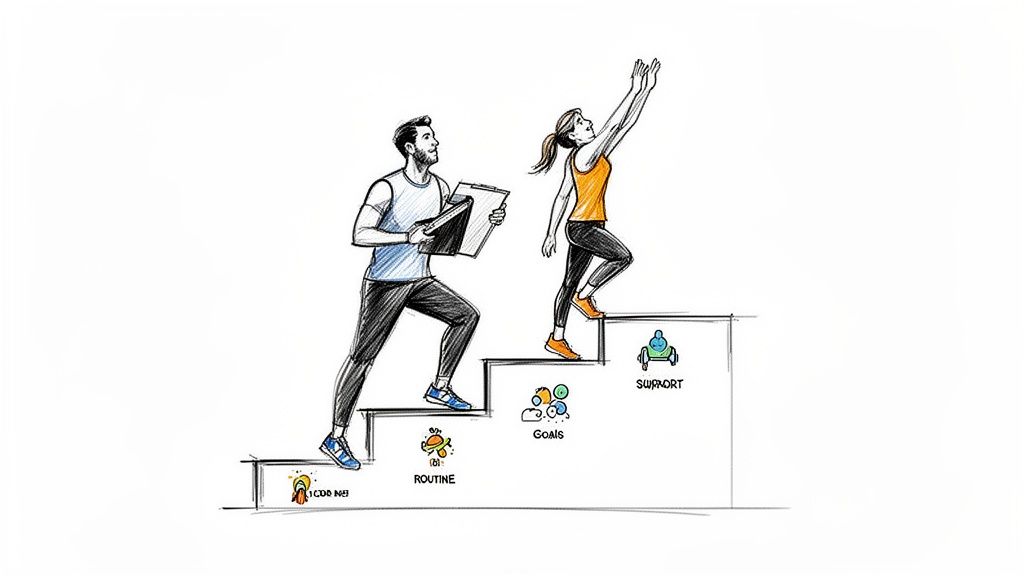
A recovery coach is a non-clinical professional who offers practical, goal-focused support for people navigating sobriety. The simplest way to think of them is as a personal trainer for your recovery—they use their expertise, and often their own lived experience, to help you build the skills, routines, and confidence you need for a fulfilling, substance-free life.
Defining the Role of a Recovery Coach
Imagine you’re learning a complex new skill, like sailing. A therapist might help you explore your fear of the open water, tracing it back to past experiences. A recovery coach, on the other hand, is the person in the boat with you, teaching you how to tie the knots, read the wind, and navigate the waves in real-time.
They focus on the here and now, helping you move forward.
This analogy gets to the heart of what a recovery coach does. They’re a hands-on guide, an ally, and a mentor all rolled into one. Their main job is to bridge the gap between clinical treatment and the real-world challenges of everyday life. While therapy often delves into the "why" of addiction, coaching centers on the "how" of recovery.
The Four Core Roles
A recovery coach’s job isn't just to be a cheerleader; they serve distinct, practical purposes in your support system. We can break their role down into four key functions.
The Four Core Roles of a Recovery Coach at a Glance
This table simplifies the main ways a recovery coach supports you, making it clear what you can expect from this partnership.
| Role | What It Means for You |
|---|---|
| Motivator | Inspires hope and strengthens your belief in your ability to succeed, especially during tough moments. |
| Guide | Helps you navigate the recovery landscape, from setting achievable goals to developing relapse prevention plans. |
| Accountability Partner | Supports you in staying committed to your goals and action plans, creating a structure for progress. |
| Resource Connector | Connects you with essential community resources, such as housing support, job training, or sober social groups. |
Each of these roles is designed to empower you on your journey, providing a well-rounded support system that adapts to your needs.
At its core, recovery coaching often embodies the principles of accountability coaching. It's all about fostering responsibility and commitment to guide you forward. A good coach empowers you to take ownership of your recovery, giving you the tools and encouragement needed to build a sustainable, independent life free from substance use.
How a Recovery Coach Fits Into Your Support System
Figuring out where a recovery coach fits in can feel confusing, especially if you already have a therapist or a sponsor. These roles aren't in competition with each other; they're all distinct and essential pieces of the recovery puzzle.
Think of it like this: a therapist is the architect who helps you understand the emotional blueprint of your past. A recovery coach is the general contractor who helps you build your new life, brick by brick, right here in the present. Their role is uniquely action-oriented and forward-looking, helping you turn the insights you gain in therapy into tangible, real-world change.
Comparing Recovery Coach vs Therapist vs Sponsor vs Case Manager
To clear up the confusion, let’s break down exactly what each support person does. While there can be some overlap, each role has a very specific focus, background, and way of relating to you. Understanding these distinctions helps you build a well-rounded support team where everyone is playing to their strengths.
| Support Role | Primary Focus | Typical Qualifications | Relationship Dynamic |
|---|---|---|---|
| Recovery Coach | Present & Future: Building life skills, setting goals, navigating daily challenges in sobriety. | Professional training & certification; often has lived experience. | Ally & Mentor: Action-oriented, collaborative partnership. |
| Therapist | Past & Present: Healing trauma, diagnosing & treating mental health conditions (anxiety, depression). | Master's or Doctoral degree, state licensure (LCSW, LPC, PhD, etc.). | Clinical & Therapeutic: Structured sessions focused on psychological healing. |
| Sponsor | Present: Guiding a person through the 12 Steps within a specific peer-support fellowship. | Personal experience with recovery and working the 12 Steps. | Peer & Guide: Informal, volunteer-based, shared spiritual framework. |
| Case Manager | Logistical: Connecting clients to resources like housing, healthcare, and legal aid. | Often a degree in social work or a related field; works for an agency. | Coordinator & Advocate: Administrative, focused on service coordination. |
Seeing them side-by-side makes it clear: these roles are designed to complement, not replace, one another. A coach helps you execute the life plan your therapist helps you design, while a sponsor provides peer-based spiritual guidance and a case manager handles the paperwork.
Coach vs. Therapist
The biggest difference here is focus and function. A therapist is a licensed clinical professional trained to diagnose and treat mental health conditions. They help you unpack the why behind your addiction—the trauma, depression, or anxiety that fuels it. Their work is often focused on healing the past to create a stable present.
A recovery coach, on the other hand, is a non-clinical professional who is all about the now and the next. They don't diagnose you or provide therapy. Instead, they partner with you to build a life that actively supports long-term recovery by helping you set practical goals, navigate daily hurdles, and develop real-world skills.
Since many people with a substance use disorder also have co-occurring mental health conditions, a therapist’s clinical expertise is absolutely vital for deep, lasting healing.
A therapist helps you understand why you feel a certain way. A coach helps you decide what you’re going to do about it today.
Coach vs. Sponsor
A sponsor, usually found in 12-step programs like Alcoholics Anonymous (AA), is a volunteer who has walked the path of recovery themselves. Their main job is to guide you through the 12 steps, offering support from one peer to another within a shared spiritual framework. The relationship is informal and deeply personal.
A recovery coach is a trained professional, even if they also have lived experience. The relationship is more structured, with formal sessions and goals that often go way beyond the 12 steps. A coach looks at your whole life—career, finances, relationships, wellness—and helps you build strength in all of those areas.
Coach vs. Case Manager
A case manager is your logistical coordinator, usually working within a treatment center or social service agency. They are expert resource connectors, making sure you have access to critical services like housing, medical appointments, legal aid, or food assistance. Their focus is on managing the administrative side of your care.
A recovery coach is much more hands-on and relational. They won’t just give you a phone number for a job agency; they might help you practice your interview skills, build a budget, or find sober social groups. They work on building your confidence and ability to use those resources effectively. Of course, a well-rounded recovery plan often includes digital tools, and platforms like supportgpt can offer helpful general information to supplement your primary support team.
What Happens During a Recovery Coaching Session
Walking into your first recovery coaching session can feel a little uncertain, but the whole process is designed to be practical, supportive, and empowering. Unlike therapy that often explores past trauma, a coaching session is firmly planted in the present moment and laser-focused on building a better future. Think less introspection, more actionable strategy.
Each meeting usually kicks off with a check-in. This isn’t just small talk; it's a purposeful review of your past week. You’ll talk through what went well, celebrate your wins—no matter how small they seem—and get honest about any challenges or triggers you ran into. This debrief gives both you and your coach valuable real-world data to work with.
From there, the session shifts into collaborative problem-solving and planning for the week ahead. This is where the real work gets done. It’s a true partnership where you and your coach create a tangible roadmap, always keeping the focus on practical, real-world steps.
Building Your Action Plan
The heart of the session is setting clear, achievable goals. These aren’t vague wishes; they are concrete tasks designed to build momentum and confidence.
- Life Skills Development: You might work on creating a weekly budget, drafting a resume for a job application, or even role-playing a tough conversation you need to have with a family member.
- Routine and Structure: A coach is fantastic at helping you design a daily schedule that actually supports sobriety. This could mean mapping out time for exercise, mindfulness, or meal planning.
- Resource Navigation: If you need to find a sober living home, a new support group, or a vocational training program, your coach acts as your guide, helping you identify and connect with the right resources.
The image below shows exactly how a coach fits into your broader support network, keeping the focus on those forward-looking goals.
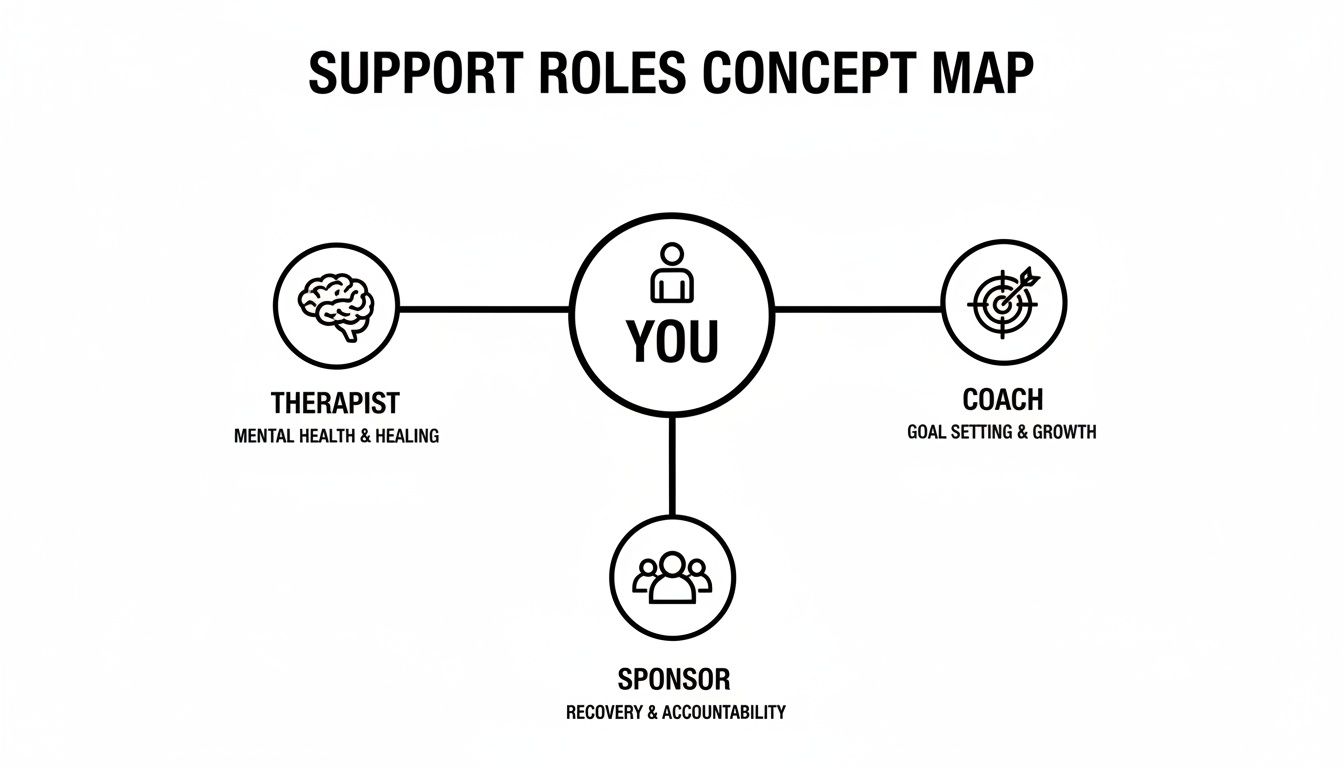
This visual really clarifies the coach's unique role: they help you take the insights from therapy and the fellowship from peer support and turn them into daily, manageable actions. They are the ones who help you execute the plan.
Accountability and Forward Momentum
You’ll leave every session with a clear action plan—a handful of manageable tasks to tackle before you meet again. This creates a powerful feedback loop of accountability and progress. Your coach isn't there to judge you if you stumble. Instead, they help you analyze what happened, learn from the setback, and adjust the game plan.
A recovery coaching session is a dedicated space to build the "how" of your recovery. It transforms the desire for a better life into a series of small, consistent actions that make it a reality.
Ultimately, every session is about empowerment. It’s a dedicated time to focus solely on your growth, with a skilled ally who believes in your potential and gives you the practical tools to get there. The goal is to build your skills and confidence so that, eventually, you can become your own best coach.
Where Does Recovery Coaching Come From? A Look at the Wider Professional Coaching World
To really get what a recovery coach is, it helps to see the bigger picture. This isn't some brand-new, isolated idea. Recovery coaching is a specialized arm of the massive, globally recognized professional coaching industry—a field that has absolutely exploded because it taps into a fundamental human need for personalized, goal-oriented support.
This isn’t a fringe service run on good intentions. It’s a formalized profession with standards, certifications, and a proven playbook. The rise of coaching signals a huge shift in how we approach personal growth. More and more, people are seeking out allies who can help them navigate tough challenges and build a better future, whether that’s in their career, their health, or their recovery.
The Solid Foundation of Professional Coaching
The professional coaching world isn’t built on fluff; it’s grounded in evidence-based methods like motivational interviewing and goal-setting theory. Its incredible expansion is backed by hard economic data and a fast-growing community of certified pros who follow a shared code of ethics. This is what ensures that when you work with a coach, you're getting someone trained in specific, effective skills.
The demand is undeniable. The global coaching industry, which includes recovery and wellness services, generated an estimated $5.34 billion USD in revenue last year alone. Between 2019 and 2025, the profession mushroomed by over 70%—a clear sign of sustained and accelerating interest. You can discover more insights about the coaching industry's growth from the International Coach Federation's massive global study.
This strong financial and professional footing is critical. It means recovery coaching isn't just a nice concept—it’s a structured, respected discipline that gets results.
When you engage a recovery coach, you are tapping into a proven professional framework that is expanding for one simple reason: it delivers real, measurable results for people seeking meaningful change.
The industry's momentum confirms that this model of support just plain works. It offers a non-clinical, strengths-based path for people to build the skills and resilience they need. A recovery coach operates within this legitimate and booming field, bringing its principles of empowerment, accountability, and forward-focused action directly to the unique challenges of building a life in sobriety. This context validates the coach’s role as a vital part of a modern, effective support system.
Weaving Recovery Coaching into Outpatient Treatment
Thinking about clinical treatment versus recovery coaching isn't an either/or choice—it’s about creating a powerful partnership. When you combine them, especially inside an outpatient program, you get a complete support system. It’s a system that tackles both the deep-seated psychological roots of addiction and the messy, practical challenges of staying sober day-to-day.
Imagine an Intensive Outpatient Program (IOP) or a Partial Hospitalization Program (PHP) is like a classroom. Inside that structured space, you learn critical skills—how to spot your triggers, manage a wave of anger, or communicate what you need. A recovery coach is your guide "on the field," helping you take those lessons and make them work in the chaos of real life.
This connection is so important because stepping out of a treatment center's structured environment can feel like jumping off a cliff. A coach bridges that gap, making sure the insights you gained in therapy don't get left behind in the classroom but actually become part of who you are.

Making Clinical Skills Stick in the Real World
In outpatient programs like ours at Altura Recovery, you spend hours each week in focused therapy. A recovery coach is the person who helps you take a breakthrough from your Tuesday group session and apply it to a high-stress work meeting on Thursday.
They offer real-time support for the kind of practical hurdles that therapy alone might not cover:
- Handling Social Situations: How do you walk into a family BBQ where everyone is drinking? A coach helps you rehearse what to say and map out an escape route if you need one.
- Managing Daily Overwhelm: From sorting out your finances to the delicate work of rebuilding trust with family, a coach helps you break down giant, scary tasks into small, doable steps.
- Building a Sober Community: They are your connector, plugging you into local resources and helping you find sober social groups that actually match your interests.
This kind of hands-on guidance is part of a fast-growing professional field. The global health and wellness coaching market was valued at USD 20.10 billion in 2025 and is expected to hit nearly USD 38 billion by 2034. This boom shows just how much people are seeking personalized support to make lasting changes. You can learn more about the health coaching market's expansion and the reasons behind it.
A recovery coach acts as a crucial bridge, connecting the controlled, therapeutic environment of an outpatient program to the messy, beautiful reality of a life in recovery.
How Altura Recovery Enhances Outpatient Care with Coaching
At Altura Recovery, we don't just offer coaching as an optional add-on; we weave motivational recovery coaching directly into our IOP, PHP, and Supportive Outpatient Programs (SOP). It's a fundamental part of how we approach treatment because we've seen it work. We know that long-term success hinges on having both clinical depth and practical, on-the-ground guidance.
When you join one of our programs, a recovery coach becomes your dedicated ally. They work side-by-side with your therapist, making sure your entire recovery plan is pulling in the same direction. While your therapist helps you heal the underlying trauma or co-occurring conditions, your coach helps you build the life skills and confidence to make your sobriety stick. This two-pronged approach ensures you feel supported from every angle as you move toward a life of independence and empowerment.
Got Questions About Recovery Coaching?
Choosing to bring a recovery coach into your life is a big move, and it’s completely normal to have questions about the practical side of things. How much does it cost? Is it confidential? What does success actually look like? Getting clear, straight answers to these questions is key to feeling confident about your decision.
We want you to have all the information you need, with no fluff or surprises. Let’s break down the details so you know exactly what to expect from this partnership.
What Does Recovery Coaching Cost, and Will My Insurance Cover It?
The price for a recovery coach can vary quite a bit, depending on their experience, where they're located, and the kind of services they offer. Most coaches charge by the hour, with rates typically falling somewhere between $50 and over $200 per session. Many also offer packages for multiple sessions, which can be a better value in the long run.
It helps to think of it not as a weekly expense, but as an investment in your long-term stability and well-being.
Insurance coverage for recovery coaching is still a mixed bag, but it's getting better. While some plans are starting to recognize and pay for peer support services, it’s definitely not standard across the board yet. The best thing to do is call your insurance provider directly and ask what your specific plan covers. On a positive note, some state Medicaid programs now cover these services, and that trend is likely to continue.
How Is My Privacy and Confidentiality Protected?
Your privacy is a top priority. A professional recovery coach is bound by a strict code of ethics that demands confidentiality, just like a therapist. What you share in your sessions stays between you and your coach.
Before you start, you’ll review a service agreement that spells out their confidentiality policy. There are, however, a few very specific, legally required exceptions to this rule:
- Risk of Harm: If you state that you intend to harm yourself or someone else, your coach has a legal duty to report it to keep everyone safe.
- Child or Elder Abuse: Any mention of abuse or neglect of a child or vulnerable adult must be reported to the proper authorities.
- Court Order: In rare legal cases, a court could subpoena a coach's records.
These exceptions are standard in all helping professions and are there to protect both you and the community. Outside of these situations, everything you discuss is held in the strictest confidence.
What Are Realistic Outcomes from Working with a Coach?
It’s important to know what you’re working toward. Unlike clinical treatment, which diagnoses and treats a disorder, coaching is all about building a life that feels good to live right now. The results are practical, tangible, and focused on moving you forward.
The ultimate goal of a recovery coach isn't just to help you stop using substances; it's to help you start living a life so meaningful and rewarding that you no longer feel the need to.
Here are a few realistic, measurable outcomes you can expect:
- Improved Life Skills: You’ll get hands-on practice with essentials like budgeting your money, managing your time, and communicating more effectively.
- A Stronger Support Network: Your coach will help you find and connect with healthy, sober friends and community groups.
- Increased Self-Confidence: By setting and hitting small, achievable goals week after week, you’ll start to really believe in your ability to handle whatever life throws at you.
- A Solid Relapse Prevention Plan: Together, you’ll build a personalized, real-world strategy for spotting your triggers and managing cravings before they take over.
Recovery coaching is a fast-growing part of the health and wellness coaching world, where substance use and mental health support have become a huge focus. This growth is driven by a greater public awareness of mental health and the understanding that lifestyle changes are non-negotiable for lasting recovery. The rise of virtual coaching has made a huge difference, connecting coaches with clients in remote areas and offering more flexible support than ever. You can read the full research about the health coaching market to learn more about these trends.
Ultimately, working with a recovery coach gives you the tools, confidence, and structure you need to build a stable, self-directed life in sobriety.
At Altura Recovery, we build motivational recovery coaching right into our outpatient programs because we’ve seen firsthand how it drives real-world success. Our coaches work side-by-side with our clinical team, giving you a complete circle of support. If you’re ready to build a life of purpose and freedom, contact us today to learn how we can help.