
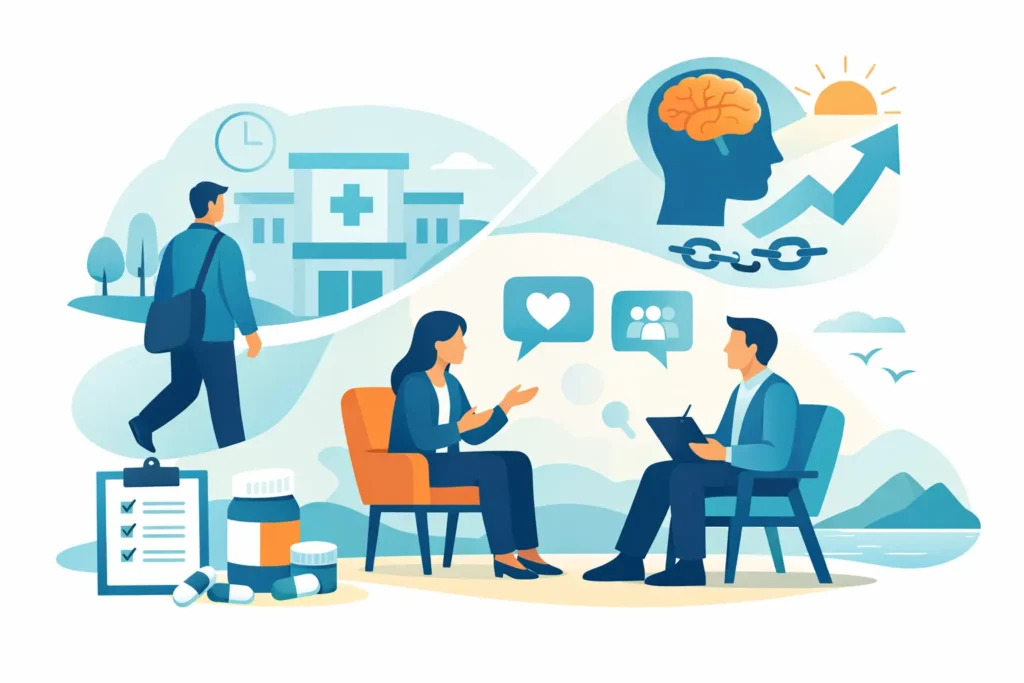
You may be ready for treatment but not able to disappear from your life for 30 days. Work still needs your attention. Classes still meet. Kids still need to be picked up. That is exactly where an outpatient addiction treatment guide can help – not by making recovery feel smaller, but by showing how real healing can happen with structure, accountability, and support built around daily life.
Outpatient care is often misunderstood. Some people assume it is only a light-touch option or a backup plan if things are not that serious. In reality, quality outpatient treatment can be highly structured, clinically grounded, and life-changing. For many people, it is the setting where recovery becomes practical, sustainable, and connected to the world they are actually living in.
What outpatient addiction treatment actually means
Outpatient addiction treatment is care you attend on a set schedule while continuing to live at home or in a supportive living environment. Instead of staying overnight in a facility, you participate in therapy, skills-building, psychiatric support, recovery planning, and other services during the week, then return to your everyday responsibilities.
That flexibility matters, but so does the clinical depth. A strong outpatient program is not simply occasional counseling. Depending on the level of care, it may include several hours of treatment multiple days per week, individual therapy, group therapy, family involvement, relapse prevention work, medication support, and treatment for co-occurring mental health conditions.
For people stepping down from detox or inpatient rehab, outpatient treatment can provide continuity at a critical time. For others, it may be the first and most appropriate level of care because they are medically stable, motivated for change, and in need of support that fits around work, school, or family life.
An outpatient addiction treatment guide to levels of care
Not all outpatient programs are the same. The right fit depends on your symptoms, your substance use history, your mental health needs, your relapse risk, and the stability of your home environment.
Partial Hospitalization Program
A Partial Hospitalization Program, or PHP, is one of the most structured outpatient options. It typically involves treatment for several hours a day, multiple days a week. PHP can be a strong fit for people who need intensive support but do not require 24-hour residential care.
This level often works well for someone transitioning from inpatient treatment or for someone whose substance use and mental health symptoms need close monitoring. PHP gives you a high level of clinical support while still allowing real-world practice outside treatment hours.
Intensive Outpatient Program
An Intensive Outpatient Program, or IOP, offers substantial support with more flexibility than PHP. Clients usually attend several sessions each week, often in morning or evening blocks that can work better for employment or school schedules.
IOP is often a strong match for people who need more than weekly therapy but can manage daily life with structure and accountability. It is also common as a step-down level after PHP, helping people keep momentum while building confidence in recovery routines.
General outpatient care
General outpatient treatment is usually less intensive and may include weekly individual therapy, group sessions, medication management, and ongoing recovery support. This level can be effective for people with a strong base of stability or as a later stage of care after more intensive treatment.
The key is not choosing the least disruptive option. It is choosing the level that gives you enough support to make change stick.
Who outpatient treatment is a good fit for
Outpatient care can be a strong option for adults, young adults, and teens, but it is not one-size-fits-all. The best candidates are usually medically stable, not at high risk for dangerous withdrawal without supervision, and able to participate consistently in treatment.
It can be especially helpful for people who want care without fully stepping away from work, school, parenting, or college responsibilities. That includes professionals trying to protect privacy, students whose substance use is affecting academics, and families looking for treatment that allows continued connection and involvement.
It is also a meaningful fit for people dealing with both addiction and mental health concerns. Anxiety, depression, trauma, bipolar disorder, and other psychiatric conditions often interact with substance use in ways that need integrated treatment. If one issue is treated while the other is ignored, progress tends to be fragile.
At the same time, outpatient care may not be the right starting point for everyone. If someone is actively unsafe, unable to remain abstinent between sessions, experiencing severe instability at home, or facing high-risk withdrawal, a higher level of care may be necessary first. That is not failure. It is a clinical decision made to protect recovery.
What to expect in a quality program
A good outpatient program should feel both supportive and structured. Compassion matters, but so do clear expectations, individualized planning, and measurable progress.
Most programs begin with a thorough assessment. This is where the clinical team looks at substance use patterns, mental health symptoms, trauma history, physical health, family dynamics, motivation, and practical concerns like transportation, work hours, and scheduling. That assessment should shape treatment rather than placing everyone into the same track.
From there, care often includes individual therapy to address personal patterns and goals, group therapy to build connection and accountability, and psychoeducation to strengthen emotional regulation, coping skills, and relapse prevention. Depending on your needs, treatment may also include psychiatric evaluation, medication management, family support, life skills coaching, and holistic services that help rebuild routine and stability.
The strongest outpatient programs are trauma-informed. They understand that substance use is often connected to pain, not just poor decisions. That does not remove accountability. It creates a more effective path for lasting change.
The real benefits and the real trade-offs
The biggest benefit of outpatient treatment is that recovery happens in real time. You are not practicing new coping skills in a bubble. You are using them while navigating daily triggers, relationships, responsibilities, and stressors. That can make treatment deeply practical.
It also allows you to maintain important parts of your life. You may be able to keep working, continue classes, stay connected to family, and apply what you learn right away. For many people in Houston, where commuting, work demands, and family obligations are part of everyday life, that flexibility is not just convenient. It is what makes treatment possible.
But outpatient care has trade-offs. Because you remain in your normal environment, you also remain closer to old routines, people, and stressors that may have fed substance use. That means motivation, accountability, and outside support matter a great deal. If home life is chaotic or unsafe, outpatient treatment can be harder to sustain without added structure, such as sober living or family involvement.
This is where honesty matters. The best program is not the one that sounds easiest. It is the one that gives you a genuine chance to recover and rise.
How to choose the right outpatient addiction treatment guide for your needs
When people look for treatment, they often focus first on schedule or cost. Those factors matter, but they should not be the only ones driving the decision.
Start with the clinical basics. Does the program treat both addiction and mental health conditions? Does it offer more than one level of care, so support can change as your needs change? Is the treatment evidence-based and trauma-informed? Are psychiatric services available if medication support is needed?
Then look at the human side of care. Does the team treat you with dignity? Do they build a plan around your actual life, or do they push a generic model? Is family involvement available when helpful? Are young adults, teens, or professionals served in ways that reflect their specific pressures and recovery challenges?
You should also ask what progress looks like. Recovery is not just about stopping substance use for a few weeks. It is about emotional regulation, healthier relationships, stronger routines, relapse prevention, and the ability to move through life with more clarity and freedom.
Recovery that fits real life
Outpatient treatment is not a lesser version of recovery. For the right person, it is the place where treatment becomes real enough to last. It creates room for therapy, accountability, and healing while you continue to show up for your life and learn how to live it differently.
That matters whether you are returning from detox, trying to stay in school, managing a career, or supporting a loved one through change. The right program does more than stabilize a crisis. It helps build a life that no longer needs substances to function.
If you are looking for help, let the next step be simple and honest. Ask what level of care fits, what support you actually need, and what kind of structure will help you follow through. Recovery does not have to begin with leaving your life behind. Sometimes it begins by learning, with real support, how to reclaim it.