
The whole individual therapy vs group therapy debate really boils down to two things: focus and environment. Think of individual therapy as a confidential, one-on-one deep dive with a therapist, designed for intensely personal exploration. Group therapy, on the other hand, is a collaborative setting where healing is fueled by shared experiences and peer support.
Your best path depends on whether you need a private, focused space to unpack your story or the reassuring power of a supportive community.
Defining the Two Paths to Healing
Before you can choose the right therapeutic support, you have to understand the core structure of each option. While both paths are designed to foster growth and teach coping strategies, they get there in very different ways.
Individual therapy is a confidential partnership between you and a licensed therapist. Every session is built around your specific history, goals, and challenges. This format is perfect for unpacking complex personal issues—like trauma or deep-seated behavioral patterns—that demand focused, uninterrupted attention. For instance, if you're exploring sensitive topics, learning more about specialized approaches like what is trauma-informed therapy can be incredibly powerful in a one-on-one setting.
Group therapy, conversely, brings together a small number of people, guided by one or more therapists, who are all navigating a similar issue. This could be anything from addiction and social anxiety to grief. Here, the therapeutic power comes from the group dynamic itself. There's immense value in realizing you aren't alone, gaining different perspectives, and practicing new interpersonal skills in a safe, structured environment.
The image below breaks down some of the key practical differences in cost, session length, and the number of participants.
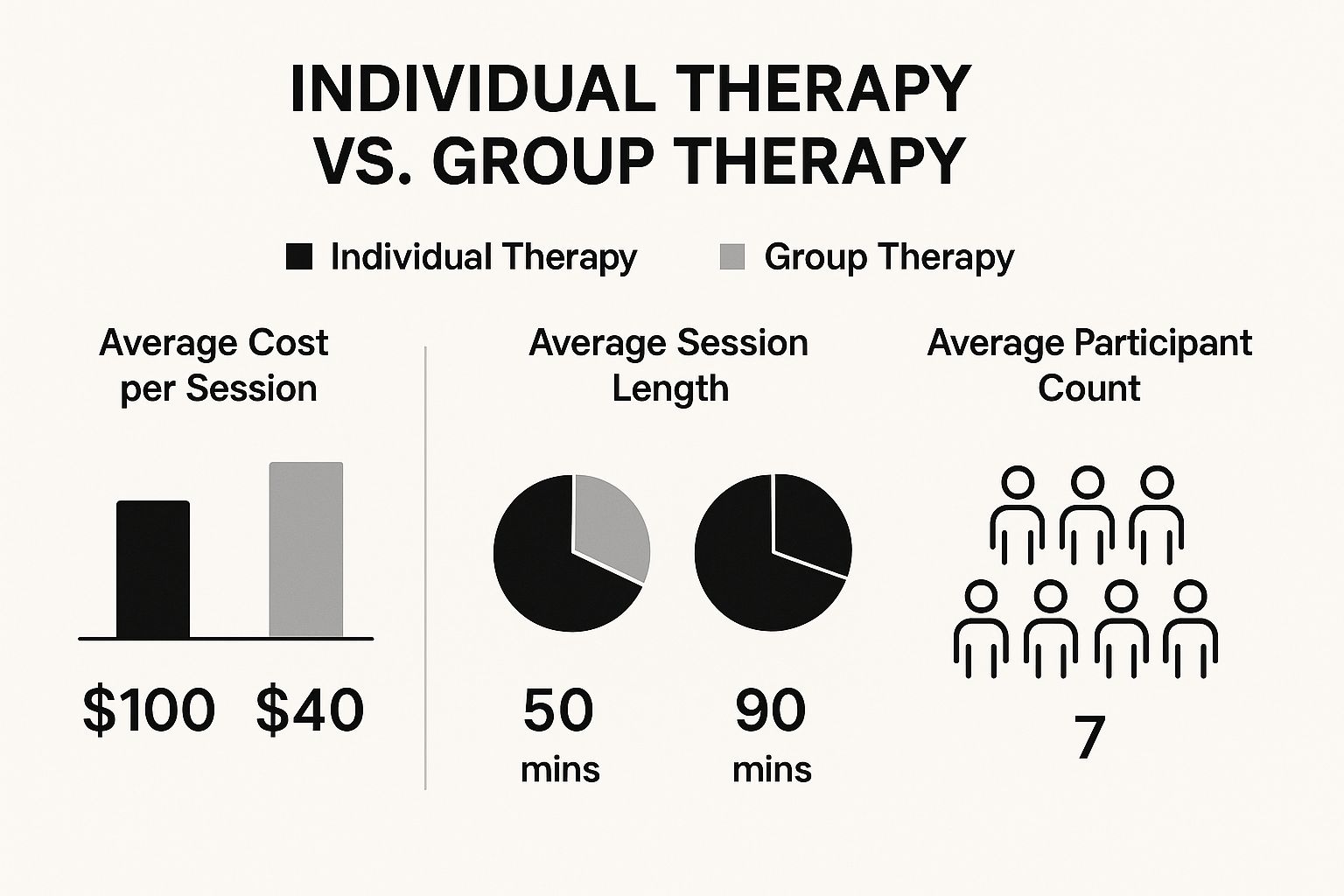
As you can see, while group sessions tend to be longer and more affordable, individual therapy provides that exclusive, dedicated focus on a single person's journey.
To make these foundational differences even clearer, here's a quick side-by-side comparison.
Individual Therapy vs Group Therapy at a Glance
This table offers a high-level summary of how the two formats stack up on key attributes.
| Attribute | Individual Therapy | Group Therapy |
|---|---|---|
| Primary Focus | Deep, personalized exploration of individual issues. | Shared experiences and peer interaction around a common theme. |
| Structure | One-on-one sessions with a single dedicated therapist. | A small group of peers led by one or more facilitators. |
| Confidentiality | Absolute privacy between the client and therapist. | Confidentiality is based on a shared group agreement. |
| Feedback Source | Direct guidance and feedback from a trained professional. | Diverse perspectives from both peers and the therapist. |
Ultimately, this table highlights the central trade-off: the laser-focused privacy of individual work versus the communal wisdom and validation found in a group setting.
Comparing the Therapeutic Journey

It’s one thing to understand the structural differences between individual therapy and group therapy, but it’s another thing entirely to live them. The day-to-day process and the emotional landscape of healing look and feel quite different depending on the setting. It’s these subtle dynamics that often make all the difference in figuring out which path is right for you.
Individual therapy is built on a single, powerful connection known as the therapeutic alliance. This is the trusting, collaborative relationship you build with your therapist. The entire session—typically around 50 minutes—is dedicated exclusively to your thoughts, your history, and your goals. This creates an environment of deep focus and absolute privacy.
Because of this one-on-one structure, the pace is entirely yours. You can spend weeks unpacking a single memory or move quickly through topics as you feel ready.
The Flow of Feedback and Insight
In individual therapy, feedback is direct. It comes from a single, expert source. Your therapist offers clinical insights, challenges your perspectives, and guides you with evidence-based techniques tailored specifically to your situation.
Group therapy operates on a completely different feedback model. While a facilitator guides the session, the main source of feedback and connection is the group itself. This creates a multi-layered loop where you get diverse perspectives from peers who get what you’re going through because they’re going through it, too.
The core difference lies in the source of reflection. Individual therapy offers a mirror held up by an expert, while group therapy provides a hall of mirrors, reflecting various angles from people who have walked a similar path.
This distinction is crucial. One approach provides targeted, professional guidance, while the other offers relational validation from people with lived experience.
Privacy and Personal Pacing
Confidentiality is the bedrock of any therapy, but it functions differently in each format.
- Individual Therapy: This setting offers absolute confidentiality. What you say is legally protected and stays strictly between you and your therapist, fostering a sense of total security. This is vital for exploring highly sensitive topics like trauma or deep-seated shame without holding back.
- Group Therapy: This format relies on shared confidentiality. All members agree to keep what’s said in the room, inside the room, creating a trusted container. While this is highly effective, its integrity depends on every single participant.
This difference directly impacts how quickly you might feel comfortable opening up. The privacy of individual sessions often allows people to go deeper, faster, on intensely personal issues. For instance, someone processing childhood trauma might need the unshakable safety of a one-on-one setting before they could even consider sharing in a group.
On the other hand, a person working on social anxiety might find the real-time interaction of a group to be a more direct and effective way to practice new skills.
Structure of a Typical Session
The agendas for each type of session are also fundamentally different, reflecting their unique goals.
A Look Inside a Session
| Aspect | Individual Therapy | Group Therapy |
|---|---|---|
| Opening | Checking in on your week, thoughts, and feelings since the last session. | Group check-in where each member briefly shares their current status. |
| Main Focus | Deep exploration of a specific issue, memory, or behavior pattern you bring up. | Discussion centered around a common theme or a member's presented challenge. |
| Interaction | A focused dialogue between you and your therapist. | A dynamic conversation involving multiple members, moderated by the facilitator. |
| Closing | Summarizing insights, identifying takeaways, and setting intentions for the week ahead. | Group-wide summary, sharing final thoughts, and reinforcing mutual support. |
Ultimately, the journey in individual therapy is an internal expedition with a skilled guide. In group therapy, it's a shared voyage where you navigate the waters together, learning from each other's maps and experiences along the way.
What the Research Says About Effectiveness

When you’re weighing individual vs. group therapy, the most common question is simple: which one actually works better? The answer, backed by tons of research, is more nuanced than a simple verdict. A therapy’s effectiveness isn’t a one-size-fits-all deal; it’s deeply tied to the specific condition being treated and the person’s unique situation.
For many common mental health challenges, the data flips the script on the assumption that one-on-one is always superior. In fact, a huge body of evidence shows both formats deliver powerful, positive results. When it comes to pure efficacy, the two paths often lead to the same destination: a healthier, more stable life.
Comparable Outcomes for Many Conditions
There’s a common misconception that the personalized attention in individual therapy automatically leads to better outcomes. Research, however, consistently shows this isn’t the case. For a whole spectrum of disorders, group therapy is just as effective as its individual counterpart.
This isn’t just a hunch. It’s backed by a large-scale analysis of more than 50 randomized clinical trials. The study dug into outcomes for conditions like major depression, PTSD, social phobia, substance use disorders, and various personality disorders. The conclusion was crystal clear: group therapy’s effectiveness was statistically on par with individual therapy. You can dig into the full study on treatment format efficacy yourself to see the detailed data.
What this means for most people is that the choice isn't about picking the "best" option, but rather the "best-fit" option for their specific needs and comfort level.
Situational Effectiveness: The Key Differentiator
While the big-picture outcomes are often similar, certain situations really highlight the unique strengths of each format. The context of your challenge plays a massive role in figuring out which approach will give you the most traction.
For instance, individual therapy is often the go-to starting point for severe, acute crises or for working through deeply personal trauma where absolute privacy is non-negotiable. That focused environment allows a therapist to provide immediate, tailored crisis management without the moving parts of a group dynamic.
The most effective therapy isn't defined by the number of people in the room, but by how well the environment aligns with the client's immediate goals, diagnosis, and relational needs.
On the other hand, group therapy absolutely shines when treating issues where peer support and social interaction are central to getting better. This is especially true for substance use disorders and co-occurring mental health conditions. Learning how to manage triggers and build healthy relationships is a core part of recovery, and a group provides a safe, real-time lab to practice these skills. If you’re exploring options for this, our guide on dual diagnosis outpatient treatment offers more insight into integrated care models that often combine both approaches.
When Group Therapy Is the Right Choice

While individual therapy offers a focused, private space, some challenges are uniquely suited for the collaborative power of a group. Group therapy isn’t just a more affordable alternative; it’s a distinct therapeutic model where the community itself becomes a powerful agent for change. For some people and certain conditions, this shared environment is not only beneficial but essential for deep, lasting healing.
The decision in the individual therapy vs group therapy debate often comes down to your primary goal. If that goal involves overcoming feelings of isolation, building interpersonal skills, or gaining perspective from others who truly understand your struggle, a group setting can be incredibly effective.
The core strength of group therapy lies in a principle called universality—the profound relief of discovering you are not alone in your experience.
Thriving in a Shared Experience
Some of life’s most difficult struggles, like grief or addiction, are amplified by isolation. In these cases, group therapy provides immediate validation and a sense of belonging that one-on-one sessions simply can’t replicate. The shared narrative is the medicine.
For example, there's a reason addiction recovery programs rely so heavily on group dynamics. Peer accountability, shared coping strategies, and mutual encouragement create a powerful support system. Seeing others succeed provides tangible hope, while helping others reinforces one's own commitment to recovery.
Group therapy transforms the healing process from a solitary climb into a team expedition. The collective wisdom and shared vulnerability of the group provide a safety net and a source of motivation that is difficult to achieve alone.
A Real-Time Lab for Social Skills
Group therapy also serves as a safe, controlled environment for practicing social skills. For someone dealing with social anxiety, talking about their fears with a single therapist is helpful. But facing those fears in a supportive group? That’s where the real progress happens. It’s a real-time lab for navigating conversations, setting boundaries, and receiving gentle feedback.
This format is particularly powerful for specific conditions where peer interaction is a key component of treatment. In fact, research shows that for certain diagnoses, the group approach can yield superior results. A significant systematic review found that group psychotherapy was notably more effective than individual therapy for improving outcomes in patients with schizophrenia at both 12-month and 24-month follow-ups. You can read more about the findings on group therapy effectiveness.
Ultimately, group therapy is the right choice when your healing journey can be accelerated by connection, shared understanding, and the reassuring power of knowing you are part of a community that gets it.
When Individual Therapy Is a Better Fit
While group therapy draws power from community, some situations just demand the focused, private environment only one-on-one therapy can offer. It’s not simply a matter of preference; for certain challenges, an individual setting is the most effective—and sometimes the only appropriate—place to start. This is especially true when the issues are intensely personal, complex, or require absolute discretion.
When you’re weighing individual therapy vs group therapy, the nature of your struggle should be the deciding factor. If you're working through complex trauma (C-PTSD) or unpacking deeply rooted family patterns, the undivided attention of a skilled therapist isn’t just a nice-to-have, it’s essential. These conditions require a slow, careful process of building trust and safety, which is best grown in a private therapeutic relationship.
For someone just starting to process severe trauma, a group setting can feel overwhelming or even counterproductive. The focus needs to be entirely on your experience, moving at your pace, without the added dynamic of hearing others’ stories before you’re ready.
For Deeply Personal or Stigmatized Issues
Confidentiality is a cornerstone of all therapy, but individual sessions provide an unmatched layer of privacy. This becomes critical for anyone dealing with highly sensitive or stigmatized issues.
- Public Figures: Professionals, executives, or community leaders often need a space completely free from any chance their personal challenges could become public.
- Sensitive Topics: Exploring experiences like sexual assault, profound shame, or specific phobias requires a level of vulnerability that usually feels safer in a one-on-one context.
- Legal or Professional Concerns: When therapy content could intersect with legal cases or workplace issues, the guaranteed privacy of individual therapy is non-negotiable.
This protected space encourages total honesty, allowing for a much deeper exploration of thoughts and feelings you might otherwise hold back.
Individual therapy creates a secure container where the most vulnerable parts of your story can be safely explored. This level of privacy isn't just a comfort—it's a clinical necessity for certain types of healing.
Addressing Severe Mental Health Conditions
For anyone navigating a severe mental health condition—like major depressive disorder, acute anxiety, or early sobriety—individual therapy is almost always the recommended first step. During a crisis or in the early phases of treatment, the primary goal is stabilization.
A therapist can provide intensive, personalized support to manage acute symptoms, develop foundational coping skills, and build a treatment plan just for you. This focused intervention helps create a stable base. From there, a person might later feel ready and able to benefit from a group setting. Trying to jump into a group while in crisis is often too demanding and can get in the way of making that crucial initial progress.
Navigating Cost and Accessibility
Beyond the therapeutic approach, the decision often comes down to brass tacks. Practical things like your budget, your schedule, and what’s even available in your area are huge pieces of the puzzle when comparing individual therapy vs group therapy. Getting clear on these logistical differences from the start helps you choose a path that you can actually stick with long-term.
One of the biggest distinctions is the price tag. Group therapy is almost always the more affordable route. Because a single therapist’s time is shared among several clients in one session, the cost gets distributed, making the per-person fee much, much lower.
This affordability is a huge driver behind its growing popularity. While individual therapy still makes up about 95% of mental health treatments around the world, group therapy is gaining ground as more people look for accessible care. The group model allows facilitators to help more people at once, which directly lowers the financial barrier for clients. You can read more about the impact of group therapy on mental health treatment to see how this dynamic plays out.
Estimated Cost and Accessibility Comparison
The real-world differences in cost and availability can be pretty stark. Let’s break down what you might expect when you start looking for care, whether you're paying out-of-pocket or using your insurance benefits.
| Factor | Individual Therapy | Group Therapy |
|---|---|---|
| Average Cost Per Session | Typically ranges from $100 to $250+ without insurance. | More affordable, often $40 to $80 per session. |
| Insurance Coverage | Widely covered, but copays and deductibles can be high. | Often covered, sometimes with lower copays than individual sessions. |
| Wait Times | Can be long for specialized or in-demand therapists. | May have shorter wait times, especially for general support groups. |
This table makes the financial upside of group sessions pretty clear. However, accessibility isn’t just about the money; it’s also about finding the right support when you need it, which can sometimes be simpler with one-on-one care.
Choosing therapy isn't just a clinical decision; it's a financial and logistical one. The "best" option is one you can consistently attend without adding financial stress to your life.
Availability plays a huge role here, too. Finding a therapist who specializes in your specific issue for individual sessions might be fairly straightforward. In contrast, finding a specialized group—say, for a niche type of anxiety or a specific life event—that also fits your schedule can be a bigger challenge.
For those in structured programs, understanding how rehab works can shed light on how both individual and group sessions are woven into a complete care plan, often balancing these cost and accessibility factors for you.
Frequently Asked Questions
Choosing between individual and group therapy always brings up a few practical, "what if" questions. It’s one thing to understand the concepts, but another to picture how they’ll fit into your life. Let's clear up some of the most common uncertainties people have.
Think of this as the final step in comparing individual therapy vs group therapy—a chance to address those last few questions so you can move forward with confidence.
Can I Do Both Individual and Group Therapy at the Same Time?
Yes, absolutely. In fact, running both at the same time is a powerful strategy that many clinicians recommend. Individual therapy gives you that private, confidential space for deep, personalized work, while group therapy provides a community where you can practice new skills and hear different perspectives from people who get it.
This combined approach can really accelerate your progress. Insights you uncover in a one-on-one session can be explored and tested in the supportive, real-world dynamic of a group. Just be sure to discuss it with your therapist so both treatments are coordinated and aligned with your overall goals.
What if I Am Too Anxious for Group Therapy?
This is an incredibly common—and completely valid—concern. Many people who could benefit most from a group, especially those dealing with social anxiety, feel nervous about the idea at first. A skilled group facilitator is trained to create a safe, non-judgmental space where you can participate at your own pace.
The initial fear of joining a group is often the very thing the group is designed to help you overcome. The supportive atmosphere itself becomes a therapeutic tool for building confidence.
It's perfectly fine to just listen during your first few sessions. Over time, as you absorb the shared understanding and gentle encouragement from others, that anxiety often begins to fade significantly.
Is My Information Kept Confidential in Group Therapy?
Confidentiality is the bedrock of group therapy. In the very first session, the therapist establishes clear, strict ground rules that every single member must agree to. The most important rule is simple: what is said in the group, stays in the group.
While this does rely on the integrity of all members, the shared agreement creates a trusted and secure space. The facilitator's job is to reinforce these rules and manage any issues that come up to keep the environment safe for everyone. For those seeking specialized, one-on-one approaches, learning about what is motivational interviewing therapy can provide insight into other focused techniques.
At Altura Recovery, we understand that the right therapeutic fit is crucial for lasting change. Our programs integrate both individual and group sessions to provide a balanced, evidence-based path to healing. If you're ready to find the support that works for you, visit us at https://www.alturarecovery.com.