
Loving an alcoholic is a uniquely exhausting and isolating experience. Life becomes a painful cycle of broken promises, unpredictability, and deep emotional wounds. You find yourself constantly putting your partner's struggles ahead of your own well-being, losing pieces of yourself along the way.
It’s so important to start here: You are not the cause of their disease. Grasping that truth is the very first step toward taking your own life back.
Understanding the Chaos of Loving an Alcoholic

It usually creeps in quietly. First, a vague feeling of unease. Then, a pattern of excuses you can’t quite put your finger on, or a growing emotional distance that leaves a chill in the room.
Living with a spouse who has a drinking problem feels a lot like trying to navigate a constant storm. It can leave you feeling confused, deeply hurt, and utterly alone. But it’s crucial to recognize this isn't about a simple lack of willpower. Alcohol Use Disorder (AUD) is a recognized medical condition that fundamentally rewires the brain.
The fallout from their drinking goes far beyond the act itself, seeping into every corner of your life. It creates a chaotic home environment where you’re constantly walking on eggshells, never sure which version of your partner you’re going to get.
Recognizing the Signs of a Partner's Problem Drinking
Seeing the problem for what it is can be the hardest part, especially when you love the person behind the disease. The signs often have less to do with the number of drinks and more to do with secrecy, behavior changes, and a slow erosion of trust.
Here are some of the common patterns I’ve seen time and time again.
| Recognizing the Signs of a Partner's Problem Drinking |
| :— | :— |
| Category | Common Signs and Examples |
| Personality Shifts | Your once-loving partner becomes irritable, defensive, or emotionally withdrawn, especially when you bring up their drinking. |
| Increased Secrecy | You might find hidden bottles in the garage, notice unexplained credit card charges from bars, or catch them in lies about where they've been. |
| Neglected Responsibilities | They start missing work, "forgetting" important family events like a child's school play, or consistently failing to follow through on household promises. |
| Broken Promises | There's a recurring, heartbreaking cycle of them vowing to quit or cut back, only to fall right back into the same patterns. This is a hallmark of addiction. |
If you're nodding along to this list, you're not imagining things. These are classic red flags that the problem is serious and requires more than just hope to fix.
The Emotional Toll on You
The constant stress of living in this environment takes a massive toll on your own health. It’s not just in your head. Research consistently shows that living with an alcoholic spouse significantly damages the partner’s mental health.
In fact, one global study found that women with heavy-drinking partners reported much higher levels of anxiety and depression and substantially lower life satisfaction.
Your feelings of exhaustion, frustration, and sadness are completely valid. Acknowledging the harm this situation is causing your own well-being isn't selfish—it's a necessary act of survival.
As you navigate the emotional minefield of this relationship, it can be incredibly helpful to look into the principles of understanding trauma-informed care. This approach helps frame what you're going through.
It’s about recognizing that the constant unpredictability and emotional upheaval can be a form of trauma. Your responses—the anxiety, the hyper-vigilance, the numbness—are normal reactions to a completely abnormal situation. Validating your own experience is the foundation for every single actionable step that follows in this guide.
Prioritizing Yourself When Your Partner Cannot

When your life starts revolving around managing your spouse’s addiction, it's inevitable that your own needs get shoved to the back burner. Self-care starts to feel like a selfish luxury you just can't afford. But it's not a luxury; it's a lifeline. Prioritizing your own well-being isn’t about abandoning your partner. It's about surviving.
Living with an alcoholic spouse is an emotionally draining, exhausting experience. The constant stress, the walking on eggshells, the hyper-vigilance—it wears you down physically and mentally over time. You have to give yourself permission to shift the focus back to you, even if it’s just for a few moments each day.
The Art of Emotional Detachment
Emotional detachment is one of the most critical survival skills you can learn in this situation. It doesn't mean becoming cold or uncaring. Far from it. It's about building an emotional buffer that helps you separate the person you love from the disease you hate.
This practice allows you to love your spouse without being completely consumed by the chaos their drinking creates. You start learning how to stop reacting to every single crisis and how to stop letting their mood dictate yours. It’s a powerful way to protect your own peace of mind when everything around you feels turbulent.
To start practicing this, you might:
- Frame hurtful behavior as a symptom of the disease. This doesn't excuse it, but it does help you take it less personally.
- Let go of trying to control their drinking. You can’t cure them. Trying to will only lead to your own frustration and burnout.
- Focus only on what you can control: your own actions, your boundaries, and your responses.
Detaching emotionally is a game-changer. It gives you the space to respond thoughtfully instead of reacting emotionally, which is a massive step toward reclaiming your own stability.
Rebuilding Your Life One Step at a Time
It’s common for your world to become very small, centered almost entirely on your partner’s addiction. Rebuilding your own life begins with small, deliberate actions that are just for you. It’s about rediscovering the person you were before their alcoholism took center stage.
Think about a hobby you once loved but have long since abandoned. Was it painting? Hiking? Playing an instrument? Carving out even 30 minutes a week for an activity that brings you joy can feel like a breath of fresh air. It's a potent reminder that you exist outside of your role as a caretaker.
Giving yourself permission to feel your own emotions—the anger, guilt, and deep sadness—is not a sign of weakness. It's an act of courage. Finding healthy ways to process these feelings, rather than letting them fester, is essential for your long-term mental health.
It's also time to reconnect with friends who lift you up. So often, partners of alcoholics isolate themselves out of shame or sheer exhaustion. Call a friend you trust, someone who can listen without judgment. A simple conversation can shatter the profound sense of isolation you've been carrying. Developing healthy personal practices is essential; you can find more information about coping skills for substance abuse that can also be adapted for your own well-being.
How to Set Boundaries That Actually Work

Setting boundaries is probably one of the most powerful—and hardest—things you’ll ever do when living with an alcoholic spouse. For a long time, your life has likely revolved around managing their chaos. Boundaries are where you stop managing and start taking back your own peace of mind.
A boundary isn't an ultimatum meant to punish your partner. Think of it instead as a clear, firm line you draw to protect your own well-being. It’s a statement about what you will do, not what you expect them to do.
This difference is everything. You can’t control their drinking, but you absolutely can control how you respond to it.
From Vague Hopes to Concrete Actions
Real, effective boundaries are specific, actionable, and communicated calmly. Vague pleas like "You need to drink less" are easy to ignore and accomplish nothing. But concrete statements about your own actions? Those are much harder to argue with.
Think of them as clear cause-and-effect rules for your own life. These aren't up for negotiation; they are your personal policies for self-preservation.
Here are a few practical examples of what this looks like in the real world:
- The Enabling Stopper: "I love you, but I will no longer call your boss with excuses when you're too hungover to work."
- The Safety Guarantee: "I feel unsafe when your voice gets loud. If you start yelling, I will take the kids to my sister’s house for the night."
- The Financial Line: "I will no longer use our savings to pay for debts you've racked up because of drinking."
These statements aren't attacks. They are calm declarations of what you will do to shield yourself and your family from the fallout of their drinking.
Using I Statements to Communicate Your Needs
The way you communicate your boundaries is just as important as the boundaries themselves. The trick is to use "I" statements that focus on your feelings and needs, rather than "you" statements that just sound like accusations. This simple shift can de-escalate a potential fight before it even starts.
For example, saying, "You always ignore me when you're drinking," will almost certainly start an argument.
Instead, try framing it from your perspective: "I feel lonely and invisible when you're drinking in the evenings." This expresses the impact on you without assigning blame. It opens the door for a conversation instead of slamming it shut with an accusation. The impact of an alcoholic spouse on family communication is significant. Research shows that women with husbands diagnosed with Alcohol Use Disorder are more than twice as likely to report poor family communication, a burden not equally shared by their male counterparts. To learn more about this dynamic, you can explore the findings of this study.
Remember: A boundary is a decision about your own behavior. It's about saying, "This is what I will do to keep myself safe and sane," not "This is what you must do to make me happy."
Preparing for Pushback
When you first start setting and enforcing boundaries, expect resistance. Your spouse is used to a certain dynamic, and your new behavior will disrupt it. They might react with anger, guilt-tripping, or empty promises to change—all designed to make you drop the boundary.
This is the moment to stand firm. Consistency is everything. If you set a boundary and then back down, you teach them that your limits aren't real. Staying firm, calm, and consistent is how you create a safer, more predictable environment for yourself.
Finding Support That Understands Your Struggle
Trying to manage the chaos of a partner's alcoholism all by yourself isn't just hard—it's a recipe for burnout. Real strength isn’t about white-knuckling it alone; it's about finding your team so you don't have to anymore. Building that support system is one of the most powerful things you can do for your own healing and stability.
You need to connect with people who genuinely understand what you're living through, beyond just well-meaning friends or family who haven't been there. This is where specialized support groups become an absolute lifeline. They offer a safe space where you can finally share your story without any fear of judgment.
Groups That Truly Get It
Groups like Al-Anon and SMART Recovery for Friends & Family are designed for people in exactly your situation. These meetings aren't about fixing your spouse; they're about giving you the tools, community, and perspective to reclaim your own life.
In these meetings, you'll hear stories that could have been pulled from your own journal. You’ll learn practical coping strategies from people who have already walked this path, which can make you feel profoundly less isolated. If you're weighing your options, our guide on support groups for spouses of alcoholics takes a deeper dive into what these communities offer.
The core idea is simple but powerful: you can find serenity and even happiness, whether the person you love is still drinking or not. It's all about shifting the focus from their behavior back to your well-being.
Individual Therapy for Your Own Healing
While group support is incredible, individual therapy provides a different, but equally crucial, kind of help. A therapist who specializes in addiction and family dynamics can help you unpack the tangled mess of emotions—the grief, anger, and guilt—that always comes with loving an alcoholic.
Therapy becomes your dedicated space to:
- Process trauma: The constant stress and unpredictability of living in an alcoholic household can be a form of trauma. Therapy helps you heal those emotional wounds.
- Develop coping strategies: A therapist can give you personalized tools to manage anxiety, set firm boundaries, and communicate more effectively.
- Rebuild your self-esteem: Addiction has a way of eroding your sense of self. Therapy is where you can rediscover your identity and worth outside of the relationship chaos.
It's essential to understand the difference between support and enabling. Supporting your partner means encouraging recovery and holding them accountable. Enabling, on the other hand, means shielding them from the natural consequences of their drinking.
For instance, offering to drive them to a treatment center is support. Calling their boss with a fake excuse when they’re too hungover for work is enabling. One promotes recovery, while the other just perpetuates the cycle. Professional guidance can help clarify this critical distinction, empowering you to make choices that genuinely support healing for everyone involved—starting with you.
Creating a Safety Plan and Considering Your Options
Your physical and emotional safety is the one thing that is absolutely non-negotiable. When you’re living with a spouse who struggles with alcoholism, the home environment can become unpredictable. In some cases, it can become outright dangerous. Recognizing this risk isn't about pointing fingers or laying blame; it’s about taking clear, proactive steps to protect yourself and any children in your home.
It's a difficult but necessary truth: heavy alcohol use is strongly connected to a higher risk of intimate partner violence. Large-scale global research has consistently shown that a male partner’s drinking is a significant predictor of violence against women. This isn't just an opinion—it's data. This fact alone underscores just how critical it is to have a safety plan in place, even if you hope you'll never have to use it.
Identifying Abuse and Taking Action
Abuse isn’t always a black eye or a broken bone. It can be emotional, verbal, or financial, slowly creating a toxic atmosphere of fear, isolation, and control. The first step is learning to recognize the signs for what they are.
- Emotional Abuse: This can look like constant criticism, guilt-tripping you for their behavior, or gaslighting (making you question your own sanity and memories). It often involves isolating you from friends and family, leaving you feeling utterly alone.
- Verbal Abuse: This is more than just arguing. It's yelling, constant name-calling, making threats, or mocking your feelings until you feel small and insignificant.
- Financial Abuse: This happens when your spouse controls all the money, prevents you from working, or runs up huge debts in your name without your knowledge. It’s a powerful tool for trapping you in the relationship.
- Physical Abuse: Any form of physical harm is abuse. This includes pushing, hitting, throwing things, or destroying property as a way to intimidate and frighten you.
If any of these behaviors are happening in your home, your safety has to become the immediate priority. This is the moment to shift from hoping things will get better to taking direct action.
Building Your Emergency Safety Plan
Creating a safety plan is an incredibly empowering act. It's not about giving up; it's about taking back control. Having a clear, actionable plan gives you a path to follow if you need to leave a dangerous situation quickly, without having to think on your feet in a moment of panic.
The infographic below outlines the essential steps for getting an emergency exit plan ready.
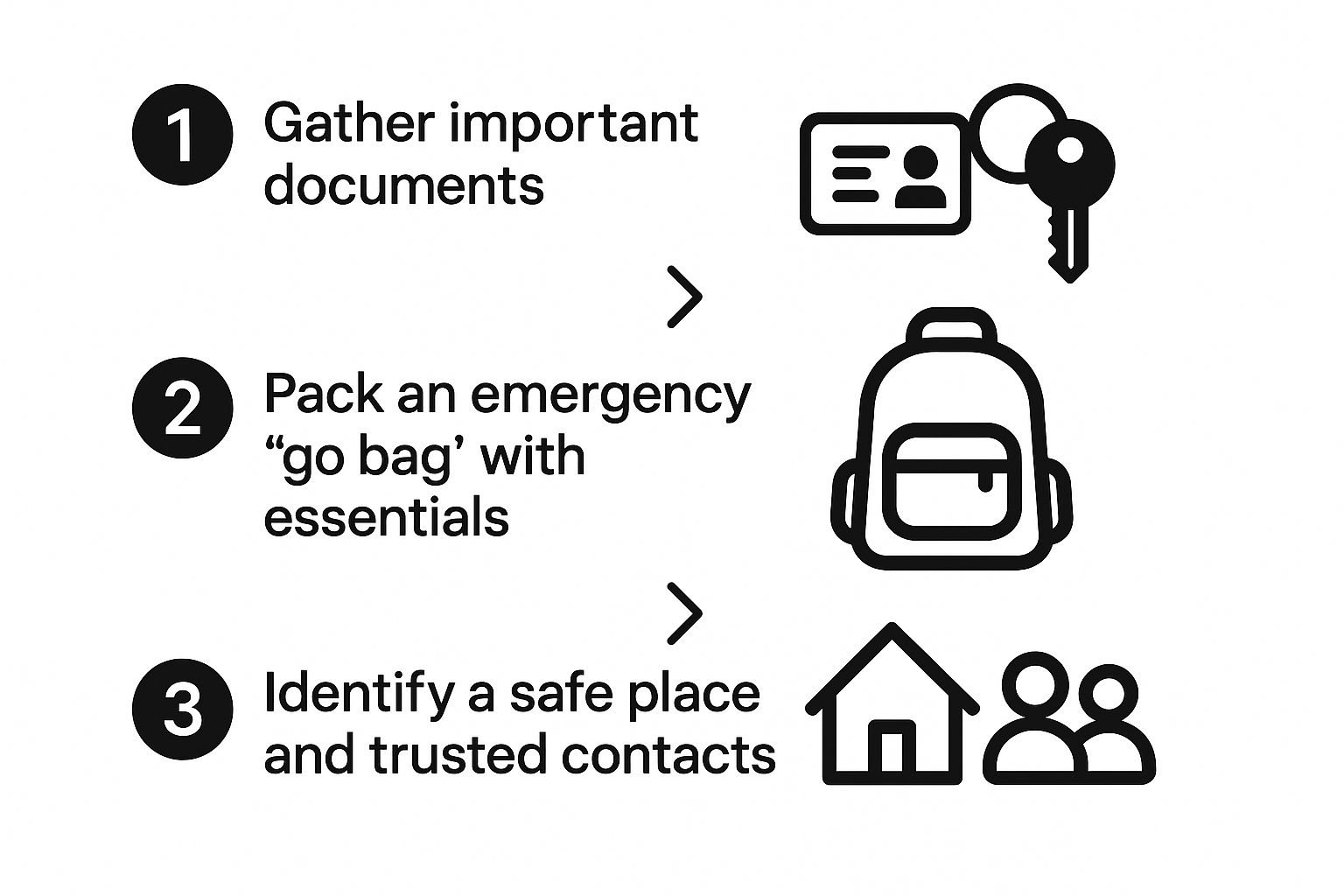
Following this process ensures you have all the necessary documents, supplies, and a support network ready to go at a moment's notice.
Leaving is not a sign of failure. It is the ultimate act of self-preservation and a courageous decision to choose safety and peace for yourself and your children.
If you find yourself at a point where separation or divorce feels like the only path forward for your well-being, exploring your legal rights and options when divorcing an alcoholic spouse is a crucial next step. Sometimes, the only way to create real consequences that might finally motivate your spouse to seek help is by completely changing the dynamic. You can also get guidance on how to stage an intervention, which offers a structured way to confront the issue with professional support.
Your journey forward, whether it leads to reconciliation or separation, begins with one foundational step: ensuring your own safety.
Your Questions About Living with an Alcoholic Spouse
When you're caught in the storm of a partner's drinking, the same questions tend to circle back again and again. Finding straight answers can be a lifeline, a small piece of solid ground when everything else feels like it’s shifting beneath your feet. Let's tackle some of the most common—and painful—questions that come up.
Can I Force My Spouse to Go to Rehab?
This is usually the first question that comes to mind, born from equal parts love and desperation. The short answer is no, you can’t force another adult into treatment against their will. It's a hard truth to swallow, but trying to force the issue often backfires.
The most powerful thing you can do is actually shift the focus back to yourself. By setting firm boundaries, stopping any behaviors that enable the drinking, and getting your own support, you change the entire dynamic of the relationship. This shift often creates natural consequences for their drinking that can, over time, become the very thing that motivates them to seek help. When they are ready, knowing how does rehab work will help you know what to expect.
How Do I Explain This to Our Kids?
Talking to your children about a parent’s alcoholism is one of the hardest conversations you'll ever have, but it’s absolutely necessary. The goal is to be honest in an age-appropriate way without laying blame. You can use simple, direct language like, "Mom has an illness called alcoholism, and it makes it hard for her to stop drinking."
The single most important message for your children is the "Three Cs": they didn't cause it, they can't control it, and they can't cure it. This simple phrase can lift a mountain of guilt from their small shoulders.
Make sure they know they are safe and that you love them no matter what. For older kids and teenagers, resources like Alateen can be a game-changer, connecting them with a community of peers who get exactly what they’re going through.
Am I to Blame for My Partner's Drinking?
Let me be perfectly clear on this: No, you are not to blame. Not now, not ever. It is never your fault. Alcoholism is a complex disease with roots in genetics, psychology, and a person's environment. So many spouses get stuck in a painful cycle of self-blame, replaying scenes in their heads and wondering what they could have done differently.
Your partner's choices around alcohol are their own. Your responsibility is to your own health and well-being. Focusing on your own healing and making healthy decisions for yourself and your children is the most constructive—and powerful—step you can possibly take.
At Altura Recovery, we understand the profound impact addiction has on the entire family. If you are struggling with the effects of a loved one's substance use, our compassionate team is here to provide the support and guidance you need to begin your own journey of healing. Find out more about our programs at https://www.alturarecovery.com.