Specialized young adult drug treatment isn't just a slightly different version of an adult program—it’s a completely different playbook. It's built from the ground up to support people navigating the unique pressures of early adulthood, addressing the specific developmental, social, and emotional hurdles of this critical life stage. The result is a more relevant and effective path to recovery.
Why Young Adults Need a Different Approach to Treatment
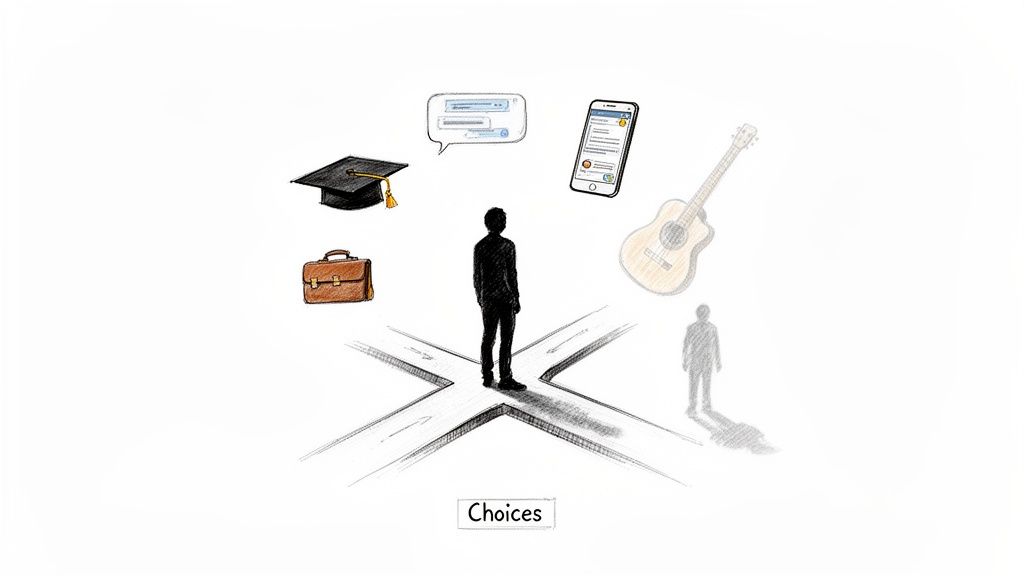
Stepping into adulthood feels like trying to cross a busy intersection without a map. You're juggling newfound independence, the weight of academic expectations, big career choices, and social circles that seem to shift overnight. It's a time of incredible growth, but also intense vulnerability.
When substance use gets thrown into that mix, it’s not just a bad habit. It’s a massive roadblock that can stall crucial development in its tracks.
This is exactly why generic, one-size-fits-all treatment so often misses the mark for this age group. It doesn’t speak their language. An adult program might focus on experiences like long-term career burnout or decades of marital stress—things a 20-year-old simply can't relate to. To be effective, a program has to connect with their reality, right now.
Spotting the problem is the first step, and the signs are often subtle shifts, not dramatic crises.
- Changing Social Circles: Suddenly dropping lifelong friends for a new, unfamiliar group.
- Loss of Interest: Abandoning hobbies or passions that once brought them joy.
- Academic or Work Decline: A noticeable drop in grades or slipping performance on the job.
- Increased Secrecy or Isolation: Withdrawing from family and spending much more time alone.
This visual shows how treatment focus shifts from a broad, general approach to one that’s highly specialized for young adults.
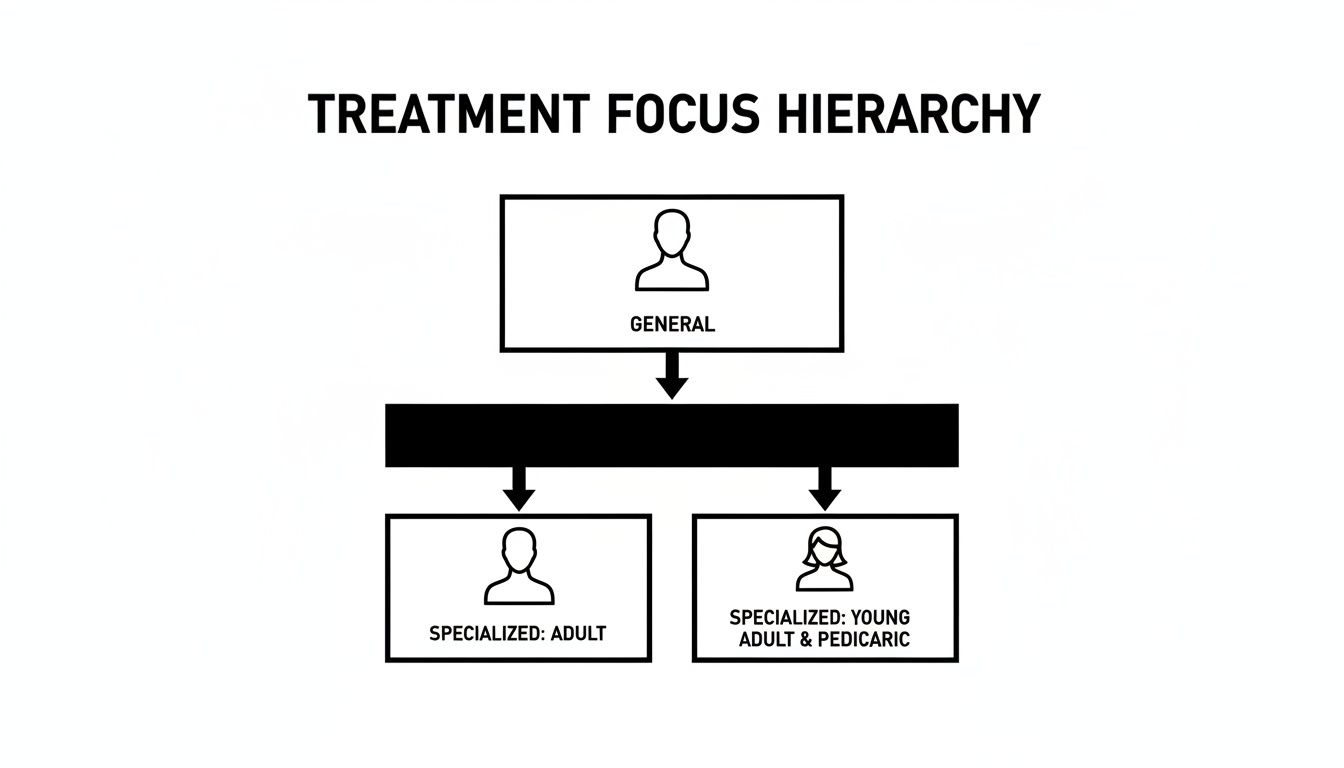
As the diagram shows, specialized care hones in on the specific needs of this demographic, moving far beyond generic solutions to deliver care that actually lands.
The differences between these approaches are not just cosmetic; they're fundamental to whether treatment will stick. A program designed for a 45-year-old with a mortgage and a 20-year career history will have completely different priorities than one designed for a 21-year-old building their identity and first resume.
Key Differences in Young Adult vs. General Adult Treatment
| Focus Area | Young Adult Treatment Focus | General Adult Treatment Focus |
|---|---|---|
| Developmental Stage | Identity formation, emotional regulation, future planning, executive function skills. | Rebuilding established careers, repairing long-term relationships, managing chronic health issues. |
| Social Context | Peer pressure, social media influence, navigating college or early career social scenes. | Workplace stress, marital conflict, family responsibilities (e.g., parenting, elder care). |
| Therapeutic Goals | Building foundational coping skills, addressing early trauma, fostering healthy independence. | Unpacking long-standing behavioral patterns, addressing mid-life transitions, processing grief/loss. |
| Family Involvement | Heavy emphasis on rebuilding communication with parents and siblings, setting healthy boundaries. | Often focuses on spouse/partner involvement and repairing trust with adult children. |
| Education & Career | Integrating treatment with school schedules, career exploration, and building a professional identity. | Maintaining an existing job, planning for retirement, managing professional burnout. |
This table highlights why a one-size-fits-all model falls short. Young adults aren't just "younger adults"—they are at a distinct life stage with unique psychological and social needs that demand a purpose-built treatment plan.
The Critical Treatment Gap
The need for this kind of specialized care is urgent, yet a massive gap exists. Last year, approximately 9.8 million young adults between 18 and 25 needed substance abuse treatment, but only a shocking 16.6% actually received it.
That means over 8 million young people are left to face these challenges without professional support, creating a major public health crisis. You can dig deeper into these addiction statistics and trends to see the full scope of the problem.
Addressing substance use in young adulthood isn't just about stopping a behavior. It's about protecting a future and ensuring the foundational years of life are built on stability, health, and purpose.
A specialized young adult drug treatment program gets this. It replaces judgment with empathy and generic advice with actionable strategies that make sense for their life stage, making recovery not just possible, but sustainable.
Why Tailored Treatment Is More Effective for Young Adults
Picture the young adult brain as a construction site buzzing with activity. Between the ages of 18 and 25, it's furiously building the essential pathways for identity, career, and complex relationships. This period of rapid growth is incredibly powerful, but it also leaves the brain wide open to disruption. Substance use is like a sudden storm rolling onto that site, halting progress and damaging the very foundations needed for a stable future.
Generic, one-size-fits-all treatment programs often miss this critical piece of the puzzle. They might focus on repairing a career that hasn't even launched or mending family dynamics that look completely different from those of older adults. Effective young adult drug treatment gets that recovery isn't just about stopping substance use—it’s about getting the entire life-building project back on schedule.
Reclaiming Developmental Milestones
Substance use has a nasty habit of derailing critical life milestones before they're ever reached. A specialized program helps young adults tackle these specific challenges head-on, focusing on skills that are actually relevant to their stage of life.
This means practical, real-world support for:
- Building an Identity: Therapy becomes a space to explore who they are and what they value—completely separate from substance use.
- Launching a Career: Programs integrate vocational counseling and genuine support for hitting educational goals, whether that's finishing a degree or entering a trade.
- Forming Healthy Relationships: Group therapy and communication workshops teach how to build connections based on trust and mutual respect, not a shared habit.
This targeted approach gets to the heart of why a young person might turn to substances in the first place, which is often a way to cope with the overwhelming pressure of these exact developmental tasks.
The brain's vulnerability during this time also means that early use dramatically cranks up the long-term risk. Individuals who use illegal drugs before age 15 are 6.5 times more likely to develop a substance use disorder than those who wait until 21 or later. That statistic alone highlights why early, specialized intervention is so vital for changing someone's entire life trajectory. You can dig deeper into these teen drug use statistics and their implications.
The Power of a Peer Community
One of the most powerful, game-changing elements of age-specific treatment is the sense of belonging. Let's be real: it’s nearly impossible for a 20-year-old to feel understood in a group of 50-year-olds talking about mortgages and retirement funds.
Being surrounded by peers who are navigating the same struggles—college stress, first jobs, dating drama, and family expectations—creates an environment of genuine connection. It's a game-changer.
In a community of peers, young adults realize they aren't alone. This shared understanding reduces shame and isolation, creating a supportive network that is often the missing ingredient for lasting recovery.
This peer-driven environment fosters motivation and accountability in a way that feels authentic, not forced. When young adults see people just like them succeeding in recovery, it provides tangible proof that a better future is possible. It empowers them to commit fully to their own healing.
From Inpatient to Outpatient: Mapping Your Treatment Options
Choosing the right type of young adult drug treatment can feel like trying to read a map in a foreign language. You see terms like “inpatient” and “outpatient” everywhere, but what do they actually mean for you or your loved one? Getting a handle on the landscape is the first real step toward finding the right path forward.
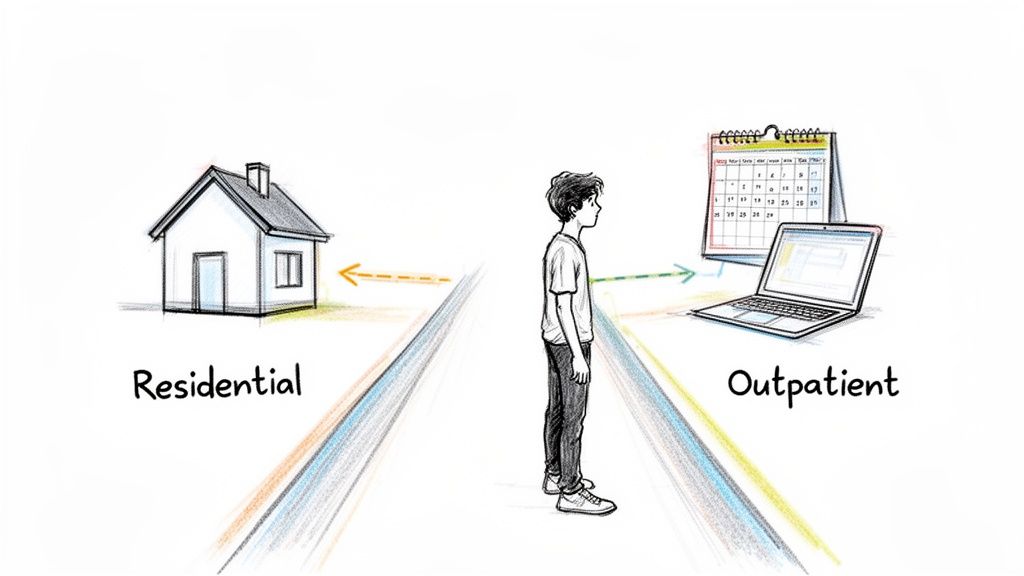
Think of it this way: inpatient residential treatment is a lot like a full-immersion language program. You live right on-site, dedicating all your time and energy to recovery in a structured, 24/7 supportive environment. This level of care is often crucial for anyone needing medical stabilization—like managing severe withdrawal symptoms—or simply a safe space away from daily triggers.
But not everyone needs to press pause on their entire life. That’s exactly where outpatient care comes in, offering a more flexible but still highly structured approach to getting well.
Finding the Right Fit with Outpatient Programs
Outpatient treatment is all about building crucial recovery skills while staying plugged into daily life—whether that’s school, work, or family. You’re learning to integrate recovery into the real world right from day one. There are a few different levels, and each one offers a different intensity of support.
Two of the most common options you’ll see are:
- Partial Hospitalization Program (PHP): This is the most intensive version of outpatient care. It usually involves treatment for several hours a day, five days a week, giving you a level of support that’s just a step down from living at a facility.
- Intensive Outpatient Program (IOP): An IOP delivers a solid treatment structure but with more flexibility. It typically requires you to be there for a few hours a day, three to five days a week, and often has evening options to fit around a work or class schedule.
The goal of outpatient care isn’t just to stop using substances; it’s to practice recovery in real-time. It empowers young adults to face daily challenges with a strong clinical support system right there behind them.
For example, a young adult struggling with prescription drug misuse might discover that safely stopping requires professional oversight. Learning more about the challenges of things like withdrawal from Valium and similar medications makes it clear why that structured support is so important. Outpatient programs provide this exact clinical guidance without forcing a complete life shutdown, which makes building a sustainable recovery a much more achievable goal.
How Evidence-Based Therapies Create Real Change
Effective treatment for young adults has to go way beyond just talking about problems. It needs to provide a structured set of tools to actively solve them. This is where evidence-based therapies come in.
These aren't just theories—they are proven, research-backed methods designed to create lasting change in how young adults think, feel, and behave.
Think of addiction as a tangled knot of thoughts, emotions, and actions. These therapies are specific techniques for carefully undoing that knot, one strand at a time. Each approach serves a unique purpose, and we often combine them to create a recovery plan that addresses the whole person.
Cognitive Behavioral Therapy (CBT): Rewiring Your Thoughts
Cognitive Behavioral Therapy (CBT) is one of the most powerful tools in addiction recovery. It works a bit like an electrician rewiring a faulty circuit in your brain.
CBT helps young adults spot the specific, automatic negative thoughts that trigger substance use. From there, we work together to systematically challenge those thoughts and replace them with healthier, more realistic ones.
For instance, a thought like, "I can't handle this stress without a drink," gets rewired into, "This is a stressful moment, but I have other coping skills I can use to get through it." This simple shift breaks the direct line between a trigger and the automatic response to use.
Dialectical Behavior Therapy (DBT): Building an Emotional Toolkit
While CBT hones in on thoughts, Dialectical Behavior Therapy (DBT) builds a toolkit for managing intense emotions. For many young adults, substance use is a way to escape feelings that feel completely overwhelming. DBT provides practical skills in four key areas to build emotional resilience:
- Mindfulness: Learning to stay present and observe your feelings without judging them.
- Distress Tolerance: Developing skills to get through crisis situations without making them worse.
- Emotion Regulation: Understanding and reducing your vulnerability to painful emotions.
- Interpersonal Effectiveness: Communicating your needs and setting boundaries in relationships.
These skills are essential for navigating the ups and downs of early adulthood without turning to substances. You can explore some practical techniques in our guide to mindfulness exercises for stress relief.
Medication and Trauma-Informed Care
For many, therapy becomes even more effective with Medication-Assisted Treatment (MAT). This approach uses FDA-approved medications to reduce cravings and stabilize brain chemistry, which creates a solid foundation for all the therapeutic work.
It’s not about replacing one substance with another. It’s about giving the brain a fighting chance to heal so the individual can fully engage in therapy and do the real work.
Combining therapy with the right medication gives young adults the stability they need to address deep-seated issues driving their addiction, like unresolved trauma. Trauma-informed care ensures that every single aspect of treatment is sensitive to past experiences, creating a genuinely safe space for healing to begin.
Sadly, the global treatment gap remains severe. In the United States, only about 1 in 4 people (23.6%) who needed substance use treatment last year actually received it. This statistic highlights just how crucial accessible, evidence-based programs are for young adults today.
The Essential Role of Family in the Recovery Journey
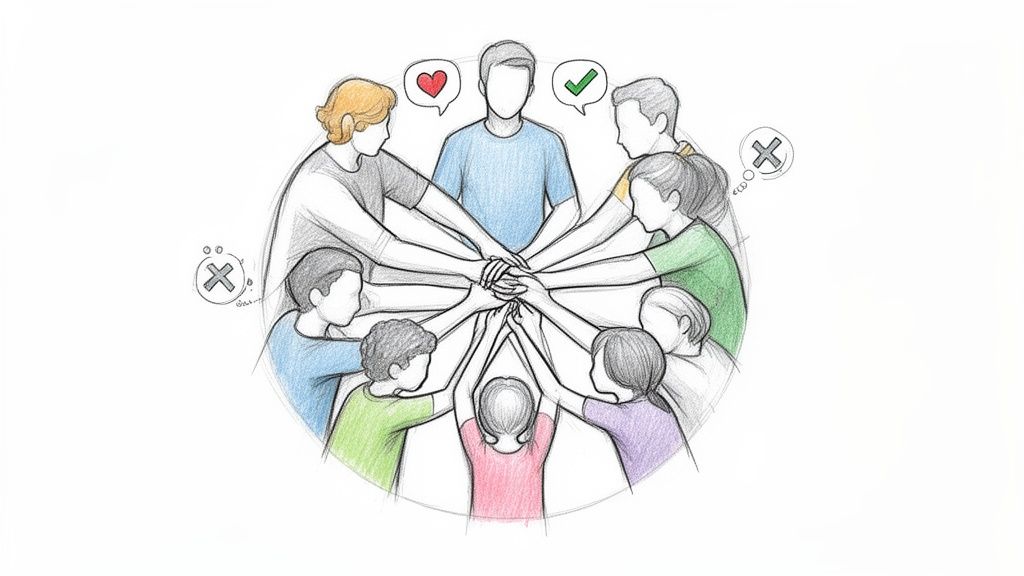
Addiction is often called a storm, but its impact feels more like an earthquake. The aftershocks ripple through the entire family system. While the focus is naturally on the person struggling, parents, siblings, and other loved ones are left navigating the emotional fallout, too. This is why effective young adult drug treatment sees family healing not as an afterthought, but as a core piece of building a recovery that lasts.
Family therapy provides a safe, professionally guided space to start untangling the complex dynamics that substance use weaves into relationships. It’s never about pointing fingers or assigning blame. Instead, the real work is in rebuilding the very foundations of trust, communication, and mutual respect that addiction so often erodes.
Building a Healing Alliance
The goal here is to help a family transform from a group of individuals in crisis into a powerful, unified healing alliance. This process involves everyone learning new skills to better support both the young adult and each other.
A few key objectives usually include:
- Establishing Healthy Boundaries: This is where you learn the crucial difference between genuinely supporting someone and accidentally enabling their behavior.
- Improving Communication: The aim is to move away from frustrating cycles of anger and blame toward conversations built on empathy and a real desire to understand.
- Rebuilding Trust: This isn’t a quick fix. It’s about creating a clear, practical roadmap for earning back trust through consistent, honest actions over time.
This collaborative approach helps mend strained relationships and gives the whole family a new toolkit for facing future challenges together. These sessions are a true cornerstone of recovery, often just as important as individual therapy. You can get a better sense of how group dynamics foster this kind of healing by exploring different substance abuse group ideas that are used in treatment.
Shifting from enabling to supporting is one of the most difficult yet powerful changes a family can make. It means loving someone enough to let them face the natural consequences of their actions, all while reinforcing that you are there to support their recovery.
This journey requires practical, concrete changes. For example, instead of giving a young adult cash that could be used for substances, a parent might offer to pay directly for a therapy session or a healthy meal. It’s about redirecting that powerful sense of care into actions that genuinely promote well-being. By actively engaging in this process, the family becomes one of the strongest pillars supporting long-term success.
Building a Fulfilling Life Beyond Treatment
True recovery is about so much more than just staying sober. It’s about building a life you no longer feel the need to escape from. Think of the end of a formal treatment program not as a finish line, but as a graduation—the moment you transition from structured support to empowered daily living.
This next phase is where aftercare and relapse prevention planning become everything. They act like scaffolding around a new building, giving you critical support while you strengthen your own foundation for a fulfilling, independent life. This is a vital part of any effective young adult drug treatment plan.
Creating a Supportive Aftercare Plan
Momentum is key right after treatment, and a solid aftercare strategy is how you keep moving forward. This isn't some generic checklist; it’s a personalized roadmap designed to help you navigate the tricky terrain of early recovery with confidence.
A strong aftercare plan usually includes a few key pieces:
- Sober Living Environments: These offer a structured, substance-free home with built-in peer support, perfectly bridging the gap between residential care and full independence.
- Ongoing Therapy: Continuing with individual or group therapy gives you a consistent space to process challenges and sharpen the coping skills you’ve learned.
- Support Groups: Programs like AA, NA, or SMART Recovery create a community of people who just get it. They understand the journey and can offer priceless encouragement when you need it most.
The ultimate goal of recovery is not just to survive without substances, but to thrive. This means rediscovering purpose, whether that's through education, a meaningful career, healthy relationships, or new passions.
Finding Purpose and Preventing Relapse
Building a vibrant future is honestly the best defense against relapse. When your life is filled with purpose and genuine connection, the appeal of old, destructive habits starts to fade. It’s all about actively replacing those patterns with constructive, joyful ones.
Of course, addressing the underlying issues is also crucial. Many young adults find it incredibly helpful to learn more about identifying and overcoming self-defeating behaviors as part of their long-term wellness strategy.
To keep that forward momentum going, people often dive into a range of personal activities. Exploring effective therapeutic activities for mental health can boost overall wellness and really support a lasting recovery. Finding new hobbies, reconnecting with nature, or volunteering can create a rich, rewarding life where sobriety feels like a natural and welcome part of your identity.
Got Questions About Treatment for Young Adults? We Have Answers
It’s completely normal to feel a mix of hope, anxiety, and a whole lot of uncertainty when you’re thinking about treatment. Taking that first step can feel huge, but getting clear, straightforward answers makes it a lot less intimidating. Our goal here is to pull back the curtain and show you how accessible—and effective—the right kind of help can be.
Let's walk through some of the most common questions young adults and their families ask when they start exploring the options.
How Do I Know If It's "Bad Enough" for Treatment?
So many people get stuck waiting for a dramatic "rock bottom" moment they see in movies. That's a dangerous myth. If alcohol or drug use is getting in the way of school, work, relationships, or your mental health, it’s serious enough to talk to a professional.
The key is not to wait for things to completely fall apart. The National Survey on Drug Use and Health found that roughly 1 in 7 young adults struggled with a substance use disorder in the last year. Stepping in early makes the recovery process more manageable and dramatically improves the odds of long-term success.
Will My Treatment Be Kept Confidential?
Absolutely. This is non-negotiable. Professional treatment centers are bound by strict federal privacy laws like HIPAA.
What that means in plain English is that everything—from the fact that you’re even in the program to the specific details of your therapy sessions—is legally protected. This isn't just a policy; it's the foundation of a safe, trusting space where you can be honest and do the real work of healing.
Can I Still Go to School or Work?
Yes, and that’s one of the biggest reasons modern outpatient treatment works so well for young adults. Flexible programs like an Intensive Outpatient Program (IOP) or Supportive Outpatient Program (SOP) are built around real-life schedules.
Many programs offer evening sessions or virtual options, which means you can build a solid foundation in recovery without having to hit pause on your education, career, or family life. Integrating treatment with your daily world is actually a huge plus—it lets you practice new coping skills exactly where you need them most.
What’s the Very First Step to Get Started?
It all starts with a simple, confidential conversation. The first step is an assessment with an admissions specialist who is there to listen, not to judge.
Think of it as a supportive chat designed to understand what you’re going through, answer your questions, and figure out what level of care might be the right fit. There’s no pressure and no commitment. It’s just an opportunity to get the information you need to decide what path feels right for you.
At Altura Recovery, we get how overwhelming this journey can feel. Our team is here to walk you through it, one step at a time, answering every question you have along the way. If you’re ready to see what healing can look like, contact us today.