
Outpatient rehab is a flexible but structured way to get help for addiction and mental health challenges while still living at home. Instead of moving into a residential facility, you attend therapy sessions at a clinic on a set schedule, allowing you to fit structured clinical support right into your daily life.
The goal? To build real-world coping skills you can use immediately.
A Bridge Between Treatment And Real Life
Think of outpatient rehab as a bridge connecting intensive, professional care with your everyday world of work, school, and family. It’s not about escaping your life to get better; it’s about learning how to thrive right where you are.
This approach is specifically designed for people who don't need round-the-clock medical monitoring but still require consistent, evidence-based support to overcome substance use or mental health issues. It honors the life you've already built while giving you the tools to strengthen it.

Here's how it works in practice: You might learn a new way to handle a trigger during a morning group session and then get to apply that exact skill when you get home that evening. This immediate feedback loop is powerful. It helps new, healthy habits stick because you’re testing them in real time, with professional guidance just a phone call away.
To give you a quick snapshot, here are the core components of outpatient rehab.
Outpatient Rehab At A Glance
| Feature | Description |
|---|---|
| Living at Home | You sleep in your own bed and maintain your personal life outside of treatment hours. |
| Structured Sessions | You attend therapy, counseling, and workshops at a facility on a set schedule. |
| Real-World Practice | Skills learned during the day are immediately applied in your personal life. |
| Community Connection | Treatment fosters connections with peers who are also navigating recovery. |
This model effectively dismantles the idea that you have to put your life on pause to heal, making it a more practical and sustainable path for many.
The Power of Flexibility and Integration
One of the biggest strengths of outpatient care is its flexibility. It recognizes that recovery isn't a one-size-fits-all journey and adapts to meet you where you are. Outpatient programs can help with a wide range of issues, including understanding the nature of addiction itself, such as food addiction, by providing structured support that coexists with your daily responsibilities.
Outpatient rehab provides the clinical structure necessary for healing while honoring the life you've already built. It's not about escaping your world; it's about learning to thrive within it.
By weaving treatment into your daily routine, this model empowers you to build a strong, realistic, and resilient foundation for recovery. It’s a vital step for those transitioning from inpatient care or for anyone ready to start their healing journey without stepping away from their life completely.
Who Is The Ideal Candidate For Outpatient Rehab?
Outpatient rehab isn't a one-size-fits-all solution; it’s a flexible approach that weaves into the rhythm of real life. The big question isn't just "who needs treatment?" but rather, "who can truly thrive in a program that balances structured therapy with personal freedom?" Figuring out if this model is right for you means taking an honest look at your daily responsibilities, your home environment, and your own motivation to get better.
To really bring this to life, let’s step away from clinical jargon and look at a few examples of people who are perfect fits. Their stories show how outpatient care makes recovery not just possible, but practical.
The Dedicated Professional
Picture Sarah, a project manager at a fast-paced tech company. She’s poured years into building her career, and the thought of hitting pause for a month or more to go to inpatient rehab feels like a non-starter. At the same time, she knows her habit of using alcohol to manage stress has crossed a line and she needs help.
For Sarah, outpatient rehab is the answer. She can attend therapy sessions in the evening after her workday is done, learning new coping skills without having to step away from her career. This setup allows her to tackle her challenges directly while holding onto the professional life that gives her stability and a sense of purpose.
The Committed Parent
Now, think about David, a father with two young kids. His family is everything, and the idea of being away from them for weeks on end is a huge barrier to seeking help. He needs a recovery plan that respects his role as a full-time caregiver.
Outpatient care allows David to keep being a present dad. He can go to programs during the day while his children are at school, join family therapy workshops on the weekends, and still be home for dinner and bedtime stories. This approach empowers him to heal himself while actually strengthening the most important relationships in his life.
The Ambitious Student
Finally, consider Maya, a college student juggling tough classes and the social pressures of young adulthood. She knows she needs support but can't afford to put her education on hold. Campus life is a big part of her world, but she needs guidance to build a healthier foundation.
An intensive outpatient program (IOP) gives Maya the structure she needs without derailing her academic goals. She can schedule therapy sessions around her classes, ensuring she stays on track for graduation. This model provides a vital support system as she learns to balance her studies with a new commitment to her own well-being.
Key Criteria For Success In Outpatient Care
While these people lead very different lives, their situations share a few common threads that make outpatient treatment such a powerful option. The ideal candidate for this level of care usually has:
- A Stable Home Environment: A safe, supportive place to live is non-negotiable. Your home is where you'll practice the skills you learn in therapy, so it needs to be a source of stability, not a source of triggers.
- A Strong Support System: Having family, friends, or a partner in your corner can make all the difference. This network acts as your safety net, offering encouragement and accountability when you're not in a clinical setting.
- High Motivation For Change: Outpatient care demands a serious personal commitment. Your success hinges on your willingness to show up, do the work in therapy, and apply new strategies to your daily routines.
- No Need For 24/7 Medical Supervision: This model is designed for individuals who are medically stable and don't require round-the-clock monitoring or intensive detox services. You can explore our guide on PHP programs to understand higher levels of care that bridge this gap.
Outpatient rehab is built for those who are ready to forge their recovery within the context of their actual lives. It’s for people who need strong clinical support but already have a foundation of stability to build on.
This flexibility makes care more accessible, too. Statistics show outpatient programs can slash treatment costs by 30-50% compared to inpatient stays. In recent years, the use of tele-rehabilitation has shot up by over 200% in major markets, allowing virtual sessions to fit seamlessly into a busy schedule—a key feature of modern, effective care. You can read more about these trends in outpatient rehabilitation centers.
Understanding The Levels Of Outpatient Care
Outpatient rehab isn’t a one-size-fits-all solution. Think of it as adjusting the difficulty on a workout plan as you get stronger—it’s a flexible system with different levels of intensity designed to meet you where you are. This structure is often called a “step-down” model, providing the right amount of support at precisely the right time.
You might start at a more intensive level that requires a significant time commitment, then gradually “step down” to programs that demand fewer hours per week. This approach builds a sturdy bridge from a highly structured clinical environment back to a life of independent, sustainable recovery. Let’s break down the most common levels you’ll see.
Partial Hospitalization Program (PHP): The Highest Level of Support
A Partial Hospitalization Program, or PHP, is the most intensive form of outpatient care available. It’s the closest you can get to residential treatment while still sleeping in your own bed at night. This level is a great fit for individuals who need significant daily structure but are medically stable and have a supportive home environment to return to.
Clients in a PHP typically attend treatment five to seven days a week for several hours each day, often mirroring a full-time work schedule. This robust schedule is packed with a rich mix of therapies, including:
- Individual Counseling: Dedicated one-on-one sessions to work through personal challenges.
- Group Therapy: Clinically-led groups that build community and let you practice new interpersonal skills in a safe space.
- Psychiatric Care: Medication management and assessments for any co-occurring mental health conditions.
- Life Skills Training: Practical workshops on everything from managing finances to communicating healthily.
PHP often serves as a crucial transition for those leaving an inpatient facility or for anyone who needs more support than a less intensive program can offer. It provides a strong, containing structure to build a solid foundation for recovery.
Intensive Outpatient Program (IOP): Balancing Treatment and Life
The next step down is the Intensive Outpatient Program, or IOP. This level strikes a powerful balance, delivering robust clinical support while allowing for much greater flexibility. It’s often the perfect fit for people who are stable in their recovery but still need consistent, structured therapy to keep moving forward.
IOP usually requires a time commitment of 9 to 15 hours per week, spread across three to five days. Sessions are often available during the day or in the evening, making it a practical option for working professionals, students, and parents. To see exactly how these two levels stack up, you can explore the key differences between IOP and PHP in our detailed guide.
The core focus of an IOP is reinforcing coping skills and learning how to apply them to real-world situations. You’ll continue with individual and group therapy, but with a growing emphasis on navigating daily triggers and strengthening your personal support network outside of the clinic.
This infographic shows the kinds of people who often find success within these flexible outpatient models.
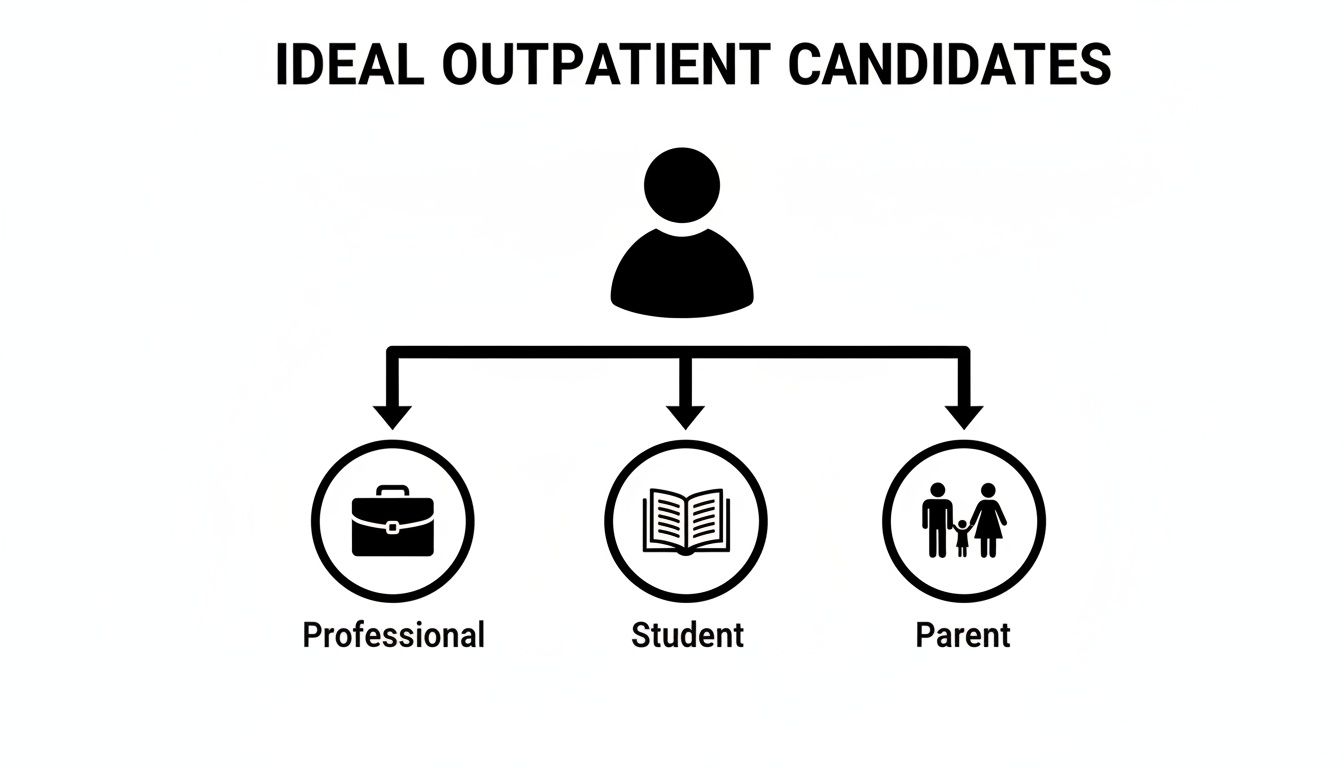
As the diagram shows, professionals, students, and parents are prime candidates because outpatient care’s structure allows them to integrate recovery into their existing lives without putting vital responsibilities on hold.
Supportive Outpatient Program (SOP): Maintaining Long-Term Wellness
The final step in this continuum of care is the Supportive Outpatient Program, or SOP. This level is designed for individuals who have successfully completed a more intensive program like IOP and have demonstrated a strong ability to manage their recovery independently.
An SOP acts like an ongoing wellness check-in, providing a consistent anchor of support to help you navigate the later stages of recovery. It’s less about intensive intervention and more about maintaining momentum.
SOP involves the least amount of time, typically just a few hours a week for one or two sessions. These sessions, often centered on group therapy, provide a space for continued accountability and vital peer connection. This ongoing support is crucial for preventing relapse and reinforcing the healthy habits you built during PHP and IOP. It’s the final, critical piece of the puzzle that helps ensure your recovery isn't just a phase, but a new way of life.
Comparing PHP, IOP, And SOP
To make it easier to see the differences at a glance, this table breaks down the time commitment and focus for each level of outpatient care.
| Level of Care | Time Commitment (Hours/Week) | Session Frequency | Best For |
|---|---|---|---|
| PHP | 20-30+ | 5-7 days/week | High-need individuals needing daily structure; step-down from inpatient. |
| IOP | 9-15 | 3-5 days/week | Individuals balancing work/school who need robust support. |
| SOP | 1-3 | 1-2 days/week | Long-term maintenance and relapse prevention after completing IOP. |
Each level is designed to provide the right amount of support at the right time, ensuring your treatment plan adapts as your recovery strengthens.
Core Therapies In Outpatient Treatment
So, what actually happens inside an outpatient rehab session? It’s not just talking. It’s about rolling up your sleeves and learning real, evidence-based skills that create lasting change. The heart of any good outpatient program is a mix of proven therapeutic methods designed to get to the roots of addiction and mental health struggles.
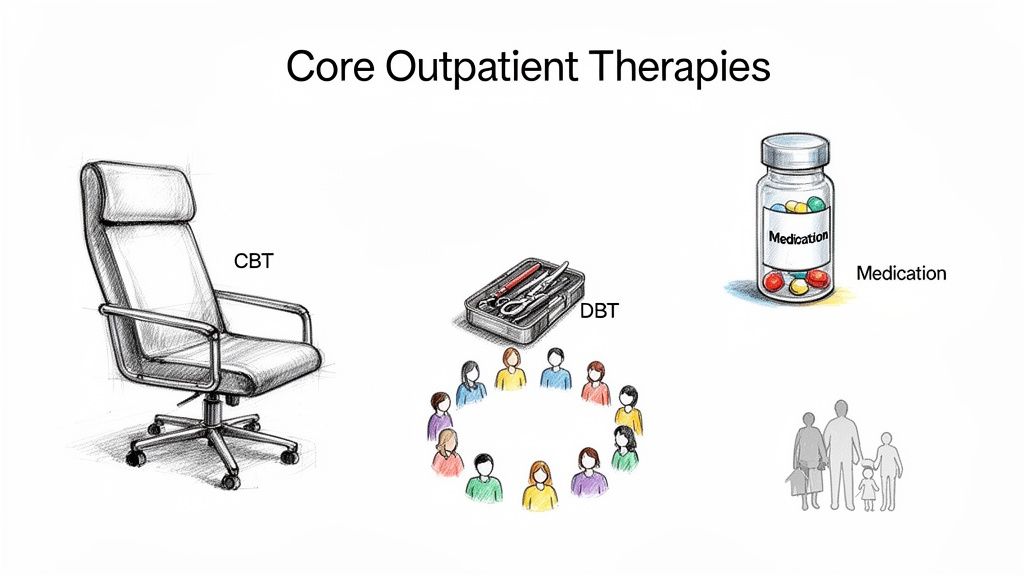
These aren’t abstract classroom lectures; they are practical tools for rebuilding your life. They give you a structured way to understand your thoughts, get a handle on your emotions, and develop healthier ways to respond when life gets stressful. Let’s break down some of the key approaches you’ll find.
Rewiring Thoughts With Cognitive Behavioral Therapy
One of the most powerful and widely used tools in the shed is Cognitive Behavioral Therapy (CBT). Think of it as learning to become a detective of your own mind. It’s built on a simple but game-changing idea: our thoughts, feelings, and actions are all connected.
CBT helps you spot, challenge, and reframe the negative or unhelpful thought patterns that act as fuel for substance use and mental health issues. For example, you might learn to catch an automatic thought like, "I had a terrible day, I deserve a drink," and consciously swap it for something more empowering, like, "I had a terrible day, so I’m going to use one of my healthy coping skills to actually feel better." It’s all about rewiring those automatic responses in your brain. For a deeper dive, check out our guide on what is Cognitive Behavioral Therapy.
CBT isn't about ignoring tough emotions. It's about changing your relationship with the thoughts that create them, putting you back in the driver's seat of your reactions instead of letting them control you.
Building An Emotional Toolkit With Dialectical Behavior Therapy
While CBT zooms in on thoughts, Dialectical Behavior Therapy (DBT) is all about building an emotional toolkit. It was originally created to treat borderline personality disorder, but it’s incredibly effective for anyone who experiences intense emotions and struggles with self-destructive behaviors, including substance use.
DBT teaches practical, real-world skills in four key areas:
- Mindfulness: Learning to stay grounded in the present moment without judging yourself.
- Distress Tolerance: Getting through a crisis without making things worse. It's your emergency plan.
- Emotion Regulation: Understanding and managing your emotional responses so they don’t run the show.
- Interpersonal Effectiveness: Learning how to ask for what you need and set healthy boundaries in relationships.
Together, these skills give you a solid set of tools for handling life’s curveballs in a healthier, more constructive way. To support overall physical recovery, some innovative programs may also explore complementary methods like Hyperbaric Oxygen Therapy.
Integrated Care For Holistic Healing
Modern outpatient rehab gets it: addiction rarely shows up alone. It often comes hand-in-hand with mental health conditions like depression, anxiety, or trauma. This is what we call a dual diagnosis, and to be effective, treatment has to tackle both at the same time.
This integrated approach weaves together individual counseling, group therapy, and sometimes medication management. It's a game-changer for people with co-occurring issues, with studies showing that combining therapy and medication can lead to sustained sobriety rates of up to 60%. This approach also empowers families to heal, bringing them into workshops to build a stronger, more informed support network.
Other cornerstone therapies often include:
- EMDR (Eye Movement Desensitization and Reprocessing): A specialized therapy that helps people process and heal from trauma.
- Family Systems Therapy: Focuses on healing relationships and improving communication patterns within the family.
- Group Therapy: Provides a supportive community where you can share experiences, practice new skills, and realize you’re not alone.
By combining these proven techniques, outpatient treatment offers a personalized and layered path to healing. It equips you with the skills you need not just to stop using, but to build a more resilient and fulfilling life.
Choosing Between Outpatient And Inpatient Rehab
Deciding between outpatient and inpatient rehab is one of the most important choices you'll make on the road to recovery. There’s no single “best” option—only the one that’s right for your specific situation. It’s less about pros and cons and more about seeing them as two distinct paths, each designed for different needs.
The main difference boils down to structure and environment. Inpatient rehab is a fully immersive, 24/7 setting that removes you from daily life and its triggers so you can focus completely on healing. Outpatient care, on the other hand, gives you robust clinical support while you continue to live at home, weaving recovery skills directly into your real-world routines.
Guiding Questions To Ask Yourself
Making the right call starts with an honest look at your life right now. Answering these questions can bring a lot of clarity and help you figure out which environment will truly set you up for success.
- Is my home life safe and supportive? A stable, encouraging home is the bedrock of successful outpatient treatment. If your living situation involves others who use substances or is filled with conflict, the protective bubble of inpatient care is probably a safer place to start.
- Can I manage daily triggers with structured help? Outpatient rehab is all about equipping you with skills to handle cravings and difficult situations as they pop up in your day-to-day life. But if the temptation to use feels overwhelming right now, a 24/7 inpatient setting can provide the buffer you need to build a stronger foundation first.
- Do I need medical supervision? If you require medically supervised detox or have severe co-occurring health conditions, inpatient care is the only appropriate choice. Outpatient is for individuals who are medically stable and ready to engage in therapy.
For a deeper dive, our detailed comparison of outpatient vs. inpatient rehab can help you explore these differences further.
The Advantages Of Real-Time Recovery
For many, outpatient rehab offers a powerful blend of flexibility and real-world effectiveness. Its biggest advantage is the chance to practice new coping skills in the very environment where you'll need them most. You might learn a new strategy for managing stress in a morning group session and get to apply it at home that same evening.
The goal of outpatient care is not just to get well, but to learn how to stay well within the context of your actual life. It builds resilience by testing your skills in real time, with a clinical safety net just a phone call away.
This model is not only practical but often more financially accessible. Because you live at home, outpatient programs significantly reduce the overall cost of addiction treatment. Studies have shown costs can be 50% lower than residential care while achieving comparable success rates—around 40-60% abstinence at one year for motivated clients, especially in programs like Altura Recovery's step-down model.
Ultimately, the choice comes down to your personal needs. Inpatient care provides a critical, life-saving reset for those who need intensive, round-the-clock support to get stable. Outpatient care, in contrast, offers a flexible and empowering path for those who are ready to weave their recovery into the fabric of their daily lives from day one.
Taking Your First Step Toward Recovery
Moving from reading and researching to actually picking up the phone can feel like the hardest part. But it’s a step you don’t have to take by yourself. By now, you understand what outpatient rehab is—a flexible way to get life-changing support while still living at home and managing your responsibilities.
The process of getting started is much simpler and more human than you might think. It’s not about pressure or making a huge commitment right away. It’s just about starting a conversation. Our entire goal is to replace the anxiety you might be feeling with a clear, empowering plan.
The Initial Phone Call
It all begins with a single, confidential phone call. When you dial our number, you’ll be connected with a compassionate care coordinator who is there just to listen. This isn't a sales pitch; it's a safe space to share what’s going on and ask whatever is on your mind.
During this call, the coordinator will help you understand your options and can schedule a free, totally private assessment with a clinical professional. This first conversation is simply about getting to know your needs and figuring out if our program feels like the right fit for you. There is zero obligation.
Reaching out for help is a sign of incredible strength, not weakness. That first conversation is the moment you start taking back control and opening the door to lasting change.
What A Professional Assessment Involves
If you decide to move forward, the next step is a professional assessment. This meeting is designed to get a complete picture of your situation so we can build a treatment plan that’s actually personalized to you—not a one-size-fits-all template. A clinician will ask about your history with substance use, your mental health, your home environment, and your goals for recovery.
Based on this in-depth conversation, our team will recommend a specific level of care. That could mean a Partial Hospitalization Program (PHP) for more intensive, daily support, or an Intensive Outpatient Program (IOP) that fits around your work or school schedule. Every recommendation is made with one thing in mind: setting you up for sustainable, long-term success.
Making that first call is the most powerful step you can take.
Your Questions, Answered
Deciding to get help brings up a lot of practical questions. How will this work with my job? Can I afford it? What does my family do? Below are straightforward answers to the questions we hear most often. We want you to have all the facts so you can feel confident about what comes next.
How Do I Know If My Insurance Covers Outpatient Rehab?
Figuring out insurance feels like a huge headache, but it doesn't have to be. The good news is that most major insurance plans cover outpatient addiction and mental health care because they are recognized as essential medical services.
The easiest way to get a clear answer is to let us do the heavy lifting for you. Our admissions team offers a free and completely confidential benefits check. Just give us a call, provide your insurance information, and we’ll figure out the specifics of your coverage. We’ll explain any deductibles or out-of-pocket costs so you have a complete financial picture before making any decisions. No surprises.
Can I Still Work or Go to School During Treatment?
Yes, absolutely. This is one of the main reasons people choose outpatient care. Our programs are specifically designed for people who need to keep their jobs, stay in school, or manage family responsibilities while getting the help they deserve.
We built our schedules to fit real-world lives, offering:
- Daytime Programs: A great fit if you have responsibilities in the evening.
- Evening Programs: Perfect for working professionals or students with classes during the day.
- Virtual Sessions: The most flexible option for fitting treatment into a packed schedule.
This structure allows you to immediately practice the skills you learn in therapy to handle the challenges you face at work or school, making your recovery stronger in real time.
How Does My Family Get Involved in the Recovery Process?
We've seen it time and again: when one person heals, the whole family system has a chance to heal. Addiction doesn't just impact the individual; it ripples out, affecting parents, partners, and children. That’s why we make family involvement a cornerstone of what we do.
Lasting recovery is often built on a foundation of strong, healthy relationships. Our family programs are designed to rebuild trust, teach effective communication, and create a supportive home environment where everyone can thrive.
Our family support includes dedicated workshops, educational resources, and, when it makes sense, family therapy sessions. The goal is to help your loved ones understand addiction, learn how to set healthy boundaries, and find new ways to communicate. By healing together, you build a much more resilient support network for the road ahead.
What’s the First Step to Get Started?
Taking the first step is often the hardest part, so we've made it as simple and stress-free as possible. It all starts with a single, completely confidential phone call to our admissions team.
You’ll talk to a compassionate care coordinator who is there to listen to your story without any judgment. Their only job is to answer your questions and, if you’re ready, schedule a free, private assessment. There’s no pressure and no commitment in this first conversation—it's just a chance for you to get information and see if we feel like the right fit for you.
Ready to take that first step? The team at Altura Recovery is here to listen and provide the guidance you need for real healing and real freedom. Contact us today for a confidential conversation about how our outpatient programs can fit into your life.