Contingency management (CM) is a therapeutic approach that operates on a simple, powerful principle: consistently reward positive behaviors to create lasting change. When someone is working to stay sober, CM offers tangible incentives for hitting key milestones.
This structured reward system helps make the incredibly hard work of early recovery feel more manageable and, just as importantly, more motivating.
Understanding Contingency Management in Simple Terms
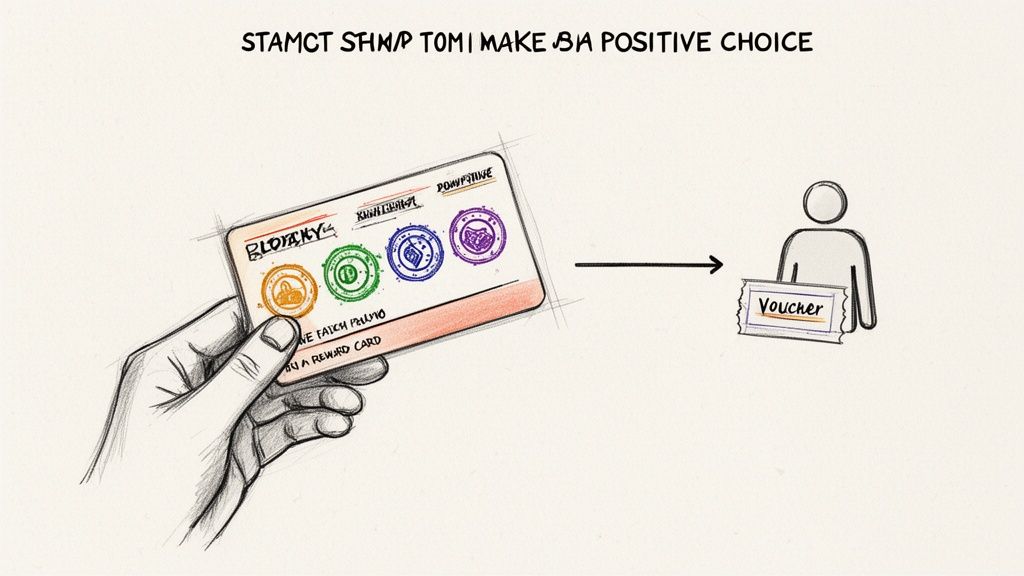
Think of it like a loyalty card you get at a coffee shop. Every time you buy a coffee—or in this case, make a healthy choice—you get a stamp. Once you collect enough stamps, you earn a free drink. Contingency Management applies this exact same logic to addiction recovery.
This behavioral therapy provides immediate, positive reinforcement for actions that support sobriety. These "target behaviors" are always clearly defined and easily measurable.
Common examples include:
- Attending therapy sessions consistently
- Providing a substance-free urine or breath sample
- Completing recovery-related goals
When a person hits one of these targets, they get a tangible reward right away. This isn't about bribery; it’s about systematically re-engaging the brain's reward circuits with healthy, positive experiences.
The Power of Positive Reinforcement
At its core, contingency management is all about making the positive choice more appealing and immediately gratifying than the alternative. Similar principles are used to create motivating weight loss rewards, which shows just how effective well-designed incentive systems can be across different areas of health.
And this approach is far from a new idea. It’s backed by decades of solid research, including over 100 randomized controlled trials conducted between 1970 and 2014. One major analysis found that CM led to successful treatment episodes 61% of the time, a huge jump compared to just 39% for other therapies.
Contingency management works by making recovery more rewarding than substance use, one choice at a time. It builds momentum, restores hope, and provides a clear path forward during a challenging journey.
The Core Components of Contingency Management
To really get how CM works, it helps to break it down into its essential parts. Each piece of the puzzle plays a specific role in creating a program that’s structured, effective, and motivating.
The table below outlines these fundamental components.
The Core Components Of Contingency Management
| Component | Description | Example In Addiction Recovery |
|---|---|---|
| Target Behavior | The specific, observable, and measurable positive action that will be reinforced. | Providing a verified negative drug test for stimulants during a weekly check-in. |
| Objective Monitoring | The method used to confirm that the target behavior has occurred. | A urine drug screen (UDS), breathalyzer test, or verified attendance log. |
| Tangible Incentive | The immediate, desirable reward provided upon confirmation of the target behavior. | Earning a chance to draw a prize slip from a fishbowl, with prizes ranging from small items to larger vouchers. |
| Incentive Schedule | The clear rules dictating how often and under what conditions rewards are given. | Earning one prize draw for the first clean test, two for the second consecutive one, and so on, with the number resetting after a positive test. |
By combining these elements, a contingency management program provides a clear, reliable, and reinforcing structure that helps turn small, positive actions into the foundation for long-term recovery.
How Contingency Management Helps Heal The Brain
To really get why contingency management works so well, you have to look at what’s happening inside the brain during addiction. Substance use isn't just a string of bad choices; it's a medical condition that fundamentally rewires the brain, especially its powerful reward system. This system is hardwired to release dopamine—a chemical that signals "do that again"—when we do things vital for survival, like eating or connecting with others.
Drugs and alcohol completely hijack this natural process. They flood the brain with a massive, unnatural surge of dopamine, creating a short-lived but intense feeling of pleasure that healthy activities simply can't compete with. Over time, the brain adapts by becoming less sensitive to normal rewards. This neurological shift is what drives the powerful compulsion to keep using, not just to get high, but eventually just to feel normal.
This is exactly where contingency management comes in. It’s not a simple behavioral trick; it’s a strategic intervention that targets this hijacked reward circuit. It introduces a powerful, healthy competitor into the system, giving the brain a new way to experience reward and kickstart the healing process.
Paving A New Road In The Brain
Think of the brain's neural pathways like roads in a forest. Active addiction carves a deep, well-traveled superhighway straight to substance use. It’s fast, familiar, and the brain’s automatic, default route. Trying to stay sober, in contrast, is like hacking your way through an overgrown, unpaved footpath right next to that highway. The path is tough, slow, and offers very little immediate reward, making it incredibly easy to slip back onto the familiar road.
Contingency management starts paving this new, sober road. Each tangible reward earned for a positive choice—like a negative drug test—is like laying down a fresh layer of asphalt on that rough footpath.
- The first clean test might be a small, bumpy patch of pavement. It’s a start, but the old highway is still incredibly tempting.
- A week of clean tests adds another layer, making the new road smoother and a little easier to travel.
- A month of consistent progress can turn that footpath into a reliable, two-lane road.
This process does more than just reward behavior; it helps form and strengthen new neural connections. Every single time the brain gets a healthy, predictable reward for sobriety, it reinforces the "sober" pathway. The brain starts to learn, on a chemical level, that positive outcomes are achievable without substances.
What is contingency management doing on a neurological level? It’s actively rewiring the brain’s reward circuitry. It provides the immediate, positive feedback needed to make the difficult work of recovery more appealing than the immediate gratification of substance use.
This consistent reinforcement helps restore balance to the brain's dopamine system. It demonstrates, in a tangible way, that sobriety can lead to good things. This is a critical step in healing because it builds self-efficacy—the belief in your own ability to succeed. For someone who feels trapped by addiction, these small, consistent wins can be the first real signs of hope and a powerful motivator for lasting change.
From External Rewards To Internal Motivation
As this new, sober road becomes smoother and more established, something amazing starts to happen. The individual begins to notice the natural rewards of recovery that were once completely overshadowed by the chaos of addiction. They start reconnecting with family, rebuilding trust, feeling physically healthier, and rediscovering old hobbies and passions.
These intrinsic rewards become their own powerful motivators. Over time, the deep satisfaction of having a clear mind, stable relationships, and a sense of personal growth becomes far more compelling than any external incentive. The rewards from the contingency management program act as a bridge, supporting the brain long enough for these natural, long-term benefits to take root.
In essence, the program serves as scaffolding while the brain rebuilds its own healthy reward structures. It provides the necessary support and reinforcement during the most vulnerable stages of early recovery, creating a foundation strong enough to support a lifetime of sobriety. The goal isn't just to stop a behavior but to heal the brain that drives it.
What Contingency Management Looks Like In A Real-World Setting
Theory is one thing, but seeing how contingency management actually works day-to-day reveals just how simple and supportive it can be. In an outpatient setting, it’s not some complex clinical procedure. It's a clear, motivating process designed to fit right into a person’s regular treatment, providing structure and a positive boost exactly when it’s needed most.
Let's imagine a client named Sarah, who is attending an Intensive Outpatient Program (IOP) for stimulant use. A huge part of her recovery plan is maintaining sobriety, which we monitor through scheduled, routine urine screenings. This is where CM clicks into place.
When Sarah comes in for her weekly therapy session, she provides a sample. We get the result in minutes. If the test is negative for stimulants—her specific target behavior—the CM protocol kicks in immediately. That instant feedback is critical; it creates a direct, powerful link between her positive action and a positive consequence.
Suddenly, a routine clinical task becomes an opportunity for an immediate win. It reinforces all her hard work and helps build momentum for the week ahead.
The Fishbowl Method: A Step-By-Step Example
One of the most common and effective ways to run a contingency management program is the "fishbowl" method. It’s transparent, easy to understand, and adds a little positive anticipation to the process.
Here’s how a typical fishbowl session would go for Sarah after she provides a clean test:
- The Setup: We have a large glass bowl filled with hundreds of folded slips of paper. Most of them have simple words of encouragement written on them, like "Good job!" or "Keep it up!" But mixed in are a number of slips designated as prizes of different values.
- The Draw: For her very first clean test, Sarah gets to draw one slip from the bowl. She might pull out a "Keep it up!" slip, which offers immediate verbal reinforcement from her therapist. Or she might draw a prize.
- Escalating Rewards: If Sarah comes back next week and her test is clean again, she earns two draws. The week after that, she gets three, and so on. This escalating schedule is a powerful way to reinforce consecutive positive behaviors, not just one-off successes.
- The Reset: What if Sarah has a positive test? The incentives are simply withheld for that week, and the number of draws she can earn resets to one. This isn't a punishment. It’s a clear, non-judgmental consequence that maintains the program's structure and predictability.
The prize slips are calculated so that participants have roughly a 50% chance of winning a small prize (like a $1 voucher) and smaller odds for bigger prizes. As the number of consecutive clean weeks goes up, the value of potential grand prizes can also increase.
This system makes progress tangible. Every draw is another step forward, helping to build the self-efficacy and confidence needed for long-term recovery.
What Kind Of Incentives Are Used?
The rewards in a contingency management program are chosen very deliberately to be practical and supportive of a healthy lifestyle. They are almost always non-cash incentives to make sure they're used to promote stability and well-being.
Common incentives include vouchers or gift cards for everyday needs and healthy activities, such as:
- Groceries from a local supermarket
- Gas to get to therapy or a new job
- Tickets to see a movie
- A gift card for a coffee shop
- A pass for a local gym or a recreational activity
These rewards do more than just reinforce sobriety. They help people start rebuilding a life where they can meet their own needs and enjoy positive social activities without turning to substances. To see how these behavioral principles are applied in other settings, you can look at examples of effective classroom behaviour management strategies.
Key Takeaway: The goal of the incentives is to provide immediate, tangible support that makes a sober lifestyle more attractive and sustainable. The prizes help bridge the gap until the natural rewards of recovery—improved health, mended relationships, and genuine self-esteem—become their own powerful motivation.
This infographic shows how CM supports the brain's journey from being hijacked by addiction to being healed through consistent, positive reinforcement.
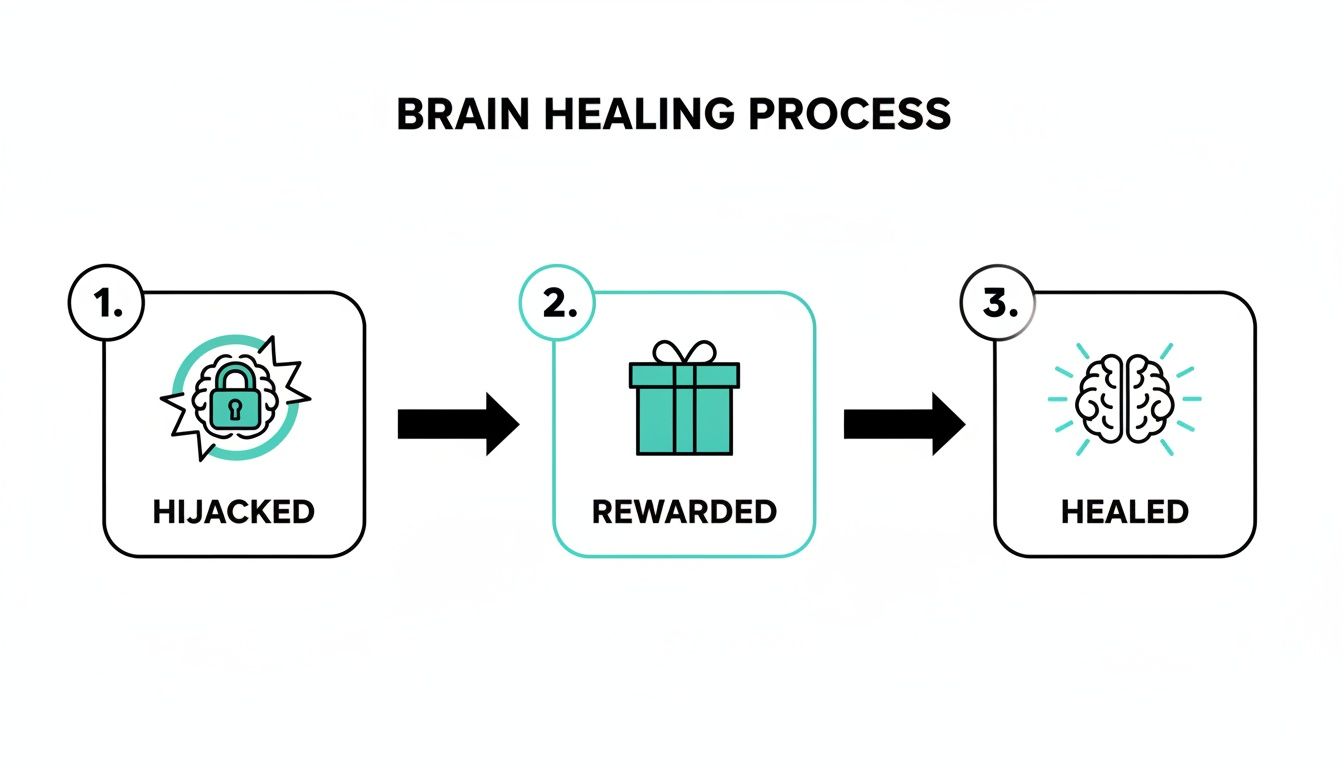
This process works because it helps forge new neural pathways. By introducing healthy rewards, we're giving the brain a new, more accessible choice. This external motivation creates the perfect conditions for the brain's internal reward system to gradually recalibrate and heal over time.
Who Benefits Most From This Approach?
While contingency management is a versatile tool in addiction treatment, it isn’t a one-size-fits-all solution. But for people facing specific, complex challenges, it can be a game-changer. Clinical experience and a mountain of research show that it delivers exceptionally powerful results when other methods have fallen short.
This approach is a lifeline for individuals who feel stuck after trying other treatment models. Its focus on immediate, tangible wins is powerful. It breaks cycles of discouragement and builds a fresh sense of momentum. When someone has struggled to see progress, these early victories foster crucial self-belief—the confidence they need to dig into deeper therapeutic work.
Thriving in the Face of Complexity
Contingency management truly shines when applied to cases that are often the toughest to treat. Its clear, cause-and-effect structure provides a rare sense of stability for individuals also navigating co-occurring mental health disorders like anxiety, depression, or PTSD.
The predictable nature of the reward system can be incredibly grounding. When life feels chaotic due to trauma or mental health symptoms, knowing that a specific positive action will lead to a specific positive outcome offers a valuable sense of control.
The real power of contingency management is its ability to create measurable success and hope for those who need it most. It provides a foothold of stability that allows for deeper, more extensive healing to begin.
Think about it: a person with severe anxiety might find the open-ended nature of traditional talk therapy overwhelming. But the clear goals and immediate reinforcement of a CM program can lower that anxiety, making it easier to simply show up and stay engaged in their own recovery.
The Evidence for Complex Cases
The data backs this up, and it's compelling. Extensive research reveals that contingency management is highly effective even for individuals with severe, overlapping challenges. It’s proven beneficial for those with significant psychiatric issues, a history of multiple treatment attempts, and even those diagnosed with antisocial personality disorder.
One key review of studies found something remarkable: patients with histories of sexual abuse, major depression, or PTSD actually gained increased benefits from CM. They showed higher rates of prolonged abstinence and were more likely to stay in their treatment programs, proving CM’s unique ability to support the most vulnerable among us. You can explore the full findings of this research on CM's effectiveness to learn more.
This shows that contingency management is more than just a behavioral gimmick; it’s a stabilizing force that helps create the right conditions for comprehensive recovery to take hold.
Building the Foundation for Deeper Work
Ultimately, contingency management isn't meant to be a standalone cure. It’s best understood as a powerful foundational tool that makes other essential therapies—like Cognitive Behavioral Therapy (CBT), Dialectical Behavior Therapy (DBT), and trauma-informed care—more effective.
It acts as a catalyst. By rewarding treatment attendance and sobriety, CM ensures that individuals are present and clear-headed enough to do the hard work required to heal from trauma, address underlying mental health issues, and develop healthy coping mechanisms for good.
Here's how CM supports the bigger therapeutic picture:
- Boosts Engagement: The immediate rewards keep people coming back, especially during the difficult early days when motivation can waver.
- Increases Self-Efficacy: Consistent, tangible wins build a person's belief in their own ability to achieve and maintain sobriety.
- Provides Stability: The program's predictable structure is calming for those dealing with the chaos of trauma or anxiety.
- Fosters Hope: By proving that change is possible one small step at a time, CM helps restore hope for a future free from substance use.
In this way, CM doesn't just address the surface behavior of substance use; it helps create the internal and external stability a person needs to rebuild their life from the ground up.
The Benefits And Limitations Of Contingency Management
To get a clear picture of Contingency Management, we need to look at it from all angles. While it's an incredibly powerful and evidence-based tool in addiction treatment, like any approach, it comes with its own set of strengths and challenges. Weighing both sides gives us a realistic view of how and why it works so well.
The biggest plus for Contingency Management is the mountain of proof that it works. Backed by decades of research, CM has consistently proven to be one of the most successful ways to promote abstinence, especially for stimulant use disorders where there are no FDA-approved medications. It delivers quick, measurable results that both clients and clinicians can see and feel.
That immediate, positive feedback is a game-changer. By rewarding sobriety and treatment attendance right away, CM dramatically improves client engagement and retention. It keeps people connected to their recovery program during those critical early stages when the risk of dropping out is highest. It also pairs perfectly with other therapies like CBT, creating a stable foundation for the deeper therapeutic work to take hold.
Key Strengths Of Contingency Management
The advantages of putting a CM program in place are clear and consistently backed by clinical outcomes. It tackles the immediate challenge of early sobriety in a way few other methods can.
Here are some of the primary benefits:
- Strong Evidence Base: Countless studies have demonstrated its success in reducing substance use and keeping people in treatment.
- Rapid, Measurable Results: Progress is tracked through objective measures like urine tests, providing clear, tangible evidence of success that builds momentum.
- Increased Treatment Retention: The incentive structure encourages consistent attendance and participation, which is vital for long-term recovery.
- Complements Other Therapies: CM works beautifully alongside therapies like CBT and MOUD, boosting their effectiveness by ensuring clients are present, sober, and engaged.
Potential Challenges And Common Concerns
Despite its proven success, Contingency Management isn’t a magic bullet. It comes with some practical hurdles and valid questions. One of the most common is: what happens when the rewards stop? There's a real concern that the motivation for staying sober might just vanish once the external incentives are gone.
A well-designed program anticipates this by using the rewards as a temporary bridge, not a permanent crutch. While the incentives are active, the client is also building internal motivation, developing new coping skills in therapy, and starting to experience the natural rewards of recovery—things like mended relationships, better health, and renewed self-respect.
Another significant challenge is logistical. Getting a CM program funded and running can be complex. Historically, regulatory caps on the value of incentives have sometimes limited how effective programs can be, though recent policy changes are starting to fix this. On top of that, staff need proper training, and the administrative work of tracking behaviors and distributing rewards demands resources that not all clinics have readily available.
While contingency management is highly effective, its success depends on proper implementation, adequate funding, and its integration into a comprehensive treatment plan that builds a client's internal motivation for lasting change.
To lay it all out clearly, this table summarizes the key points, weighing the distinct advantages against the practical and ethical considerations.
Weighing The Pros And Cons Of Contingency Management
A balanced look at Contingency Management shows an approach with powerful, evidence-backed benefits that also requires thoughtful planning to overcome its practical challenges. Here’s how the pros and cons stack up.
| Benefits (Pros) | Limitations (Cons) |
|---|---|
| Highly Effective: Backed by extensive research showing significant reductions in substance use. | Sustainability Concerns: Questions about whether behavioral changes persist after incentives are removed. |
| Boosts Engagement: Increases treatment attendance and retention, especially in early recovery. | Implementation Costs: Requires funding for incentives and administrative resources to manage the program. |
| Provides Clear Structure: The predictable, rule-based system can be calming and motivating for clients. | Potential for "Gaming the System": Though rare, some individuals may try to find ways around the monitoring. |
| Objective and Measurable: Success is based on clear data, offering tangible proof of progress. | Ethical Debates: Misconceptions about "bribing" patients can create stigma or philosophical opposition. |
Ultimately, when implemented correctly within a broader therapeutic framework, the benefits of CM often far outweigh the limitations, providing a critical tool to help people build a strong foundation for lifelong recovery.
How Altura Recovery Integrates CM Into Personalized Care
At Altura Recovery, we know that lasting recovery is built from a personalized blueprint, not a one-size-fits-all kit. That’s why we see contingency management as a vital thread woven into each client’s individual treatment plan, rather than a separate, standalone program. We use CM strategically to supercharge motivation and lock in the progress made in therapy.
The structure of CM provides the kind of immediate, positive feedback that’s often missing in the tough first weeks of recovery. It’s a way of celebrating the small, consistent efforts that add up to big changes, creating tangible proof that all the hard work is paying off. That boost can be incredibly powerful.
A Tool to Support Deeper Healing
We integrate contingency management to work in harmony with our core therapeutic services. Think of it as the scaffolding that supports the deeper, more intensive healing happening in other parts of a client’s treatment. The goal is to build momentum and self-belief from day one.
CM helps our clients score tangible early victories, which in turn builds the confidence and resilience they need for the journey ahead. When someone sees measurable success through CM, they show up more engaged and empowered in their other therapies.
Our integrated model ensures CM works hand-in-hand with:
- Individual Therapy: The confidence gained from CM allows clients to dig deeper into personal challenges with their therapist, feeling more capable and hopeful.
- Group Counseling: Celebrating CM-related wins can inspire others in the room, strengthening the sense of community and shared purpose in group sessions.
- Trauma-Informed Modalities: The stability and predictability of CM’s structure can be incredibly grounding for clients who are also working to address past trauma.
At Altura Recovery, contingency management is a catalyst for engagement. It helps build the initial momentum and self-efficacy needed for clients to fully benefit from the rich, personalized therapeutic work that is the heart of our mission.
Building Confidence for Lasting Change
Our philosophy is simple: use every effective, evidence-based tool available to support our clients on their path to real healing and freedom. By integrating CM, we help individuals build a strong foundation of early successes. These initial wins are crucial, proving that change isn’t just possible—it’s already happening.
This approach ensures that the clear, reinforcing structure of contingency management amplifies the personalized, compassionate care that defines Altura Recovery. It’s one more way we empower our clients to build the skills and resilience necessary for a sustainable, long-term recovery.
Frequently Asked Questions About Contingency Management
Navigating addiction treatment brings up a lot of questions, both for individuals seeking help and the families supporting them. When it comes to an approach like contingency management, it’s completely natural to wonder how it works and what to expect.
Here are some clear, straightforward answers to the questions we hear most often about this powerful therapeutic tool.
Is This Just Bribing Someone to Stay Sober?
This is easily the most common misconception about contingency management, but it misses the mark on what's really happening in the brain. It’s far more helpful to see it not as a bribe, but as a therapeutic tool designed to help the brain heal.
Addiction essentially rewires the brain’s reward system, training it to prioritize the immediate, powerful gratification from substances above all else. CM works by offering a healthier, equally immediate reward for positive behavior, which helps retrain those exact same reward circuits. It's all about building momentum and self-confidence in early recovery, giving the natural rewards of sobriety—like better health, mended relationships, and a renewed sense of self-respect—enough time to take over as the primary motivation.
What Happens When The Rewards Stop?
This is a critical question and something every well-designed contingency management program plans for from the very beginning. The incentives are intentionally designed to be a temporary support structure, like the scaffolding used to support a building while it's under construction.
Their main job is to keep you stable and engaged long enough to build a solid foundation through therapy and skill-building. While you're in the CM program, you’re also developing healthy coping mechanisms, attending group and individual therapy, and building a sober support network. These are the tools that ensure your success long after the external rewards have phased out.
Contingency Management acts as a bridge. It provides the initial structure and motivation needed to cross the most challenging phase of early recovery, allowing you to reach the other side where intrinsic rewards become the driving force.
Can I Still Work or Go to School While in a CM Program?
Absolutely. Contingency management is specifically designed to integrate seamlessly into outpatient programs like PHP and IOP, which are built for people managing real-life responsibilities. It is not a separate, time-intensive commitment that will disrupt your schedule.
The process itself is typically quick and straightforward. For example, it might involve providing a simple urine sample for testing during one of your regularly scheduled appointments. This adds a powerful layer of support and accountability without requiring a major time commitment, letting you focus on recovery while maintaining your work, school, and family life.
At Altura Recovery, we believe in using every evidence-based tool available to build a path to lasting sobriety. Contingency management is a key part of our personalized, comprehensive care plans designed to create Real Healing, Real Growth, and Real Freedom. If you or a loved one are ready to take the next step, learn more about our approach to recovery.