When a loved one is struggling with addiction, it feels like the entire family is pulled into the storm. Getting comprehensive support for families of addicts isn’t just a nice idea—it’s absolutely essential for creating an environment where recovery has a fighting chance. True, lasting healing involves everyone, not just the person with the substance use disorder.
The Hidden Struggle of Loving Someone with an Addiction

Loving someone caught in the grip of addiction is often a quiet, lonely experience filled with confusion, fear, and a whole lot of heartbreak. It’s like living in a house where a hurricane is constantly raging in one room. Even if you aren't at the center of the downpour, the winds shake the foundation and the thunder echoes through every hallway. You end up living in constant fear of the flood.
This experience ripples outward, touching every single part of family life. Communication grinds to a halt, trust completely erodes, and family roles often shift in unhealthy ways. One person might become the constant caretaker, another a silent observer, and someone else an enabler—all in a desperate attempt to keep some sense of normalcy.
This is exactly why addiction is often called a "family disease." It doesn't just hit one person; it reorganizes the entire family's emotional landscape, leaving everyone to navigate the fallout.
The Emotional and Psychological Weight on Families
The toll on a family's mental health is immense. You might find yourself wrestling with a whole range of intense emotions, which creates a constant state of stress and uncertainty. These feelings are valid and incredibly common for anyone in this situation.
- Anxiety and Fear: You're constantly worried about your loved one’s safety, their health, and what the future holds. Every late-night phone call or unanswered text can trigger a wave of panic.
- Guilt and Shame: So many family members blame themselves. They get stuck wondering if they did something to cause the addiction or if they could have done more to stop it.
- Anger and Frustration: It's completely natural to feel angry at the addiction for stealing the person you love. The broken promises and the chaos it brings into your home are endlessly frustrating.
- Isolation: The stigma around addiction often keeps families from reaching out. This leads to a profound sense of loneliness and the feeling that no one could possibly understand what you’re going through.
Why Family Support Is a Public Health Priority
The need for real support for families is a critical global issue. In the United States in 2023, nearly 48.5 million people aged 12 or older had a substance use disorder, yet a staggering treatment gap remains. This reality shines a light on the immense secondary stress placed on families, who are often the primary—and sometimes only—support system.
For those navigating the profound difficulties of living with an addicted loved one, understanding your own rights can be a crucial lifeline, especially when considering separation. Knowing the legal rights and options when divorcing an alcoholic spouse can provide a sense of control in a situation that often feels powerless. This journey isn’t just about helping them; it’s about protecting yourself and creating a stable path forward for everyone involved.
Learning to Help Without Hurting
When you love someone struggling with addiction, one of the hardest things to figure out is how to support them without accidentally making things worse. It’s a gut-wrenching tightrope walk. Every instinct tells you to protect and rescue them, but sometimes those very actions can trap them deeper in the cycle.
Think of yourself as a lifeguard on duty. Your job is to have the life buoy ready, offering a safe way for them to swim to shore under their own power. What you want to avoid is becoming an anchor, pulling them under with well-meaning actions that ultimately do more harm than good.
This delicate balance is the difference between genuine help and enabling. Learning to tell them apart is the first crucial step toward creating an environment where recovery has a fighting chance.
The Fine Line Between Helping and Enabling
On the surface, enabling often looks and feels exactly like helping. It’s driven by powerful, understandable emotions—love, fear, and guilt—which makes it incredibly difficult to spot in the moment. You're not trying to cause harm; you're just trying to stop the immediate crisis.
But enabling behaviors consistently shield your loved one from the natural consequences of their choices. This protective bubble, built from a place of love, strips away their motivation to seek real change. It simply makes it easier for the addiction to continue.
Common enabling patterns include:
- Making excuses for them: Calling their boss to say they have the flu when they're actually hungover or high.
- Minimizing the problem: Telling yourself or others, "It's really not that bad," or, "Everyone goes through a phase like this."
- Taking over their responsibilities: Paying their rent, finishing a school assignment, or handling legal troubles that resulted from their substance use.
- Providing financial support: Giving them cash, paying off their debts, or buying them things they can no longer afford.
- Ignoring dangerous behavior: Looking the other way when they drive under the influence or engage in other risky activities.
These actions bring short-term relief because they defuse an immediate conflict. But over time, they create a destructive loop where the person struggling never has to face the true cost of their addiction.
Shifting from Rescuer to Supporter
Breaking the cycle means making a conscious shift in your role. It’s about moving away from being the "rescuer" who fixes every problem and becoming a stable, reliable source of support for their recovery efforts—not for their active addiction.
This isn't about "tough love" in a punishing way, and it's certainly not about abandonment. It's about a healthier, more effective form of love that has clear boundaries. It means allowing your loved one to feel the weight of their own choices, which is often the most powerful catalyst for them to finally seek help.
True support empowers someone to take responsibility for their own journey. It sends a powerful message: "I love you enough to let you face this, and I will be right here to support you the moment you choose recovery."
Making this transition is tough because it means you have to manage your own anxiety and fear. It requires setting boundaries that feel completely unnatural at first but are absolutely essential for long-term healing—for both of you.
Building Healthy Boundaries for Recovery
Boundaries aren't walls you build to push someone away. Think of them as clear, firm lines you draw to protect your own well-being and to stop participating in the addiction's chaos. They simply define what you are and are not willing to do.
A healthy boundary is a statement about your actions, not a demand about theirs.
- Enabling Statement: "You have to stop using right now, or else!" (This is an ultimatum focused on controlling their behavior.)
- Boundary Statement: "I love you, but I will no longer give you money that could be used for drugs. I am ready to help you find a treatment center anytime." (This is a clear, calm statement about your own actions.)
Putting these new rules in place creates a much healthier dynamic. It cuts off the resources that fuel the addiction and creates a space where your loved one can clearly see the real impact of their substance use. It's in that space that the desire for change often takes root, making it one of the most powerful forms of support for families of addicts you can offer.
Finding the Right Support System for Your Family
When a loved one is struggling with addiction, it can feel like your entire world is shrinking. The isolation is real, but you don't have to walk this path alone. There is an entire ecosystem of support designed specifically for families—not just to help you cope, but to give you the tools and clarity you need for the long road of recovery.
Just like a person with a substance use disorder needs a personalized treatment plan, your family needs a support strategy that fits your unique situation. What works for one family might not be the right fit for another. The key is to explore your options with an open mind, recognizing that each one offers a different kind of strength.
Professional Guidance Through Family Therapy
Addiction has a way of twisting communication, shattering trust, and leaving deep emotional wounds in its wake. Family therapy, led by a licensed clinician, creates a structured, safe space to start repairing that damage. This isn't about pointing fingers or assigning blame; it's about untangling the complicated ways addiction has impacted everyone.
In these sessions, you'll learn to:
- Communicate Constructively: A therapist helps you move past the cycles of arguing, shutting down, or blaming. You'll practice healthier ways of expressing your feelings and needs.
- Rebuild Trust: Therapy provides a neutral ground to talk about broken promises and work toward re-establishing trust through consistent, honest actions.
- Understand Family Roles: You'll start to see and address the unhealthy roles—like the enabler, the hero, or the scapegoat—that often pop up as desperate coping mechanisms.
This is all about shifting from actions that unintentionally keep the addiction going (enabling) to behaviors that genuinely foster recovery (supporting).
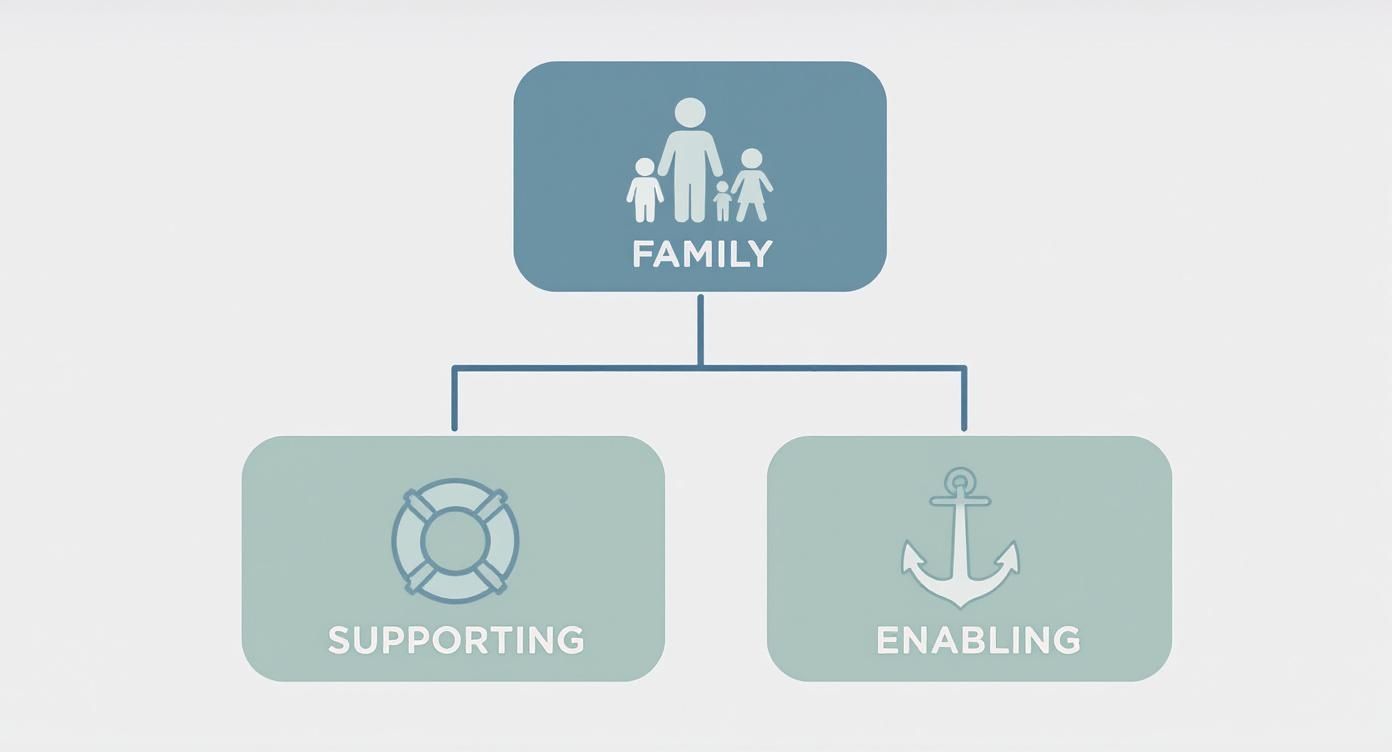
Think of it this way: true support is a lifeline that empowers recovery, while enabling is an anchor that weighs everyone down.
The Power of Shared Experience in Peer Support Groups
While a professional therapist is invaluable, there’s a unique comfort that comes from connecting with people who just get it. Peer support groups like Al-Anon (for families of those with alcohol use disorder) and Nar-Anon (for families of those with drug addiction) offer exactly that. These aren't formal therapy sessions; they are communities built on the foundation of shared experience.
The biggest benefit is the immediate sense of relief. You can finally talk about your fears, frustrations, and small wins without feeling judged because every single person in the room has a similar story. It's a powerful reminder that you are not alone.
"Peer support is a lifeline. It’s where you realize your chaotic reality is understood by others, and their survival becomes proof that you can survive, too."
These groups provide a safe harbor to process your own emotions and pick up practical coping skills from people who have already navigated the same rough waters.
Comparing Family Support Options
With several avenues for help, it can be tough to know where to start. This table offers a quick breakdown of the main options to help you see what might be the best fit for your family right now.
| Support Type | Primary Goal | Best For | Format |
|---|---|---|---|
| Family Therapy | Repair communication, rebuild trust, and address unhealthy family dynamics with a licensed professional. | Families in active crisis or those ready to work through deep-seated issues together. | Structured, confidential sessions (in-person or virtual) led by a therapist. |
| Peer Support Groups | Provide emotional validation, shared coping strategies, and a sense of community with others in similar situations. | Individuals seeking ongoing, informal support and a sense of belonging. | Free, anonymous group meetings (in-person or virtual) following a 12-step or similar model. |
| Educational Programs | Demystify the science of addiction, teach effective boundary-setting, and explain the recovery process. | Families who feel confused and want clear, evidence-based information to make informed decisions. | Workshops, seminars, or multi-week courses, often offered by treatment centers. |
Ultimately, many families find that a combination of these supports—like attending Al-Anon while also participating in family therapy—provides the most comprehensive foundation for healing.
Gaining Clarity with Educational Programs
Knowledge is a powerful weapon against the chaos of addiction. Educational programs and workshops, like those offered by treatment centers such as Altura Recovery, are designed to pull back the curtain on substance use disorder. They replace confusion and fear with clear, evidence-based information.
These programs typically cover crucial topics like:
- The Science of Addiction: Understanding how addiction physically changes the brain helps you stop seeing it as a moral failing and recognize it as the medical condition it is.
- Effective Boundary Setting: You’ll learn the critical difference between healthy boundaries and ultimatums, often with practical scripts you can use in real conversations.
- The Recovery Process: Getting a realistic picture of what recovery involves—including the possibility of relapse—prepares you for the journey ahead.
This kind of education empowers you to make informed decisions and provide more effective support for families of addicts, starting with your own. The entire treatment field is recognizing just how vital this is. The addiction treatment sector is projected to grow to $20.93 billion by 2025, with a major emphasis on family and peer support.
In fact, studies show that peer support networks can reduce the risk of relapse by 35% when combined with clinical care. As you can discover more insights about the evolution of addiction recovery on PinnacleRecovery.org, it's clear that a well-informed, supported family is one of the most powerful assets in a loved one's recovery.
Communicating Effectively When Things Are Difficult
When addiction takes hold of a family, everyday conversations can start to feel like walking through a minefield. Communication shuts down, trust evaporates, and any talk about the "problem" seems to end in either a shouting match or a heavy, painful silence.
Learning to talk to each other again isn't about finding some magic set of words. It’s about fundamentally changing the dynamic of how you interact.
This isn’t about winning arguments or proving a point. It’s about creating just enough space for honesty to get in, giving recovery a little room to grow. It means stepping away from the super-charged language of blame and frustration and trying a calmer, more deliberate approach. The goal is simple: to be heard without immediately putting the other person on the defensive.
Let's turn abstract ideas like "boundaries" and "healthy communication" into real things you can do and say today.
From Blame to Boundaries with I-Statements
One of the most powerful tools you can start using immediately is the "I-statement." It’s a straightforward but incredibly effective way to share your feelings and needs without pointing fingers. It instantly shifts the energy of a conversation from an accusation to an expression of your own reality.
An I-statement follows a basic formula: I feel [your emotion] when [the specific behavior happens] because [the impact it has on you].
Let's look at the difference between a typical blame-focused comment and a constructive I-statement:
- Blame Statement: "You're so irresponsible with money! You just don't care how much you're hurting us." This is an attack, and it will almost always be met with denial, excuses, or anger.
- I-Statement: "I feel scared and anxious when our savings are spent unexpectedly because I worry about our family's financial security." This is about your feelings, which is something no one can really argue with.
Using I-statements consistently helps turn down the temperature in the room and opens the door for an actual conversation instead of another fight. It moves the spotlight from their supposed character flaws to the real, tangible impact their actions have on you.
The Power of Listening to Understand
In tense situations, most of us listen with the goal of replying—we’re just waiting for our turn to correct the other person or defend our own point of view. Active listening, on the other hand, is about listening with the genuine intent to understand. It means giving your loved one your full attention, absorbing what they’re saying (and what they’re not saying), and showing them that you hear them.
This doesn't mean you have to agree with them. It just validates their feelings, which can be a surprisingly effective way to disarm someone during a conflict.
Active listening sends a clear message: "Your perspective matters to me, even if I see things differently." This validation can be the first step toward lowering defensive walls and finding common ground.
Simple active listening techniques include:
- Reflecting: Briefly summarize what you heard them say. "So, it sounds like you're feeling really overwhelmed and trapped right now."
- Asking Open-Ended Questions: Encourage them to share more. "Can you tell me more about what that feels like for you?"
- Using Minimal Encouragers: Simple verbal cues like "I see," "uh-huh," and "go on" show you're engaged without cutting them off.
Navigating Manipulation and Broken Promises
When you start setting and holding new, healthy boundaries, you should absolutely expect some pushback. Your loved one might react with anger, guilt trips, or manipulation because you're disrupting the old dynamic that, frankly, made their addiction easier to maintain. This is a tough part of the process, but it's a predictable one.
The absolute key is consistency. A boundary is only as strong as your commitment to upholding it.
Here are a few examples of firm, loving boundaries in action:
- Financial Boundaries: "I love you, and I am here to support your recovery in any way I can, but I can no longer give you money or pay your bills."
- Behavioral Boundaries: "You are always welcome in my home, but I cannot allow you to be here if you are under the influence. If you arrive intoxicated, I will have to ask you to leave."
- Emotional Boundaries: "I am willing to talk about your recovery, but I will not get into shouting matches or listen to verbal abuse. If the conversation becomes disrespectful, I will walk away until we can both speak calmly."
For couples navigating the unique challenges of addiction, practical strategies are vital for strengthening your bond. You can learn more about improving marriage communication with specific tips designed for connection. Enforcing these kinds of rules isn't about punishment; it’s a necessary form of support for families of addicts that fosters accountability while protecting your own mental and emotional health.
Why Your Own Wellbeing Is Not Selfish

Loving someone with a substance use disorder is an all-consuming role. It's emotionally draining, mentally taxing, and physically exhausting. In the constant whirlwind of crisis management, your own needs get pushed to the very bottom of the list, filed under "things I'll get to later."
But "later" rarely comes. Over time, letting your loved one's addiction eclipse your own wellbeing isn't just unsustainable; it’s counterproductive. You simply cannot pour from an empty cup. Self-care isn't a selfish luxury in this situation—it's a fundamental necessity for survival and a core part of providing effective support.
The Real Impact of Chronic Stress
Living in a constant state of high alert, just waiting for the next phone call or crisis, takes a serious toll on your health. This prolonged exposure to stress and trauma can show up in very real physical and psychological ways.
Many family members experience symptoms similar to post-traumatic stress disorder (PTSD), including hypervigilance, anxiety, depression, and insomnia. Your body isn't designed to stay in fight-or-flight mode forever. Ignoring these signs is like continuing to drive your car while the engine warning light is flashing red.
Reframing self-care is essential. It is not an indulgence or a distraction from the "real" problem. It is the very foundation that allows you to be a stable, resilient, and effective source of support for your entire family.
This ripple effect of addiction through a family is profound, especially for the youngest members. The situation for children highlights the urgent need for family-wide support. In 2023, nearly 1 in 4 US children lived with a parent who had a substance use disorder, significantly increasing their risk for long-term mental health challenges and even their own future substance use. You can learn more about these critical findings on the NIH website.
Practical Strategies for Your Own Healing
True self-care goes far beyond surface-level comforts like bubble baths. It’s about intentionally and consistently taking steps to replenish your own emotional and mental reserves. This is a crucial element of finding support for families of addicts, as it builds your capacity to handle the journey ahead.
Consider these actionable strategies:
- Seek Your Own Therapy: You have experienced your own trauma and deserve a safe space to process it. A therapist can help you navigate feelings of guilt, anger, and grief while developing healthy coping mechanisms.
- Reconnect with Hobbies: What brought you joy before addiction took over your life? Re-engage with activities—painting, hiking, reading, music—that are just for you. This helps you remember who you are outside of your role as a caretaker.
- Practice Mindfulness: Techniques like deep breathing, meditation, or even just a five-minute walk without your phone can help ground you in the present moment. This practice helps manage the daily anxiety that comes with uncertainty.
Building these habits isn't just about feeling better; it's about building resilience. By taking care of your own wellbeing, you model healthy behavior for your entire family and become a more effective advocate for your loved one's recovery. You are not abandoning them; you are fortifying yourself to be there for the long haul.
How to Find Local and Online Resources
Knowing you need help is a monumental first step. The next is figuring out where to find it, and that search can feel overwhelming. But you don't have to navigate this alone. Starting the journey doesn't require some grand gesture—it can begin with a single, confidential phone call or a quiet search online from your kitchen table.
Think of it like gathering tools for a tough but important project. You wouldn't try to build a house with just a hammer; you need a whole toolbox for different tasks. In the same way, effective support for families of addicts comes from a mix of resources, each serving a unique purpose in your family's healing.
Your First Steps Toward Finding Help
The initial search should focus on accessible, reliable sources that can give you immediate guidance without any pressure or judgment. These are your confidential first points of contact, designed to help you understand your options.
- National Helplines: Organizations like the SAMHSA National Helpline (1-800-662-HELP) are lifelines. They offer free, 24/7 treatment referral and information services. A trained specialist can connect you with local treatment options and support group information in just a few minutes.
- Online Communities: Sometimes you just need to talk to someone who gets it. Peer support forums like Al-Anon, Nar-Anon, and SMART Recovery Family & Friends offer virtual meetings and online forums where you can instantly connect with others walking a similar path.
- Treatment Center Websites: Reputable facilities, like Altura Recovery, often have extensive blogs and resource pages. These are goldmines for understanding different treatment philosophies and seeing what kinds of family programs are available in your area.
Locating Specialized Local Support
Once you have a foundational understanding of what's out there, you can start narrowing your search to specialized local programs. These services offer more structured, in-person support that can be tailored to your family's specific needs.
Taking action is the antidote to despair. The goal is to move from a state of passive worry to active participation in your family's recovery journey, armed with information and professional guidance.
A simple online search for "family addiction support near me" or "family workshops Houston" is a surprisingly effective way to start. Many treatment centers host educational workshops designed for families, covering everything from the science of addiction to communication strategies that actually work.
Learning about the nitty-gritty of the recovery journey, like the challenges of post-acute withdrawal syndrome, can also better prepare you for what lies ahead. Attending a local program gives you a structured environment to learn these concepts alongside other families, which creates a powerful sense of community and reminds you that you are not alone.
Common Questions from Families
When a loved one is struggling with addiction, your mind races with urgent, confusing questions. Getting clear, straightforward answers is like finding an anchor in a storm—it gives you the stability to figure out the next right step.
What If My Loved One Refuses Help?
This is one of the most common and painful roadblocks families face. The hard truth is you can't force an adult into treatment unless they are an immediate danger to themselves or others. Your real power isn't in controlling their choices, but in controlling your own actions.
This is where healthy boundaries become your most important tool. You can stop enabling the addiction by refusing to give them money, make excuses for them, or shield them from the consequences of their actions. It means being able to say, "I love you too much to support your active addiction, but I am ready to support your recovery the moment you are." This shift in the family dynamic is often the very thing that creates the crisis needed for them to finally consider getting help.
Am I Making Things Worse by Helping?
It’s a fear every loving family member has. The line between helping and enabling is incredibly thin, and it’s often blurred by love, worry, and fear. The simplest way to tell the difference is to look at the outcome of your actions.
- Helping promotes recovery and personal responsibility. Think of it as driving them to a therapy appointment or attending a family support meeting with them.
- Enabling, on the other hand, protects them from the natural consequences of their addiction. This looks like paying their rent after they spent their money on substances or calling them in sick to work when they're hungover.
Learning to provide support for families of addicts means empowering yourself to step back from the rescuer role and, instead, encourage their own accountability.
The most compassionate action you can take is to allow your loved one to face the reality of their situation. This is not abandonment; it is allowing for the possibility of genuine change.
Where Should I Even Start?
The sheer number of options can feel paralyzing. Don't try to solve everything at once. Just focus on one small, manageable step. You could call a national helpline like SAMHSA for free, confidential guidance. You could find a local Al-Anon meeting to connect with other people who know exactly what you're going through. Or you could simply schedule a consultation with a family therapist. The first step is all you need to take right now.
At Altura Recovery, we know that healing is a journey for the entire family, not just one person. Our dedicated family workshops and outpatient programs are designed to give you the education and therapeutic support you need to walk this difficult path with confidence and hope. Learn more about how we can help your family heal by visiting us at AlturaRecovery.com.