Self-defeating behaviours are those maddening patterns of thought and action that stop you from reaching your goals, even when you desperately want to succeed. It’s that frustrating gap between knowing exactly what you should do and what you actually end up doing, creating a cycle of setbacks and disappointment.
Unpacking The Cycle Of Self-Defeating Behaviours
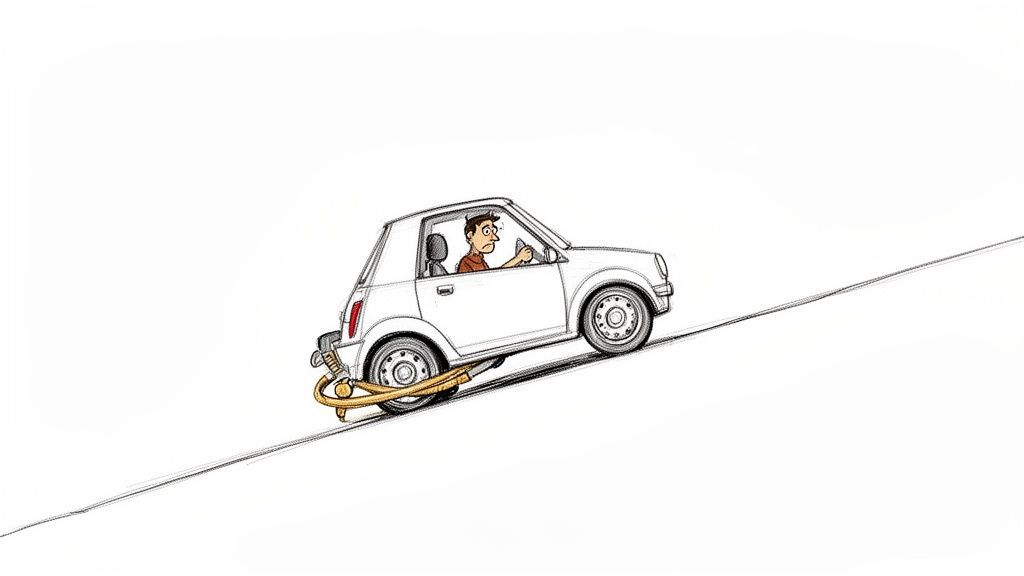
Imagine trying to drive a car forward while your foot is jammed on the emergency brake. You’re burning fuel, making a lot of noise, and getting absolutely nowhere. That’s a perfect way to think about self-defeating behaviours. They act as an internal resistance that stalls your progress, especially during a vulnerable process like addiction recovery.
These patterns aren't a sign of weakness or a simple lack of willpower. Far from it. They are often deeply ingrained coping mechanisms we learned from past experiences—sometimes years ago. They might sprout from a fear of failure, deep-seated low self-esteem, or even a twisted attempt to protect yourself from future disappointment by controlling the outcome, even if it's a negative one.
The Four Stages Of The Cycle
To stop these behaviours, you first need to see them for what they are. Every self-defeating action tends to follow a predictable, four-stage loop. Getting familiar with this progression is the first real step toward interrupting it and choosing a different path.
The diagram below shows the simple but powerful cycle that keeps so many people stuck.
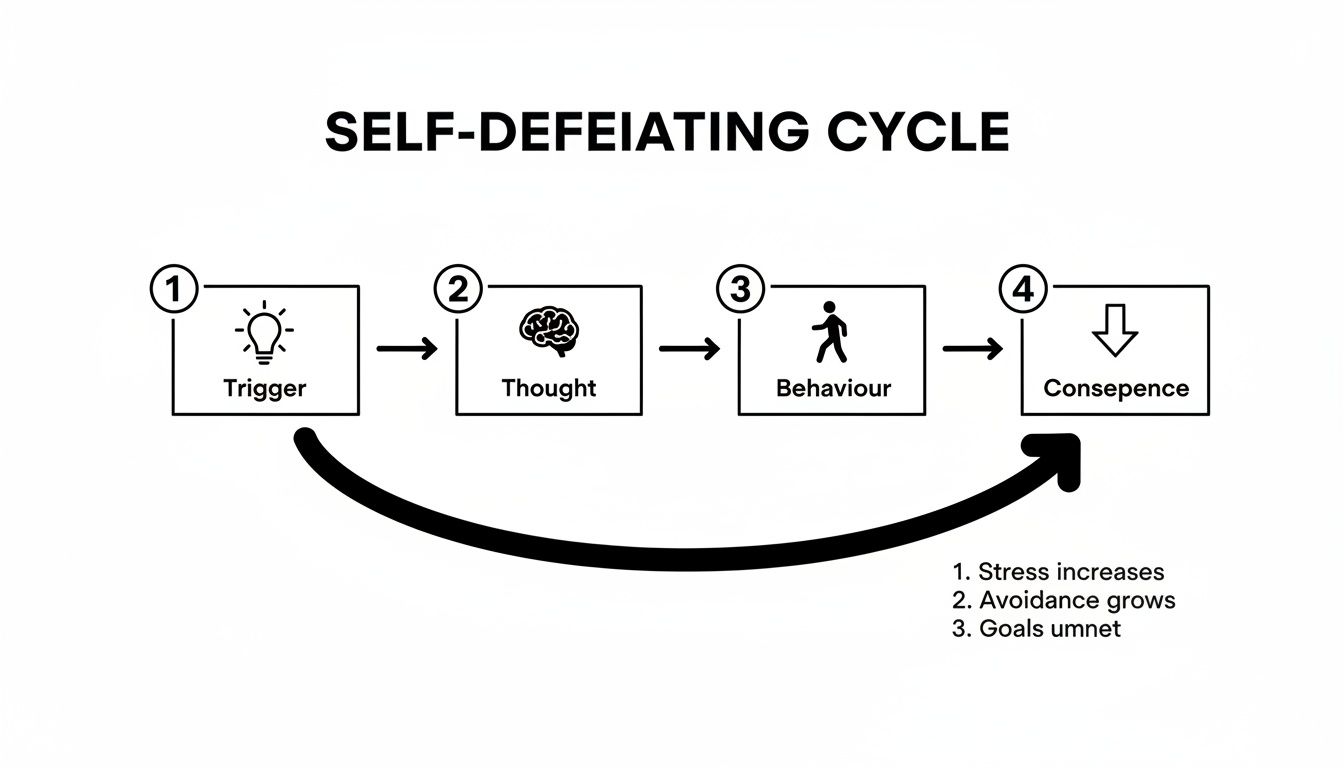
This simple cycle explains how these behaviours take hold and repeat themselves. Let's break down each stage to see how it works in the real world, especially for someone navigating the challenges of recovery.
The Four Stages of a Self Defeating Cycle
| Stage | Description | Example in Recovery |
|---|---|---|
| 1. The Trigger | An external event or internal feeling that initiates the cycle. This could be stress, a memory, boredom, or a social cue. | Receiving an invitation to a party where alcohol will be served. |
| 2. The Thought | The internal, often automatic, belief or assumption that follows the trigger. This thought is usually negative and self-critical. | "I'll be boring if I don't drink. No one will want to talk to me. I can just have one." |
| 3. The Behaviour | The action taken in response to the thought. It's the self-sabotaging act itself, providing temporary relief but long-term problems. | Deciding to go to the party and having a drink, which leads to several more. |
| 4. The Consequence | The negative outcome of the behaviour, which often reinforces the initial negative thoughts and feelings, priming the cycle to repeat. | Waking up with a hangover, feeling intense shame and regret, and thinking, "See, I can't do this. I'll always be a failure." |
Seeing the pattern laid out like this makes it clear: the problem isn’t just the final behaviour, but the entire chain reaction that leads to it.
As the flow shows, an external trigger sparks an internal thought, which then prompts a destructive action. This ultimately results in a negative consequence that reinforces the very feeling that started the whole mess. This connection is especially powerful in addiction, where these kinds of maladaptive patterns are incredibly common. In fact, research shows that approximately 47% of the U.S. adult population displays signs of an addictive disorder over a 12-month period, which highlights just how widespread these underlying challenges are. You can read the full research about addiction statistics and see how these behaviours contribute to the bigger picture.
Recognizing this cycle in your own life is a total game-changer. It shifts the focus from blaming yourself for the consequence to understanding the trigger and the thought that kicked off the chain reaction. It’s right there, in those early stages, that you hold the power to make a new choice and finally break free from the loop.
Recognizing Self-Sabotage in Your Recovery Journey
Self-defeating behaviours often operate in the shadows of our daily lives, making them tough to spot. For someone in recovery, these patterns are especially tricky because they can disguise themselves as harmless habits or even coping mechanisms while quietly chipping away at your progress.
The first step to changing them isn't about judgment; it’s about awareness. It's that "aha" moment when you realise a certain action isn't actually helping you move forward but is keeping you chained to the past. These patterns can be big and obvious or small and insidious, but they all serve the same purpose: to derail your journey toward healing.
Common Examples in Daily Life
Self-sabotage can pop up in countless forms. For anyone building a new life in recovery, these behaviours often get in the way of the very actions needed for a stable, sober future.
- Procrastination on Recovery Goals: This looks like putting off the essentials—finding a sponsor, going to a meeting, or doing your therapy homework. The excuse might sound reasonable ("I'm swamped this week" or "I'll get to it tomorrow"), but the delay keeps you from building a solid foundation of support.
- Emotional Avoidance: When tough feelings like shame, anger, or sadness surface, your first instinct might be to isolate yourself from your support system. This move prevents you from processing those emotions in a healthy way and reinforces the dangerous idea that you have to handle everything alone, which can be a direct path back to old habits.
- Perfectionism: Striving for a flawless recovery is a classic trap. When you set impossibly high standards for yourself, any small slip-up feels like a complete failure. This all-or-nothing thinking creates intense stress and burnout, making you want to give up entirely when you inevitably fall short of perfection.
These actions create a powerful cycle. By avoiding a necessary task or feeling, you get a quick hit of relief from the discomfort, which makes you more likely to repeat the behaviour next time.
The Inner Critic and Its Impact
One of the most powerful engines of self-sabotage is negative self-talk. This is that constant, critical voice in your head telling you that you're not good enough, you'll never succeed, or you don't deserve to be happy.
This inner voice erodes your confidence and self-esteem one thought at a time. It convinces you that failure is inevitable, making it that much easier to fall into behaviours that prove it right.
This brand of self-sabotage often comes from deep-seated internal criticism and a lack of self-belief, which is why learning how to overcome self doubt is so critical. When your own mind is your biggest enemy, taking the positive risks necessary for growth feels impossible.
This pattern is especially damaging in recovery, where self-compassion and believing in your ability to change are absolutely essential. Every negative thought chips away at your resolve, leaving you more vulnerable to triggers and old habits. Learning to spot and challenge this inner critic is a fundamental part of breaking free from self-defeating cycles and building a resilient mindset for long-term sobriety.
Uncovering the Roots of Self-Defeating Patterns
Self-defeating behaviors don’t just pop up out of nowhere. They aren’t random acts of self-destruction but deeply ingrained patterns that, at some point, probably served a purpose—even if it was a misguided one. To genuinely change them, we have to look under the hood and understand the powerful psychological drivers keeping them in motion. This isn't about judgment; it's about fostering compassion for ourselves along the way.
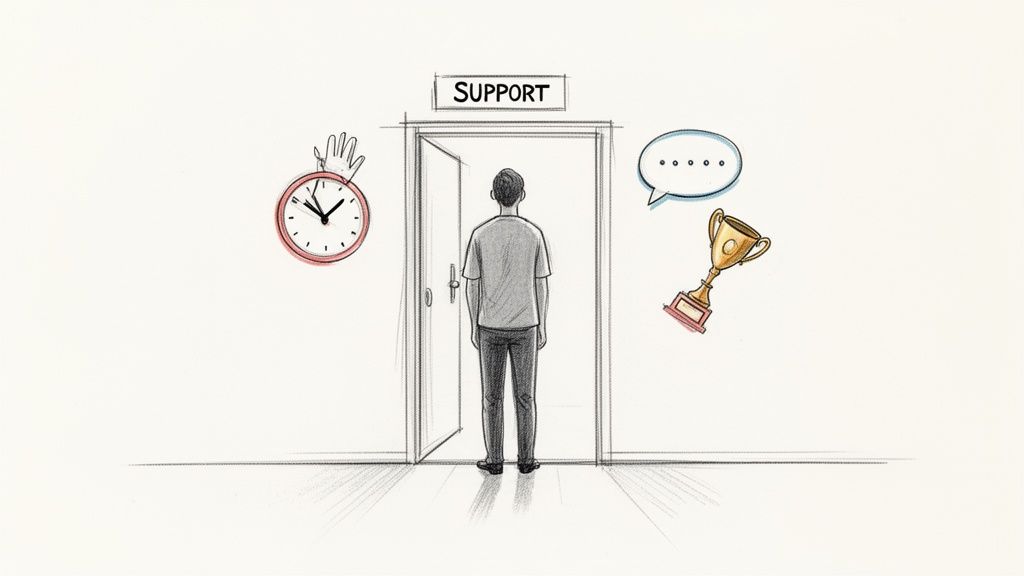
Often, these patterns are tangled up in fear. A paralyzing fear of failure can make it feel safer to sabotage your own efforts than to give it your all and fall short. If you’re the one who controls the failure, it somehow feels less painful than being blindsided by it. It’s a strange logic, but it keeps you stuck in a predictable, unfulfilling loop.
The Hidden Logic Behind Self-Sabotage
What’s even more surprising to many is the fear of success. Actually achieving a goal, especially a big one like sustained recovery, means taking on new responsibilities and facing new expectations. Success can feel so unfamiliar and threatening that retreating to old, comfortable misery seems like the safer bet. It’s a paradox where the very thing you want is the thing you instinctively push away.
Low self-esteem also plays a massive role. When you carry a core belief that you’re unworthy or don’t deserve happiness, you’ll unconsciously act in ways that prove that belief right. You might turn down a fantastic opportunity or push away a supportive partner because, deep down, you feel you don't deserve good things.
These behaviors are often misguided attempts at self-protection. For someone with a history of trauma, the world can feel unpredictable and dangerous. Self-sabotage becomes a way to control outcomes and avoid being hurt or let down by others again.
This constant need for control can lead to a state of hypervigilance, where your brain is always scanning for the next threat. It’s operating from a survival mode rather than a learning mode, which makes it incredibly difficult to embrace new, healthier ways of living. The focus becomes all about avoiding pain instead of pursuing growth.
The Powerful Influence of Social Connection
Another critical piece of the puzzle is our fundamental human need to belong. Social rejection and interpersonal conflict are powerful triggers for self-defeating behaviors because they directly mess with the brain's ability to self-regulate. When we feel rejected, our capacity to resist harmful impulses weakens, leaving us far more vulnerable to falling back into addictive patterns. You can discover more insights about the neuroscience of social rejection on PMC and see just how deeply it affects us.
Understanding these roots is a game-changer. It shifts the entire conversation from "What's wrong with me?" to "What happened to me?" This compassionate perspective is the first real step toward healing the source of the problem, not just managing the symptoms. By acknowledging where these patterns came from, you can start the work of building new, healthier responses grounded in self-worth and genuine safety.
Why Willpower Is Rarely Enough to Stop
Have you ever found yourself doing something you know is bad for you, all while asking, “Why do I keep doing this?” It's one of the most maddening parts of being human, and it trips up millions of people. There's a common belief that breaking self defeating behaviours is just a matter of trying harder or having more grit.
But the hard truth is, willpower has very little to do with it.
Relying on willpower alone is like trying to patch a leaking dam with your bare hands. You might be able to hold back the water for a little while, but the moment you get tired, stressed, or hit by a powerful trigger, the pressure becomes too much. The old patterns come flooding back in. This isn't a character flaw—it’s just brain science.
The Power of Ingrained Pathways
Our brains are built for efficiency. Every time we repeat an action, whether it’s good or bad, we deepen the neural pathway for it. Over time, that path becomes a mental superhighway. Self-defeating behaviors, especially those tangled up with addiction, essentially hijack the brain’s reward system. They make the quick hit of relief feel far more urgent than any long-term goal.
This is why simply knowing the negative consequences often isn't enough to spark real change. Behavioral research has even pinpointed a 'compulsive profile' in some people. These individuals tend to stick with harmful actions even when they get clear, negative feedback, making them resistant to change based on information alone.
When stress hits, the brain automatically defaults to these well-worn paths. Willpower is a limited resource that gets exhausted, making it a poor match for a deeply ingrained habit that promises a fast escape from discomfort. It’s critical to understand the real psychological mechanics at play, which is a big part of why change is so difficult.
Your brain isn’t trying to sabotage you intentionally. It’s following the path of least resistance—a path that was paved over years of repeated behaviour, often as a way to cope with underlying pain or stress.
To truly break free from self defeating behaviours, especially when addiction is in the mix, you need a better toolkit than sheer will. It takes structured, evidence-based strategies that help you actively rewire those neural pathways and build new, healthier ways to cope. This often means getting therapeutic support and sometimes includes targeted medication. You can explore how medication management supports mental health to see how this piece fits into the puzzle.
The goal is to stop blaming yourself for a lack of willpower and start empowering yourself with the right tools for the job.
Proven Strategies to Break the Cycle for Good
Understanding why you get in your own way is a huge first step, but real freedom comes from taking action. Let’s be clear: shifting these deep-seated patterns requires more than just willpower. It demands a toolkit of practical, evidence-based strategies designed to rewire your responses to stress, fear, and all those old triggers. The goal isn't a quick fix, but building new, healthy habits that actually last.
This is where powerful therapeutic approaches provide a structured path forward. These aren't just about talking through problems—they are about actively learning and practicing new skills to change how you think, feel, and behave. They empower you with real tools for lasting change, moving you from a cycle of sabotage to one of intentional growth.
Retraining Your Brain with Therapy
Several therapeutic models are especially effective at dismantling the thought processes that fuel self-defeating behaviors. Each one offers a unique lens and set of skills to help you break the cycle for good.
At Altura Recovery, we lean on evidence-based therapies because they work. They provide a clear framework for identifying the root of self-sabotage and building new, healthier neural pathways. Each approach offers a different angle, allowing us to tailor a plan that fits the individual.
Here’s a look at some of the core therapies we use and how they help untangle these self-defeating knots.
Therapeutic Approaches for Self Defeating Behaviours
| Therapy | Core Principle | How It Helps Break the Cycle |
|---|---|---|
| Cognitive Behavioral Therapy (CBT) | Our thoughts, feelings, and behaviors are interconnected. Changing negative thought patterns can change our actions. | CBT acts like a mental detective, helping you spot the automatic negative thoughts that kick off a spiral. You learn to challenge and reframe them into more balanced views, cutting the self-defeating cycle off at the source. |
| Dialectical Behavior Therapy (DBT) | Building skills to manage intense emotions and navigate relationships is key to breaking destructive habits. | DBT gives you a practical toolbox for distress tolerance and emotional regulation. Instead of reacting impulsively to painful feelings, you learn how to sit with them and respond constructively, preventing the urge to self-sabotage. |
| Eye Movement Desensitization and Reprocessing (EMDR) | Unprocessed traumatic memories can remain "stuck," triggering present-day self-sabotaging behaviors. | EMDR is a specialized therapy that helps your brain finally process and heal from past trauma. By reducing the emotional charge of old memories, it loosens their grip on your current actions and frees you from repeating the past. |
These therapies don’t just put a bandage on the symptoms; they get to the underlying mechanics of self-sabotage. By fundamentally changing your relationship with your own thoughts and emotions, you create the space you need to make different, healthier choices.
Building Healthy Coping Mechanisms
Beyond formal therapy, developing a set of daily practices is crucial for making these new patterns stick. Think of these as the small, consistent actions that build resilience over time. Every time you use them, you’re making your brain's "healthy" pathways stronger than the old, destructive ones.
A great place to start is with simple mindfulness techniques. Mindfulness helps you stay grounded in the present moment, creating a critical buffer between a trigger and your reaction. It’s a game-changer. You can learn more by exploring some simple mindfulness exercises for stress relief that can make a real difference.
Another powerful strategy is creating a "coping ahead" plan. When you know you're heading into a potentially triggering situation, take a few minutes to think it through beforehand. What are the potential challenges? How can you respond in a healthy way? This kind of mental rehearsal prepares your brain to choose a new path instead of defaulting to old self-defeating behaviors.
Ultimately, breaking the cycle is about consistently choosing actions that align with your long-term goals, one small, intentional step at a time.
How Outpatient Treatment Supports Lasting Change
It's one thing to understand the roots of self defeating behaviours and learn strategies to stop them. It's another thing entirely to put that knowledge into practice when life gets messy. This is where a structured, professional environment becomes your most important partner in recovery. At Altura Recovery, our programs are built to bridge that gap between knowing what to do and actually doing it, especially when you're feeling challenged.
Our whole approach is designed to address the tangled nature of self-sabotage and addiction together. We don’t just focus on stopping substance use; we help you heal the underlying thoughts and patterns that keep it going.
Building Resilience in the Real World
The incredible benefit of outpatient treatment, like our Intensive Outpatient (IOP) and Partial Hospitalization (PHP) programs, is that you aren't walled off from your life. You get to build and test out new coping skills in your actual daily environment—navigating work, family, and social triggers with our team backing you up every single step of the way.
True change happens when you can apply therapeutic skills to real-world stress. Outpatient care provides a safety net, allowing you to face challenges and process them in therapy without derailing your progress.
Our evidence-based services create a complete support system for making that change stick:
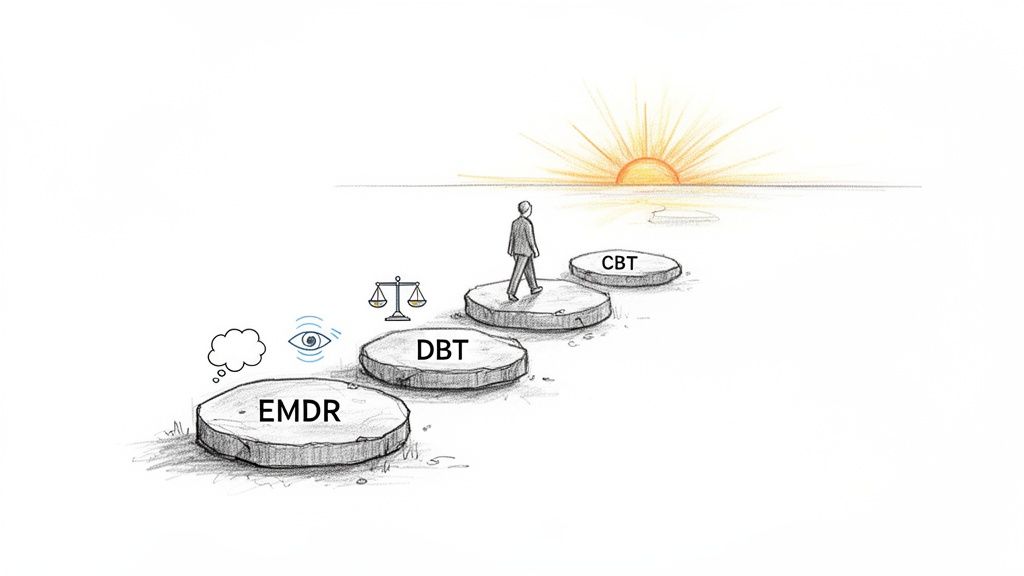
- Individual Therapy: We use powerful tools like CBT, DBT, and EMDR to help you directly challenge and reframe the thoughts that lead to self-sabotage.
- Trauma-Informed Care: We know that many self-defeating patterns are rooted in past trauma, so we create a safe space where you can finally start to heal those wounds.
- Relapse Prevention Planning: This isn't just a generic worksheet. It's about identifying your specific self-defeating triggers and creating a clear, actionable plan to respond differently when they pop up.
By weaving these methods together, we help you build genuine, lasting resilience. If you'd like a deeper look at how we integrate different therapeutic styles, you can learn more about the holistic therapy benefits we offer and see how they create a truly well-rounded recovery plan.
At Altura Recovery, our goal is to be your partner in achieving real healing, growth, and freedom from those old patterns that have held you back for too long.
Frequently Asked Questions
Got questions? You’re not alone. Here are some of the most common things people ask when they start exploring the cycle of self-sabotage.
Is Self-Sabotage a Sign of a Mental Health Disorder?
While self-sabotage isn’t a standalone diagnosis you’d find in a medical manual, it’s often a major red flag for underlying conditions. Think of it as a symptom, not the core illness.
These patterns are frequently intertwined with depression, anxiety, personality disorders, or past trauma. They also have a very strong connection to substance use disorders, creating a cycle where one fuels the other. At Altura Recovery, our comprehensive psychiatric evaluations are designed to identify and treat these co-occurring conditions, because getting to the root cause is the only way to achieve lasting recovery.
Can I Overcome These Behaviors on My Own?
It's a fair question. Self-help strategies like mindfulness and journaling can definitely be useful tools in your toolkit. However, when you're dealing with deeply ingrained patterns, going it alone is incredibly difficult and often doesn't stick long-term.
These patterns are complex because they serve a psychological purpose, even if it's a harmful one. A therapist helps uncover these root causes and develops personalized, evidence-based strategies in a supportive environment.
Professional guidance doesn't just make the process easier; it significantly boosts your chances of making a sustainable, life-altering change.
How Does Outpatient Treatment Help with Self-Defeating Behaviors?
Outpatient treatment is uniquely effective because it lets you build new skills while still living your life. Instead of learning coping mechanisms in a bubble, you get to practice them in your real-world environment.
You’ll face daily triggers related to work or family, but you’ll have consistent clinical support to process those experiences in therapy. It’s learning by doing. Altura Recovery’s flexible IOP and PHP programs provide the exact structure and guidance needed to replace those old self-defeating habits with healthy, resilient ones that truly support long-term sobriety and well-being.
Are you ready to stop the cycle of self-sabotage and build a life free from addiction? The compassionate team at Altura Recovery is here to provide the expert guidance and evidence-based care you need. Discover our outpatient programs and start your journey toward real healing today at https://www.alturarecovery.com.