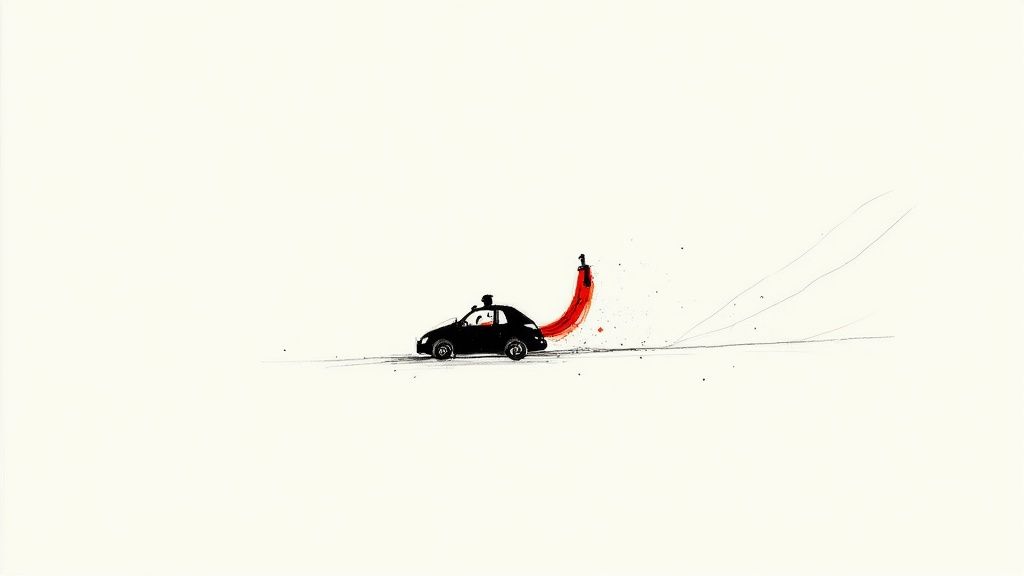
Ever feel like you’re flooring the gas and hitting the brakes at the same time? That’s what self defeating behaviors feel like in a nutshell—a pattern of choices that consistently trip you up, derailing your own success and well-being even when you have the best intentions.
Why We Sabotage Our Own Success
Self-sabotage is a complicated part of being human. It’s that baffling space where our actions are in direct conflict with our stated goals. This isn't about making a one-off mistake; it’s about falling into a cycle of behaviors that lead to the same negative outcomes, over and over again, even when we know better. It's a frustrating loop that can leave you wondering why you keep getting in your own way.
These actions serve a dual purpose: they are both destructive and defensive. On one hand, we’re actively wrecking our chances of getting what we say we want. On the other, we're subconsciously protecting ourselves from some deep, buried fear—maybe it’s the fear of failure, the fear of being truly seen, or even the fear of handling the pressure that comes with success.
The Unseen Forces Driving Our Actions
So, where does this all come from? Often, the roots of these patterns stretch way back to our earliest experiences. The relationships we had with our caregivers helped write the script for our core beliefs about ourselves and how the world works.
If our childhood left us feeling unlovable, unsafe, or simply not good enough, we might carry those beliefs into adulthood as a kind of "internal saboteur." This subconscious part of us works overtime to prove those old, negative beliefs right, making sure we stay tucked inside a familiar—though painful—comfort zone.
Think about it: a fantastic opportunity lands in your lap. That internal saboteur might start whispering that you're not qualified or that you'll just mess it up. This can lead you to procrastinate on the application or underperform in the interview. It's a strange way of snatching defeat from the jaws of victory, but it neatly confirms that old, painful story you've been telling yourself for years.
These self defeating behaviors are not a sign of weakness or a character flaw. They are often learned survival mechanisms—outdated strategies our minds developed to protect us from past pain or perceived threats.
How It Manifests in Daily Life
Spotting these behaviors in your own life is the first real step toward changing them. They can be sneaky and subtle, but they have a powerful impact.
Here are a few common ways they show up:
- Procrastination: Constantly putting off important tasks, even when you know it will create more stress down the road.
- Perfectionism: Setting the bar so impossibly high that you're too paralyzed to even start.
- Relationship Sabotage: Pushing away caring, supportive partners because you're terrified of intimacy or being abandoned.
- Neglecting Self-Care: Ignoring your physical and mental health needs, which reinforces a deep-seated belief that you aren't worthy of care.
Getting familiar with your specific patterns is the key to finally dismantling them.
Recognizing Self-Sabotage in Your Daily Life
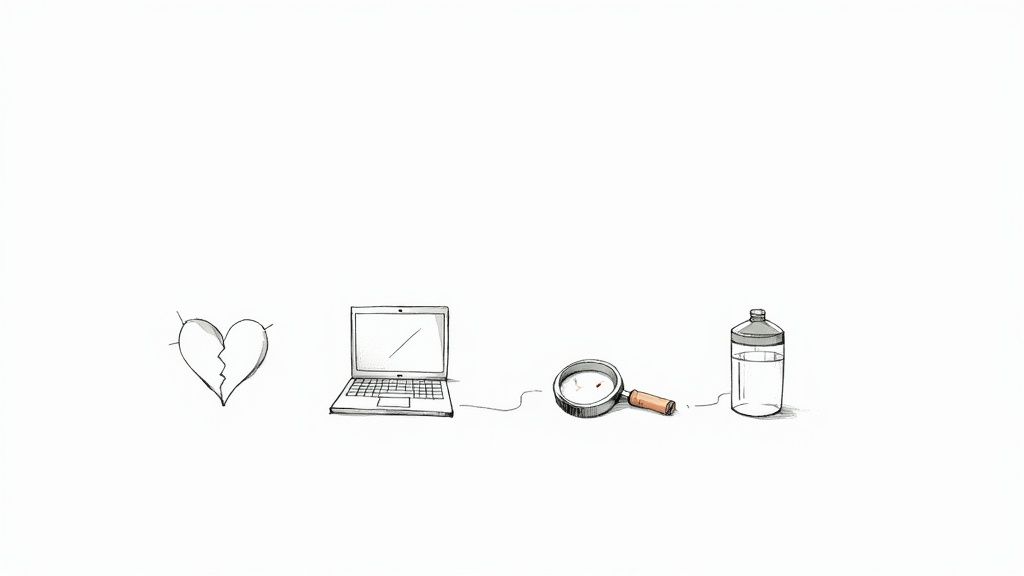
Self-defeating behaviors are masters of disguise. They rarely show up announced, instead masquerading as caution, high standards, or even self-protection. To break their cycle, you first have to learn to spot them in action.
Think of it like an invisible script you follow without realizing it. The scenes might change—your job, your relationships, your health goals—but the ending is always the same. You end up feeling stuck, frustrated, or confirming a deep-seated negative belief about yourself. This isn't a conscious choice; it's an automatic response, usually driven by fears you haven't had a chance to examine yet.
Self-Sabotage in Relationships
In relationships, self-sabotage often looks like a defense mechanism against getting hurt. It’s that impulse to push away a good partner because you’re terrified they might eventually leave anyway. It’s a preemptive strike against pain.
This pattern can also show up as repeatedly choosing emotionally unavailable partners. Doing so guarantees a familiar—though painful—outcome of loneliness, which reinforces a core belief that you aren't worthy of a real, lasting connection.
Common relational patterns include:
- Picking fights over tiny issues to create distance when intimacy feels too vulnerable.
- Accusing your partner of things you secretly fear about yourself (a defense mechanism called projection).
- Avoiding tough conversations, ensuring that core problems fester and resentment builds.
These actions create a self-fulfilling prophecy. By acting as if you expect rejection, you create the very conditions that make it happen.
Self-Sabotage at Work and in Personal Goals
When it comes to your ambitions, self-defeating behaviors often wear the mask of perfectionism. You might set goals so impossibly high that you're paralyzed by the fear of falling short, leading to chronic procrastination. Instead of starting a project, you get lost in endless "research" or planning, never actually producing anything.
This isn't laziness; it's a protective measure. If you never truly start, you can never truly fail. The underlying fear is that your best effort won't be good enough, so it feels safer not to even try.
Another common pattern is accepting chronic stress as the price of admission. You might take on an unsustainable workload to prove your worth, leading straight to burnout that torpedoes your long-term performance and well-being.
Similarly, neglecting self-care—like getting enough sleep, eating well, or moving your body—is a quiet but powerful form of self-sabotage. It sends a message to your subconscious that you don't deserve to feel good, making it that much harder to show up as your best self anywhere in your life.
To help you connect these dots, here’s a quick look at some common patterns and the fears that often hide behind them.
Common Self-Defeating Patterns at a Glance
| Behavior Pattern | Potential Underlying Cause |
|---|---|
| Procrastination | Fear of failure or fear of success. |
| Perfectionism | Belief that you are only as good as your last achievement. |
| Pushing people away | Fear of abandonment or intimacy. |
| Negative self-talk | Internalized belief that you are unworthy of love or success. |
| Neglecting self-care | Feeling that you don't deserve to feel rested and well. |
| Picking fights | Fear that vulnerability will lead to being controlled or hurt. |
Recognizing these habits for what they are—protective strategies that have outlived their usefulness—is the first, most crucial step toward rewriting your script.
Exploring the Psychological Roots of Self-Sabotage
To change a behavior, you have to get to the bottom of where it comes from. Self-defeating patterns are rarely a conscious choice. Instead, they’re usually echoes of past experiences—psychological scripts we learned long ago and have been following ever since. These patterns aren't character flaws; they're sophisticated, if outdated, survival mechanisms.
Imagine your mind is a garden. Early life experiences—how you were treated, what you were taught about your own worth—are the seeds planted there. If those seeds were neglect, harsh criticism, or instability, they can grow into the tangled weeds of negative core beliefs like "I am unworthy" or "I am bound to fail." Self-sabotage is the act of tending to these weeds instead of the healthy plants you consciously want to grow.
Cognitive Distortions: The Lens That Warps Reality
One of the main drivers of self-sabotage is cognitive distortions, which are basically faulty thinking patterns that twist our perception of reality. These aren't just random negative thoughts; they are systematic errors in logic that reinforce feelings of inadequacy and fear, making self-sabotage feel almost inevitable.
Common distortions that get in the way include:
- Black-and-White Thinking: You see everything in extremes. If you aren't a complete success, you're an absolute failure. There's just no room for nuance or learning from mistakes.
- Catastrophizing: You automatically jump to the worst-case scenario in any situation. A small mistake at work doesn't just mean a minor setback; in your mind, it means you're definitely getting fired.
- Emotional Reasoning: You assume that because you feel something, it must be true. "I feel like a fraud, so I must be one," is a classic example that fuels imposter syndrome and makes you pull back from opportunities.
These distorted thoughts create a vicious feedback loop. They generate anxiety and shame, which in turn trigger self-defeating behaviors that seem to "prove" the original distorted thought was right all along.
The Lasting Echo of Unresolved Trauma
Perhaps the deepest root of self-sabotage is unresolved trauma. When you experience overwhelming events that leave you feeling powerless, your brain and body adapt to survive. The problem is, these adaptations can become ingrained patterns long after the threat is gone.
For example, if you grew up in a chaotic environment, avoiding success as an adult might feel safer because, in the past, being visible only brought negative attention.
Self-sabotage is often a misguided attempt at self-protection. The mind tries to control a future outcome by recreating a familiar, albeit painful, past. It’s a way of choosing a known pain over an unknown fear.
For those with deeper historical factors, understanding trauma-informed care provides crucial insights into how past experiences shape present behaviors. The connection is powerful, and healing often requires addressing these old wounds directly. You can learn more about how trauma often co-occurs with other mental health challenges in our guide on comorbid posttraumatic stress disorder.
Research backs this up, showing that a significant portion of the population persists in these harmful actions. One large study found that roughly 27% of people fall into a "Compulsive" profile, continuing self-defeating acts despite the negative outcomes they produce.
The Vicious Cycle of Self-Sabotage and Addiction
Self-sabotage and addiction aren’t just related; they often feed each other in a destructive loop. For many people, substance use doesn’t start as a search for a good time. It begins as a desperate attempt to quiet the inner critic—to numb the emotional pain that comes from feeling worthless, anxious, or haunted by past trauma.
In short, drugs or alcohol become a misguided coping mechanism for the very feelings that self-defeating behaviors create and sustain.
This attempt to escape the pain quickly becomes a core part of the problem. What felt like a solution only digs the hole deeper, creating a powerful feedback loop. The consequences of substance use—the missed appointments, the broken promises, the financial strain—pile on more guilt and shame. This only seems to confirm the core negative beliefs that were already there: "See? I really am not good enough," or "I always mess things up."
How Sabotage and Substance Use Fuel Each Other
This dynamic makes recovery incredibly challenging because those ingrained self-sabotaging patterns become powerful relapse triggers. When things start going well—a new job, a mended relationship—it can feel unfamiliar and undeserved. Faced with the anxiety of potential success, a person might unconsciously turn back to substance use as a familiar way to derail progress and return to the painful, yet predictable, state of failure.
Substance use becomes the ultimate act of self-sabotage. It provides a destructive, temporary escape from the anxiety of building a better life while simultaneously confirming every negative belief a person holds about themselves.
This is why lasting recovery demands tackling both issues at once. Addressing the addiction without exploring the underlying self-defeating behaviors is like treating a symptom without curing the disease. The old patterns that drove the substance use in the first place will just lie in wait for the next opportunity to resurface. A great first step is understanding the difference between the mental and physical hooks of addiction, which you can learn about in our guide on the psychological vs. physical dependence on substances.
This infographic shows just how deep these roots can go, often starting in our earliest experiences.

As you can see, there's a clear pathway where trauma can create distorted thinking. That thinking then builds survival mechanisms that show up in our adult lives as self-sabotage.
The Stakes for Young Adults
This connection is especially critical for young people. Worldwide, about one in seven adolescents struggles with a mental health disorder, which often fuels self-defeating behaviors like substance misuse and self-harm.
Tragically, these patterns can have fatal consequences. Suicide is the third leading cause of death for people aged 15–29 globally. These aren't just statistics; they represent young lives cut short by cycles of pain that could have been interrupted with the right support.
Proven Therapeutic Strategies for Lasting Change
The good news is that self-sabotage is a learned behavior. And just like any other habit, it can be unlearned. But breaking free from these deep-rooted patterns isn’t just a matter of willpower; it often requires professional guidance and proven therapeutic tools.
Evidence-based therapies offer a structured roadmap for change. They help you get to the bottom of why you're stuck in these cycles and, more importantly, give you the practical skills to finally get out. This isn't about blame—it's about empowerment. Think of it as getting a new, healthier set of instructions for your brain, learning how to retrain your brain to overcome self-sabotage and transform your life.
Cognitive Behavioral Therapy (CBT)
Cognitive Behavioral Therapy (CBT) is one of the heavy hitters when it comes to tackling self-sabotage. Its core idea is surprisingly simple: our thoughts, feelings, and behaviors are all linked. CBT essentially trains you to become a detective of your own mind, spotting the automatic negative thoughts (clinicians call them cognitive distortions) that kickstart your self-defeating actions.
Let’s say you chronically procrastinate on important projects. CBT helps you trace that behavior back to a thought like, "If I don't do this perfectly, I'm a total failure." By learning to challenge that all-or-nothing thinking and reframe it into something more realistic, you dial down the anxiety that fuels the procrastination in the first place.
Dialectical Behavior Therapy (DBT)
Where CBT shines a light on thoughts, Dialectical Behavior Therapy (DBT) excels at helping you manage the intense emotions that often drive self-sabotage. DBT is especially powerful if your behaviors are tied to emotional dysregulation—things like picking fights when you feel vulnerable or reaching for a substance when you feel overwhelmed.
DBT teaches practical skills across four key areas:
- Mindfulness: Learning to observe your thoughts and emotions without judging them.
- Distress Tolerance: Finding healthy ways to get through painful moments without making things worse.
- Emotion Regulation: Understanding your emotional triggers and reducing your vulnerability to them.
- Interpersonal Effectiveness: Clearly communicating your needs and setting boundaries in relationships.
You can get a head start by exploring some foundational techniques in our guide on mindfulness exercises for stress relief.
The goal of these therapies isn’t to eliminate negative feelings but to change your relationship with them. Instead of being controlled by your emotions, you learn to navigate them effectively.
Eye Movement Desensitization and Reprocessing (EMDR)
Sometimes, self-defeating behaviors aren't just bad habits; they're survival mechanisms rooted in unresolved trauma. When that's the case, Eye Movement Desensitization and Reprocessing (EMDR) can be a profoundly effective therapy. Trauma can leave painful memories "stuck" in the brain, causing you to react to today's triggers as if the past danger is still happening right now.
EMDR uses bilateral stimulation (like guided eye movements) to help the brain properly reprocess these traumatic memories. This doesn't erase the memory, but it removes its intense emotional charge. As the trauma starts to feel like a part of your past instead of a constant present-day threat, the self-sabotaging coping strategies it created naturally begin to fall away.
Your Action Plan for Building Healthier Habits

Therapy is where you get the tools and insights to understand why you engage in self-defeating behaviors. But the real, lasting change? That happens in the small choices you make every single day.
Turning that hard-won knowledge into action is how you build a new future, one healthier habit at a time. This isn’t about some dramatic, overnight overhaul. It's about taking small, consistent steps that build momentum and prove to yourself that you can do this.
The first step is simply noticing. You can't change a pattern you don't see. Start a daily practice—even just five minutes of journaling or quiet reflection—to become aware of your triggers as they happen. Before acting on an old impulse, just pause and ask yourself: "What am I really feeling? What old story is this trying to play out?"
Setting Yourself Up for Success
Once you can spot your patterns in the wild, the next move is to intentionally choose a different path. This is where small, achievable goals become your best friend. Forget about perfection—that’s a classic trap that leads straight to paralysis. Instead, focus on tiny, incremental progress.
- Break It Down: If you procrastinate on big projects, your goal isn't to "never procrastinate again." It’s to work on the project for just 15 minutes. That's it.
- Track Your Wins: Keep a running list of every single time you choose a healthier response, no matter how small. You are literally building a new neural pathway, and every win strengthens it.
- Practice Self-Compassion: You’re going to have setbacks. Everyone does. Instead of seeing them as failures, view them as data. What can you learn from that slip-up to make things easier next time?
Lasting change is not about perfection; it’s about persistence. Each small victory proves to your subconscious mind that a different way of living is not only possible but also safe.
Creating a Supportive Environment
Your environment plays a massive role in whether you succeed or stumble. It can either support your efforts or actively sabotage them. This means getting intentional about the people you surround yourself with and the boundaries you set.
Nurturing relationships with people who genuinely encourage your growth is a powerful antidote to the negative self-talk that fuels self-sabotage.
Setting healthy boundaries is also a non-negotiable act of self-care. It teaches others how to treat you while reinforcing your own sense of self-worth. Exploring different self-care activities for mental health can give you a strong foundation, building the resilience you need to finally break free from those old cycles for good.
Of course. Here is the rewritten section, crafted to sound completely human-written and match the expert, compassionate voice of the provided examples.
Common Questions About Self-Sabotage
Facing the reality that you might be getting in your own way brings up a lot of tough questions. It’s completely normal to feel confused, frustrated, or even a little overwhelmed by it all. Let's walk through some of the most common questions that come up when people start this journey.
Getting clear on these patterns is the first real step toward changing them. It gives you the insight you need to move forward with purpose and, most importantly, with kindness toward yourself.
Why Do I Keep Messing Things Up When I Genuinely Want to Succeed?
This is probably the most maddening part of self-sabotage. You have a goal, you want it badly, but you keep doing things that pull you in the opposite direction. What’s going on? It’s almost always a clash between what your conscious mind wants and what your subconscious mind believes is true.
Often, a deep-rooted fear of failure—or even a fear of success—can trigger old protective behaviors that just don’t fit your life anymore. Maybe past experiences taught you that success is dangerous, that it brings negative attention, or that on some level, you don't really deserve it. These aren't logical choices you're making in the moment; they are deeply ingrained reactions designed to keep you in a familiar (though painful) comfort zone. Therapy is incredibly effective at digging up these roots so you can finally align your actions with your true goals.
The real conflict is between what you consciously want and what your subconscious believes you can handle. Healing starts the moment you begin to bring those two into alignment.
Can I Stop Self-Defeating Behaviors on My Own?
Self-help tools like journaling, mindfulness apps, and setting small goals are fantastic starting points. They can build awareness and give you some early wins. But for patterns that are really dug in, especially those tied to trauma, addiction, or other mental health conditions, professional guidance often makes all the difference.
Think of it like trying to navigate a dense forest. You might find your way out eventually, but a skilled guide knows the terrain, can spot the hidden pitfalls, and has the right tools to get you through safely and much more effectively. A good therapist provides that same expert guidance—a safe, objective space to do the real work.
How Long Does It Take to Actually Change These Behaviors?
There’s no magic number here. This is a personal journey, and the timeline depends on so many things—the root cause of the behavior, how long you've been stuck in the pattern, and how strong your support system is.
Instead of staring at a finish line that doesn't exist, try to focus on consistent progress, not perfection. The goal is to build new, healthier neural pathways through steady, compassionate effort. Celebrate the small victories, give yourself grace during setbacks, and trust that you’re moving in the right direction.
At Altura Recovery, we understand the complex roots of self-sabotage and how deeply it’s connected to addiction. Our outpatient programs provide the evidence-based therapies and compassionate support you need to finally break free from these cycles and build the life you truly deserve. If you're ready to stop getting in your own way, we're here to help you take that next step toward real healing. Learn more about our approach at https://www.alturarecovery.com.