True, lasting recovery isn't just about individual willpower; it's about building a robust toolkit of skills within a community that understands the journey. Relapse can be a part of the recovery process, but it doesn't have to be the final word. The key is proactive prevention: learning to identify triggers, manage cravings, and navigate high-risk situations before they take hold. Group therapy provides a unique and powerful environment for this work, offering shared experience, diverse perspectives, and a sense of accountability that solo efforts often lack.
This guide moves beyond generic advice to provide a detailed roundup of the most effective, evidence-based relapse prevention activities for groups. We'll explore eight distinct approaches, each with specific objectives, step-by-step instructions, and practical tips for facilitators and participants. For many, substance use is linked to underlying issues, and addressing these deeper roots is critical. Exploring supplemental practices like trauma release exercises for healing can be an integral part of building a stronger and more resilient foundation within a group setting.
Whether you are a clinician designing a program, a family member seeking to understand, or an individual looking for supportive strategies, these activities offer a clear roadmap. This article provides the practical tools necessary to build resilience, foster connection, and achieve sustainable sobriety. Let's dive into the structured exercises that transform recovery from a solitary struggle into a shared success.
1. Relapse Prevention Planning (RPP) Groups: Creating a Personal Roadmap
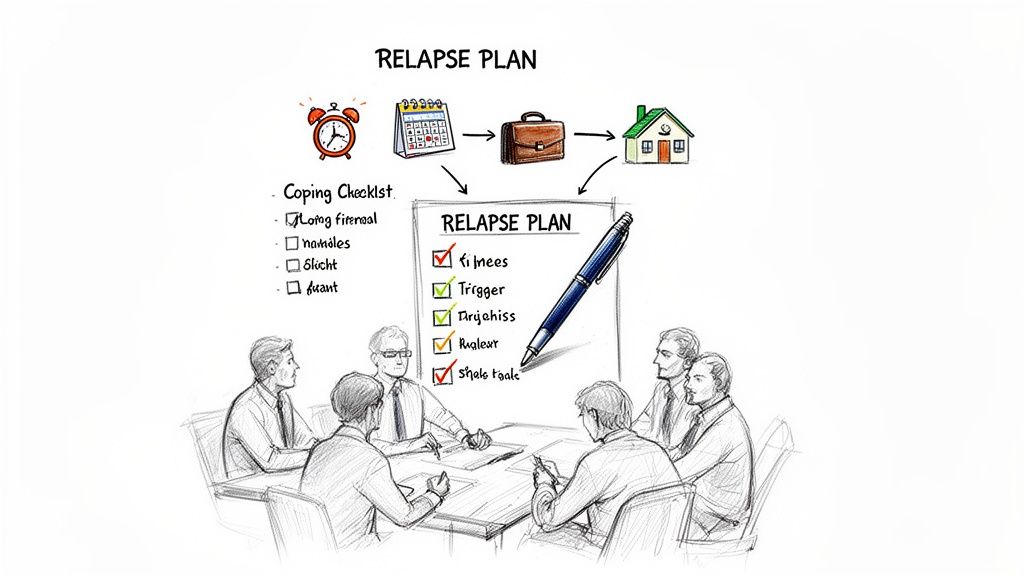
Relapse Prevention Planning (RPP) is a foundational, evidence-based strategy that empowers individuals to take an active role in their recovery. These structured group sessions guide participants in creating a personalized, written roadmap to navigate the challenges of sobriety. By focusing on identifying personal triggers and developing proactive coping strategies, this activity transforms abstract recovery concepts into a concrete, actionable plan.
The group setting enhances this process by fostering a sense of shared experience and mutual support. Hearing others discuss their high-risk situations can help members identify triggers they may not have recognized in themselves. This collaborative environment is a cornerstone of effective relapse prevention activities for groups, making the task feel less isolating and more manageable.
Objectives and Key Benefits
The primary goal of an RPP group is to equip each member with a tangible document they can turn to in times of stress or temptation. This approach is rooted in G. Alan Marlatt's cognitive-behavioral model, which views relapse as a process rather than a single event.
- Increased Self-Awareness: Participants learn to identify their unique internal and external triggers, from emotional states like loneliness to environmental cues like driving past a specific location.
- Proactive Skill-Building: The group works to develop a robust toolkit of coping mechanisms, such as mindfulness exercises, reaching out to a sponsor, or engaging in a healthy hobby.
- Reduced Stigma and Shame: Sharing plans in a group normalizes the challenges of recovery and reinforces that having a plan is a sign of strength, not weakness.
How to Implement This Activity
Facilitating a successful RPP session requires structure and clear guidance. The process involves breaking down the plan into manageable components that the group can work on together over one or more sessions.
Step-by-Step Guide:
- Introduction: Begin by explaining the purpose of a relapse prevention plan, emphasizing it as a proactive tool for empowerment.
- Trigger Identification: Use worksheets or a whiteboard to brainstorm categories of triggers (e.g., social, emotional, environmental). Members then privately list their top 3-5 personal triggers.
- Warning Sign Recognition: Discuss the subtle emotional and behavioral shifts that often precede a relapse, such as isolating, romanticizing past use, or neglecting self-care.
- Coping Strategy Development: For each identified trigger, guide members to list at least two specific, healthy coping strategies.
- Support Network Mapping: Have participants list key support contacts, including names, phone numbers, and when it is appropriate to call them.
- Action Plan Creation: The final step is to assemble all elements into a written plan. Encourage members to keep a copy with them, such as a photo on their phone or a card in their wallet.
2. Cognitive-Behavioral Coping Skills Groups
Cognitive-Behavioral Therapy (CBT) skills groups are a cornerstone of modern addiction treatment, providing participants with evidence-based techniques to challenge and change destructive thought patterns. These groups operate on the principle that our thoughts, feelings, and behaviors are interconnected. By learning to identify and reframe the distorted thinking that fuels substance use, individuals can develop healthier, more effective responses to cravings and life stressors.
This group activity is particularly powerful because it moves beyond simply talking about problems to actively practicing solutions. Participants learn concrete skills, such as how to complete a thought record or engage in behavioral activation, in a supportive environment. The group dynamic allows members to see these principles in action, learn from each other's experiences, and gain confidence in applying these new tools to real-world challenges, making it one of the most effective relapse prevention activities for groups.
Objectives and Key Benefits
The primary goal of a CBT skills group is to empower members to become their own therapists by mastering techniques to manage thoughts and behaviors. The approach, heavily influenced by the work of Aaron Beck, is structured, goal-oriented, and highly effective for co-occurring mental health conditions like anxiety and depression.
- Identify Cognitive Distortions: Participants learn to recognize common errors in thinking, such as "all-or-nothing" thinking or catastrophizing, that can trigger a desire to use.
- Develop Practical Coping Skills: The group focuses on tangible strategies like problem-solving, behavioral experiments, and creating coping statements to manage high-risk situations.
- Improve Emotional Regulation: By changing the thoughts that lead to overwhelming emotions, members gain better control over their feelings and reduce the need for substances as a coping mechanism.
- Enhance Self-Efficacy: Successfully applying CBT skills builds confidence and reinforces the belief that one can handle life's challenges without resorting to substance use.
How to Implement This Activity
A successful CBT skills group requires a structured curriculum that introduces concepts progressively and includes ample time for practice. The facilitator acts as a teacher and coach, guiding the group through exercises and discussions.
Step-by-Step Guide:
- Introduce the CBT Model: Begin by explaining the core concept: the link between thoughts, feelings, and actions. Use a simple, relatable example to illustrate how a thought can trigger an emotion and a subsequent behavior.
- Teach Cognitive Distortions: Dedicate a session to identifying common cognitive distortions. Use worksheets with definitions and examples, then have the group brainstorm personal examples related to their substance use.
- Introduce Thought Records: Distribute and explain how to use a thought record worksheet. Guide the group through a collective example on a whiteboard, then have members practice filling one out based on a recent personal experience.
- Practice Behavioral Activation: Brainstorm a list of healthy, rewarding activities. Encourage members to schedule one or two small, achievable activities before the next session and report back on their experience.
- Develop Coping Statements: Have the group create a shared "library" of positive coping statements tailored to specific triggers (e.g., "This craving will pass" or "I can handle this feeling without using").
- Role-Play Scenarios: Set up role-playing exercises where members can practice using their new CBT skills to navigate a high-risk situation, such as declining a drink at a social event.
3. Peer Support and Accountability Circles
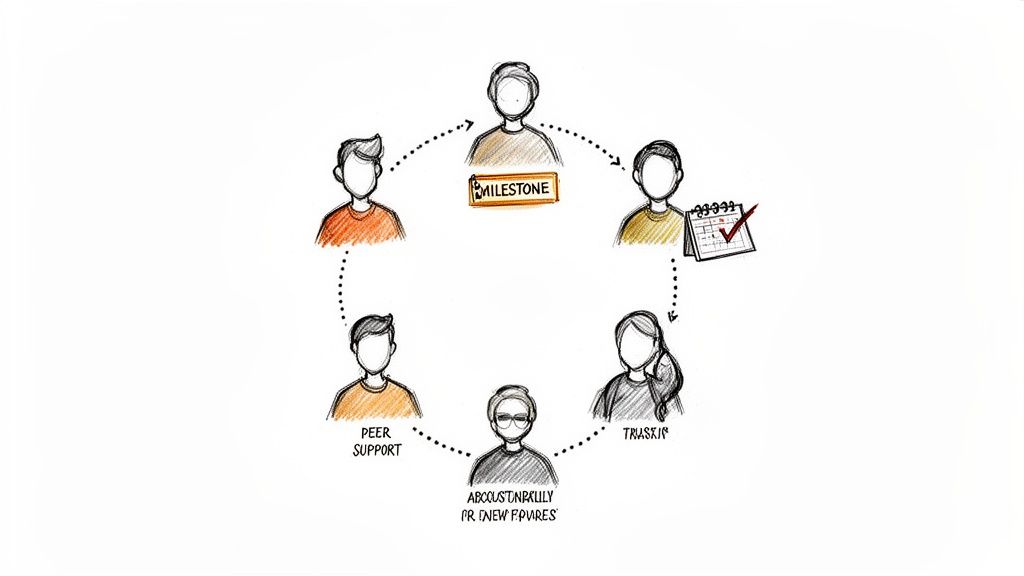
Peer Support and Accountability Circles harness the power of shared experience by creating small, consistent groups dedicated to mutual encouragement and goal-oriented recovery. These circles, typically composed of 6-10 members, meet regularly to check in, share progress, and hold one another accountable in a structured yet compassionate environment. This model directly combats isolation, a common and dangerous relapse trigger, by fostering a strong sense of community and belonging.
The foundation of this activity is the principle that connection with others who have similar lived experiences can be profoundly healing. Unlike clinician-led therapy, these groups are peer-driven, which can reduce feelings of hierarchy and make sharing feel more authentic. Models like the sponsorship system in 12-step programs or the mutual support meetings in SMART Recovery exemplify this powerful approach.
Objectives and Key Benefits
The primary goal of an accountability circle is to create a reliable and safe space where members feel comfortable being vulnerable about their struggles and proud of their successes. This dynamic, pioneered by organizations like Alcoholics Anonymous, leverages peer connection as a primary tool for sustained recovery.
- Enhanced Accountability: Knowing you will report back to a supportive group provides powerful motivation to stick to recovery goals and make healthy choices.
- Reduced Isolation: Regular meetings create a consistent social support system, reminding individuals they are not alone in their journey.
- Development of Pro-Social Skills: Participants practice active listening, giving and receiving constructive feedback, and celebrating others' achievements, which are vital life skills.
How to Implement This Activity
Establishing a successful peer support circle requires clear ground rules and a commitment to creating a safe, non-judgmental atmosphere. A facilitator, at least initially, can help set the tone and structure.
Step-by-Step Guide:
- Establish Group Norms: In the first session, collaboratively create and agree upon group rules, including a strict confidentiality agreement.
- Structure the Check-In: Begin each meeting with a structured check-in where each member shares a recent success, a current challenge, and progress on a specific recovery goal.
- Set SMART Goals: Guide members in setting Specific, Measurable, Achievable, Relevant, and Time-bound (SMART) goals for their recovery.
- Implement Accountability Partnerships: Pair members up to serve as accountability partners who can check in with each other between formal group meetings.
- Rotate Leadership: Once the group is established, consider rotating the facilitator role among members to build confidence and leadership skills.
- Celebrate Milestones: Make a point to acknowledge and celebrate recovery milestones, no matter how small, to reinforce positive behavior and build group morale.
4. High-Risk Situation Scenario Practice Groups
Knowledge of coping skills is one thing; applying them under pressure is another entirely. High-risk situation scenario practice groups bridge this gap by using experiential techniques like role-playing and simulations. This approach moves beyond theoretical discussion, allowing participants to actively rehearse their responses to real-world relapse triggers in a safe, controlled environment.
This method creates "muscle memory" for healthy decision-making. By practicing how to handle social pressure, unexpected conflict, or sudden cravings, individuals build the confidence and automaticity needed to navigate these challenges successfully outside the therapy room. The group setting provides immediate feedback and a variety of perspectives, making it one of the most dynamic relapse prevention activities for groups.
Objectives and Key Benefits
The central goal is to improve a participant's ability to respond effectively in high-stakes moments. This is rooted in behavioral learning theories, where repeated practice strengthens desired behaviors. Instead of freezing or reverting to old habits, members learn to pause, think, and act in line with their recovery goals.
- Builds Real-World Confidence: Successfully navigating a simulated scenario provides a tangible sense of accomplishment and self-efficacy that is difficult to achieve through talk therapy alone.
- Develops Practical Skills: Participants practice specific communication skills, such as saying "no" assertively, setting boundaries with loved ones, or leaving a triggering situation gracefully.
- Reduces Anxiety and Fear: By confronting feared situations in a supportive setting, individuals can desensitize their anxiety response, making the actual event feel less intimidating.
How to Implement This Activity
Effective facilitation is crucial for creating a safe space where participants feel comfortable being vulnerable. The key is to start with low-intensity scenarios and gradually build toward more personalized and challenging ones.
Step-by-Step Guide:
- Introduce the Concept: Explain the purpose of role-playing as a rehearsal for real life. Emphasize that there are no "wrong" answers and the goal is practice, not perfection.
- Establish Ground Rules: Set clear rules for respectful feedback and support. Ensure everyone understands that they can "pass" on participating or "pause" a scenario if it becomes overwhelming.
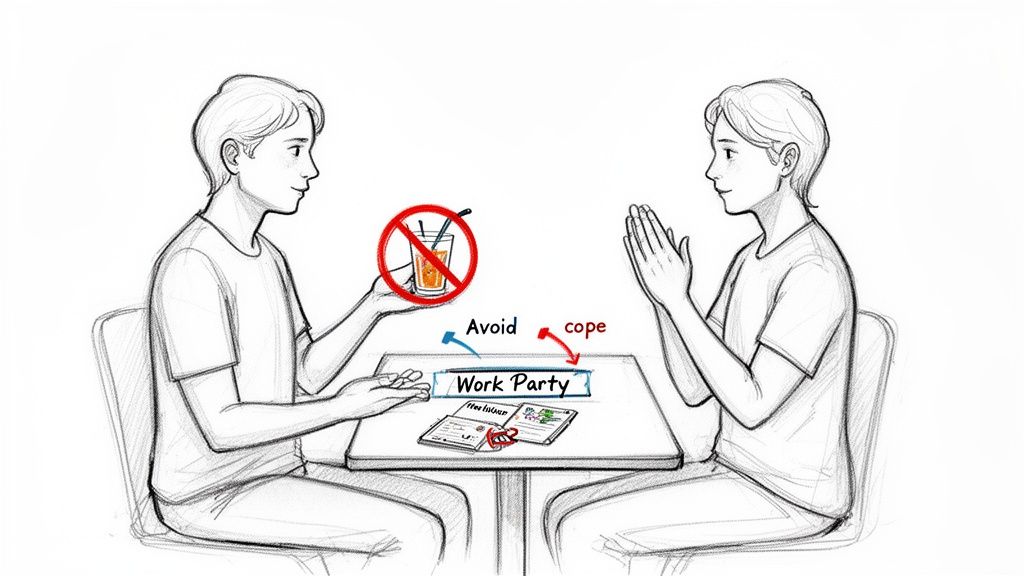
- Present a Scenario: Use pre-written scenario cards for consistency. Start with a common, less personal situation, such as a coworker offering a drink after a stressful day at work.
- Assign Roles: Ask for volunteers to play the different roles in the scenario. At first, facilitators can model responses to demonstrate the process.
- Run the Role-Play: Allow the scene to play out for a few minutes. Encourage the participant to try implementing a coping skill they have learned.
- Debrief and Provide Feedback: After the scene, lead a group discussion. Ask the participant how it felt and invite others to offer supportive, constructive feedback and alternative strategies.
5. Mindfulness and Urge Surfing Groups
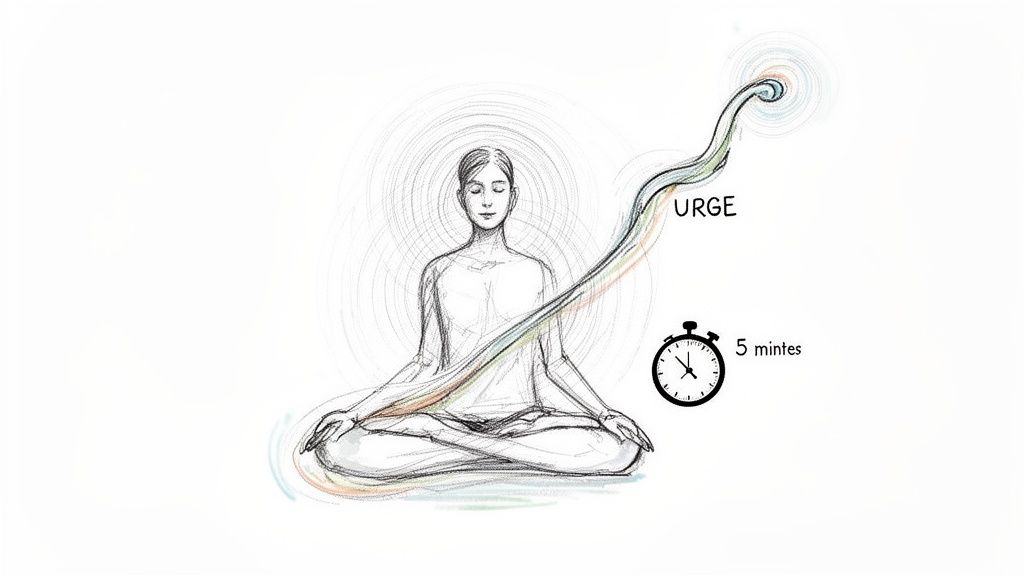
Mindfulness and Urge Surfing groups teach participants to observe cravings and triggers without immediately reacting to them. This approach, rooted in principles from Mindfulness-Based Relapse Prevention (MBRP) and Acceptance and Commitment Therapy (ACT), helps individuals develop a new relationship with their internal experiences. Instead of fighting or suppressing urges, members learn to view them as temporary mental events, like waves that rise and fall.
These group sessions provide a supportive space to practice these skills, which are crucial for long-term recovery. By learning to "ride the wave" of a craving, participants build distress tolerance and metacognitive awareness. This transforms the urge from an overwhelming command into a manageable sensation, making it one of the most empowering relapse prevention activities for groups.
Objectives and Key Benefits
The central goal is to give individuals practical, in-the-moment tools to manage cravings non-judgmentally. Pioneered by figures like Jon Kabat-Zinn and further adapted for addiction by Sarah Bowen, this method focuses on acceptance rather than resistance.
- Increased Distress Tolerance: Participants learn to sit with discomfort, reducing the impulsivity that often drives substance use.
- Decoupling Thought from Action: The practice helps create a crucial pause between feeling an urge and acting on it, allowing for a conscious choice.
- Enhanced Emotional Regulation: Regular mindfulness practice improves the ability to manage difficult emotions like anxiety and anger, which are common relapse triggers.
How to Implement This Activity
A successful mindfulness group requires a calm, safe environment where participants feel comfortable being vulnerable. The facilitator should guide the exercises with a gentle, encouraging tone, emphasizing that there is no "right" or "wrong" way to meditate.
Step-by-Step Guide:
- Introduction: Explain the concept of mindfulness and urge surfing. Use the "riding the wave" metaphor to describe how an urge builds, peaks, and subsides on its own.
- Guided Breathing Exercise: Start with a simple 3-5 minute guided meditation focused on the breath. This helps anchor the group and introduces the core practice.
- Introducing Urge Surfing: Ask participants to recall a mild craving. Guide them to notice the physical sensations, thoughts, and emotions associated with it without judgment.
- Practice Session: Lead a 5-10 minute urge surfing meditation. Instruct members to observe the "wave" of the craving, noting its intensity as it changes over time.
- Group Processing: Facilitate a discussion where members can share their experiences. Normalize any difficulty or discomfort, reinforcing that consistency is more important than perfection.
- Homework: Encourage daily practice and provide resources like guided meditation audio recordings to support them between sessions.
6. Family Systems and Relationship Skills Groups
Recovery does not happen in a vacuum; it is deeply intertwined with our relationships. Family Systems and Relationship Skills Groups address the interpersonal dynamics that can either support or sabotage sobriety. This approach recognizes that unresolved family conflict, poor communication, and unhealthy relationship patterns are significant relapse triggers for many individuals.
These groups provide a safe and structured environment to explore these dynamics. By learning and practicing skills like healthy communication, boundary-setting, and conflict resolution, members can transform their relational environment from a source of stress into a foundation of support. This makes it one of the most impactful relapse prevention activities for groups, as it addresses the root causes of much emotional distress.
Objectives and Key Benefits
The primary objective is to help participants build healthier, more resilient relationships that foster long-term recovery. The group focuses on practical skills rooted in models like Family Systems Theory and Marshall Rosenberg's Nonviolent Communication, moving beyond blame to find actionable solutions.
- Improved Communication: Members learn to express their needs and listen to others without resorting to criticism, defensiveness, or blame.
- Stronger Boundaries: Participants practice setting and maintaining healthy personal boundaries, which is crucial for protecting their recovery and well-being.
- Conflict Resolution Skills: The group provides tools to navigate disagreements constructively, reducing the relationship stress that often leads to substance use.
- Healing Family Systems: By understanding family roles and patterns, members can begin to break generational cycles of dysfunction and build a supportive home environment.
How to Implement This Activity
Facilitating a family and relationship skills group requires creating a space of high emotional safety where members feel comfortable being vulnerable. The focus should be on psychoeducation and skill practice rather than unstructured processing.
Step-by-Step Guide:
- Establish Ground Rules: Begin by co-creating strict rules for respectful communication, confidentiality, and non-judgment. Screen for any active domestic violence situations, which require specialized intervention.
- Introduce Core Concepts: Dedicate initial sessions to teaching fundamental concepts. Use handouts and whiteboards to explain topics like "I-Statements," active listening, and the drama triangle (victim, persecutor, rescuer).
- Skill-Based Role-Playing: Design structured role-play scenarios based on common relational challenges (e.g., saying no to a loved one, responding to criticism). Allow members to practice new communication skills in a controlled setting.
- Boundary Mapping: Guide participants in creating a "boundary map," identifying areas where their boundaries are weak, rigid, or healthy. Discuss specific language to use when setting a boundary.
- Conflict Resolution Practice: Introduce a simple, step-by-step model for resolving conflict. Have pairs practice using the model to work through a hypothetical disagreement.
- Celebrate Progress: Consistently acknowledge and celebrate small improvements members report in their relationships. This reinforces their efforts and maintains motivation for change.
7. Life Skills and Lifestyle Design Groups
Recovery involves more than just abstinence; it requires building a fulfilling life where substance use is no longer the primary source of meaning or coping. Life Skills and Lifestyle Design Groups address this by focusing on the practical, day-to-day abilities needed to create a stable, purposeful, and rewarding lifestyle. This activity directly counters common relapse triggers like boredom, unemployment, financial stress, and lack of routine.
The group setting provides a dynamic space for members to learn from facilitators and each other. Sharing strategies for job hunting, budgeting, or finding healthy hobbies normalizes these challenges and creates a built-in accountability system. As an essential part of relapse prevention activities for groups, this approach shifts the focus from avoiding negatives (use) to building positives (a meaningful life).
Objectives and Key Benefits
The primary goal is to empower individuals with the concrete skills and confidence needed to navigate adulthood and construct a life that naturally supports sobriety. This model is heavily influenced by Supported Employment principles and vocational rehabilitation, which recognize that meaningful activity and structure are critical to long-term recovery.
- Reduces Idle Time and Boredom: Participants learn to structure their days with productive activities, from job searching and education to new hobbies and exercise routines.
- Builds Practical Competence: The group addresses essential life domains like financial literacy, time management, communication skills, and sleep hygiene, increasing self-sufficiency.
- Fosters Purpose and Self-Esteem: Achieving goals like securing a job, creating a budget, or learning a new skill provides a powerful sense of accomplishment and purpose that competes with the lure of substance use.
How to Implement This Activity
A successful Life Skills group is highly practical and action-oriented, translating abstract goals into achievable weekly steps. The facilitator acts as a coach, providing resources, structure, and encouragement.
Step-by-Step Guide:
- Introduction and Goal Setting: Begin by discussing how lifestyle factors can impact recovery. Have each member identify one or two key areas they want to improve (e.g., employment, social life, health).
- Skill-Building Workshops: Dedicate sessions to specific topics. For financial literacy, create sample budgets. For employment, practice mock interviews and resume writing.
- Action Planning: Use worksheets to help members break down large goals into small, weekly action steps with specific deadlines. For example, "apply for three jobs by Friday."
- Resource Sharing: Provide curated lists of local resources, such as job fairs, financial advisors, or community centers. Invite guest speakers like employers or fitness professionals to share expertise.
- Accountability Check-ins: Start each session with a brief check-in where members report their progress on the previous week's action steps, creating a supportive accountability loop.
- Celebrate Milestones: Acknowledge and celebrate every success, no matter how small, such as landing an interview, sticking to a budget for a week, or joining a new social club.
8. Medication Management and Psychoeducation Groups
For individuals with co-occurring mental health conditions or those utilizing medication-assisted treatment (MAT), understanding the role of medication is a critical component of relapse prevention. Psychoeducation groups demystify the science behind addiction and recovery, explaining how brain chemistry, psychiatric conditions, and medications interact. This knowledge empowers members to become active, informed participants in their treatment.
These groups provide a safe, professionally-guided space to discuss medications, side effects, and adherence challenges. By integrating medical knowledge with peer support, this activity addresses both the biological and psychosocial factors that influence relapse risk. Normalizing the use of prescribed medication as a tool for stability makes it one of the most vital relapse prevention activities for groups serving dual-diagnosis clients.
Objectives and Key Benefits
The primary goal is to increase medication literacy and adherence, reducing the risk of relapse triggered by unmanaged psychiatric symptoms or medication misuse. This approach is supported by leading organizations like the National Institute on Drug Abuse (NIDA) and the American Society of Addiction Medicine (ASAM).
- Empowerment Through Knowledge: Participants gain a clear understanding of their diagnoses and how prescribed medications help restore neurological balance and reduce cravings.
- Improved Medication Adherence: The group addresses common barriers to taking medication as prescribed, such as side effects, stigma, or forgetting doses, and brainstorms practical solutions.
- Reduced Stigma: Openly discussing the role of medication in recovery helps dismantle shame and misinformation, reinforcing it as a legitimate and effective part of a comprehensive treatment plan.
How to Implement This Activity
Facilitating a medication group requires a clinician, such as a psychiatric nurse or licensed therapist, who can accurately discuss complex topics in an accessible way. Coordination with prescribing physicians is essential for consistency and accuracy.
Step-by-Step Guide:
- Establish a Safe Space: Begin by setting ground rules, emphasizing that no medical advice should be exchanged between peers and that all specific questions should be directed to the facilitator or one's own doctor.
- Introduce the Topic: Start with a foundational concept, such as "How Addiction Affects Brain Chemistry" or "The Role of Antidepressants in Recovery." Use simple language and visual aids.
- Address Common Myths: Proactively discuss and debunk common misconceptions about MAT (e.g., "trading one drug for another") or psychiatric medications (e.g., "they are a crutch").
- Facilitate Q&A: Allow time for questions. An anonymous question box can encourage members to ask about sensitive topics they may be hesitant to voice publicly.
- Develop Adherence Strategies: Guide the group in brainstorming tools for remembering medication, like phone alarms, pill organizers, or habit stacking (taking pills with a daily meal).
- Provide Resources: Distribute handouts summarizing key information and provide vetted resources for further reading. You can find more addiction topics for groups on alturarecovery.com to build out your curriculum.
Comparison of 8 Group Relapse-Prevention Activities
| Program | 🔄 Implementation complexity | ⚡ Resource requirements | 📊 Expected outcomes | 💡 Ideal use cases | ⭐ Key advantages |
|---|---|---|---|---|---|
| Relapse Prevention Planning (RPP) Groups | Moderate — structured curriculum, facilitator-led | Low–Moderate — facilitator, workbooks, meeting space | Concrete written plans, earlier warning sign detection, increased accountability | Clients needing actionable daily strategies; IOP/SOP integration | Personalized coping plans; peer feedback; cost-effective |
| Cognitive-Behavioral Coping Skills Groups | Moderate–High — requires trained CBT clinicians and structured sessions | Moderate — clinician time, worksheets, homework tracking | Reduced cognitive distortions, improved coping, better dual-diagnosis outcomes | Dual‑diagnosis clients and those able to engage cognitively | Evidence-based, transferable skills; addresses mental health co‑morbidities |
| Peer Support and Accountability Circles | Low — peer-led with simple structure but needs careful formation | Low — minimal materials, modest space; brief facilitator support initially | Increased engagement, reduced isolation, sustained peer support networks | Clients seeking long‑term social support and community connection | Strong social support; scalable; low cost |
| High-Risk Situation Scenario Practice Groups | High — scenario design, skilled facilitation, time‑intensive rehearsal | Moderate — facilitators, prep time, optional recording tools | Improved real‑world responses, increased confidence, habit formation | Clients facing workplace or social triggers; professionals needing rehearsal | Experiential practice builds automatic healthy responses; gap identification |
| Mindfulness and Urge Surfing Groups | Low–Moderate — trained instructor, gradual skill development | Low — quiet space, audio resources, minimal equipment | Improved distress tolerance, reduced craving reactivity over weeks | Clients needing emotional regulation, stress management, trauma‑informed care | Builds metacognitive awareness; complements pharmacotherapy |
| Family Systems and Relationship Skills Groups | Moderate–High — complex dynamics, screening and skilled facilitation required | Moderate — clinician/family involvement, materials, potential screening | Better communication, boundary setting, reduced interpersonal relapse triggers | Clients with relationship-driven relapse risk; family involvement available | Addresses relational triggers; strengthens home support for recovery |
| Life Skills and Lifestyle Design Groups | Low–Moderate — practical curriculum, action-oriented exercises | Moderate — guest speakers, community resources, planning tools | Increased structure, employment readiness, reduced boredom‑related relapse | Young adults, students, working professionals rebuilding routines | Enhances daily functioning and purpose; tangible progress milestones |
| Medication Management and Psychoeducation Groups | Moderate — clinician- or psychiatrist-led, requires up‑to‑date info | Moderate–High — psychiatric staff, educational materials, legal considerations | Improved medication adherence, reduced relapse from untreated symptoms | Clients on medication or with co‑occurring psychiatric conditions | Clarifies neurobiology and meds; improves adherence and integration with care |
Integrating Group Activities for Real Healing and Real Growth
Effective relapse prevention is not a one-size-fits-all formula or a single event. It is a dynamic, ongoing process of building a comprehensive, multi-layered support system tailored to an individual's unique needs. The eight distinct group activities detailed in this article provide a powerful and diverse toolkit designed to address recovery from every critical angle, from cognitive restructuring to practical life skills and interpersonal dynamics. By weaving these approaches together, individuals move beyond simply "not using" and begin to build a fulfilling, resilient life in recovery.
The true strength of these relapse prevention activities for groups lies in their synergistic potential. A person might use the structured framework of a Relapse Prevention Planning (RPP) Group to identify their personal triggers and then practice navigating them in the safe, simulated environment of a High-Risk Situation Scenario Practice Group. The coping mechanisms learned in a Cognitive-Behavioral Coping Skills Group become more deeply ingrained when reinforced by the shared experiences and accountability found in Peer Support Circles. This integration transforms abstract knowledge into tangible, real-world competence.
Key Takeaways for Sustainable Recovery
To truly harness the power of these group activities, it's essential to remember a few core principles. First, consistency is paramount. Recovery is a practice, not a destination. Regular attendance and active participation build momentum and reinforce new, healthy neural pathways. Second, vulnerability fosters connection. The group setting is most effective when members feel safe enough to share their struggles and successes honestly. This shared humanity is the bedrock of peer support and dismantles the isolation that so often fuels addiction.
Finally, personalization is key. No single group will be the perfect fit for everyone at every stage of their journey. An effective recovery plan often involves participating in several types of groups simultaneously or sequentially. For instance, an individual might focus on Mindfulness and Urge Surfing in early recovery to manage intense cravings, while later transitioning to Family Systems and Relationship Skills Groups to repair damaged connections and build a healthier support network. The goal is to create a customized "recovery curriculum" that addresses your specific challenges and goals.
Actionable Next Steps: Putting Knowledge into Practice
Understanding these group modalities is the first step; actively engaging with them is what creates lasting change. Here are some actionable steps you can take today:
- Self-Assess Your Needs: Review the eight group types discussed. Which ones resonate most with your current challenges? Are you struggling with negative thought patterns (CBT Group), difficult family dynamics (Family Systems Group), or a need for practical daily structure (Life Skills Group)? Identify your top two or three priorities.
- Research Local and Virtual Options: Seek out treatment centers, community organizations, or therapy practices that offer these specific types of groups. Look for facilitators with experience and proper credentials. For those who facilitate or aspire to lead these sessions, enhancing your capabilities through professional development can be profoundly impactful. An accredited online certificate in mental health provides a structured pathway to gain the expertise needed to guide participants effectively and ethically.
- Commit to Participation: Once you find a suitable group, commit to attending for a set period, for example, six to eight sessions. This gives you enough time to build rapport, understand the process, and begin seeing tangible benefits. True growth in recovery is a marathon, not a sprint.
By embracing the collaborative and multifaceted nature of these relapse prevention activities for groups, you are not just avoiding a return to substance use; you are actively constructing a more conscious, connected, and meaningful life. This journey is about reclaiming your power, rebuilding trust in yourself, and discovering a future defined by hope and resilience, not by past struggles.
Ready to build a recovery plan that integrates these powerful group strategies? At Altura Recovery, we specialize in providing comprehensive, evidence-based outpatient programs that utilize a variety of relapse prevention activities for groups to support your unique journey. Contact our compassionate team today to learn how our tailored IOP and SOP programs in Houston can help you achieve lasting freedom and growth.