An Intensive Outpatient Program (IOP) is a structured treatment option that gives you more support than standard weekly therapy but lets you keep living at home. Think of it as a middle ground—it delivers consistent, meaningful care without forcing you to press pause on your entire life for a residential program.
Understanding What an IOP Is and If It Is Right for You
When you search for "IOP programs near me," you're looking for a specific level of care designed to balance structured recovery with your real-world responsibilities. It’s a significant step up from a once-a-week therapy session. An IOP typically requires a commitment of 9 to 15 hours per week, usually spread across three or four days.
This model is built for people who need substantial support but already have a safe and stable home life. It’s a perfect step-down for someone leaving residential treatment or a necessary step-up for anyone realizing that weekly therapy just isn't cutting it anymore.
Who Benefits Most From an IOP
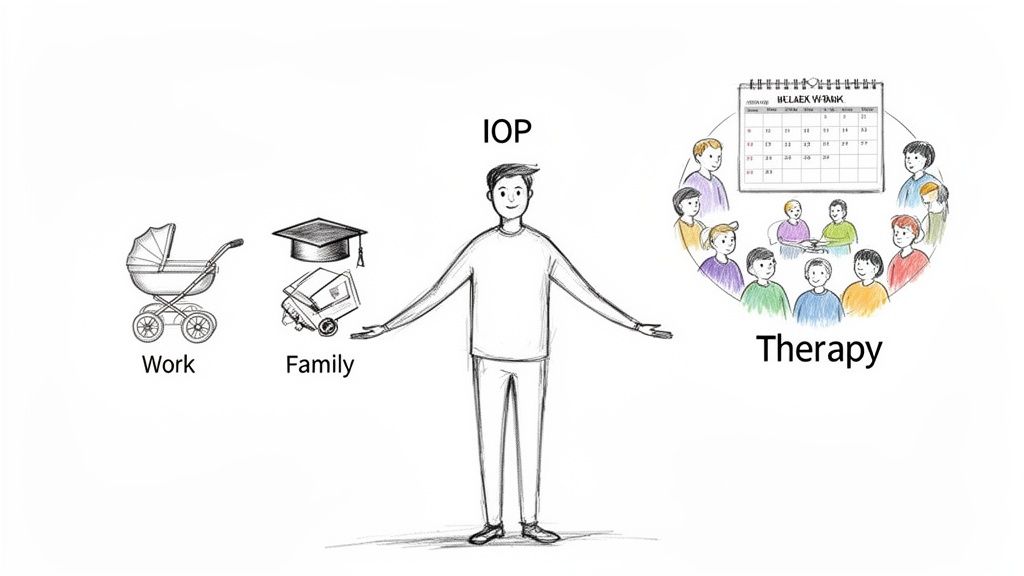
An IOP is designed for real life. Its flexibility makes it a practical solution for people whose circumstances make residential care impossible or unnecessary.
Here are a few common scenarios where an IOP is a perfect fit:
- The Working Professional: A project manager struggling with alcohol can attend evening sessions three times a week, getting the help they need without jeopardizing their job or career.
- The University Student: A college student overwhelmed by anxiety can join a program with telehealth options, fitting therapy into their schedule between classes without having to drop out for a semester.
- The Parent with Young Children: A stay-at-home parent can join a daytime IOP, scheduling their recovery work while the kids are at school and keeping family life stable.
At its core, an IOP is designed to integrate healing into your daily life, not remove you from it. The goal is to build coping skills and resilience that you can apply immediately at home, work, or school.
This chart helps visualize where IOPs fit within the broader spectrum of mental health and addiction care.
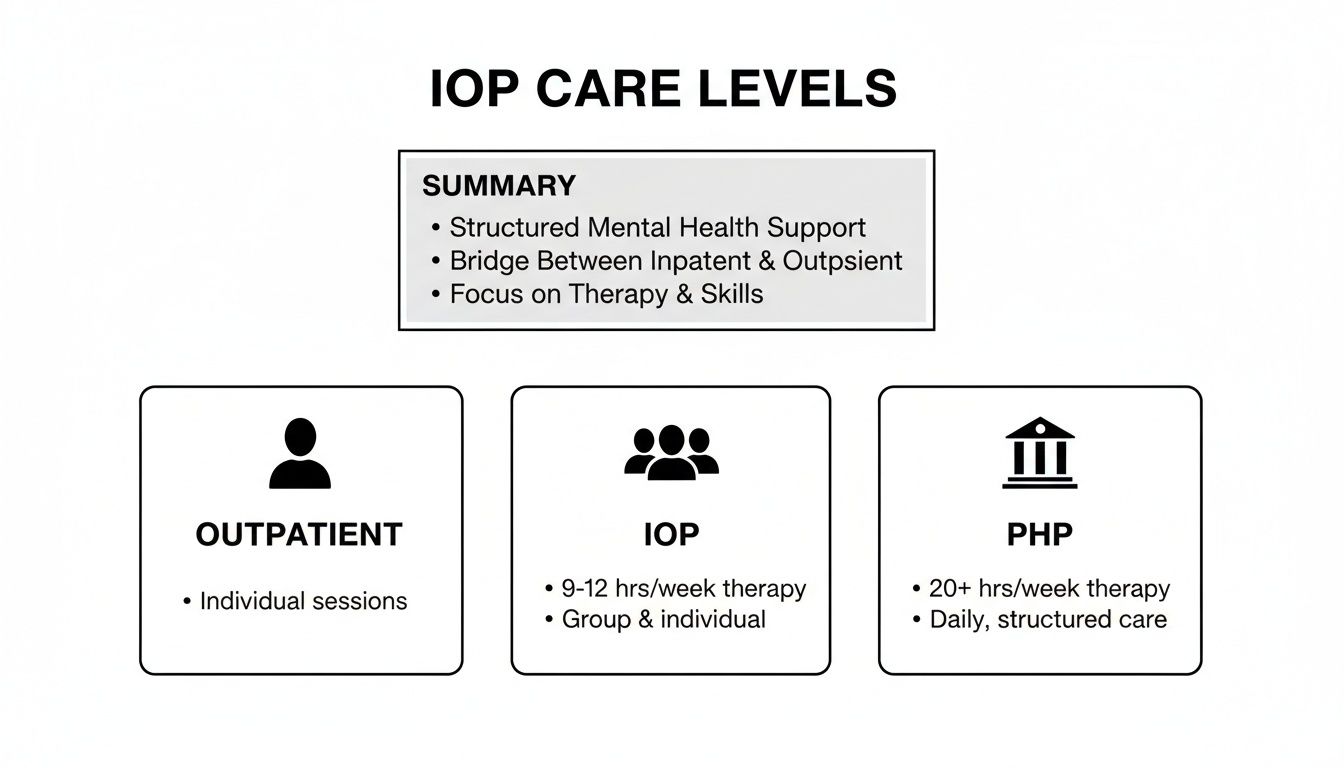
As you can see, an IOP serves as a critical intermediate step. It offers far more structure than standard outpatient therapy but provides more freedom and real-world integration than a Partial Hospitalization Program (PHP).
To make the differences clearer, this table breaks down how each level of care compares.
Comparing Levels of Care: IOP vs. PHP vs. Outpatient
| Level of Care | Weekly Time Commitment | Primary Focus | Best For |
|---|---|---|---|
| Outpatient | 1-3 hours | Maintaining stability and managing specific issues. | Individuals with strong coping skills and a supportive environment. |
| IOP | 9-15 hours | Building foundational recovery skills and coping strategies. | Individuals needing more structure than weekly therapy but who can manage daily responsibilities. |
| PHP | 20-30 hours | Medical stabilization and intensive skill-building. | Individuals stepping down from inpatient care or at risk of needing hospitalization. |
Choosing the right level ensures you get the support you need without disrupting your life more than necessary.
The Critical Role of Group Therapy
Group therapy is the backbone of nearly every IOP. These aren't just informal support meetings; they are clinician-led sessions focused on building specific skills and exploring core recovery topics. The real power of group work is in the shared experience—it shatters the isolation that so often comes with addiction and mental health struggles.
In these sessions, you learn from others, practice new communication skills in a safe space, and start building a sober support network. Discussing different addiction topics for groups helps you see your own challenges from new angles, which builds both empathy and accountability. For many people, this sense of community becomes one of the most powerful parts of their recovery.
The rise of IOPs signals a major shift in how we approach treatment. These programs have gone from a niche option to a mainstream pathway for care. In fact, outpatient centers now account for over 55.5% of the entire mental health and addiction treatment market in the U.S., making them the dominant setting for care. As noted by industry analysts at Grand View Research, it's because they effectively blend structured, evidence-based therapy with the practical need to maintain a daily life.
How to Start Your Search for Local IOPs
Taking the first step to find an "IOP program near me" can feel massive, but you don't have to figure it all out at once. Breaking the search down into a few manageable actions makes the whole process feel much clearer and less overwhelming.
While a quick Google search is a decent start, a more strategic approach will give you a much better list of potential programs that genuinely fit your life and your needs. Think of it like building a foundation for your recovery—the stronger and more careful your initial research is, the more stable your outcome will be.
The goal here isn't just to find any program. It's to find the right one. That means looking beyond the first page of search results and digging into specialized resources that let you filter options by clinical needs, insurance, and treatment philosophy.
Broaden Your Search Terms
Going beyond the basic search query is the easiest way to uncover more specialized options. Different facilities use different language to describe their services, so mixing up your keywords can reveal programs you might have missed otherwise.
Try getting more specific with phrases that match your situation:
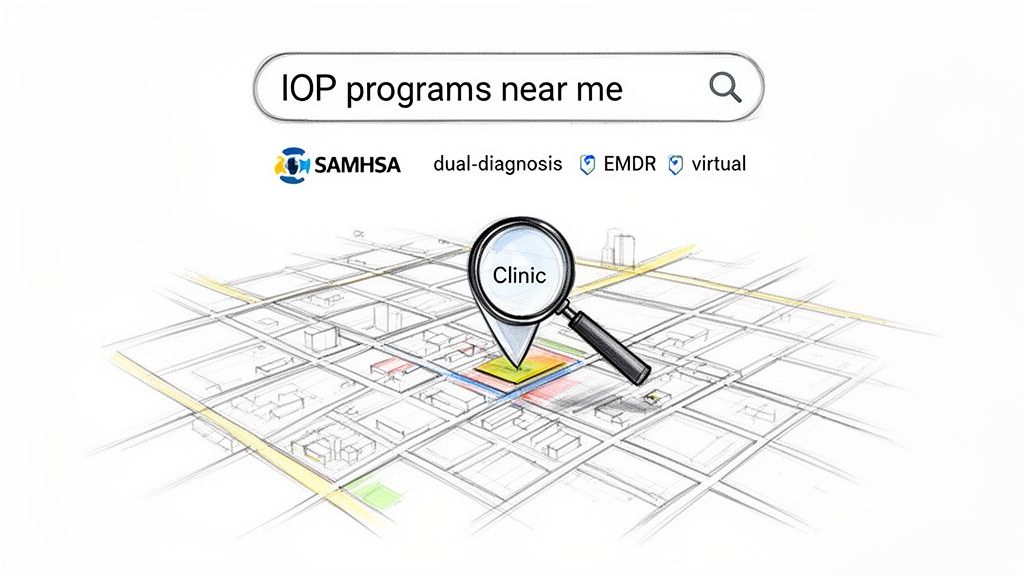
- "Dual diagnosis IOP near me" if you're dealing with both a substance use disorder and a mental health condition like anxiety or depression.
- "Trauma-informed IOP for adults" to find programs that specialize in addressing underlying trauma as a core part of the recovery process.
- "Evening IOP for working professionals" if your schedule demands treatment outside of standard business hours.
- "Virtual IOP program Texas" for anyone needing the flexibility of telehealth services within the state.
These targeted searches immediately narrow the field to programs that are a better potential fit, saving you a ton of time and energy down the road.
Use Trusted Professional Directories
A standard search engine is useful, but professional directories and government-sponsored locators offer a more curated and reliable list of options. These resources are designed for exactly this purpose and often provide detailed information that a simple business listing just won't have.
One of the most valuable tools out there is the Substance Abuse and Mental Health Services Administration (SAMHSA) treatment locator. This national database is the gold standard for finding licensed and accredited facilities.
The SAMHSA National Helpline, 1-800-662-HELP (4357), and its online Behavioral Health Treatment Services Locator are confidential, free, and available 24/7. They can provide referrals to local treatment facilities, support groups, and community-based organizations.
Other great resources include directories from organizations like Psychology Today or the National Association of Addiction Treatment Providers (NAATP). These platforms let you filter results by insurance, specialty, and therapeutic approach, giving you a powerful tool for creating a shortlist of high-quality IOP programs near me.
Tap Into Your Existing Support Network
Sometimes, the best referrals come from professionals who already know your health history. Your existing network can provide trusted recommendations, helping you bypass the uncertainty of a cold online search.
- Your Primary Care Physician (PCP): Your doctor is often an excellent starting point for referrals to reputable local behavioral health providers.
- Your Current Therapist or Psychiatrist: If you're already seeing a mental health professional, they will almost certainly have a network of trusted colleagues and programs they can recommend.
- Employee Assistance Programs (EAPs): Many employers offer EAPs that provide confidential assessments and referrals for mental health and substance use issues. It's a free and private resource that can connect you directly with vetted local IOPs.
By combining smart online research with professional referrals, you create a much stronger search strategy. This approach helps ensure you're building a list of potential programs that aren't just conveniently located, but are also clinically sound and aligned with your specific recovery needs. This initial legwork sets the stage for the next crucial phase: vetting each option to find your perfect fit.
Vetting and Verifying Potential IOP Programs
Once you’ve built a solid list of potential IOP programs, the real work begins. Now, it’s time to dig deeper to separate the high-quality, clinically sound options from the ones that just have good marketing. This vetting process is your most important tool for ensuring you choose a program that offers real, effective care.
Think of it like hiring a specialist—you wouldn’t choose one based on a flashy advertisement alone. You’d check their credentials, their methods, and their track record. The same diligence is essential when choosing a treatment center.
Your first step is to confirm that a program is legitimate and held to a high professional standard. This is non-negotiable.
Confirm Licensing and Accreditation
Every reputable IOP must be licensed by the state to provide behavioral health services. This is the absolute baseline for safety and quality. A program’s license should be easy to find on its website or available the moment you ask. If you can’t find it, that’s a huge red flag.
Beyond state licensing, look for accreditations from independent, nationally recognized organizations. These bodies conduct rigorous on-site surveys to ensure a facility meets the highest standards of care.
The two most respected accrediting bodies are:
- The Joint Commission: Often associated with hospitals, their Gold Seal of Approval signifies a deep commitment to quality and patient safety in behavioral health.
- CARF International (Commission on Accreditation of Rehabilitation Facilities): CARF accreditation shows that a provider is dedicated to continuous improvement and delivering person-centered services.
Accreditation isn’t just a fancy badge. It’s proof that a program has voluntarily undergone a demanding review process to prove its excellence and a powerful indicator of a facility’s commitment to providing effective treatment.
Scrutinize the Program's Website and Philosophy
A program’s website is its digital front door, and it can tell you a lot about its approach. Look past the stock photos and testimonials to analyze the actual language they use. High-pressure sales tactics, vague promises of a "cure," or guarantees of success are major warning signs.
Quality programs speak in terms of evidence-based care, skill-building, and long-term recovery management. They’re transparent about their methods and what clients can realistically expect. As you start looking at local IOPs, you might also consider if their clinical approach fits your specific needs. For example, some people benefit from researching topics like finding neurodiversity-affirming therapists to see if a program’s team has that specialized training.
A program's philosophy should feel empowering, not predatory. The focus should be on providing you with the tools for sustainable recovery, not on selling you a quick fix.
This philosophy is reflected in the actual therapies they offer, which brings us to the clinical core of any good program.
Insist on Evidence-Based Treatments
The most effective IOPs build their programs around evidence-based treatments—therapeutic methods that have been scientifically studied and proven to work. Vague terms like "holistic wellness" are fine as supplements, but they should never be the core of the clinical program.
You want to see specific, proven modalities like:
- Cognitive Behavioral Therapy (CBT): Helps you identify and change destructive thinking patterns and behaviors.
- Dialectical Behavior Therapy (DBT): Focuses on building critical skills in mindfulness, distress tolerance, emotion regulation, and interpersonal effectiveness.
- Eye Movement Desensitization and Reprocessing (EMDR): A specialized therapy designed to help people heal from trauma and other distressing life experiences.
These therapies form the clinical foundation of a strong IOP. If a program can't clearly articulate its therapeutic model, it likely isn't equipped to provide the structured care you need.
This commitment to structured, outpatient care is why IOPs have become such a vital part of the recovery landscape. For individuals comparing IOP programs near me to residential options, real-world data highlights their importance. In U.S. rehab statistics, intensive outpatient programs accounted for 13% of post-discharge treatment types, placing them ahead of both short-term residential (9%) and long-term residential (6%) placements. You can explore more data about these rehab statistics from Addiction Help to understand the trends better. This shows that IOPs are not just an alternative but a preferred pathway for many seeking sustainable recovery.
What to Ask on Your First Call to an IOP
Making that first phone call is often the hardest part. It’s a huge step, and feeling a mix of hope and anxiety is completely normal. But remember, this call is more than just gathering information—it’s your first real chance to get a feel for the program’s culture and see if it truly fits.
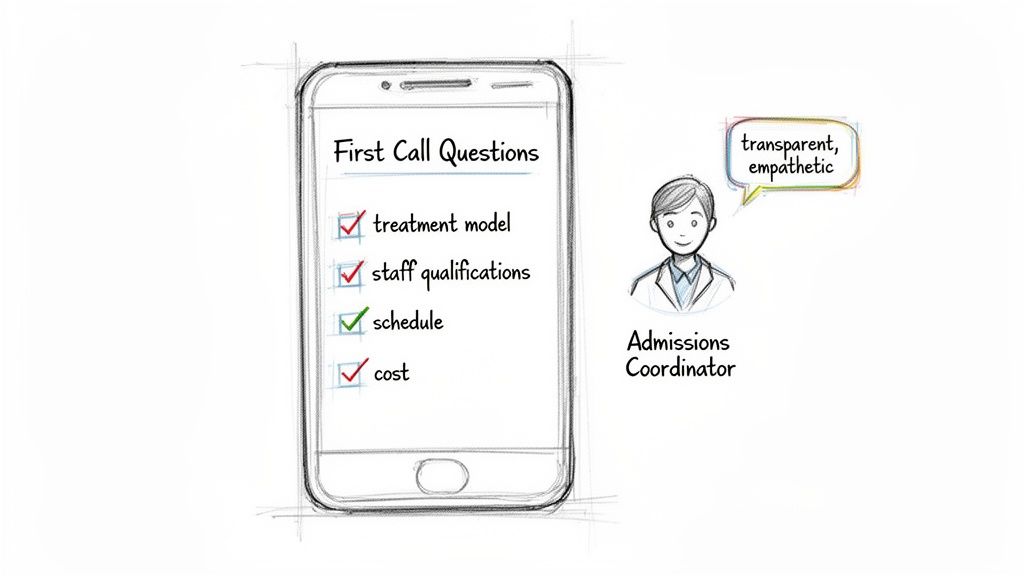
The person on the other end, usually an admissions coordinator, should be empathetic, knowledgeable, and transparent. Your goal here is to get past the marketing language on the website and understand what the day-to-day reality of the program looks like. Having a few key questions ready empowers you to lead the conversation and get the clear answers you deserve.
Think of it like an interview where you’re the one doing the hiring. You're looking for a partner in your recovery, so it’s critical to find a team that aligns with your needs, values, and real-life schedule.
Digging into the Treatment Model and Philosophy
First things first: you need to understand the program's clinical foundation. A great IOP is built on more than good intentions; it uses proven therapeutic methods. If you get vague answers here, that's a major red flag.
Ask them to get specific about how they help people heal.
- "What specific evidence-based therapies do you use?" Listen for terms like Cognitive Behavioral Therapy (CBT), Dialectical Behavior Therapy (DBT), or EMDR. If they can’t name their core treatment methods, be cautious.
- "Can you walk me through a typical week in the program?" This helps you picture the experience. How many hours are dedicated to group therapy versus individual counseling? Do they offer family sessions or educational workshops?
- "How do you create personalized treatment plans?" Your recovery journey is unique. The program should have a clear process for assessing your specific needs and tailoring the treatment plan to match.
A quality program will never offer a one-size-fits-all solution. They should be able to clearly explain how they adapt their services to meet individual client goals, whether that involves dual diagnosis care, trauma work, or specific life skills training.
The answers you get will reveal whether their clinical approach is solid and if their philosophy is genuinely client-centered. It’s all about making sure their methods are a good match for your needs as you search for an effective IOP program near me.
Getting a Feel for the Staff and Culture
The people you’ll be working with are just as important as the therapeutic models they use. The qualifications, experience, and even the size of the clinical team can make or break your experience.
You need to know you'll be supported by qualified professionals in a safe, healing environment.
- "What are the credentials of your clinical staff?" Therapists should be licensed professionals, such as LPCs (Licensed Professional Counselors) or LCSWs (Licensed Clinical Social Workers).
- "What's the staff-to-client ratio in your group therapy sessions?" Smaller groups, typically under 12-15 clients, allow for more personal attention and create a safer, more productive therapeutic space.
- "How do you support clients with co-occurring disorders?" If you're dealing with both substance use and a mental health condition like depression or anxiety, the program must have an integrated approach. Ask if they have a psychiatrist on staff for medication management.
A program’s culture is often a direct reflection of its staff. Pay attention to their tone. Are they compassionate, respectful, and professional? An admissions coordinator who is patient and willing to answer every single question is a great sign of a supportive internal culture.
To make this easier, we've put the most important questions into a checklist you can use during your call.
Admissions Call Checklist: Critical Questions to Ask
This quick-reference table breaks down the essential questions to ask an IOP admissions team, helping you cover all your bases—from clinical methods to insurance details.
| Category | Question to Ask | What to Look For in the Answer |
|---|---|---|
| Treatment Approach | What specific evidence-based therapies do you use (e.g., CBT, DBT)? | Clear, confident answers naming specific, proven therapies. Vague responses are a red flag. |
| Personalization | How is my treatment plan personalized to my unique situation? | A detailed process for assessment, goal-setting, and adapting the plan as you progress. |
| Dual Diagnosis | How do you treat co-occurring disorders like anxiety or depression? | An integrated approach, with mental health professionals and psychiatry services available on-site. |
| Staff Credentials | What are the licenses and qualifications of your clinical staff? | Licensed therapists (LPC, LCSW) and ideally, staff certified in addiction counseling (CADC). |
| Group Size | What is the average staff-to-client ratio in group sessions? | Smaller is better. Look for ratios that allow for individual attention, ideally under 15 clients per group. |
| Logistics | What are the exact days and times for your day and evening programs? | Specific, concrete schedules that you can compare against your work and family commitments. |
| Insurance & Cost | Can you verify my insurance and explain my out-of-pocket costs? | A commitment to provide a full, transparent breakdown of costs before you commit. |
| Flexibility | How do you handle occasional absences for emergencies? Do you offer telehealth? | A practical, understanding policy that acknowledges real-world responsibilities. |
Having this list handy ensures you won’t forget a critical detail in the moment. Remember, you’re gathering facts to make an informed decision about your health.
Sorting Out Logistics and Scheduling
Let's be real: practical considerations are everything. A program can be clinically perfect, but if it doesn't work with your life, it's not the right program for you. This is where you confirm that the IOP can realistically fit into your day-to-day world.
Here are the key logistical details to nail down:
- Program Schedule: "What are the exact days and times for the day and evening programs?"
- Flexibility: "How do you handle occasional absences for work or family emergencies?"
- Telehealth Options: "Do you offer a virtual or hybrid IOP option?"
- Program Duration: "What is the average length of stay for a client in your IOP?"
A program designed for working adults and parents should offer practical flexibility. As of January 1, 2024, Medicare began covering IOP services, a major step that signals the growing recognition of this treatment model's importance. This increased accessibility makes it even more vital to find a program that truly fits your life.
The goal is to integrate treatment into your routine, not have it completely take over. Transparent answers about scheduling show a program understands and respects your real-world responsibilities.
Navigating Insurance and Payment for Treatment
Let's be honest: thinking about the cost of treatment can feel overwhelming. But financial concerns should never be the reason you or a loved one puts off getting help. The good news is that most health insurance plans cover Intensive Outpatient Programs, but figuring out the specifics can feel like learning a new language.
Taking a few proactive steps can demystify the process and give you a clear picture of your costs upfront.
Your first move should be a call to your insurance provider. While the admissions team at your chosen IOP can often handle this for you, it’s empowering to understand your own benefits. Get your insurance card ready and be prepared to ask a few direct questions.
Understanding Your Insurance Benefits
When you get an insurance representative on the phone, you’ll want to get clear on a few key terms. These numbers are what determine your actual out-of-pocket costs for treatment.
- Deductible: This is the amount you have to pay for covered services before your insurance plan starts chipping in. If your deductible is $1,000, you’ll pay the first $1,000 of covered services yourself.
- Copay: This is a fixed amount you pay for a specific service after you've met your deductible. For instance, you might have a $50 copay for each day you attend the IOP.
- Out-of-Pocket Maximum: This is the absolute most you'll have to pay for covered services in a plan year. Once you hit this amount through deductibles and copays, your health plan pays 100% of the costs for covered benefits.
Knowing these three figures is essential for budgeting. Don't be shy—ask the representative directly: "What is my remaining deductible, and what will my copay be for intensive outpatient services?"
What to Do If Coverage Is Denied
Sometimes, an initial request for coverage gets denied. This is frustrating, but it is not the end of the road. Insurers have formal appeal processes, and many denials are successfully overturned with persistence.
If your coverage for an IOP is denied, knowing how to appeal a health insurance denial is a critical next step. The key is to not give up.
Don’t let insurance jargon intimidate you. Your only job is to ask questions until you feel confident you understand your costs. A quality IOP admissions team will help you with this verification process every step of the way.
The demand for accessible care like IOPs is growing. The global substance abuse treatment market is a massive part of the healthcare industry, estimated to be between USD 11.82–15.61 billion. North America holds about 43.7% of this market, largely due to strong insurance participation and a dense network of outpatient providers.
Exploring Other Payment Options
What if you’re uninsured, underinsured, or facing high out-of-pocket costs? You still have options. Many high-quality IOP programs near me are committed to making treatment accessible and offer other financial solutions.
- Sliding Scale Fees: Some programs adjust their fees based on your income, making the cost more manageable.
- Healthcare Financing: Specialized companies offer loans and payment plans specifically for healthcare expenses, allowing you to pay over time.
- Scholarships or Grants: Some nonprofit facilities may have access to funds that can help offset the cost of care for those who qualify.
Always ask the admissions coordinator what financial assistance options are available. The right program wants to see you succeed and will work with you to find a path forward that doesn't add to your stress.
Why Altura Recovery Is a Leading Houston IOP
When you're searching for an "IOP program near me" here in Houston, you need more than just a provider. You need a partner that gets the local community and is committed to delivering exceptional, evidence-based care. That's where Altura Recovery stands out.
We’ve built our program to embody all the qualities of a top-tier IOP. We are fully licensed by the state and unwavering in our commitment to clinical excellence.
Our treatment plans are grounded in proven therapies that get results, like Cognitive Behavioral Therapy (CBT) and Eye Movement Desensitization and Reprocessing (EMDR). But we don't just treat addiction in a vacuum. We provide specialized, integrated care for co-occurring mental health disorders, making sure you get to the root causes of the challenges you're facing.
Designed for Your Real Life
We get it—recovery has to fit into your world, not the other way around. Life doesn’t stop for treatment, which is why we've designed our scheduling options around real-world responsibilities.
- Day and Evening Programs: You can attend treatment without having to sacrifice your job or step away from your family duties.
- Virtual IOP Sessions: Can't make it in person? Our secure telehealth platform lets you access the same high-quality care from the comfort of home.
At Altura Recovery, we are more than a treatment provider—we are a dedicated partner in your long-term wellness. Our goal is to make sustainable recovery accessible to every Houstonian who needs it.
Our team blends deep clinical expertise with invaluable lived experience. We've been there, and we're here to help you take that next, crucial step forward.
Common Questions About IOPs
It’s completely normal to have questions when you’re considering an intensive outpatient program. Getting clear, direct answers helps cut through the confusion and empowers you to make the best possible decision for your health. Let's tackle some of the most common concerns people have when they start looking for "IOP programs near me."
How Long Does a Typical IOP Program Last?
The length of an IOP isn’t one-size-fits-all; it’s designed to flex with your personal progress and clinical needs. That said, most programs generally run between 8 to 12 weeks.
Some people might hit their initial goals more quickly, while others find that a longer period of structured support gives them a much stronger foundation for lasting recovery. A quality program won't just discharge you when the time is up. They'll be assessing your progress the entire way and working with you on a clear "step-down" plan for when you're ready for a less intensive level of care.
Will My Employer Find Out I Am Attending an IOP?
Your privacy is paramount, and it’s protected by strict federal laws like HIPAA. A treatment facility cannot share any information about your attendance or what happens in your sessions without your explicit, written permission.
If you need to arrange time away from work, you might be eligible for the Family and Medical Leave Act (FMLA), which protects your job. You are not required to tell your employer the specific medical reason for your leave. Many IOPs, recognizing this need, offer evening or virtual sessions designed specifically to help clients maintain their professional lives with total discretion.
Your health information is confidential. The decision to share any details about your treatment with your employer, family, or friends is entirely yours to make.
What Is the Difference Between Individual and Group Therapy?
Both individual and group therapy are the backbone of a strong IOP, but they play very different—and equally important—roles in your recovery.
- Individual Therapy: This is your one-on-one time with a dedicated therapist. It’s a completely private space to dig into deeply personal issues, process specific traumas, and zero in on your unique treatment goals without any distractions.
- Group Therapy: Led by a licensed clinician, these sessions bring together a small handful of peers. The power of group therapy is hard to overstate. It’s where you realize you aren’t alone, develop new communication skills, and gain invaluable perspective from the shared experiences of others in a safe, structured setting.
Most IOPs integrate both because they work together so well. The one-on-one sessions provide the depth, while group work builds the community and perspective essential for a robust recovery. You can learn more about this in our article on how to build a support system.
At Altura Recovery, we know these questions are just the beginning. Our team is here to give you straightforward answers and guide you through every part of the process. If you’re in Houston and ready to start healing, contact us today.