
Of course. Most health plans today do provide insurance coverage for addiction treatment. Thanks to a couple of landmark federal laws, substance use disorder is now treated as an essential health benefit. This means your insurance company is required to cover it much like it would any other medical condition, such as diabetes or heart disease.
Decoding Your Insurance Plan for Addiction Treatment
Trying to make sense of an insurance plan while you're also trying to find help can feel completely overwhelming. It’s like being handed a map in a foreign language when all you want is the quickest route to safety. The good news? The path to getting treatment covered is clearer than you think, and it's legally protected.
Two key pieces of legislation really form the bedrock of your right to care. Think of them as your advocates working behind the scenes:
- The Mental Health Parity and Addiction Equity Act (MHPAEA): This law is a big one. It ensures that insurance coverage for mental health and substance use disorders can't be more restrictive than the coverage for other medical or surgical care.
- The Affordable Care Act (ACA): This act built on the foundation of MHPAEA, officially classifying addiction treatment as one of the ten essential health benefits that most health insurance plans are required to cover.
These regulations completely shifted the landscape. Over the past couple of decades, insurance coverage for addiction treatment has expanded significantly, especially in the United States. The ACA’s mandate that substance use disorder (SUD) treatment be covered in most health plans dramatically increased access to everything from detox to outpatient counseling.
This legal framework means your insurer can't just place unfair limits on your care because it’s for addiction. You have a right to access the treatment you need. Understanding these protections is the first step toward using your benefits with confidence. If you want to get a better sense of your provider's reliability, it's also helpful to learn about understanding insurance company ratings.
The core principle is simple: treating addiction is treating a medical condition. Your insurance plan is legally obligated to reflect that reality, giving you a solid foundation to begin your recovery journey.
Knowing this empowers you to ask the right questions and advocate for the level of care you deserve. For a clearer picture of the different kinds of help available, take a look at our guide on what rehab programs involve.
What Types of Treatment Your Insurance May Cover
Once you’ve confirmed your insurance policy has addiction treatment benefits, the next question is simple: what does it actually pay for? Addiction treatment isn’t a single event. It’s a journey through different levels of support, kind of like moving from the ICU to physical therapy after a major surgery. Your insurance plan is designed to cover this spectrum of services, matching the right type of care to each stage of your recovery.
Think of it as a continuum. The process usually starts with the most intensive level of care and then gradually steps down as you build the strength and skills for independent recovery. Most insurance plans are built to recognize and cover each of these critical phases.
From Intensive Care to Ongoing Support
For many, the journey kicks off with medical detoxification. This is the process of safely managing withdrawal symptoms under the eye of a medical team. Because withdrawal from substances like alcohol or benzodiazepines can be dangerous, insurance companies almost always cover detox when a doctor deems it a medical necessity. It’s the essential first step—stabilizing your body so the real psychological healing can begin.
After detox, you’ll likely move into a more structured therapeutic setting. Here are the most common levels of care your insurance may cover:
- Inpatient or Residential Treatment: This is the highest level of care, where you live at the facility 24/7. It’s like a focused retreat dedicated entirely to your recovery, pulling you away from daily triggers and immersing you in a supportive community.
- Partial Hospitalization Program (PHP): A step down from residential, a PHP involves treatment for several hours a day, five to seven days a week. You get the intensity of a hospital-level program but return home or to a sober living environment at night.
- Intensive Outpatient Program (IOP): An IOP offers a robust, structured treatment schedule but with fewer hours than a PHP—typically a few hours a day, three to five days a week. This level is designed to fit around work, school, or family life.
The visual below shows how different insurance plan types—like HMOs, PPOs, and EPOs—are structured to provide coverage for essential medical services, including addiction treatment.
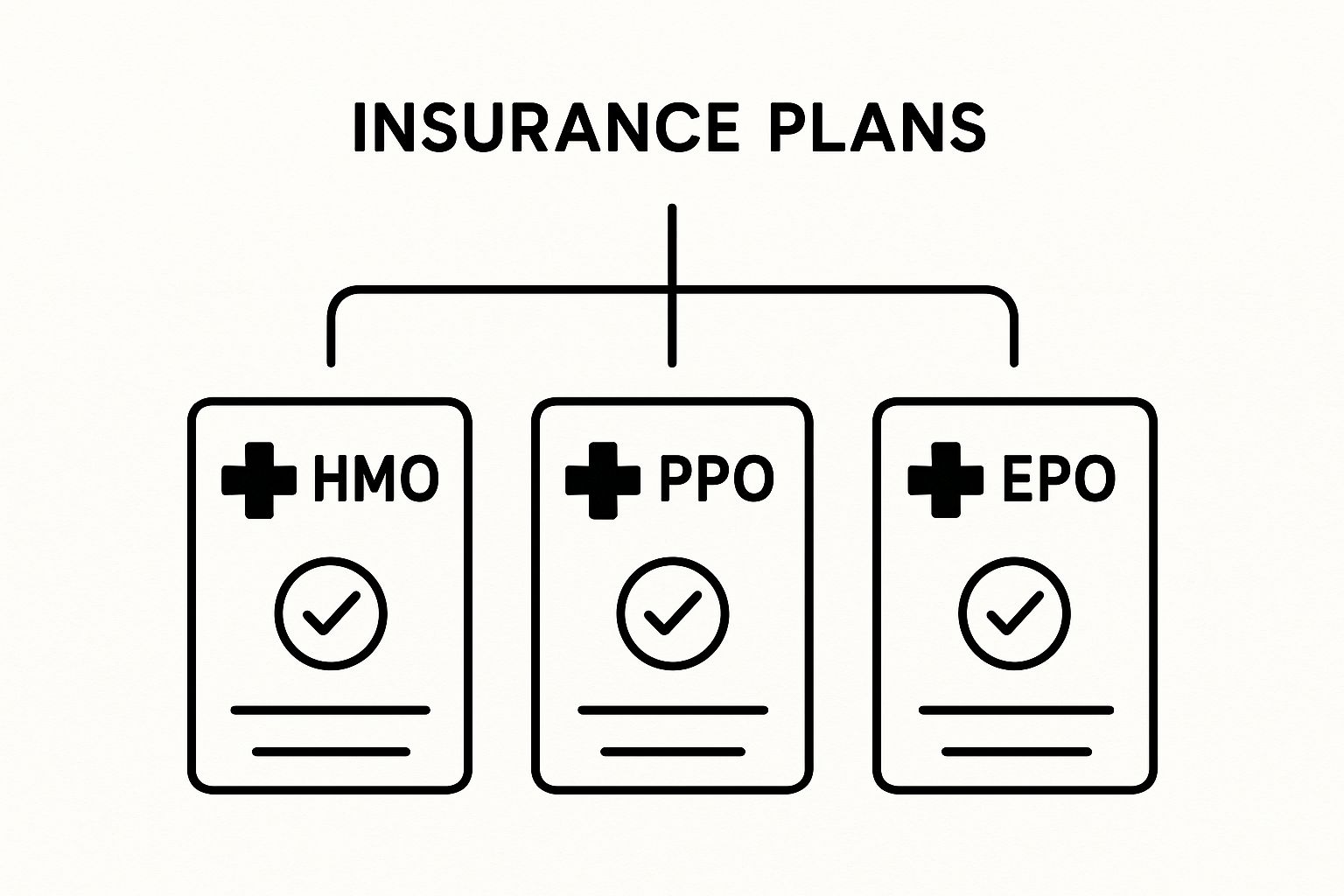
While each plan type has its own network and rules, all are legally required to offer coverage for substance use disorders.
Commonly Covered Addiction Treatment Services
To help you see how these levels of care translate into actual services, the table below breaks down what's typically included. This can help you and your provider identify the right starting point for your needs.
| Level of Care | Description | Typical Services Covered |
|---|---|---|
| Medical Detoxification | Medically supervised withdrawal management to ensure safety and comfort. | 24/7 medical monitoring, withdrawal medications, vitals tracking, initial assessments. |
| Inpatient/Residential | A live-in program providing immersive, around-the-clock therapeutic support. | Individual therapy, group counseling, family therapy, medical care, psychiatric services, holistic therapies. |
| Partial Hospitalization (PHP) | Intensive, structured day treatment, typically 5-7 days a week for several hours. | Daily individual and group therapy, medication management, skills-building workshops, case management. |
| Intensive Outpatient (IOP) | A flexible yet structured program with fewer required hours than PHP. | Multiple group therapy sessions per week, weekly individual counseling, family support, drug testing. |
Understanding this structure makes it easier to navigate conversations with both your insurance provider and potential treatment centers, ensuring you advocate for the level of care that truly fits.
Key Therapies and Treatments Covered
Beyond the program type, insurance also covers the specific therapeutic services that make up your treatment plan. This almost always includes individual therapy, group counseling, and family therapy sessions.
Addiction often co-occurs with mental health conditions like anxiety or depression. When this is the case, comprehensive insurance coverage for addiction treatment is absolutely vital. You can learn more about how facilities handle these overlapping issues in our guide to dual diagnosis treatment programs.
A critical component often covered is Medication-Assisted Treatment (MAT). MAT combines behavioral therapies with specific medications to treat substance use disorders. It helps reduce cravings and manage withdrawal symptoms, which significantly lowers the risk of relapse.
Your specific plan will detail which medications are on its formulary (the list of covered drugs) and what therapeutic services are included. By getting clear on these options, you can work with a treatment provider to build a personalized recovery plan that lines up perfectly with your insurance benefits, making sure you get the comprehensive care you need to heal.
How to Confidently Verify Your Insurance Benefits
Knowing you have coverage is one thing; understanding exactly what it entails is something else entirely. This is your practical playbook for getting clear, direct answers from your insurance provider. The process can feel intimidating, but asking the right questions puts you in control of the conversation and helps you get the clarity you need to move forward.
Your first step is simple: find the right phone number. Flip over your insurance card and look for a number labeled "Member Services" or "Behavioral Health." Using the specific number for mental or behavioral health often connects you with representatives who are better equipped to discuss insurance coverage for addiction treatment.
Before you pick up the phone, it helps to get a handle on a few key terms. Think of your insurance plan as a financial partnership for your health.
- Deductible: This is the amount you have to pay out-of-pocket for covered services before your insurance plan starts chipping in. It’s like the cover charge at a venue; you pay it once per plan year, and then your partner (the insurer) starts helping with the bill.
- Copay: This is a fixed, predictable amount you pay for a covered service after you've met your deductible.
- Out-of-Pocket Maximum: This is the absolute most you will have to pay for covered services in a single year. Once you hit this limit, your insurance pays 100% for covered benefits. It’s your financial safety net.
The image below, from the healthcare marketplace glossary, helps define some of these essential terms.

Getting comfortable with these concepts is the key to unlocking what your plan will truly cost you throughout the year.
Questions to Ask Your Insurance Representative
When you get a representative on the line, being prepared with specific questions is your greatest asset. Don't be afraid to ask them to clarify or repeat something. Your goal is to hang up with zero ambiguity about your benefits.
Here is a checklist of essential questions to guide the conversation:
- Confirm Your Benefits: "Can you confirm my plan includes benefits for substance use disorder treatment? What are my specific benefits for both inpatient and outpatient care?"
- Understand Your Costs: "What is my remaining individual deductible and my out-of-pocket maximum for this year?"
- Check for Pre-Authorization: "Is pre-authorization or pre-certification required for residential treatment or an intensive outpatient program?"
- Find In-Network Providers: "Can you provide a list of in-network addiction treatment facilities in my area?"
Getting a list of approved local facilities is a game-changer. It allows you to explore options with the confidence that they are covered under your plan. For more guidance on this, our article on finding the right substance abuse therapy near me can be a great resource.
Pro Tip: Always ask for a reference number for your call and jot down the name of the representative you spoke with. This documentation is invaluable if you need to follow up or if any discrepancies arise later.
This one conversation can transform confusing policy documents into a clear roadmap for accessing care. By asking these direct questions, you're not just a passive member; you're an active, informed advocate for your own health and recovery journey. This single phone call can provide the peace of mind you need to take the next brave step.
Navigating In-Network vs. Out-of-Network Rehab

One of the biggest financial forks in the road you'll face is choosing between an in-network and an out-of-network treatment center. It's a lot like using your insurance at the pharmacy. If you go to a pharmacy your insurance has a deal with (in-network), you pay a small, predictable copay. But if you choose one they don't have a deal with, you might have to pay the full price upfront and just hope to get some of it back later.
The difference in what you'll pay out-of-pocket can be massive. In-network providers have a contract with your insurance company where they've already agreed on discounted rates for their services. For you, that means lower, more predictable costs.
Finding In-Network Treatment Centers
Your insurance company wants you to use in-network facilities—it saves them money, too—so they usually make it pretty easy to find them. The most direct way to get a list of approved centers is to just call the member services number on the back of your insurance card. You can also typically find a list by logging into your online member portal.
Taking this simple step ensures you’re looking at places where your insurance coverage for addiction treatment is used to its full potential, saving you from surprise bills that can derail recovery.
When to Consider Out-of-Network Options
While sticking to in-network providers is almost always the most affordable route, there are rare times when an out-of-network facility might be the right call. Maybe a particular center offers a highly specialized program that no one in your network provides, or perhaps all the in-network options have long waitlists.
If you go this route, you need to be ready for a completely different financial ballgame:
- Higher Costs: Expect to pay much more out of your own pocket. Your insurance will cover a smaller slice of the bill, if it covers anything at all.
- Upfront Payment: Many out-of-network centers will require you to pay for everything in full before or at the time of admission.
- Reimbursement Hassles: It will be your job to submit all the paperwork to your insurer to try and get reimbursed, and there's often no guarantee you'll get anything back.
The good news is that the growing demand for accessible treatment is pushing the market to expand. North America's addiction treatment market was valued at USD 2.44 billion and is expected to keep growing, largely because better insurance coverage is lowering these financial hurdles. You can find more details on this market growth at Precedence Research.
In very specific situations, you might be able to secure a single case agreement (SCA). This is a special, one-time contract your insurer makes with an out-of-network provider to cover your care at in-network rates. This usually only happens when it's proven that no in-network facility can offer the specialized treatment you absolutely need.
Ultimately, getting a handle on this distinction is critical for making a smart decision that balances your clinical needs with your financial reality. And for those planning their next steps after treatment, our guide on finding a sober living home near you can be an incredibly helpful resource.
What Happens When Your Insurance Claim Gets Denied?
Getting a claim denial for addiction treatment can feel like hitting a brick wall, especially when you’re finally ready to get help. But it's critical to see this as a hurdle you can clear, not a final verdict.
More often than not, a denial isn’t about whether you need the care. It’s usually tied to a simple administrative error, a missed deadline, or a procedural mix-up.
The first step? Don’t panic. Become a detective. You need to carefully read the denial letter or the Explanation of Benefits (EOB) from your insurance company. This document is your road map, as it’s legally required to tell you exactly why they said no.
Common Reasons Your Claim Might Be Denied
Understanding why a claim was rejected is the key to getting it overturned. The reason is often less intimidating than you’d think.
- Simple Clerical Errors: It’s amazing how often this happens. A misspelled name, a wrong policy number, or an incorrect billing code can be enough to trigger an automatic denial from the system.
- Prior Authorization Hiccups: The treatment facility may not have secured the necessary pre-approval from your insurer before you started care. This is a big one.
- "Not Medically Necessary": This is a more complex denial. It means the insurance company is questioning whether the level of care you received was truly required for your specific situation.
Problems with prior authorization are a frequent source of denied claims. It’s worth noting that many providers are now using tools like AI prior authorization tools to streamline this process and cut down on these kinds of errors.
Your Action Plan: The Appeals Process
Once you know the reason for the denial, you have a clear path to fight back. This is called the appeals process, and it typically has two main stages.
- Internal Appeal: This is your first move. You formally ask your insurance company to take a second look and conduct a full and fair review of its own decision. This is your chance to strengthen your case by submitting additional documentation from your doctor or treatment provider.
- External Review: If your internal appeal is also denied, you can take your case to an independent third party. This neutral reviewer has zero connection to your insurance company. They will examine all the facts and make a final, legally binding decision.
A denial is not a dead end. Think of it as an invitation to advocate for yourself and your care. Gather your documents, team up with your treatment provider, and follow the appeals process one step at a time. You have the right to challenge their decision.
The need for accessible care has never been clearer. The global drug addiction treatment market was valued at USD 18.6 billion and is projected to nearly double by 2033. This highlights just how critical insurance coverage for addiction treatment really is. You can discover more insights about these market trends on custommarketinsights.com.
By understanding your rights and the steps in the appeals process, you can navigate these challenges with confidence.
Common Questions About Insurance for Rehab
Even after you get the hang of your policy's fine print, a few personal, nagging questions are bound to pop up. Let's be honest—navigating insurance coverage for addiction treatment brings up real worries about privacy, family, and what happens if you don't have insurance at all. Getting clear, straight answers is the only way to move forward with confidence.
Think of this as your final pre-flight check. You’ve got the basics down, but a few key confirmations will make the journey feel much smoother. Let's clear up these common concerns so you can focus on what matters: getting help.
Will My Employer Find Out If I Use My Insurance for Rehab?
This is a huge—and completely understandable—fear for so many people. The short answer is a firm no. Your privacy is locked down by strict federal laws, primarily the Health Insurance Portability and Accountability Act (HIPAA).
HIPAA acts as a legal shield around your personal health information. When you use your insurance for treatment, the insurer is legally forbidden from sharing the specifics of your care with your employer. Your company might see high-level, anonymous data like, "our employees used behavioral health services X amount of times this year," but your individual record stays completely confidential.
Your personal health information is strictly between you, your treatment provider, and your insurance company. Your employer is never notified about the specific medical services you or your family members use.
This means you can seek help for a substance use disorder knowing your job and professional life are secure.
Does Insurance Cover Treatment for Any Type of Addiction?
For the most part, yes. Thanks to federal laws like the Mental Health Parity and Addiction Equity Act (MHPAEA), health plans have to cover substance use disorders the same way they cover chronic physical conditions like diabetes or heart disease. This rule isn't just for one or two specific substances.
This broad mandate generally includes treatment for addiction to:
- Alcohol
- Opioids (like prescription painkillers and heroin)
- Stimulants (such as cocaine or methamphetamine)
- Benzodiazepines
- Cannabis
The guiding principle here is that addiction is a treatable medical condition, no matter what substance is involved. While the exact programs or levels of care covered can differ from one plan to another, the requirement to offer benefits for substance use disorders is nearly universal for most insurance policies.
How Does Coverage Work for an Adult Child on My Plan?
If you have an adult child on your health insurance plan (which the ACA generally allows up to age 26), they have the exact same right to access addiction treatment benefits as you do. Their coverage is identical to yours.
What's really important to know is that their privacy is also independently protected by HIPAA, even though you're the primary policyholder. You cannot access their specific medical records or treatment details without their explicit written permission. This empowers them to seek and receive care confidently and take ownership of their own recovery journey.
What if I Have No Private Insurance?
Lacking private insurance is a hurdle, not a dead end. You still have excellent, solid options for getting the help you need. The healthcare system has several safety nets built in to ensure people can find care regardless of their job status.
Here are your main paths forward:
- Health Insurance Marketplace: Head over to HealthCare.gov to shop for a plan. Based on your income, you may qualify for major subsidies that dramatically lower your monthly premiums.
- Medicaid: This is a joint federal and state program that provides comprehensive health coverage—including addiction treatment—to millions of low-income adults, children, and people with certain disabilities.
- Medicare: If you're over 65 or have a qualifying disability, Medicare provides coverage for both inpatient and outpatient substance abuse treatment.
- State and Local Programs: Many states and counties offer publicly funded treatment centers that provide services on a sliding-scale fee, which means the cost is adjusted based on what you can afford to pay.
There is always a path to recovery. These resources exist to make sure financial barriers don't have to stand in your way.
At Altura Recovery, we know that wrestling with insurance can feel like a major roadblock. Our dedicated team is here to help you verify your benefits, make sense of your coverage, and find a treatment plan that fits your life. If you or someone you love needs help, visit us at https://www.alturarecovery.com to start your journey toward healing.