

Deciding to stop taking Ambien means creating a careful, medically guided plan—not just stopping all at once. The safest way forward is a gradual taper, where your doctor helps you slowly lower your dosage over weeks or even months. This approach gives your body and brain time to adjust and keeps withdrawal symptoms to a minimum. Trying to quit "cold turkey" isn't just difficult; it can be outright dangerous, and it's something experts strongly advise against.
Why a Gradual Ambien Taper Is Essential

Making the choice to get off Ambien is a huge step toward getting your natural sleep cycle back on track. But to do it successfully, you first need to understand why the process has to be slow and deliberate. It’s not a test of willpower. It’s about respecting the very real chemical changes the medication has made in your brain.
Zolpidem, the active drug in Ambien, works by slowing down brain activity so you can fall asleep. Over time, your brain gets used to having it around and starts to rely on it to kickstart the sleep process. This adaptation is what we call dependence.
Recognizing Dependence
Dependence isn't a moral failing or a sign of weakness—it's a predictable physiological response to a powerful medication. It often shows up in subtle ways you might not immediately connect to the drug itself.
Here are a few telltale signs that dependence has developed:
- Needing a higher dose: You might notice that the 10 mg pill that used to knock you out no longer seems to do the trick.
- "Bedtime anxiety": You start feeling anxious hours before you even go to bed, worried about whether you’ll be able to sleep without taking Ambien.
- Failed attempts to stop: You've tried skipping a night or two, only to be hit with severe insomnia, anxiety, or physical discomfort that makes you take it again.
It's also crucial to understand the difference between physical and psychological dependence, because both are at play here. Your body might physically crave the drug, while your mind has become convinced that sleep is impossible without it.
The single most important reason for a gradual taper is safety. Stopping Ambien suddenly can throw your entire system into shock, triggering a wave of withdrawal symptoms that range from deeply uncomfortable to medically serious.
The Dangers of Stopping Cold Turkey
Quitting Ambien abruptly forces your brain into overdrive. After being chemically suppressed for so long, your central nervous system rebounds with a vengeance. This is a risk you simply shouldn't take.
The potential fallout from stopping cold turkey includes:
- Severe Rebound Insomnia: Your sleeplessness can come roaring back, often far worse than it was before you ever started taking Ambien.
- Intense Anxiety and Panic Attacks: The sudden surge in brain activity can trigger overwhelming feelings of panic, dread, and agitation.
- Physical Symptoms: It’s common to experience tremors, heavy sweating, nausea, and painful muscle cramps.
- Serious Medical Risks: In rare but dangerous cases, abrupt withdrawal can lead to confusion, hallucinations, and even life-threatening seizures.
A slow, controlled taper plan designed with your doctor is the only medically sound way to stop taking Ambien. This method allows your brain to gradually re-learn how to function on its own, which dramatically reduces the severity of withdrawal and gives you the best possible chance of success.
Your Pre-Taper Preparation Checklist
A successful Ambien taper starts long before you ever cut your first pill. Think of this prep work as building the foundation for a new house—you wouldn't rush it, and you definitely wouldn't skip it. Diving into a taper without the right support and a clear plan can make the whole process feel ten times harder than it needs to be.
Your first, non-negotiable step? Schedule a meeting with your doctor.
Talking with Your Doctor
This conversation with your healthcare provider is a strategic partnership, not a confession. You need to be completely open about your Ambien use—how much you're taking, how often you take it, and how long you've been on it. This level of honesty is the only way they can help you build a tapering schedule that is both safe and effective for you.
To make the most of that appointment, show up with a list of questions. This simple step ensures you don't forget anything important and you leave feeling clear and confident.
Consider asking things like:
- Based on my history, what does a realistic tapering timeline look like?
- Are there any non-addictive medications we could use temporarily if rebound insomnia gets rough?
- What specific withdrawal symptoms are red flags that mean I should call you immediately?
- Do you know any therapists or counselors who specialize in sleep issues or medication dependence?
This is also the perfect time to discuss more structured support. Because Ambien dependence has become more common, there are now specialized detox programs that offer medical supervision and psychological care. It's worth exploring all your options for Ambien treatment to see what fits best.
Assembling Your Support System
Please, don't try to go through this alone. A solid support system is one of the most critical parts of your pre-taper checklist. This includes the people in your personal life as well as any professionals who can offer guidance and practical help.
Find at least one trusted friend or family member and let them in on your plan. Give them a heads-up that you might be more anxious or irritable than usual, and ask if they'd be willing to check in on you. Just knowing someone has your back can be a game-changer on the tougher days. Your doctor might also recommend professional support like medication-assisted treatment, which combines medical oversight with counseling to smooth out the process.
The infographic below breaks down these foundational steps.
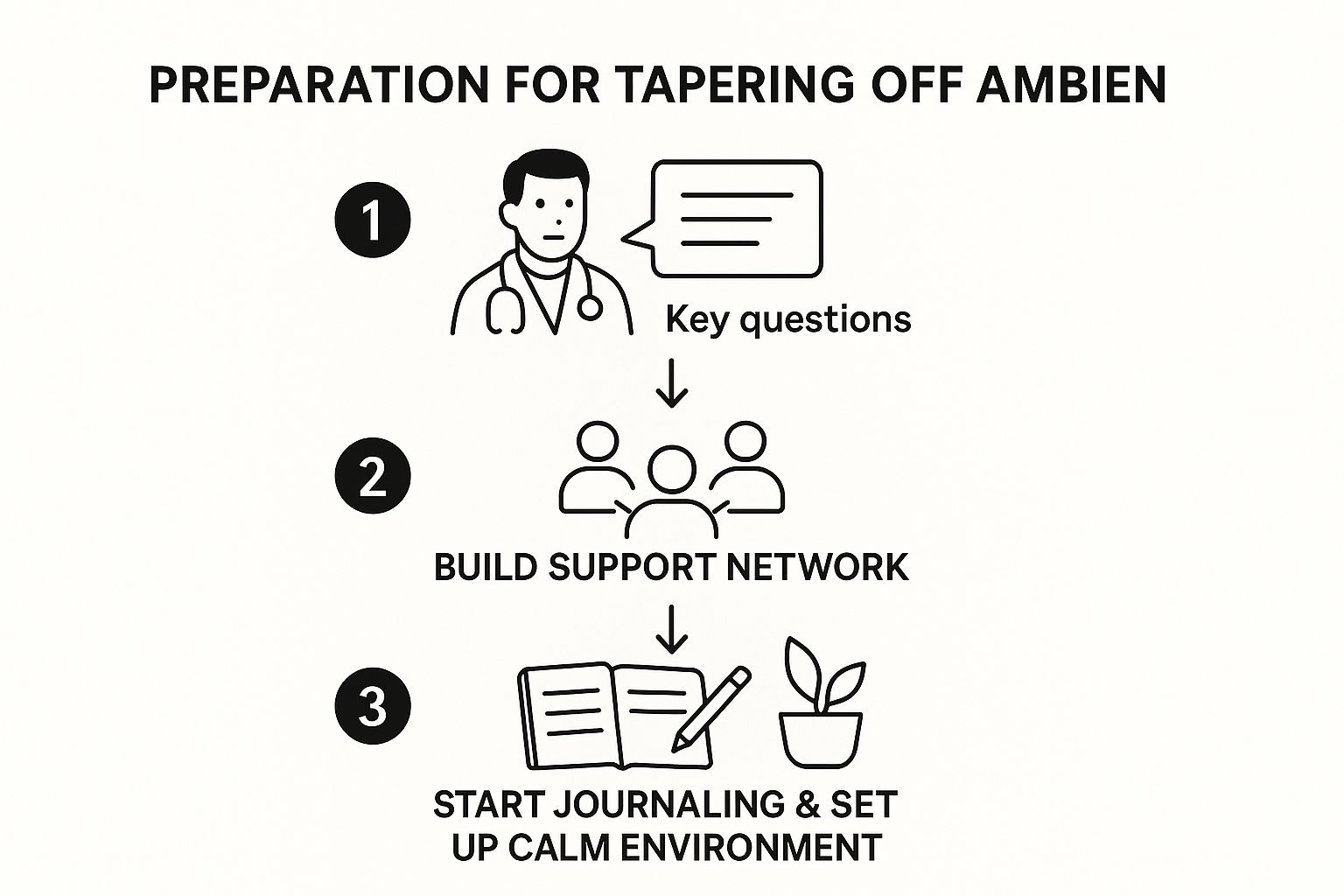
As you can see, getting medical advice and building your network aren't just suggestions—they are the essential first moves you make before you even think about changing your dose.
Preparing Your Environment and Mindset
The final piece of the puzzle is setting up your daily life for success. A week or two before you plan to start, begin keeping a simple journal. Each day, log your Ambien dose, how well you slept, your mood, and your energy levels. This baseline data will become incredibly valuable for tracking your progress and spotting patterns once you begin tapering.
Creating a low-stress environment is not an indulgence; it's a strategic part of your recovery. A calm space minimizes potential triggers for anxiety and insomnia, making withdrawal symptoms more manageable.
Finally, start tidying up your sleep environment. This is the time to move the TV out of the bedroom, invest in some blackout curtains, and start practicing a consistent, relaxing bedtime routine. By taking these steps before you start, you're actively setting the stage for a smoother, more successful journey to becoming Ambien-free.
Navigating Your Tapering Schedule Day by Day
Once your doctor hands you a tapering plan, the real work begins. This is where the theory gets put into practice, day by day. Your main job now is to execute that schedule carefully, and the most important rule is simple: go slow. A gradual, patient reduction is what gives your brain the time it needs to adapt, minimizing the shock of withdrawal.
Remember, your schedule is tailored to you. It’s based on your current dose, how long you’ve been taking Ambien, and your overall health profile. This isn't a race to the finish line; it’s a controlled descent designed for your body's comfort and safety.
The Nuts and Bolts of Tapering
For most people, tapering means physically taking less of the medication each night. This is always done under a doctor's supervision, and there are a couple of common ways to go about it.
- Pill Splitting: If your doctor says it's okay for your specific Ambien tablets, they might have you use a pill cutter to create smaller doses. For instance, you could be instructed to cut a 10 mg tablet in half to get a 5 mg dose.
- Switching Dosages: An even simpler method is for your doctor to just write you a new prescription for lower-dose tablets. Moving from a 10 mg pill to a 5 mg pill is precise and removes any guesswork from splitting.
The "how" isn't as critical as the "how slow." A standard approach is to reduce your total daily dose by 10-25% every one to two weeks. This slow-and-steady pace is what prevents the abrupt jolt to your system that can trigger intense withdrawal symptoms.
What a Sample Taper Might Look Like
To give you a clearer picture of how this unfolds, let's walk through a hypothetical scenario. It's crucial to understand this is just an illustration and not a substitute for medical advice.
Important Takeaway: Your journey is not a race. It's perfectly okay to pause at a certain dose for an extra week or to slow down the rate of reduction if symptoms become too challenging. Constant communication with your doctor is essential.
Below is a generalized example. Your doctor will create a personalized plan based on your dosage, duration of use, and overall health.
Sample Ambien Tapering Schedule (For Illustrative Purposes Only)
| Tapering Phase (Example) | Current Daily Dose | Reduced Daily Dose | Duration at This Dose |
|---|---|---|---|
| Phase 1 | 10 mg | 7.5 mg | 1-2 Weeks |
| Phase 2 | 7.5 mg | 5 mg | 1-2 Weeks |
| Phase 3 | 5 mg | 2.5 mg | 1-2 Weeks |
| Phase 4 | 2.5 mg | 2.5 mg every other night | 1 Week |
| Final Phase | 2.5 mg every other night | 0 mg | Stop taking the medication |
As you can see, the reductions are small and spaced out. Throughout this process, you’d be keeping a simple journal to track your symptoms, sleep quality, and mood, sharing these notes with your doctor at every check-in. If withdrawal ever feels too rough, your doctor will likely advise you to hold steady at your current dose for a bit longer before making the next cut.
When Withdrawal Feels Too Intense
Feeling some discomfort—like a bit of anxiety or a few restless nights—is pretty normal. But if your symptoms start to feel unmanageable, that's your body sending a clear signal to slow down, not to just grit your teeth and push through it.
For those who find they need more structured support to navigate this challenging phase, learning about an intensive outpatient program can be a great next step. These programs offer medical and therapeutic guidance that fits around your daily life, providing a safety net while you taper.
Ultimately, getting through your tapering schedule successfully comes down to three things: listening to your body, staying in close contact with your doctor, and giving yourself plenty of grace.
Practical Ways to Manage Withdrawal Symptoms
Once you start lowering your Ambien dose, your body begins the hard work of adjusting. It’s a transition that can kick up some challenging physical and emotional symptoms, but I want you to see this for what it is: a sign that your brain is actively recalibrating itself without the medication. Knowing what’s coming and having a game plan makes all the difference.
The most common hurdles are rebound insomnia—a temporary return of sleeplessness that can feel even worse than before—along with a spike in anxiety and general irritability. You might just feel completely on edge. Let's break down how to handle these head-on.
Handling Anxiety and Irritability
That uptick in anxiety is no surprise. Ambien slows down your central nervous system, and as it comes out of that state, everything can feel like it’s firing on all cylinders. This can leave you feeling restless, uneasy, and jumpy. The trick is to have non-medical coping tools ready to go before these feelings get overwhelming.
Simple, in-the-moment techniques are surprisingly powerful.
- Mindful Breathing: When you feel that wave of anxiety rising, just stop. Inhale slowly through your nose for a count of four, hold it for four, and then exhale slowly through your mouth for six. Do this five or ten times. It really does work.
- Grounding Exercises: To pull yourself out of an anxious thought spiral, anchor yourself in the present. Name five things you can see, four things you can touch, three things you can hear, two things you can smell, and one thing you can taste.
- Journaling: Don’t let anxious thoughts circle in your head. Dump them onto a piece of paper. The act of writing your worries down can make them feel smaller and far more manageable.
For a deeper toolkit, exploring various coping strategies for anxiety and depression can give you more structured support during this sensitive period. Sometimes, winding down at night is the hardest part. Resources like this complete guide to bedtime stories for adults with anxiety and stress can be a huge help in calming a racing mind and encouraging natural sleep.
Tackling Rebound Insomnia
Fighting rebound insomnia isn't about forcing sleep; it’s about creating the perfect conditions for sleep to find you. This is where rock-solid sleep hygiene becomes your best friend. Your mission is to send clear, consistent signals to your brain that it’s time to power down.
Remember: A few rough nights are a totally normal part of this journey. The worst thing you can do is panic and reach for another pill. Stick to your tapering schedule and trust that your body is re-learning how to sleep on its own.
Generally, the withdrawal process kicks in within 48 hours of cutting back your Ambien dose. Symptoms tend to peak around days five to seven and can linger for a couple of weeks. While things like anxiety and insomnia are expected, you need to be able to tell them apart from more severe issues. If you experience tremors, confusion, or anything that feels truly alarming, call your doctor immediately.
By arming yourself with these practical strategies, you can navigate the choppy waters of withdrawal with more confidence and stay on track to finally leave Ambien behind for good.
Relearning How to Sleep Naturally

Coming off Ambien isn't just about surviving withdrawal. The real work is rebuilding your entire relationship with sleep. For a long time, a pill was the switch you flipped for rest. Now, the goal is to retrain your brain to recognize its own natural cues, creating a sleep pattern that can actually last.
This part of the process isn't about finding a new magic bullet. It’s about putting proven, non-medical strategies to work that get to the root of why you couldn't sleep in the first place. The single most effective framework for this is Cognitive Behavioral Therapy for Insomnia (CBT-I).
There's a reason CBT-I is considered the gold-standard treatment for chronic insomnia. It's a structured approach that helps you pinpoint and then replace the specific thoughts and behaviors that are sabotaging your sleep.
Adopting a CBT-I Mindset
You don't need a formal program to start using CBT-I principles tonight. The core idea is simple: change your actions and thoughts around bedtime. One of the first and most powerful rules is to stop trying to sleep.
If you find yourself lying awake for more than 20 minutes, get out of bed. Seriously. Go to another room and do something quiet and calming—read a book under dim light, listen to soft music, or do some gentle stretches. Only return to bed when you feel sleepy. This small change helps break the frustrating mental link between your bed and being awake.
Building Your Sleep Sanctuary
Your environment sends powerful signals to your brain. If your bedroom doubles as your office, movie theater, and late-night scrolling station, your brain won't see it as a place for rest. It's time to turn it into a space dedicated solely to sleep.
- Darkness is Key: Blackout curtains or a good eye mask are non-negotiable. Even a sliver of light from a streetlamp or a clock face can mess with your natural melatonin production.
- Keep it Cool: A slightly cool room, somewhere between 60-67°F (15-19°C), is ideal for sleeping. Your body temperature naturally drops to initiate sleep, and a cool room helps that process along.
- Eliminate Noise: A white noise machine, a fan, or simple earplugs can be a lifesaver, masking the sudden sounds that can jolt you awake.
As you move away from Ambien, creating this kind of supportive environment becomes critical. For more great ideas, check out these tips for creating a healthy sleep environment.
Your bedtime routine should be a clear signal to your body and mind that the day is over. This isn't just a nice-to-have; it's a critical part of re-establishing a healthy sleep-wake cycle.
Powerful Pre-Sleep Rituals
A consistent wind-down routine is absolutely essential. About an hour before you plan to sleep, turn off all screens. The blue light they blast out is notorious for suppressing melatonin and tricking your brain into thinking it's still daytime.
Instead of scrolling, try one of these calming activities:
- Warm Bath or Shower: It's not just relaxing. The drop in your body temperature after you get out is a natural trigger for sleepiness.
- Light Stretching or Meditation: Gentle movements or a guided meditation can release the physical tension you've held all day and quiet a racing mind.
- Journaling: Got worries or a massive to-do list for tomorrow? Write it all down. Getting it out of your head and onto paper can provide a surprising amount of relief.
These strategies work together to dismantle the psychological dependence on a pill. By giving your brain new, healthy cues for sleep, you're not just stopping a medication—you're learning a skill that will serve you for the rest of your life.
Of course. Here is the rewritten section, crafted to sound completely human-written and natural, following all the specified requirements.
What to Expect When You Stop Taking Ambien
It’s completely normal to have a dozen questions running through your head right now. Stepping away from a medication you've relied on for sleep can feel intimidating, but knowing what’s coming can make all the difference. Let's walk through some of the most common concerns so you can feel more prepared and in control.
The first thing people always ask is how long this will all take. The honest answer? It’s different for everyone. How long you’ve been taking Ambien, your current dose, and your own unique metabolism all play a part. The whole process could wrap up in a few weeks or stretch over a few months. The goal isn’t speed—it’s safety.
How Long Will the Tapering Process Take?
Your doctor will map out a schedule that works for you. A pretty standard approach is to reduce your dose by about 10-25% every one to two weeks. But think of this as a guideline, not a strict deadline. If the withdrawal symptoms feel too intense, the plan can be adjusted. Slowing things down gives your brain and body the time they need to adapt.
One of the biggest hurdles is rebound insomnia. It’s frustrating, but you absolutely can get through it without switching to another pill. This is where all those sleep hygiene habits and CBT-I skills we talked about become your best friends. They are the tools that will help you rebuild your natural sleep patterns.
A key takeaway is that the risk of dependence on Ambien is significant. Understanding this helps frame the importance of a structured, medically supervised taper.
Some people are more vulnerable to this risk than others. For example, older adults and women often clear the drug from their systems more slowly, which means greater exposure and a higher chance of becoming dependent. You can read more about these zolpidem dependence findings to get a clearer picture of the risk factors involved.
What to Do if Symptoms Feel Overwhelming
If you hit a rough patch and the withdrawal symptoms—like intense anxiety, irritability, or sleepless nights—feel like too much, your first move should always be to call your doctor. Please, do not try to change your tapering schedule on your own. Your doctor is your partner in this, and they have the expertise to make adjustments that will bring you relief.
They might suggest holding steady at your current dose for an extra week, or they might make the next dose reduction even smaller. The tapering plan is a flexible map, not a rigid set of rules. Honest, open communication is what will get you through this safely and successfully.
At Altura Recovery, we understand that breaking free from medication dependence requires more than just a schedule—it requires compassionate, expert support. Our outpatient programs in Houston are designed to give you the medical supervision and therapy you need to wean off Ambien safely, all while you continue to manage your daily life. If you’re ready to find real healing and lasting freedom, learn more about our personalized treatment plans.