Before you can truly help your alcoholic spouse, you have to make one fundamental shift in your thinking: alcoholism is a disease, not a moral failure.
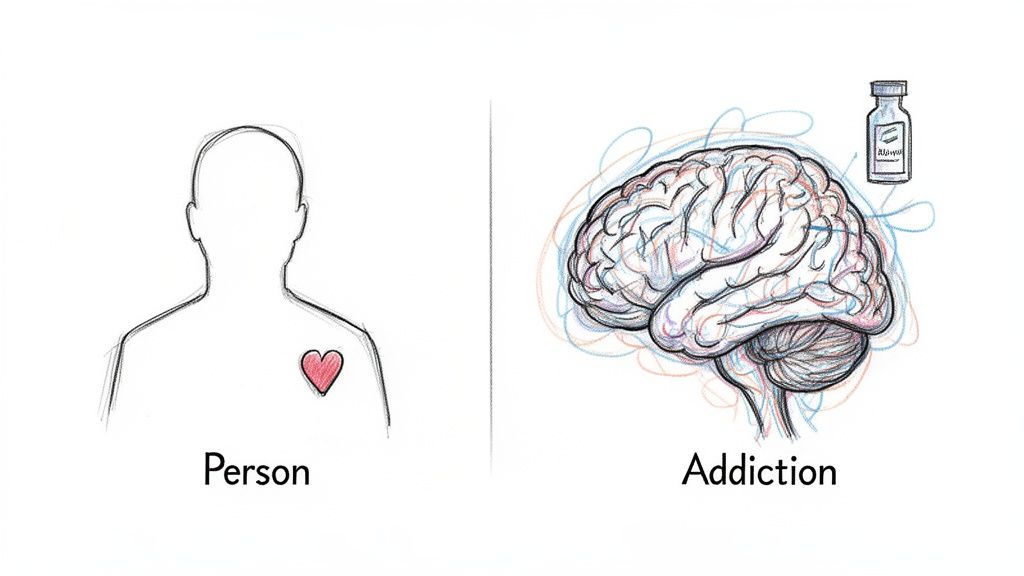
It’s a tough pill to swallow, I know. But seeing Alcohol Use Disorder (AUD) as the chronic brain condition it is allows you to finally separate the person you love from the addiction that has taken hold. This perspective is what opens the door to empathy, productive conversations, and ultimately, guiding them toward the professional help they need.
Understanding Alcoholism in Your Marriage
Living with an alcoholic spouse traps you in a painful cycle of frustration, broken promises, and confusion. It’s completely natural to wonder why they can’t "just stop" for you, for the kids, for your family. But that very question, while understandable, actually creates a barrier to getting them the help they need.
The most powerful thing you can do right now is to reframe what your spouse is going through. Alcohol Use Disorder (AUD) isn't a choice or a simple lack of willpower. It's a recognized medical condition—a chronic disease of the brain defined by a compulsive need to drink despite devastating consequences.
Heavy, prolonged alcohol use literally rewires the brain, hijacking the parts responsible for pleasure, judgment, and self-control.
This is why logical arguments and emotional pleas almost always fail. You're not just reasoning with the person you married; you're up against a disease that has rewired their brain’s entire reward system.
Recognizing the Symptoms Beyond the Glass
The signs of alcoholism aren’t always as obvious as slurred speech or stumbling. In fact, many people with AUD are masters of hiding it, maintaining jobs and responsibilities while their inner world crumbles. To really see what’s happening, you have to look past the drink itself and notice the subtle, painful shifts in their behavior.
Seeing these changes as symptoms of the disease—not personal attacks—is a game-changer.
- Growing Isolation: Have they started dodging family events or any social gathering where drinking isn't the main event? Withdrawing is a classic way to protect their drinking from judgment.
- Intense Defensiveness: Do they lash out with anger, denial, or accusations the moment you gently bring up their drinking? That defensiveness is a shield for the deep shame and loss of control they're likely feeling.
- Unpredictable Moods: Do you constantly feel like you’re walking on eggshells? The chemical rollercoaster of drinking and withdrawal creates extreme mood swings, making your home life feel chaotic and unsafe.
- Neglecting Responsibilities: Are they missing work, forgetting important family dates, or dropping the ball on promises? As the addiction gets stronger, alcohol becomes the brain's top priority, pushing everything else to the side.
This can be especially confusing when your spouse seems to have it all together on the surface. You can learn more about this pattern by exploring the traits of a high-functioning alcoholic. It’s a mask that makes the problem harder for both of you to confront.
Separating the Person from the Disease
This is the hardest—and most important—mental leap you can make. The person you fell in love with is still in there, but their thoughts, words, and actions are being driven by a disease. The lies, the anger, the broken promises… these are symptoms of addiction, not a reflection of their true character or how much they love you.
Think about it this way: when your spouse swears they’ll stop drinking and then picks up a bottle that same evening, it feels like a dagger to the heart. A deep, personal betrayal.
From a medical standpoint, however, this is a classic symptom of relapse. It’s driven by an overwhelming physical and psychological compulsion that their altered brain chemistry simply cannot resist on its own.
Making this mental separation doesn’t mean you excuse their behavior. It means you finally understand where it's coming from. This new lens allows you to approach the situation with empathy instead of anger, which is absolutely essential for the tough conversations ahead. You start to see that they don't need more judgment; they need professional, medical help to heal their brain and learn to manage this chronic illness.
How to Talk About Their Drinking Without Starting a War
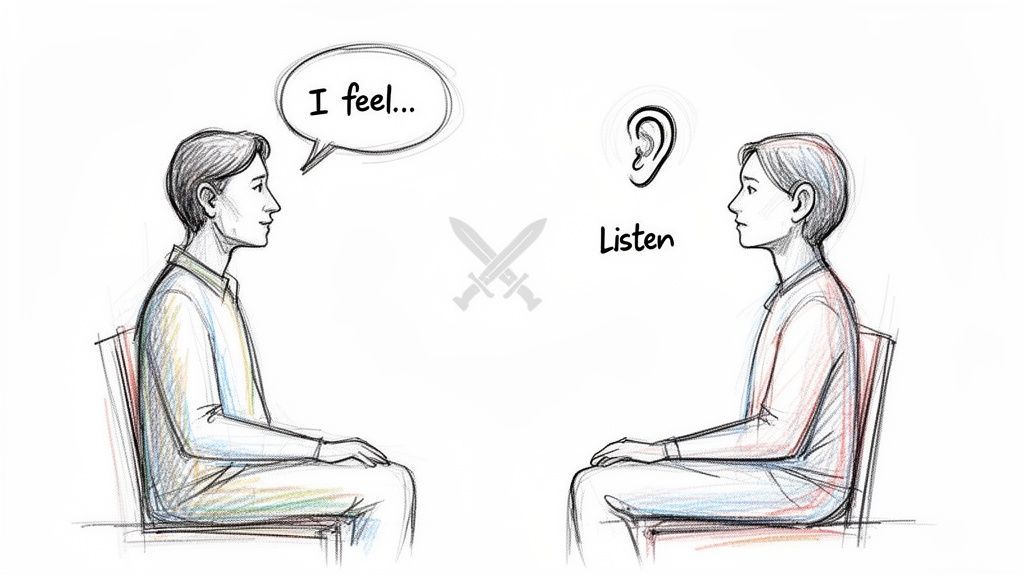
Talking to your spouse about their drinking can feel like trying to disarm a bomb. One wrong move, and the entire conversation explodes into anger, denial, and a fresh round of blame. Years of fear and frustration are simmering right below the surface, ready to turn a well-intentioned talk into just another fight.
The secret is to change your goal. You're not trying to win an argument or force a confession. You're trying to open a small door for connection and, eventually, change. It’s less about a single, dramatic confrontation and more about planting seeds of awareness by calmly sharing how their actions are impacting you.
Timing and Tone Are Everything
Your single most powerful tool is choosing the right moment. Ambushing them after a night of heavy drinking or trying to talk in the middle of a heated argument is a recipe for disaster. That conversation is doomed from the start.
Wait for a time when you are both sober, calm, and have some privacy without the kids or the TV interrupting. Think a quiet Saturday morning over coffee or a peaceful evening after dinner. Your tone has to be one of genuine concern, not accusation.
Think of it as a conversation about your feelings and the health of your relationship, not a lecture on their failures. Your goal is to be heard, and that only happens when they don’t feel attacked right out of the gate.
This approach signals respect and shows you want to solve a problem together instead of just pointing fingers. It's a foundational first step when you're learning how to help an alcoholic spouse without pushing them further away.
Use “I” Statements to Share Your Reality
If you change one thing about how you communicate, make it this: switch from accusatory “you” statements to personal “I” statements. “You” statements immediately put someone on the defensive. But “I” statements simply state your feelings and experiences, which are impossible to argue with.
Instead of: “You always get drunk at parties and embarrass me.”
Try: “I felt so lonely and disconnected from you at the party when you were drinking heavily.”
Instead of: “You broke another promise. I can’t trust you.”
Try: “When we have to cancel plans we made because of drinking, I feel hurt and like I don’t matter.”
Instead of: “You have to stop drinking so much.”
Try: “I’m scared of what will happen to our family if things don’t change.”
This isn’t about manipulation; it’s about raw honesty. You’re sharing the tangible, real-world impact their drinking has on you. It shifts the focus from their character to the consequences of their actions, which can sometimes be the only thing that breaks through the denial.
Come Prepared With Specific, Non-Judgmental Examples
General complaints like "you drink too much" are vague and easy to dismiss. They invite arguments and let your spouse sidestep the issue. Instead, you need to come to the conversation with specific, factual examples of behaviors that have worried or hurt you.
Ground your concerns in reality. For example: “Last Tuesday, when you drove home after happy hour, I was terrified something would happen. I couldn’t sleep until I heard your car in the driveway.” That’s a specific event with a clear, emotional impact.
Or you could try: “When we had to leave the family barbecue early on Saturday because you were slurring your words, I felt so isolated and sad for the kids.”
These concrete examples make the problem real. They aren't character attacks; they are undeniable facts about how their drinking is affecting the family. These talks are tough, and exploring different addiction topics for groups can give you more insight into effective communication strategies.
Just remember, this will likely be a series of small conversations, not one big breakthrough. Each calm, honest discussion is a step toward helping them see the need for help. Patience and consistency are your greatest allies.
Setting Boundaries That Protect You and Your Family
There’s a fine, often blurry line between supporting the person you love and unintentionally enabling their addiction. One feels like help; the other just keeps the destructive cycle spinning. Drawing that line with firm, healthy boundaries is one of the most loving and protective things you can do—for yourself, your kids, and ultimately, for your spouse.
Enabling is any action you take that shields your spouse from the natural consequences of their drinking. It’s almost always driven by a mix of love and fear, but what it really does is allow the addiction to thrive. Genuine support, on the other hand, empowers them to face reality while you protect your own well-being.
Differentiating Enabling from Supporting
Getting clear on the difference here is a game-changer. Enabling behaviors often feel like a quick fix, like you're putting out a fire, but they cause so much damage in the long run.
Enabling is: Calling their boss to say they're "sick" when they’re actually hungover.
Supporting is: Allowing them to face the professional consequences of missing work.
Enabling is: Making excuses for their behavior to friends and family to avoid embarrassment.
Supporting is: Being honest (in an appropriate way) with loved ones who are genuinely concerned.
Enabling is: Quietly taking over all household chores and childcare because they're passed out on the couch again.
Supporting is: Stating clearly that you can no longer manage everything alone and that their drinking is hurting the family.
Enabling sends a dangerous message: that their drinking is manageable and you'll always be there to clean up the mess. Supporting sends a much different one: "I love you, but I will no longer participate in the chaos of your addiction."
Boundaries are not punishments; they are acts of self-preservation. They are not about controlling your spouse's drinking but about controlling your own response to it. This shift in focus is the key to reclaiming your peace and stability.
How to Create and Communicate Your Boundaries
Effective boundaries need to be crystal clear, consistent, and focused on your actions, not theirs. You can't control whether they drink, but you absolutely can control what you will and won't do when they do. This is a core part of learning how to help an alcoholic spouse without losing yourself in the process.
Think about the specific behaviors you are no longer willing to accept or participate in. Frame your boundary as a personal limit using a simple formula: “If you [behavior], then I will [action].”
- “I will no longer lie to cover for you. If you’re too hungover to go to your family’s dinner, you’ll have to be the one to tell them why.”
- “I can't be around you when you are drinking heavily. If you choose to drink tonight, I am going to take the kids and stay at my sister’s house.”
- “I will no longer let our family's finances be at risk. From now on, I'm moving my paycheck into a separate bank account to make sure our bills get paid.”
The key is to communicate these boundaries calmly and during a sober moment. These aren't threats; they are decisions you've made for your own well-being. Be prepared for pushback—anger, pleading, or blame are common reactions. Your job is to hold firm and, most importantly, follow through. Every single time. Consistency is what makes a boundary real.
Creating a Safety Plan for Volatility
If your spouse’s drinking ever leads to verbal aggression, threats, or physical violence, your priority must shift immediately to safety. Alcohol lowers inhibitions and can turn a simple disagreement into something dangerous. A safety plan isn't about expecting the worst; it's about being prepared to protect yourself and your children.
- Identify a safe place: Know exactly where you can go at a moment's notice—a friend's house, a relative's, or a domestic violence shelter.
- Keep essentials ready: Pack a small "go-bag" with keys, cash, important documents, and a change of clothes for you and your children. Keep it somewhere you can grab it quickly and discreetly.
- Establish a code word: If your children are old enough, create a code word that signals it’s time to leave immediately, no questions asked.
- Know who to call: Keep phone numbers for trusted friends, family, and the National Domestic Violence Hotline saved and easily accessible.
Sadly, the link between alcohol abuse and intimate partner violence is strong. But there's hope. Research shows that family-focused treatment can make a huge difference. In one study, violence from female alcoholic patients toward their partners dropped from 68% pre-treatment to just 31% after they engaged in couples-based therapy. It’s a powerful reminder of how getting professional help can drastically improve safety at home. You can learn more about the findings on family therapy and violence reduction.
When children are involved, navigating all of this becomes even more complex—and even more critical. If you're in this spot, learning about co-parenting effectively with an addicted spouse is crucial for their well-being and for keeping your own sanity. Setting and enforcing these boundaries is the first step toward building a healthier future, whether your partner gets sober or not.
Guiding Them Toward Professional Treatment Options
You can’t force your spouse into recovery, but you can absolutely be their most powerful guide. The key is to present treatment not as an ultimatum or a punishment, but as a tangible, hopeful path forward for the entire family. It's about opening a door, not shoving them through it.
If you understand the different options available, you can talk about them as a team. This isn’t a fight; it’s a shared problem that needs a shared solution. Knowing what treatment actually looks like demystifies the process and makes it feel far less scary for someone who is already feeling defensive and isolated.
Approaching the conversation about treatment with a plan provides structure and hope. Frame it as a team effort: "Let's look into this together" is far more effective than "You need to go to rehab." This collaborative spirit can lower defenses and make the idea of getting help feel less isolating.
Understanding the Levels of Care
The world of addiction treatment isn't one-size-fits-all. Not everyone needs to leave home for 30 days. The right fit is everything, and care is structured as a spectrum designed to meet people exactly where they are. The journey often starts with the most intensive care needed and then "steps down" as the person builds stronger recovery skills.
Here’s a look at the most common levels of care:
Medical Detox: This is the first, non-negotiable step for anyone with a significant physical dependence on alcohol. Quitting cold turkey can be incredibly dangerous—even fatal—due to severe withdrawal. A medical detox provides 24/7 medical supervision to manage these symptoms safely and make the process as comfortable as possible.
Inpatient or Residential Treatment: After detox, this is the most immersive option. Your spouse would live at the facility, which removes them from daily triggers and allows them to focus completely on getting better through therapy, education, and peer support.
Partial Hospitalization Program (PHP): Think of this as a step down from residential care. It offers intensive therapy for several hours a day, five to seven days a week, but the person returns home or to a sober living environment at night. It’s a bridge back to daily life.
Intensive Outpatient Program (IOP): This option offers even more flexibility. An IOP usually involves therapy for a few hours a day, a few times a week, making it ideal for someone who is ready to get back to work or school but still needs a strong support system in place.
This simple decision tree can help you see the difference between actions that enable the addiction and those that set the healthy boundaries needed to make treatment a viable option.
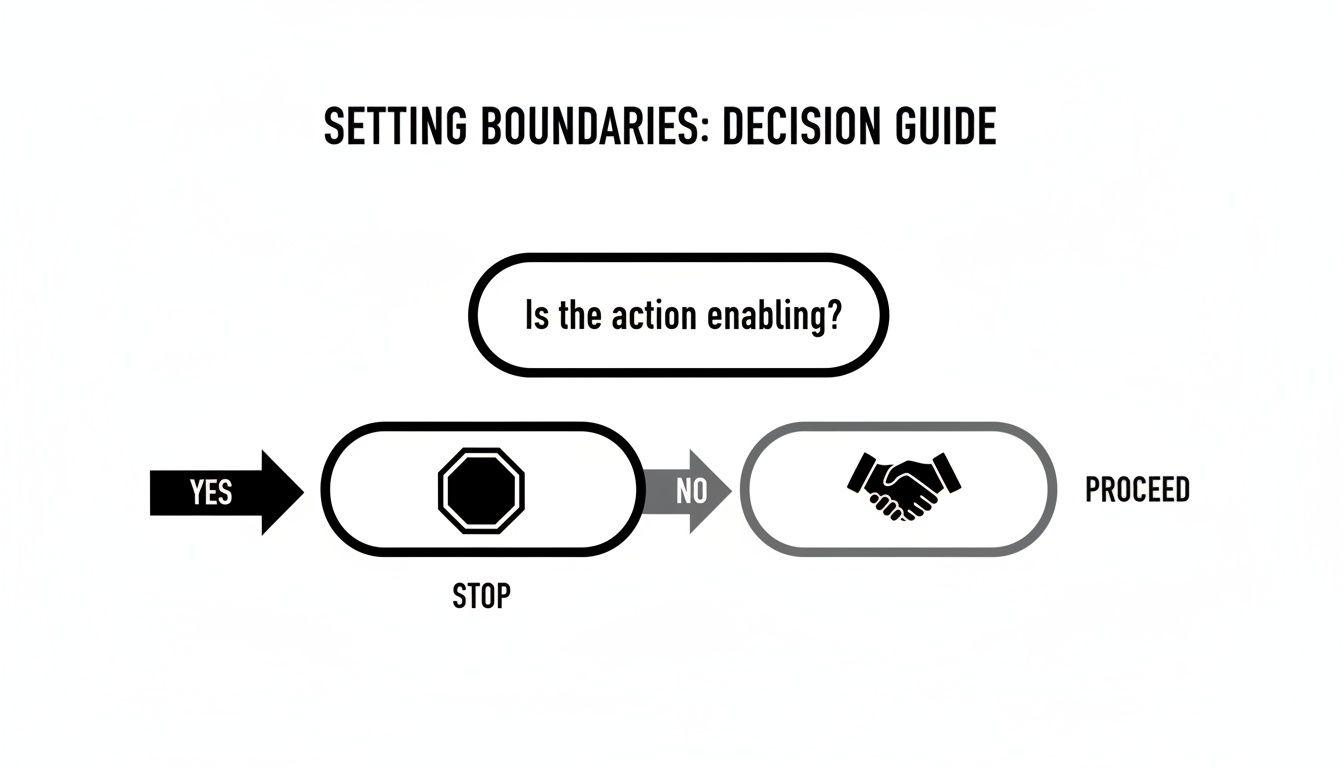
As the flowchart shows, stopping enabling behaviors is a crucial prerequisite. It helps your spouse face the natural consequences of their drinking, which is often the catalyst for finally accepting help.
Comparing Outpatient Treatment Options
Once your spouse is medically stable, choosing the right outpatient program can feel overwhelming. The main difference between a PHP and an IOP is intensity and time commitment. This table breaks it down.
| Treatment Level | Time Commitment (per week) | Best For | Services Included |
|---|---|---|---|
| Partial Hospitalization (PHP) | 25-30 hours | Individuals stepping down from inpatient care or those needing intensive structure without living on-site. | Daily group therapy, individual counseling, medication management, family sessions. |
| Intensive Outpatient (IOP) | 9-12 hours | People who are stable enough to work or attend school but still need significant support and accountability. | Multiple group sessions weekly, individual therapy, skill-building workshops. |
Understanding this step-down model helps you see recovery as a journey, not a single event. Each level is designed to provide the right amount of support at the right time.
The Reality of Relapse and the Power of Persistence
It is absolutely vital to walk into this process with realistic expectations. Relapse rates for addiction mirror those of other chronic diseases like diabetes or hypertension, sitting at 40-60%. One major study showed that over 75% of people relapse within their first year after treatment.
But here’s the hopeful part: that risk drops to under 15% for those who maintain sobriety for five years or more. A relapse isn't a sign of failure; it’s a sign that the recovery plan needs to be adjusted. If you can understand what relapse means in the context of mental health, you can respond with compassion and persistence instead of panic.
Your Role in Their Recovery
Your involvement is more than just a nice-to-have; it's a proven factor in their success. Most reputable treatment centers offer family therapy, workshops, or educational programs for a reason.
Participating helps you in two critical ways. First, it gives you a space to heal from the trauma of living with addiction. Second, it teaches you how to build a home environment that actively supports sobriety.
When you learn to communicate differently and hold your boundaries, you stop participating in the old, dysfunctional dance. You become a partner in a new, healthy one, and that unified front dramatically improves the odds of a lasting recovery for everyone.
Remembering to Take Care of Yourself
Living with a spouse’s addiction can feel like being caught in a storm you can’t control. Your focus narrows to just one thing: keeping the ship from sinking. Over time, your own needs get pushed so far down the priority list they practically disappear.
This isn’t just tiring; it’s dangerous. Chronic stress, anxiety, and emotional exhaustion become your new normal. You stop being a partner and become a full-time crisis manager, often losing your own identity in the process.
Let me be clear: prioritizing your well-being isn’t selfish—it's a critical act of survival. You cannot pour from an empty cup, and you certainly can't be a source of stability for your family if you're crumbling on the inside. Taking care of yourself is the single most powerful thing you can do to build a foundation strong enough to weather this storm.
Acknowledging the Toll on Your Health
That constant state of high alert that comes with loving someone in active addiction takes a significant toll on both your mental and physical health. It’s not just in your head; the stress is real and has measurable consequences. You might notice yourself feeling constantly on edge, having trouble sleeping, or getting sick more often than usual.
The emotional weight of supporting an alcoholic spouse is immense and often leads to chronic anxiety for the person trying to help. It's so important to be aware of the serious health risks of chronic anxiety and make your own well-being a priority. Recognizing these impacts isn't a sign of weakness—it's the very first step toward reclaiming your own health.
You are not responsible for causing, controlling, or curing your spouse's addiction. Your primary responsibility is to your own physical and mental safety, and that of your children if you have them.
This realization is freeing. It gives you permission to shift your focus from fixing them to healing yourself.
Finding Support That Understands
You are not alone in this struggle, even though it so often feels that way. There are resources designed specifically for people in your exact situation—people who understand the unique pain, frustration, and love that define this experience. Finding your community is essential.
Al-Anon Family Groups: This is a cornerstone of support for families affected by alcoholism. It's a fellowship where you can share your experiences and learn coping strategies from others who truly get it. It’s a safe space to focus on your own healing, entirely separate from your spouse's journey.
Individual Therapy: A therapist can give you practical tools to manage stress, process complex emotions like anger and grief, and reinforce the healthy boundaries you’ve worked so hard to set. It's a confidential space to untangle your feelings without judgment.
Family Counseling: When the time is right, family therapy can help repair communication and address the dysfunctional dynamics that addiction creates for everyone in the household. It offers a structured, neutral environment to start healing together.
Seeking help for yourself isn’t a betrayal of your spouse. It’s a necessary step to ensure you have the strength and clarity to navigate the path ahead, whatever it may hold.
Actionable Self-Care Strategies for Today
Self-care doesn’t have to be a grand gesture or a spa day. In the midst of chaos, it's about finding small, consistent ways to reconnect with yourself and replenish your energy. These are not luxuries; they are necessities.
Start with simple, manageable actions you can take right now:
- Reconnect with a Hobby: What did you love to do before the addiction took center stage? Painting, hiking, reading, gardening? Spend just 30 minutes this week doing something that is purely for you.
- Move Your Body: Stress gets stored physically. A brisk walk, a yoga class, or even just stretching for ten minutes can release tension and clear your head.
- Set a "No-Addiction" Time: Designate a small window each day—even 15 minutes—where you do not think, talk, or worry about your spouse's drinking. Use this time to listen to music, meditate, or call a supportive friend.
- Guard Your Sleep: Lack of sleep amplifies stress and anxiety. Try to create a calming bedtime routine to signal to your body that it’s time to rest.
Learning how to help an alcoholic spouse must include a chapter on helping yourself. When you prioritize your own recovery, you model healthy behavior and build the resilience needed for the long journey of family healing.
Common Questions When Helping a Spouse with Alcoholism
Even with a solid plan, you're going to face moments that leave you feeling completely stuck. Loving someone with an alcohol use disorder is filled with tough questions and situations that don't have easy answers. Here are some direct, experience-based responses to the most common challenges families face.
What Should I Do If My Spouse Relapses?
A relapse can feel like a punch to the gut. It’s easy to see it as a total failure, erasing all the progress you’ve both fought so hard for. The anger, fear, and disappointment are real, and it’s okay to feel them.
But it's critical to remember that relapse is often a part of the long-term recovery process, not the end of the road.
Your first move should be to stay calm and encourage honesty. This isn't about getting a confession to punish them; it's about getting them reconnected with their support system—their sponsor, therapist, or recovery group—immediately.
A relapse isn't a sign that the journey is over. It's a signal that the current recovery plan needs a tune-up. It points to a specific trigger or a weak spot in their coping skills, which is valuable information for the next phase of treatment.
At the same time, this is where you must gently but firmly hold the line on the boundaries you’ve set. A relapse doesn’t get a free pass. Sticking to your boundaries is what prevents the situation from spiraling and protects your own well-being from getting dragged back into the chaos.
My Spouse Is in Complete Denial. What Can I Do?
Denial is easily one of the most powerful and frustrating parts of alcoholism. It’s a defense mechanism, a shield your spouse uses to protect themselves from the overwhelming shame of losing control. Trying to smash through it with facts, evidence, or tearful pleas is like hitting a brick wall—it usually just makes them dig their heels in deeper.
Arguing is a dead end. Instead, you have to shift your focus to the only thing you can control: your own actions and responses.
- Stick to "I" statements. Continue to express how their actions affect you personally. "I felt scared when you didn't come home last night" is a statement about your feelings, and they can't argue with how you feel.
- Enforce your boundaries. Consistently. When they start to experience the natural consequences of their drinking—without you swooping in to clean up the mess—it slowly chips away at their illusion that everything is fine.
If the denial is iron-clad and the situation is getting worse, it might be time to consider a professional intervention. This isn’t the dramatic, confrontational ambush you see on TV. A trained interventionist facilitates a structured, compassionate conversation where family can express their concerns, making it much harder for denial to hold its ground.
How Do I Protect Our Children from the Chaos?
When kids are in the picture, your number one job shifts from helping your spouse to shielding your children. Period. Creating a safe, predictable, and stable home for them is not negotiable.
You need to be honest with them in age-appropriate ways. The most important thing you can do is reassure them, over and over again, that none of this is their fault. This is a secret, heavy burden that children of alcoholics often carry, believing they somehow caused the drinking or the fighting.
Establish rock-solid daily routines for meals, homework, and bedtime. That sense of normalcy is a powerful antidote to the chaos and unpredictability that addiction creates. It becomes their anchor in a stormy sea.
Make sure they have their own support, too. Resources like Alateen, which is specifically for young people affected by someone else's drinking, or a good family counselor can give them a safe space to work through feelings they can't share with anyone else.
Ultimately, taking care of yourself is the best way to protect them. Prioritizing your own mental health isn't selfish; it's what ensures you have the strength and stability to be the consistent, reliable parent your kids desperately need right now.
At Altura Recovery, we understand that addiction impacts the entire family. Our programs are designed not just to treat the individual but to provide the resources, therapy, and education families need to heal together. If you're ready to explore a path to recovery that includes compassionate support for you and your loved one, learn more about our comprehensive outpatient services.