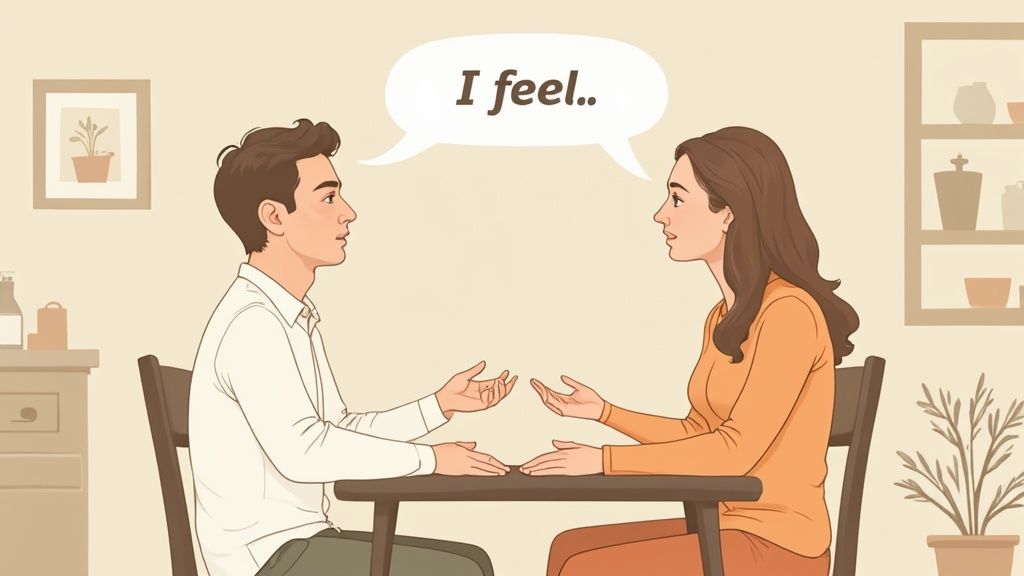
Figuring out how to even start a conversation about his drinking is often the hardest part. It can feel like walking on eggshells. The best way in? Find a calm, sober moment to talk. Frame your concerns with "I" statements, focusing on how his drinking is affecting you rather than pointing fingers.
How to Start a Conversation About His Drinking
The thought of confronting your husband about his alcohol use can be absolutely paralyzing. You worry it will spark a huge fight, push him further away, or just make everything worse. Those fears are completely valid.
But opening a line of communication is the critical first move—for his sake, and for yours.
The goal of this initial talk isn't to force a confession or demand he quit on the spot. It’s about planting a seed. It’s about showing him that you’re coming from a place of love and genuine concern, not anger.
Choosing the Right Time and Place
Timing is everything. Trying to talk when he’s intoxicated, hungover, or when either of you is already stressed or angry is a recipe for disaster. It’s guaranteed to end in defensiveness and get you nowhere.
Instead, wait for a moment when you are both calm, sober, and have some privacy. This might be on a quiet weekend morning over coffee or one evening after the kids are in bed and the house is settled. A neutral, comfortable setting where you won't be interrupted is key.
Framing the Conversation with Care
How you bring it up sets the tone for everything that follows. Avoid accusatory language like "You always…" or "You have a problem." That kind of talk will just make him throw up a defensive wall, and the conversation will be over before it starts.
A much more effective approach is using "I" statements to share how you feel. This shifts the focus to the impact of his behavior without assigning blame.
Here’s what that looks like in practice:
- Instead of: "You're embarrassing when you drink."
- Try: "I felt hurt and lonely at the party last night when we had to leave early."
- Instead of: "You need to stop drinking and driving."
- Try: "I feel terrified when I know you're driving after you've been drinking."
This technique is a cornerstone of therapeutic approaches like motivational interviewing because it builds a bridge instead of a battlefield. You're trying to help him see the consequences through your eyes.
The objective here is to open a door for honest communication, not to win an argument. Be prepared for him to get angry or deny it. Stand your ground, but do it with calm, loving statements about your own experience.
The stakes are incredibly high. Excessive drinking is linked to approximately 385 deaths every single day in the U.S., with men being three times more likely than women to die from alcohol-related causes.
These aren't just numbers; they're a stark reminder of why your voice matters. Family involvement and open dialogue are often the first crucial steps in guiding someone you love toward getting the help they need. You can discover more insights about alcohol's global impact from the World Health Organization.
Before you can figure out how to help your husband, you have to get a clear-eyed view of what you’re actually dealing with. Alcoholism, which clinicians now call Alcohol Use Disorder (AUD), isn’t a choice or a simple lack of willpower. It’s a chronic, relapsing brain disease.
This isn’t just semantics—it’s a critical shift in perspective. His brain has been physically rewired by long-term alcohol use, creating a powerful compulsion that overrides rational thought, promises, and even his own desire to stop. Seeing it as a disease moves the focus from blame and frustration to strategy and support.
It's a Ripple Effect, Not a Solo Act
Alcoholism is never a one-person problem. It’s a condition that pulls the entire family into its orbit, creating chaos and forcing everyone to adapt. Over time, family members start taking on unspoken roles and developing unhealthy coping skills just to survive the day-to-day stress.
You might find yourself walking on eggshells, making excuses for his behavior at work, or downplaying his drinking to friends and family. These actions almost always come from a place of love and a fierce desire to protect your family. But without realizing it, they can become a form of enabling that insulates him from the real-world consequences of his drinking.
Living with an alcoholic spouse often means falling into a pattern of self-blame, trying to control their drinking, and making excuses for them. The first, most powerful step toward breaking this cycle is simply recognizing that it's happening.
This struggle is far more widespread than most people think. Around the world, alcohol use disorders affect an estimated 400 million adults. The problem hits men especially hard, who account for 2 million of the 2.6 million alcohol-related deaths each year.
Despite these staggering numbers, only a tiny fraction—about 7.2% of people with AUD—ever get professional treatment. This highlights a massive gap in care and just how hard it is to take that first step. You can read more about these alcohol addiction statistics to better understand the scale of the issue.
Have You Fallen Into One of These Roles?
In families grappling with addiction, certain unhealthy dynamics tend to emerge. See if any of these sound familiar. Recognizing these patterns is a huge step toward changing them.
- The Enabler: This is often the spouse. You’re the one who calls him in sick to work, pays the bills he forgot, or cleans up his messes—all to shield him from the fallout.
- The Hero: This is usually an older child who becomes a high achiever. They try to bring positive attention to the family through good grades or sports, hoping to mask the dysfunction at home.
- The Scapegoat: This is the child who acts out. They’re often blamed for the family’s problems, which conveniently diverts attention away from the drinking.
Identifying where you and your children fit can be a real eye-opener. It helps you see exactly how the disease has shaped your family’s interactions and gives you a starting point for building healthier, more honest ways of relating to one another.
Setting Boundaries That Protect Your Well-Being
When you're trying to figure out how to help an alcoholic husband, it’s far too easy to let your own needs get lost in the chaos. But here's a truth that took me a long time to learn: supporting him should never come at the expense of your own mental, emotional, or financial health.
Setting and sticking to healthy boundaries isn’t about punishment or control. It’s an act of self-preservation, and it's one of the most critical steps in breaking the cycle of addiction that has taken over your home.
A boundary is simply a rule you set for yourself—what you will or will not do, tolerate, or participate in. This is completely different from an ultimatum, which is a threat designed to force someone else's behavior.
Let's break that down with a real-world example:
- Ultimatum (Controlling): "If you drink again, I'm leaving you."
- Boundary (Protecting): "I will not stay in the house with you when you are drinking. If you start, I will go to my sister's for the night."
The first is a threat meant to control him. The second is a clear, calm statement of what you will do to protect yourself. That shift in focus is everything.
Alcoholism starts in the brain, but it doesn't stay there. It quickly weaves its way into the fabric of the entire family, which is why your individual well-being is so central to everyone's potential for healing.
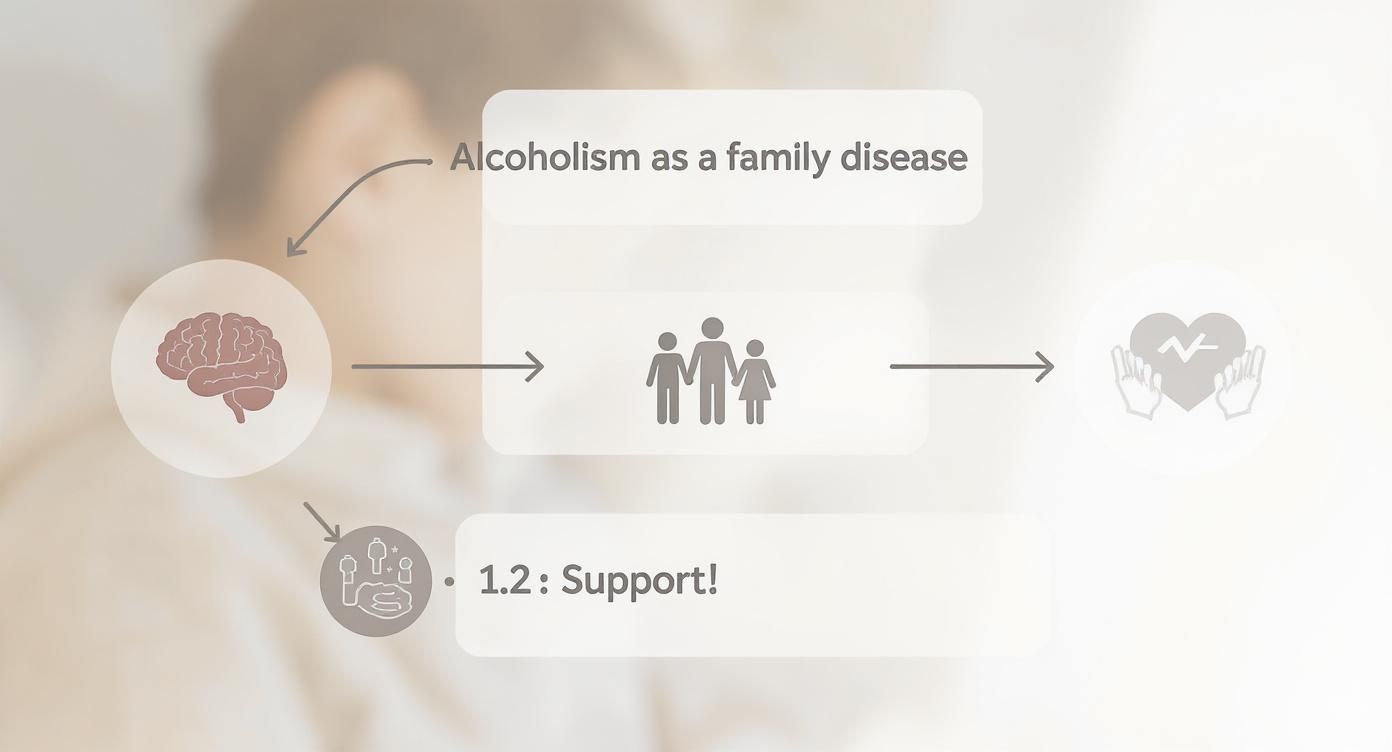
As the infographic shows, what begins as a disease of the brain quickly becomes a family system problem. This is exactly why your personal boundaries are non-negotiable.
Identifying Your Essential Boundaries
Figuring out where to even start with boundaries can feel overwhelming. My advice? Don't try to build a fortress overnight. Instead, focus on the areas where your safety, stability, or sanity are most at risk.
You aren't creating a long list of rules for him to follow. You're identifying a few non-negotiable lines for you that will have the biggest positive impact on your life. For a deeper dive, our guide on setting boundaries in recovery can offer more specific strategies on how this empowers both partners.
Here are a few practical examples of boundaries you might need to establish:
- Financial Boundaries: "I will no longer use our joint savings to pay off your credit card debt or any legal fees that come from your drinking." This isn't about being cruel; it's about protecting your family's financial future from being drained by the addiction.
- Emotional Boundaries: "I will not argue with you or get into serious conversations when you're intoxicated." This saves you from those soul-crushing, circular arguments that go nowhere and leave you feeling exhausted and hopeless.
- Behavioral Boundaries: "I am no longer going to lie to your boss, friends, or family to cover for you when you're hungover or miss an obligation." This stops you from enabling the behavior and forces him to face the natural consequences of his own actions.
Setting boundaries is about reclaiming control over your life and actions, not his. It teaches him the natural consequences of his choices while protecting you from the chaos.
The Hardest Part: Sticking To Your Boundaries
Let’s be honest—setting the boundary is the easy part. Enforcing it is where the real work begins. Your husband will almost certainly test your new boundaries, whether he means to or not, just to see if you’re serious.
This is where consistency becomes your most powerful tool.
When you follow through—when you actually pack a bag and go to your sister’s house the moment he starts drinking—you send a message that’s impossible to ignore. You are teaching him, and more importantly, you are teaching yourself, that your well-being matters.
It will feel hard. You might feel guilty or selfish at first. But this is how you start to dismantle the destructive patterns that allow addiction to thrive. It’s how you begin to heal, whether he chooses recovery or not.
Healthy Boundaries vs Unhealthy Enabling
It's easy to confuse helping with enabling. This table clarifies the difference by showing how a healthy boundary protects you, whereas an enabling action unintentionally allows the destructive behavior to continue.
| Situation | Healthy Boundary (Your Action) | Unhealthy Enabling (Your Action) |
|---|---|---|
| He's too hungover for work. | You state, "You'll need to call your boss yourself to explain." | You call his boss and make up an excuse for his absence. |
| He spends bill money on alcohol. | You open a separate bank account for your paycheck and essential bills. | You use your savings or borrow money to cover the bills he neglected. |
| He starts a fight when drunk. | You say, "I'm not discussing this with you now. We can talk when you're sober." Then you leave the room. | You engage in the argument for hours, trying to reason with him. |
| He asks you to lie for him. | You say, "I'm not comfortable lying for you. You need to handle this." | You lie to friends or family to hide his drinking or its consequences. |
Seeing the contrast laid out like this can be a real eye-opener. The goal is to shift your actions from the "Unhealthy Enabling" column to the "Healthy Boundary" column, one situation at a time. It's a gradual process of reclaiming your peace.
Finding the Right Professional Help and Support
Facing alcoholism isn’t a battle you or your husband should fight alone. Professional help brings the structure, medical oversight, and therapy needed for real, lasting recovery. Your role as an ally is to understand the options so you can offer concrete solutions when he’s finally ready to listen.
The world of addiction treatment can feel overwhelming at first, but it’s designed to meet people wherever they are. There’s no one-size-fits-all cure; instead, it’s a continuum of care that adapts to what your husband needs right now.
Understanding the Different Levels of Care
For many, the first step is a medical detox. This is a supervised process that helps manage the physical symptoms of alcohol withdrawal, which can be uncomfortable and even dangerous. After detox, treatment usually moves into one of several levels of intensity.
- Inpatient or Residential Treatment: This means living at a treatment facility for a period, typically 30 to 90 days. It’s an immersive, structured environment that removes the triggers of everyday life, making it a critical option for those with severe addiction.
- Partial Hospitalization Programs (PHP): A step down from residential care, a PHP offers treatment at a facility for several hours a day, several days a week, while the person lives at home or in a sober living environment.
- Intensive Outpatient Programs (IOP): This is an even more flexible option. Treatment sessions happen a few times a week for a few hours at a time, often scheduled in the evenings to work around a job or family commitments.
- Outpatient Therapy: This involves meeting regularly with a therapist or counselor. They’ll often focus on practical skills, like Cognitive Behavioral Therapy (CBT), to help change the negative thought patterns tied to his drinking.
You can learn more about what daily life looks like in these programs by exploring our guide on how rehab works. Demystifying the process can make it seem much less intimidating for both of you.
The Power of Peer and Family Support
Professional treatment is the foundation, but ongoing support is what keeps recovery strong. Peer groups create a sense of community and understanding that is absolutely essential. Alcoholics Anonymous (AA) can give your husband a network of people who get what he’s going through and can offer practical, day-to-day encouragement.
Just as importantly, you need your own support system. Al-Anon is a group created specifically for the families and friends of alcoholics. It’s a safe place to share what you’re going through, learn healthy coping skills, and realize you are far from alone in this.
Finding the right support for yourself is not a luxury—it’s a necessity. You cannot pour from an empty cup, and Al-Anon helps refill it by connecting you with others who truly understand.
The physical toll of alcoholism is severe and can be a powerful motivator for change. In 2023, alcoholic liver disease was a factor in 44.5% of all liver disease deaths in the U.S. For men, that number is even higher, with alcohol contributing to 56.8% of cirrhosis deaths. These statistics are a stark reminder of the life-or-death importance of getting help, especially since the highest rates are seen in men aged 25-44.
While navigating treatment options, you might also find that the addiction has exposed deeper issues in your relationship. Exploring resources like marriage counseling exercises to strengthen your bond can be a powerful way to heal and reconnect. Your role is to be a prepared, supportive partner, ready with well-researched options when that window of opportunity finally opens.
Why Your Own Self-Care Is Non-Negotiable

Living with a partner who drinks is a marathon of chronic stress, not a sprint. The constant worry, the broken promises, and the emotional roller coaster can leave you feeling completely hollowed out. It’s dangerously easy to pour all your energy into trying to fix him, forgetting the one person who needs your care the most—you.
Let me be clear: taking care of yourself isn't selfish. It's a critical survival strategy. You can't be a calm, effective support system if your own well is dry. Prioritizing your own mental and physical health is what builds the resilience you need to walk this path without losing yourself along the way.
Beyond the Basics of Self-Care
Real self-care in this situation goes way beyond bubble baths or a night out with friends. It’s about intentionally building a fortress of support and coping skills strong enough to withstand the unique pressures of loving someone with an addiction. It’s about protecting your own sanity from the fallout.
This means finding outlets that genuinely recharge you and remind you that you have an identity completely separate from his illness.
- Seek Your Own Therapy: A good therapist provides a confidential space to unload your grief, anger, and exhaustion without judgment. They can also give you professional guidance on managing stress and actually holding the boundaries you’ve set.
- Find Your People: You are not the only one going through this. Connecting with others who get it is incredibly powerful. You can find excellent support groups for spouses of alcoholics that offer a community built on shared experience and hard-won wisdom.
- Reconnect with Hobbies: Deliberately carve out time for things you used to love, whether that's gardening, reading a novel, or just grabbing coffee with a friend. These moments are vital for reminding you who you are outside of the chaos.
Self-care isn't about escaping your reality. It's about building the strength and clarity needed to face it head-on, day after day, without letting it consume you.
Cultivating Inner Resilience and Compassion
The emotional toll of this experience is immense and often leads to anxiety, depression, and a profound sense of isolation. Research confirms that spouses of alcoholics face significant hits to their own physical and emotional well-being. This is precisely why your internal coping strategies are just as important as any external support.
In the middle of all this, it is crucial to practice self-compassion. This means treating yourself with the same kindness and understanding you’d give a dear friend walking in your shoes. Acknowledge that your feelings are valid and that you’re doing the best you can in an impossibly difficult situation.
Building this inner strength is absolutely non-negotiable. It’s what gives you the stamina to maintain your boundaries, offer support from a healthy place, and make clear-headed decisions for yourself and your family. Your well-being is the anchor that will keep the entire ship from sinking, no matter which way the storm turns.
Your Toughest Questions Answered
When you’re trying to navigate your husband’s alcoholism, the path forward is rarely clear. It’s filled with painful, confusing questions that can keep you up at night. Below are some of the most common ones we hear from spouses, with direct answers to help you find your footing.
What Do I Do If He Refuses to Admit He Has a Problem?
This is probably the most frustrating hurdle you'll face. But it’s crucial to understand that denial isn’t just stubbornness—it's a core symptom of addiction. If your husband can’t or won’t see that his drinking is an issue, your most powerful move is to stop trying to change his mind and start changing your own actions.
Forget the arguments and pleading. Instead, focus on enforcing the boundaries you’ve set and get support for yourself through groups like Al-Anon. Sometimes, the only thing that can break through the denial is letting him experience the natural consequences of his drinking, without you there to run interference.
You can’t force him to see the truth. But you can create a new reality where his denial no longer controls your life.
Letting him explain to his boss why a project is late or feel the sting of a friendship he damaged—without you stepping in to fix it—is often a more effective wake-up call than any conversation you could ever have.
Should I Try Staging an Intervention?
An intervention can feel like a dramatic, last-ditch effort, and sometimes it works. But it’s not something to jump into on an impulse. A poorly planned confrontation can backfire spectacularly, digging him deeper into resentment and making him even more resistant to the idea of treatment.
A successful intervention requires meticulous planning, and it's best done with professional guidance. A certified interventionist can be invaluable here. They know how to:
- Frame the conversation: They'll help ensure the focus stays on love and concern, not blame and anger.
- Pick the right people: A professional helps select family and friends who can communicate calmly and stick to the script.
- Have a clear next step: They’ll have a treatment facility lined up and ready for immediate admission, closing the window for excuses or second thoughts.
Never, ever stage an intervention out of desperation or rage. It must be a carefully orchestrated, loving effort designed to connect him with immediate, professional help.
How Should I React If He Relapses?
First, breathe. Relapse is a common, though gut-wrenching, part of the recovery process for many people. It doesn't mean he’s failed or that all hope is lost. Think of it as a sign that his recovery plan needs to be adjusted.
Your immediate reaction here is critical. This is not the time for blame, shame, or “I told you so.” Stay calm and encourage him to reconnect with his support system right away—his sponsor, his therapist, his support group. For you, this is the moment to lean hard on your own support network and double down on your boundaries. Addiction is a chronic disease, and learning how to manage a relapse is a critical skill for both of you.
When Is It Time to Think About Leaving?
This is the hardest question, and there's no easy, one-size-fits-all answer. It’s a deeply personal decision.
However, there is one absolute, non-negotiable line: your safety and the safety of your children. If there is any physical, emotional, or financial abuse, your priority must shift immediately to creating a safety plan and getting out.
Beyond immediate safety, it might be time to seriously consider leaving if you’ve set boundaries, sought help, and done the work, but his addiction continues to escalate. If the relationship is causing irreparable damage to your own mental, physical, and emotional health, you have to weigh that cost. Working with your own therapist can provide the clarity and support you need to navigate this incredibly difficult choice.
At Altura Recovery, we see every day how addiction impacts the entire family system. If you need guidance on helping your husband while protecting your own well-being, our compassionate clinicians are here. Explore our comprehensive outpatient programs and let us help your family find a path toward healing.