
Experiential family therapy isn't about sitting on a couch analyzing the past; it’s an active, hands-on approach that helps families heal by doing things together, right here and now. It’s built on the idea that to truly fix broken connections and understand deep-seated emotions, you have to experience new ways of relating to each other—not just talk about them. This makes it an incredibly powerful tool for tackling complex issues like addiction and trauma, where words alone often fall short.
Understanding the Heart of Family Healing
Picture a mobile hanging from the ceiling. If you gently touch one of the hanging shapes, the whole structure moves. The other pieces shift, sway, and find a new balance. That simple image perfectly captures the core idea behind experiential family therapy. No one in a family operates in a vacuum. Each person’s actions, feelings, and struggles create ripples that touch everyone else.
When a major challenge like substance use or a co-occurring disorder hits a family, it’s like a storm rocking that mobile. The entire system is thrown off-kilter. Communication gets tangled, trust frays, and unhealthy patterns start to feel normal. Families often create unspoken rules and roles just to survive the stress, but these coping mechanisms can end up trapping everyone and preventing real healing from ever starting.
Moving Beyond Surface-Level Talk
Traditional talk therapy is essential, but sometimes, it’s not enough. This is especially true when you're dealing with old wounds or conflicts that have been buried for years. Experiential family therapy carves a different path forward. It works on a simple principle: real change happens when you live out new ways of interacting, not just when you analyze the old, broken ones.
Instead of just discussing feelings abstractly, a therapist guides the family through a structured activity designed to pull those hidden dynamics out into the open. The goal is to interrupt the rigid, automatic ways you respond to each other and create a safe space for genuine emotions to finally come out in the "here and now."
The focus of experiential therapy isn't to point fingers or assign blame. It's about healing the entire family system by helping each person see their role in the family dance and learn new steps—together.
Why This Approach Is So Effective
This hands-on, in-the-moment method is uniquely suited for untangling the complex knots that fuel addiction and mental health struggles. It helps families by:
- Revealing Hidden Patterns: Many families have no idea what "rules" they're playing by. Through activities like role-playing or creating a "family sculpture," those invisible forces suddenly become visible, and you can finally see what’s really going on.
- Building Emotional Safety: Addiction shatters trust. By creating a guided, safe space to be vulnerable, this therapy helps families carefully rebuild that trust, which is the foundation for any real connection.
- Fostering Empathy: When you’re guided to literally stand in another family member’s shoes, you gain a powerful, gut-level understanding of their perspective. It’s an experience that melts away resentment and makes room for compassion.
- Practicing New Skills: The therapy room becomes a safe "rehearsal space." Here, you can practice healthier ways to communicate, set boundaries that stick, and offer support that actually helps, all with a therapist there to guide you.
This approach doesn't just talk about change—it helps you live it, right there in the room. By sharing these experiences, families can finally break free from painful cycles, forge authentic connections, and build a resilient foundation for a future rooted in recovery.
The Core Principles That Guide Experiential Family Therapy
Experiential family therapy operates on a few foundational ideas that completely shift the focus from endlessly analyzing problems to actively experiencing solutions in real-time. Unlike approaches that can get stuck dissecting past events, this therapy zeroes in on what is happening emotionally and behaviorally in the room, right here and now. This immediate, present-moment focus is its guiding star.
Think about a typical family dinner. A parent asks, "How was your day?" and the teenager, eyes glued to their phone, mumbles, "Fine." The word is "fine," but the feeling it sends is one of total disconnection. Experiential therapy doesn't get bogged down by the surface-level word; it dives straight into the underlying experience, asking what "fine" actually feels like in that moment.
Fostering Authentic Emotional Expression
A central goal here is to help family members share their true, authentic feelings rather than hiding behind the scripted roles they’ve adopted over the years. In families grappling with addiction, these roles—the caretaker, the hero, the scapegoat—can become rigid prisons that make genuine connection impossible.
The core belief is that emotional suppression is the root of family dysfunction. When feelings are buried, they fester and emerge sideways as conflict, resentment, or enabling behaviors that fuel substance use.
Therapy sessions become a safe container where it’s finally okay to be vulnerable. It encourages each person to say what they truly mean and feel, moving away from a polite frictionlessness that masks pain and toward an honesty that actually fosters healing.
This diagram shows how experiential therapy gets at those unspoken rules and hidden patterns by bringing them to life through real-time action.
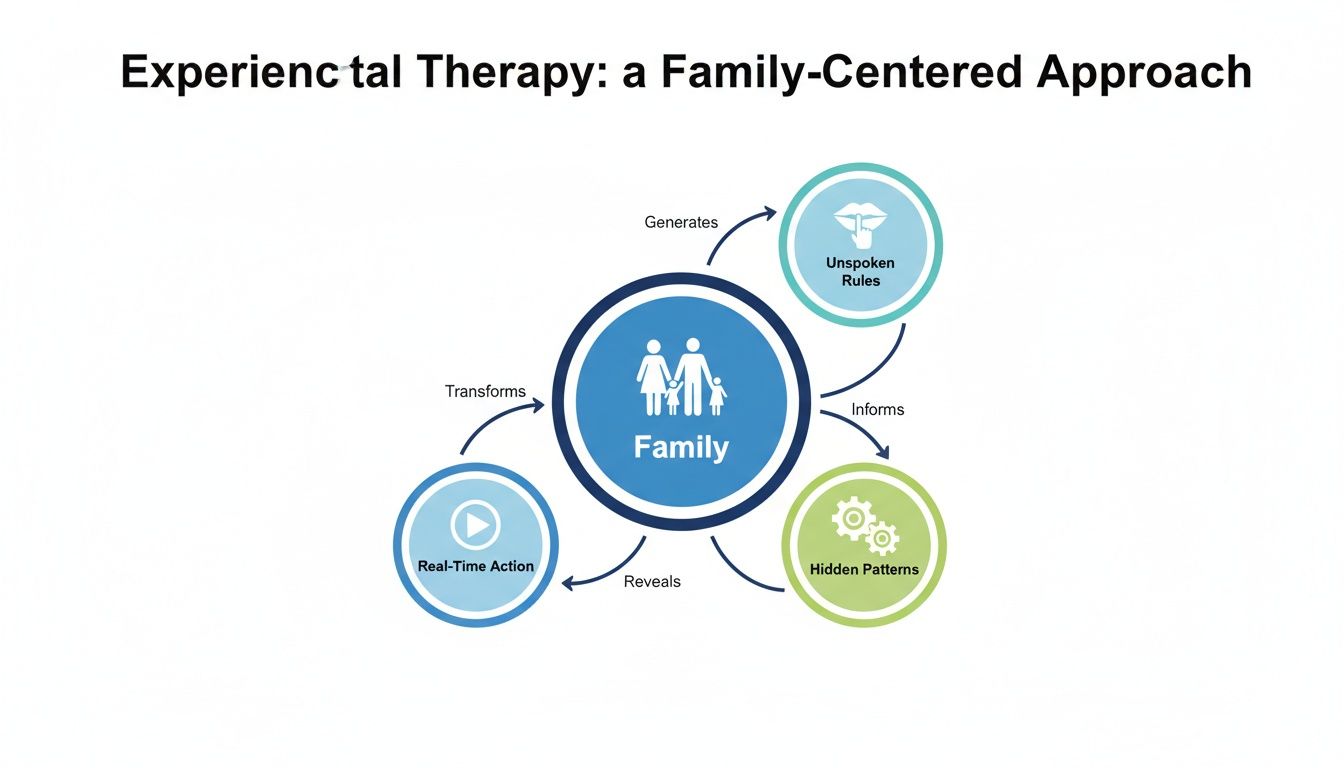
As you can see, it’s a dynamic process. The therapy works to make the invisible dynamics inside a family visible and, most importantly, actionable.
Building Individual Self-Worth and Congruence
Another cornerstone is boosting the self-worth of each individual in the family. When self-esteem is low, people often seek validation in unhealthy ways or simply lose their voice within the family system. By fostering self-acceptance, the therapy empowers each person to engage with others from a place of strength, not desperation.
This naturally leads to the vital concept of congruent communication, which is when a person’s words, body language, and underlying feelings are all aligned. For example, instead of saying "I'm not mad" with clenched fists, a congruent person would say, "I feel angry when this happens." This alignment is the absolute bedrock of trust. When family members can trust that what they see is what they get, emotional safety finally has a chance to flourish.
To bring these principles together, here’s a quick look at how they translate into practice during a therapy session.
| Core Principles of Experiential Family Therapy |
|---|
| A summary of the foundational concepts that guide experiential therapy sessions, with practical implications for families. |
| Principle |
| What It Means In Practice |
| Focus on the "Here-and-Now" |
| Therapists guide conversations away from recounting old stories and toward the emotions and interactions happening in the room. |
| Emotional Expression is Key |
| Family members are encouraged to voice feelings directly, using "I feel…" statements, instead of bottling them up or blaming others. |
| Authenticity Over Roles |
| Activities help people step out of rigid roles (e.g., the "responsible one") and interact as their genuine selves. |
| Growth Through Experience |
| Sessions involve activities like role-playing or family sculpting to make underlying dynamics tangible and changeable. |
| Enhancing Self-Worth |
| Each person's perspective is validated, helping them build the confidence to communicate honestly. |
| Congruent Communication |
| The therapist points out misalignments between words and body language to foster direct, trustworthy communication. |
These guiding principles don't just teach new communication skills; they work together to dismantle the defensive patterns that keep families stuck. They foster an environment where genuine emotional connection can finally become possible again, creating a strong foundation for recovery.
Key Techniques Used in Experiential Family Therapy
Talk therapy is powerful, but sometimes words aren't enough to get to the heart of the matter. Experiential family therapy uses a toolkit of creative, interactive exercises designed to bring those hidden emotional currents right to the surface.
The whole point is to move beyond just talking about problems and allow families to physically and emotionally experience their dynamics in real-time. This active, hands-on approach is what sparks deep insights and lasting change, making therapy feel less like a clinical analysis and more like a collaborative journey of discovery. These methods create a safe, structured space where families can finally see, feel, and reshape the invisible forces that have been running their relationships.
Family Sculpting: Revealing Emotional Truths
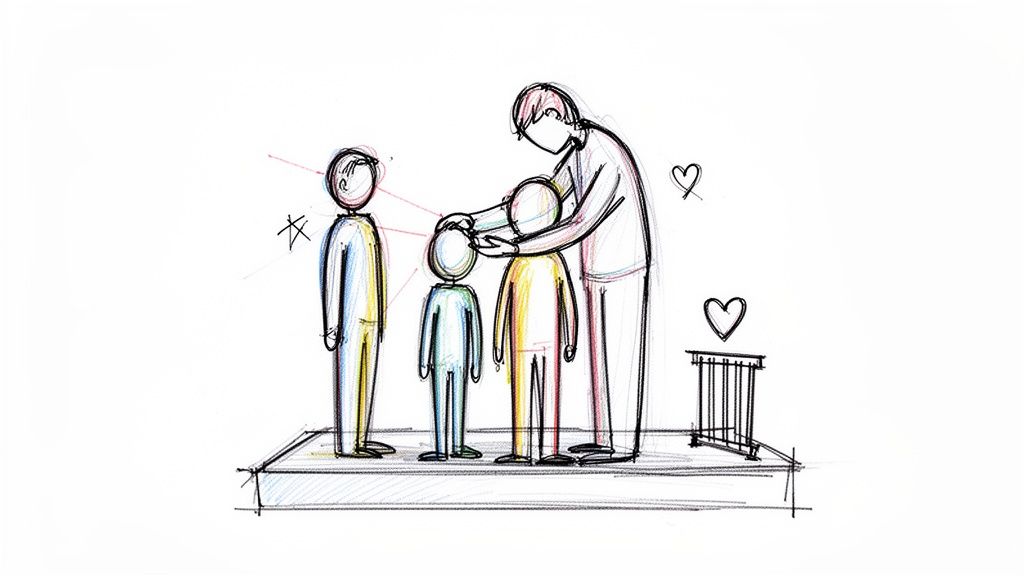
One of the most powerful techniques in the playbook is family sculpting. Imagine a therapist asks one person to act as a "sculptor." Their job is to physically arrange the other family members into a living statue—a silent, physical snapshot of their inner emotional world.
Who is standing close together? Who is turned away, staring at the floor? Is someone towering over another in a position of power, or is someone left completely out of the group?
This single exercise creates a stunningly clear visual metaphor for the family's emotional landscape. It bypasses verbal defenses and makes abstract feelings like "distance" or "control" tangible and impossible to ignore. For the first time, family members can literally see how their emotional states impact the entire system, sparking a profound sense of empathy and awareness.
Role-Playing: Practicing New Ways to Connect
Another core technique is role-playing. This isn't about putting on a theatrical performance; it's about safely rehearsing difficult conversations and trying out new, healthier behaviors in a supportive environment.
A parent might practice setting a firm but loving boundary with their teenager about substance use. Siblings might role-play how to resolve a conflict without immediately resorting to blame and yelling. The therapy room becomes a rehearsal space where families can test-drive new communication scripts with a guide. This guided practice builds confidence and muscle memory, making it far more likely they’ll use these healthier patterns at home during a real, high-stress moment.
Role-playing allows families to step outside their automatic reactions. By trying on different perspectives and practicing new responses, they break free from old, destructive cycles and learn to interact with intention and empathy.
Using Metaphors and Symbolic Expression
Sometimes, emotions are just too big, complex, or painful for words. This is especially true for children or anyone who has experienced significant trauma. Experiential family therapy brilliantly uses metaphors and symbolic tools to bridge that gap.
- Creative Arts: Using drawing, painting, or clay gives family members a non-verbal outlet. A child might draw their family as a small boat in a raging storm, opening a powerful door to discuss feelings of instability and fear.
- Symbolic Play: Therapists might use simple objects to represent emotions or challenges. A heavy stone could symbolize a burden of guilt, and the family can then work together to decide how to share or set down that weight.
- Music and Movement: Engaging in rhythmic activities or making music together can help families connect on a more primal, non-verbal level. This can dissolve tension and rebuild a sense of shared joy that addiction may have eroded.
These creative methods make intimidating dynamics feel more accessible. They give every family member—regardless of age or verbal skill—a voice in the healing process.
Many of these foundational techniques are rooted in the pioneering work of Virginia Satir. Her model was built on exploring a family's history to address hidden issues. A key part of her approach, known as reconstruction, used experiential interventions like sculpting and role-playing to empower clients as the main agents in their own healing. You can learn more about how these interventions create an immersive therapeutic environment on psychologywriting.com.
How Experiential Family Therapy Transforms Addiction Recovery
When addiction takes root in a family, it rarely travels alone. It brings a tangled mess of codependency, enabling habits, and old wounds along for the ride. While traditional talk therapy helps families unpack these issues verbally, experiential family therapy offers something different: a hands-on way to dismantle the very systems that let addiction breathe.
Think of it this way: addiction is often a symptom of deeper, unspoken problems within the family unit. Ingrained roles—like the over-responsible caretaker or the rebellious scapegoat—create a predictable but deeply unhealthy environment. In this system, certain behaviors, even those coming from a place of love, can accidentally keep the cycle of substance use spinning.
This is where experiential family therapy really shines. It stops pointing fingers at the person with the addiction and starts healing the entire family dynamic.
Uncovering the Roots of Enabling
Let's look at a common scenario. A young adult is struggling with alcohol, and their parents keep making excuses for missed classes, paying their overdue bills, and cleaning up the fallout. From where the parents stand, they're just being supportive, trying to prevent their child from hitting rock bottom. They’re trying to help.
In an experiential session, a therapist might bring this dynamic to life using a technique like role-playing or family sculpting. The parents could be asked to physically hold their child up, forcing them to feel the literal weight of that responsibility.
Through this guided experience, the family doesn't just talk about enabling—they feel it in their bones. The parents realize their "helpful" actions have been erasing natural consequences, making it easier for the addiction to persist. The young adult feels the awkwardness of being propped up, seeing their own lack of agency in the situation.
This isn’t about assigning blame. It's about revealing the hidden dance of the family system so everyone can learn new, healthier steps. The goal is empowerment, not judgment.
This process helps everyone see that addiction isn’t a solo act; it’s a role played within a larger family script. By making these patterns visible and felt, families can finally start rewriting that script together.
Building a Foundation for Lasting Sobriety
Lasting recovery needs a strong, honest support system to stand on. Experiential family therapy builds that foundation by focusing on two crucial areas: emotional honesty and healthy boundaries. Addiction thrives where secrecy and stuffed-down feelings are the norm—where sharing what you really feel feels too dangerous.
Experiential activities create a safe laboratory for practicing vulnerability. Families learn to:
- Express Emotions Authentically: Instead of defaulting to "I'm fine," members are guided to say what’s really going on. "I feel scared when you don't come home," or "I feel angry when my feelings are dismissed."
- Set and Respect Boundaries: Role-playing becomes a rehearsal for setting boundaries that are firm but compassionate. A parent learns to say, "I love you, but I will not give you money for rent if you are actively using."
- Rebuild Trust Through Action: Trust isn't rebuilt with words and promises alone; it's rebuilt through consistent, reliable actions. The therapy sessions become a place to practice this new consistency.
By actively doing these things, families don't just learn about healthy communication—they live it. This transforms the family from a source of stress and triggers into a resilient support network. Each person develops the skills to support their loved one’s recovery while also protecting their own well-being, creating the best possible environment for sustainable, long-term sobriety.
Weaving Experiential Therapy with Other Proven Methods
Recovery isn't about finding a single magic bullet. The most profound, lasting change comes from a personalized plan that addresses healing from multiple angles—the emotional, the practical, and the psychological. While experiential family therapy is incredibly powerful for digging up the deep-seated roots of conflict, top-tier treatment centers know its effects are magnified when woven together with other evidence-based methods like Cognitive Behavioral Therapy (CBT), Dialectical Behavior Therapy (DBT), and Eye Movement Desensitization and Reprocessing (EMDR).
Think of it like building a house. Experiential therapy is the excavation. It gets right to the core of the family’s emotional structure, clearing the ground and revealing the “why” behind the pain and disconnection. But to build a resilient, functional home on that foundation, you need blueprints and tools. That’s where other therapies come in, providing the practical “how” to manage the day-to-day.
Complementary Tools for Complete Healing
Each therapeutic method brings a unique strength to the table. When combined, they create a comprehensive support system that addresses thoughts, feelings, behaviors, and past trauma all at once.
Cognitive Behavioral Therapy (CBT): This is the skill-building workhorse. While experiential therapy helps a family feel the impact of their dynamics, CBT gives them the concrete skills to challenge the destructive thought patterns that keep those dynamics in place. It’s the toolbox for developing healthier coping mechanisms when triggers pop up.
Dialectical Behavior Therapy (DBT): DBT is all about learning to manage big emotions and tolerate distress. After an experiential session unearths intense feelings, DBT offers practical mindfulness and communication skills to handle those emotions without falling back into old, unhealthy habits.
Eye Movement Desensitization and Reprocessing (EMDR): When individual or shared trauma is driving the addiction, EMDR is a vital component. It helps the brain process and file away traumatic memories, allowing individuals to heal from past events that might otherwise keep derailing the family’s progress.
This blended approach ensures that the emotional breakthroughs from experiential family therapy are anchored by the practical, skill-based tools needed for everyday life.
The Power of an Integrated Strategy
Combining these therapies isn't just a modern trend; it’s the evolution of what works. Experiential family therapy first made its mark in the 1960s and was a leading approach for nearly three decades. As cognitive theories gained traction, its popularity dipped, but a revival began around 1985 as clinicians recognized its irreplaceable value. You can find more details on this therapeutic evolution on study.com.
This history shows us that modern, effective programs don't view these methods as competitors. They are partners in healing.
An integrated treatment plan addresses the whole person and the entire family system. It honors the emotional depth uncovered by experiential work while equipping everyone with the cognitive and behavioral skills needed to sustain long-term recovery.
Ultimately, this combined strategy creates a powerful synergy. Families don't just understand their emotional triggers; they also have a toolkit of proven strategies to manage them. They don't just recognize unhealthy communication patterns; they have practiced and mastered new ways to connect. By addressing the roots of pain, the thoughts that fuel it, and the behaviors that result from it, this approach builds a truly resilient foundation for healing, growth, and lasting freedom from addiction.
What to Expect on Your Family Therapy Journey
Stepping into therapy for the first time can feel like staring at a blank map. It’s natural to feel a mix of hope and anxiety, especially when you’re opening up about deeply personal family challenges. This section is designed to fill in that map, giving you a clear picture of what the journey with experiential family therapy actually looks like, step by step.
Your journey doesn't begin with pointing fingers. It starts with understanding. The first few sessions are all about creating a safe, neutral space where every single family member feels heard and respected.
The First Steps: Building Trust and Safety
The therapist’s first and most important job is to build a foundation of trust. Think of them as a neutral guide, not a judge or referee. The initial goal is to simply understand the unique landscape of your family—its strengths, its pain points, and the unspoken rules that quietly shape your interactions.
A lot of people worry that therapy will just become a blame game, with one person singled out as "the problem." It's a common fear, but it’s the exact opposite of how experiential family therapy works.
The core idea is that there is no single "scapegoat." Instead, the focus is on the family system and how each person’s feelings and actions contribute to the bigger picture. The goal is always collaborative healing, not assigning blame.
You will never be pushed to share anything you aren't ready to discuss. The therapist’s role is to cultivate an environment where vulnerability feels safe, allowing honest communication to bubble up naturally, at a pace that feels right for everyone.
What Ongoing Sessions Look Like
As you move past the initial phase, sessions become more interactive and hands-on. The therapist will guide your family through carefully chosen activities designed to bring hidden dynamics to the surface in a way that feels constructive, not confrontational.
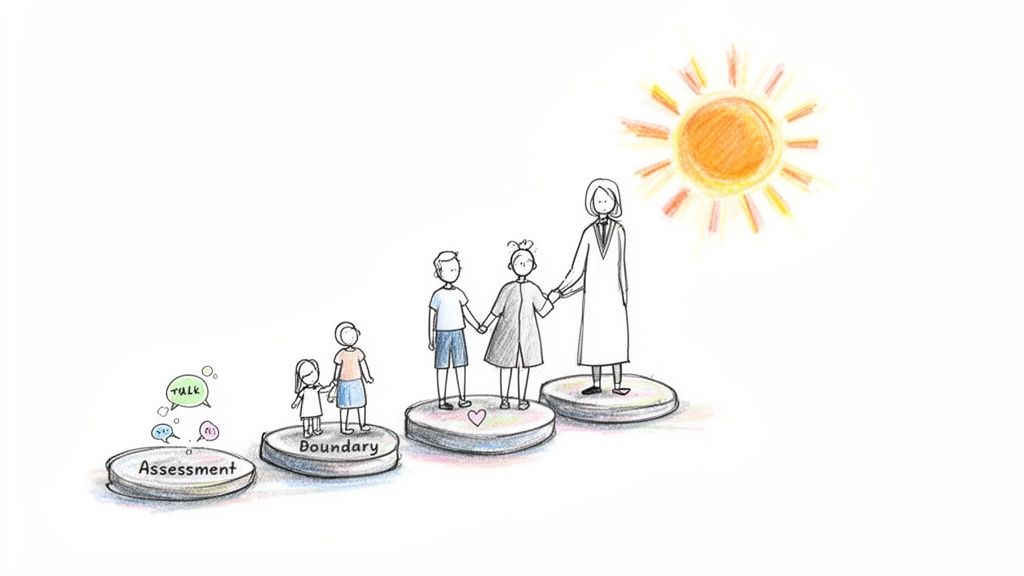
While every family's path is different, the process generally follows a clear structure:
- Initial Assessment: The therapist spends time getting to know each person and the family’s history, which helps them create a personalized roadmap for your sessions.
- Goal Setting: You’ll work together to define what a healthier, more connected future looks like for your family. What do you want to achieve?
- Experiential Activities: This is where the "doing" happens. Sessions will involve techniques like role-playing or family sculpting to explore relationships and feelings without just talking about them.
- Skill Building: You'll get to practice new, healthier ways of communicating and setting boundaries right there in the therapy room, with real-time feedback and support.
This entire process is designed to empower every member to become an active part of the family’s growth. By showing you what a supportive, personalized journey looks like, we hope you feel more confident and ready to take that brave first step toward real, lasting healing.
Frequently Asked Questions About Experiential Family Therapy
Stepping into family therapy can bring up a lot of questions. It's completely normal to want a clearer picture before you begin. To help you feel more confident and prepared, we've gathered answers to a few of the most common questions families ask about this unique approach.
How Long Does Experiential Family Therapy Usually Take?
There’s really no one-size-fits-all timeline. The length of therapy is unique to every family because every family's story is different. Some find they hit their stride and achieve their initial goals within just a few months.
For others, especially when dealing with more complex or long-standing dynamics, a longer period of support feels more beneficial. The real focus is always on making meaningful, sustainable progress—not just checking a box. Your therapist will work with you to set clear goals and will regularly check in to make sure the sessions are still on track and meeting your needs.
Will We Be Forced to Share Things We Are Not Comfortable With?
Absolutely not. The entire process is built on a foundation of safety, respect, and trust. You are always in control of what you choose to share.
A therapist's role here is to be a gentle guide, creating the right conditions for honest communication to flourish, not to pressure anyone. You will never be pushed to talk about anything you aren't ready to address. The goal is to build enough trust so that vulnerability feels like a choice, not a demand.
The therapeutic space is designed for safety. This allows each family member to participate authentically, opening up at a pace that feels comfortable and secure.
Is This Therapy Suitable for Families with Young Children?
Yes, and it's actually incredibly effective for families with younger kids. The beauty of this approach is its use of creative, non-verbal methods, which are perfect for children who might not have the words to express their big, complicated feelings.
Therapists are skilled at adapting the techniques to be age-appropriate and engaging. Some common methods include:
- Art and creative expression, like drawing or sculpting, which give kids a powerful way to show what's going on inside.
- Symbolic play, where objects are used to represent feelings or relationships, making abstract ideas feel more concrete.
- Family sculpting and movement, which allows children to participate physically and show their perspective without needing a lot of words.
These tools make sure everyone, from the youngest child to the oldest adult, has a meaningful voice in the family’s healing journey.
At Altura Recovery, we know that healing from addiction is a family affair. Our outpatient programs weave experiential family therapy into our care to help you rebuild connections and create a strong foundation for lasting recovery. To learn how we can support your family's journey, reach out to our compassionate team today at alturarecovery.com.