
When you’re trying to figure out the right level of addiction treatment, the acronyms can get confusing. Two of the most common options you'll hear about are Partial Hospitalization Programs (PHP) and Intensive Outpatient Programs (IOP). At first glance, they seem similar—both offer structured care while you live at home. But the real difference comes down to two key things: time commitment and clinical intensity.
Think of it this way: A Partial Hospitalization Program (PHP) is like a full-time job focused on your recovery. It’s a direct step down from 24/7 inpatient care. An Intensive Outpatient Program (IOP), on the other hand, offers more flexibility, designed to help you balance treatment with your existing work, school, or family life.
A Foundational Look at IOP vs PHP
Choosing the right program is one of the most important decisions you'll make on your recovery journey. It’s what matches the right level of support to where you are right now. Both PHP and IOP deliver evidence-based treatment without requiring you to live at a facility, but they are built for different stages of healing and different daily needs.
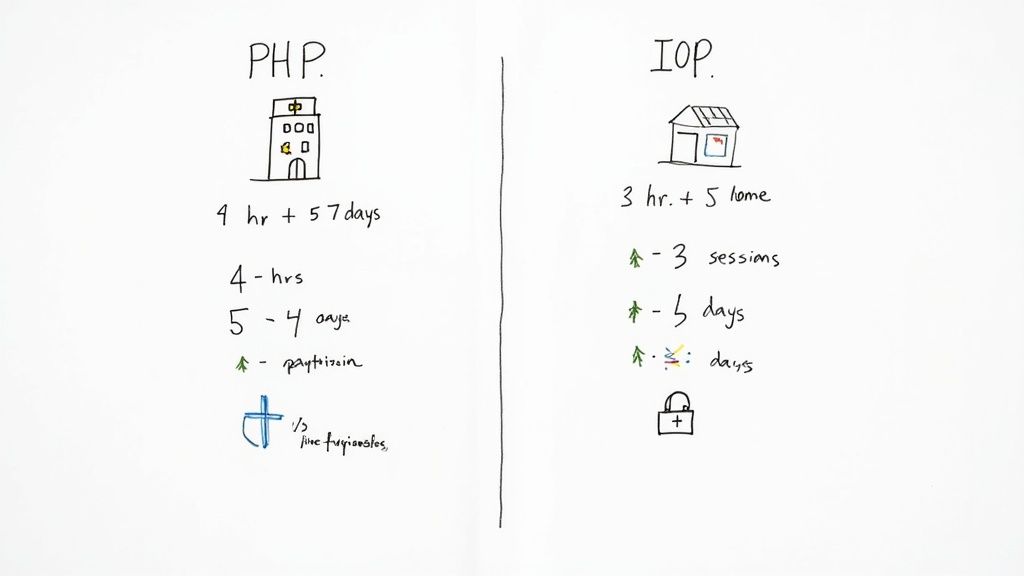
Understanding what each one offers is the first step. PHP is designed for people who need significant support and medical oversight but have a safe, stable home to return to each night. It perfectly bridges the gap between residential rehab and a more independent outpatient setting.
An IOP, however, is a better fit for someone who has already built a solid foundation in recovery and can handle their daily responsibilities with less direct supervision. To truly understand what an intensive outpatient program is, think of it as a place to practice recovery skills in the real world while still having a strong therapeutic safety net. Getting this distinction right ensures you get the right intensity of care at exactly the right time.
The primary goal is not just to find treatment, but to find the right fit. A PHP provides a containing, highly structured environment, whereas an IOP promotes autonomy and real-world integration.
To break it down even further, this table gives you a quick, side-by-side look at how IOP and PHP stack up against each other on the most important features.
Comparing Core Components of IOP and PHP
| Feature | Intensive Outpatient Program (IOP) | Partial Hospitalization Program (PHP) |
|---|---|---|
| Time Commitment | 9-12 hours per week (3-5 days/week) | 20-30 hours per week (5-7 days/week) |
| Daily Structure | 3-hour sessions, often in mornings or evenings | 4-6 hours of daily programming, similar to a full day |
| Ideal Candidate | Stable home life, stepping down from PHP, needs to work/study | Stepping down from inpatient care, needs high medical oversight |
| Clinical Intensity | Focus on group therapy and skill integration | Higher level of medical/psychiatric supervision and individual therapy |
As you can see, while both are powerful outpatient options, their structure and intensity are tailored to support individuals at very different points in their recovery.
Comparing Daily Structure and Time Commitment
When you get down to the brass tacks, the biggest practical difference between an IOP and a PHP is the schedule. It’s all about the time commitment, which shapes how treatment fits—or doesn't fit—into your daily life, your job, and your family responsibilities. Getting this piece right is critical for choosing a program that supports your recovery instead of overwhelming it.
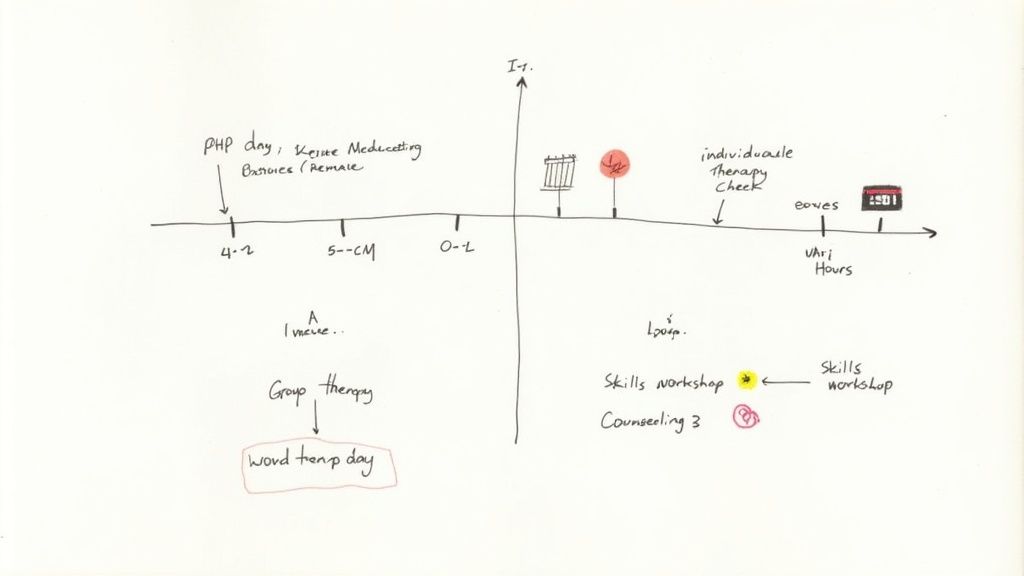
A Partial Hospitalization Program (PHP) is basically a full-time job focused on getting you well. You can expect to be in treatment for 20-30 hours a week. That usually breaks down to about four to six hours of programming, five to seven days a week, making it a highly intensive and structured environment.
An Intensive Outpatient Program (IOP), on the other hand, is built for flexibility. The schedule typically involves 9-12 hours of treatment each week. Sessions usually run for about three hours at a time, held three to five days a week, leaving plenty of room for work, school, or parenting.
A Day in the Life: PHP vs. IOP
To really see how these schedules play out, let's walk through a couple of real-world scenarios.
Scenario 1: The PHP Participant
Someone in a PHP might arrive at the treatment center around 9 AM for a packed day. Their schedule could look something like this:
- Morning: Kick off with a group therapy session on cognitive behavioral therapy (CBT), then meet one-on-one with their primary therapist.
- Lunch: A structured meal break, which might include a session on nutrition or a guided mindfulness exercise.
- Afternoon: Dive into an educational workshop on relapse prevention, followed by a check-in with a psychiatrist for medication management. The day wraps up with a final process group before they head home around 3 PM.
This kind of highly structured day provides constant support and minimizes the unstructured time where triggers can sneak in. It's an ideal setup for someone who needs serious stabilization.
A PHP schedule is demanding by design. It creates a therapeutic container that mimics the structure of residential care, giving you a safe and predictable environment during a fragile stage of recovery.
Scenario 2: The IOP Participant
Life in an IOP looks quite different. An individual might keep their day job and attend an evening program.
- Evening: They arrive at 6 PM for a three-hour session. This block of time typically includes a group check-in, a main therapy session focused on building coping skills, and a brief educational piece before they leave at 9 PM.
This setup allows them to maintain their career while still getting solid therapeutic support. The focus isn't just on stabilization; it’s about actively integrating recovery skills into a busy, real-world life. For many people, finding an outpatient drug rehab in Houston that works with their existing commitments is the deciding factor.
Ultimately, choosing between these programs comes down to an honest look at how much structure you truly need versus how much flexibility your life demands.
When you look past the weekly schedules, you get to the real heart of the matter: the clinical intensity and the kinds of therapy offered. It’s the biggest difference between a Partial Hospitalization Program (PHP) and an Intensive Outpatient Program (IOP). Both programs use similar evidence-based methods, but how they use them is calibrated for very different recovery needs.
The choice really boils down to how much medical and psychiatric support someone needs to get stable and start making progress.
The Clinical Depth of a PHP
A Partial Hospitalization Program (PHP) operates at a much higher level of clinical oversight. Think of it as a direct, non-residential alternative to inpatient rehab, designed for people who need serious medical and psychiatric stabilization to get back on their feet.
That intensity shows up in the services provided. In a PHP, the environment is immersive and deeply integrated with medical care. You’ll find participants have more frequent access to specialized professionals, which is non-negotiable for managing complex conditions.
- Psychiatric Oversight: Regular, often weekly, sessions with a psychiatrist for medication management are a cornerstone. This is critical for clients wrestling with severe co-occurring disorders like bipolar disorder, schizophrenia, or major depression.
- Medical Monitoring: It’s common for on-site nursing staff to be available to check vital signs, manage medications, and address physical health issues. This provides a layer of medical safety just shy of what you’d find in a hospital.
- Individual Therapy: Participants usually get more one-on-one counseling sessions. This helps them dive into deep-seated issues and build a strong, trusting relationship with their primary therapist right from the start.
A PHP is structured to be a clinical safety net. Its main goal is stabilization. It uses intensive medical and therapeutic support to help people navigate acute symptoms and build a solid foundation before they’re ready for a less structured setting.
The Therapeutic Focus of an IOP
An Intensive Outpatient Program (IOP), while still demanding, shifts its focus away from intense stabilization and toward real-world skill integration. The clinical services here are all about helping you apply recovery principles to your actual daily life—your job, your family, your social circles.
This means an IOP client still gets excellent, rigorous care, but the structure is less medically intensive. For example, psychiatric care is often coordinated with a client’s own outside provider rather than being a built-in, weekly part of the program. The real engine of an IOP is often its group therapy sessions, where real-life challenges get workshopped in real-time.
Here’s a look at how the same therapies might be applied differently in each setting:
| Therapeutic Modality | How It's Used in a PHP | How It's Used in an IOP |
|---|---|---|
| Cognitive Behavioral Therapy (CBT) | Focuses on tackling acute, distorted thoughts that pose an immediate threat to sobriety or mental stability. It’s about crisis management. | Emphasizes applying CBT skills to real-world stressors from work, home, or social events. It’s about practical application. |
| Dialectical Behavior Therapy (DBT) | Concentrates on foundational skills like distress tolerance and emotion regulation to manage crises and prevent relapse or self-harm. | Builds on those foundations, focusing on using mindfulness and interpersonal skills to navigate everyday challenges and relationships. |
At the end of the day, the difference isn't just about the number of hours you spend in treatment. It’s about what those hours are designed to accomplish. PHP is all about medical and psychiatric stabilization. IOP is about taking those hard-won recovery skills and weaving them into a functioning, sober life.
Who Is the Right Fit for Each Program?
Choosing between a Partial Hospitalization Program (PHP) and an Intensive Outpatient Program (IOP) isn’t about picking the “better” option—it’s about matching the right level of support to a person’s unique situation. The ideal candidate for each program looks very different, depending on their clinical needs, home environment, and where they are in their recovery journey.
Making the right call comes down to an honest look at the support required to build stability and keep moving forward. The difference between IOP and PHP becomes crystal clear when you consider the person each program was built to serve.
The Profile of a PHP Candidate
A Partial Hospitalization Program is designed for someone who needs significant clinical structure and medical oversight but is stable enough to return home each evening. Think of it as a direct step-down from residential treatment or a strong intervention to prevent a full inpatient stay.
Ideal candidates for a PHP often share a few key traits:
- They're transitioning from inpatient care. After leaving a 24/7 facility, they need a robust, structured environment to solidify their progress and prevent a quick relapse.
- They’re dealing with significant co-occurring disorders. Many are managing a serious mental health condition, like major depression or bipolar disorder, alongside substance use. Exploring options for dual diagnosis outpatient treatment is a critical step for them.
- Their home environment is unstable. While they have a place to sleep, their home life might be chaotic or full of triggers, making a full day of structured therapy a necessity.
- They struggle with daily functioning. Their symptoms are often severe enough to get in the way of work, school, or even basic self-care without intensive daily support.
Let’s look at an example: Sarah
Sarah just finished a 30-day residential program. She’s motivated, but she also battles severe anxiety and doesn't have a strong support system at home. A PHP gives her the daily structure and psychiatric oversight she needs to build a solid foundation before stepping down to a less intensive level of care.
The Profile of an IOP Candidate
An Intensive Outpatient Program works best for people who have a good degree of stability but still need consistent therapeutic support to navigate recovery. It’s all about balancing treatment with real-world responsibilities, making it a great fit for those who are already integrating recovery into an active life.
An ideal IOP candidate usually has:
- A stable and supportive living situation. Their home is a safe, sober, and encouraging place to be.
- Strong internal motivation. They are committed to recovery and can manage their own schedules and responsibilities without constant oversight.
- Existing work or school commitments. They need a program with flexible hours—often in the evenings—that allows them to keep up with their professional or academic life.
This decision tree infographic gives a great visual of whether a higher or lower clinical need points you toward PHP or IOP.
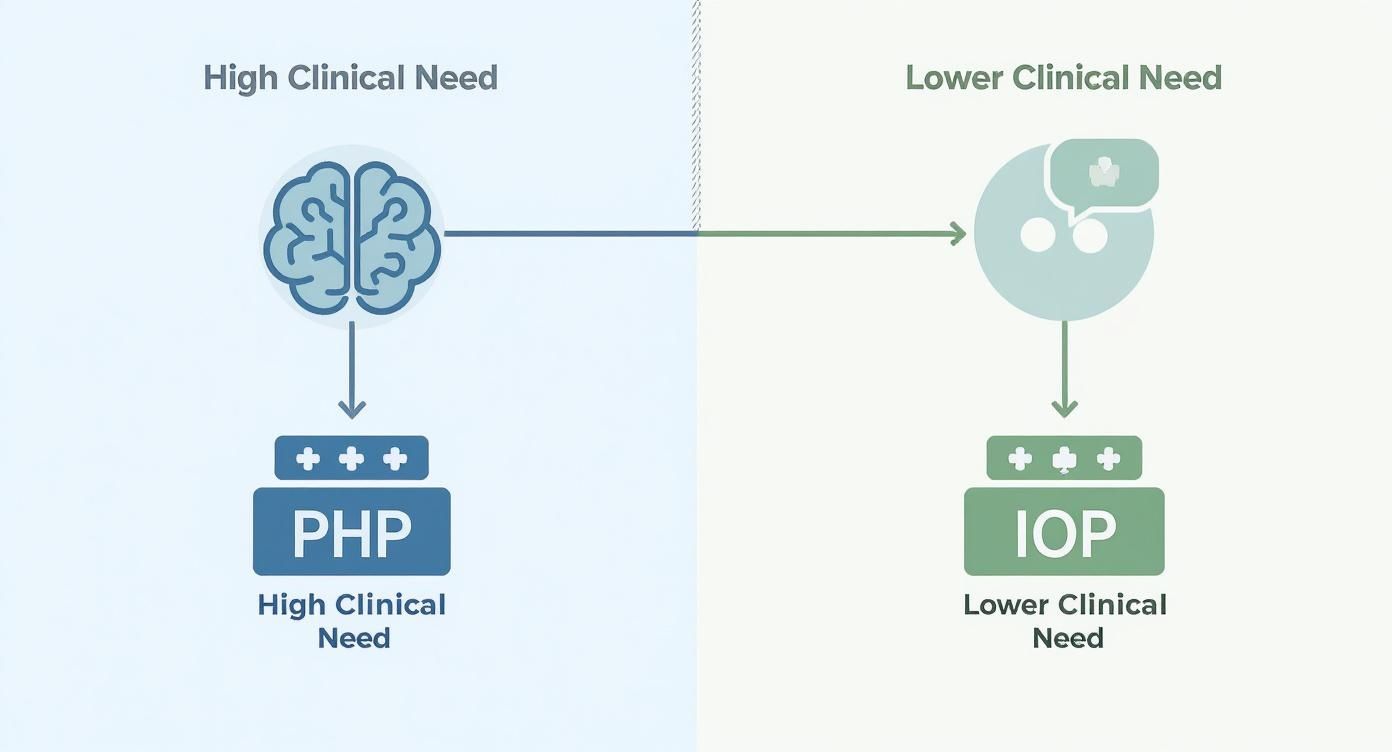
As you can see, higher clinical needs line up with PHP, while people with more stability are better suited for an IOP.
Ultimately, when deciding between an IOP or PHP, the goal is to think about the entire recovery journey. Ensuring effective continuity of care is what paves the way for lasting success.
Evaluating Medical and Psychiatric Support Levels
One of the biggest differences between an IOP and a PHP comes down to the level of medical and psychiatric support baked into the program. A Partial Hospitalization Program (PHP) is designed to be a direct alternative to inpatient care, which means it’s built from the ground up to manage more acute medical and mental health needs.
You can see this higher level of care in a PHP’s staffing and services. PHPs almost always have on-site nursing staff to monitor vitals and help manage medications. Even more critical is the frequent, direct access to a psychiatrist—often weekly—for in-depth medication management and psychiatric check-ins. For someone with complex needs, this intensive oversight is non-negotiable.
Navigating Dual Diagnosis and Medication Needs
Think about someone struggling with a severe co-occurring disorder, like bipolar disorder or significant trauma alongside a substance use disorder. They need this kind of robust clinical framework. Being able to closely monitor how medications are working and manage side effects in real time is a core strength of the PHP model.
A PHP is built to stabilize. It provides a medical and psychiatric safety net for individuals whose conditions are too complex for traditional outpatient care but do not require 24/7 supervision.
An Intensive Outpatient Program (IOP), on the other hand, takes a different approach. While it’s still clinically rigorous, the medical support is less direct and integrated. Medical and psychiatric care is usually coordinated with a client’s outside providers, like their personal psychiatrist or family doctor.
The focus in an IOP shifts from acute stabilization to applying recovery skills in the real world. Medication management is still a key piece of the puzzle, but it’s handled outside the program’s day-to-day structure. This works perfectly for people who are already stable on their medications and don't need constant medical eyes on them. For anyone who does rely on this type of support, you can learn more about what is medication-assisted treatment and how it fits into different levels of care.
Comparing Support Structures
To make the distinction crystal clear, here’s a side-by-side look:
| Support Feature | Partial Hospitalization Program (PHP) | Intensive Outpatient Program (IOP) |
|---|---|---|
| Psychiatric Access | Frequent, often weekly, on-site psychiatric sessions | Coordinated with external, off-site providers |
| Medical Staff | On-site nursing staff for monitoring and medication administration | No dedicated on-site medical staff; coordination with external doctors |
| Ideal For | Acute symptom stabilization, complex dual diagnoses, close medication monitoring | Maintaining stability, less acute symptoms, stable medication regimen |
At the end of the day, a PHP is the clear choice for someone whose medical or psychiatric state is still fragile. Its built-in, high-touch support system is designed to manage complex health needs safely and effectively. Both programs, however, put well-being first, highlighting the importance of recognizing and supporting mental health at every single stage of recovery.
Navigating Costs and Insurance Coverage
Let’s talk about the practical side of choosing a treatment program: the financial commitment. The cost difference between IOP and PHP comes down to the intensity and scope of services you receive, which is a major factor for both you and your insurance provider.
As a rule, a Partial Hospitalization Program (PHP) costs more than an Intensive Outpatient Program (IOP). This isn't surprising when you break it down—PHP involves a much bigger time commitment, often 20 to 30 hours per week, and includes a higher level of medical and psychiatric oversight. Think frequent sessions with psychiatrists and on-site nursing support, which naturally increases the daily rate.
Understanding Insurance Approval
Most health insurance plans are required to cover mental health and substance use disorder treatments on par with medical services, thanks to the Mental Health Parity and Addiction Equity Act (MHPAEA). But getting that coverage approved isn’t automatic; it requires a few specific steps.
Insurance companies almost always require a pre-authorization for both PHP and IOP. This is where your treatment provider submits detailed clinical documentation showing that the level of care is medically necessary for your specific situation.
A key takeaway here is that insurance approval isn't just a formality; it's a clinical validation. Your provider has to build a strong case, detailing the severity of your symptoms, risk factors, and why a less intensive option just won’t be enough to get you on solid ground.
To avoid any surprises, it’s crucial to verify your benefits before you start. When you call your insurance provider, have a list of questions ready so you get the clear answers you need.
- What is my deductible for outpatient behavioral health services?
- Are there limits on the number of sessions or days my plan will cover?
- Is this specific treatment facility in-network with my plan?
- What is my copay or coinsurance responsibility per day or session?
If you don't have adequate insurance, don't lose hope. Many facilities offer options like sliding-scale fees based on income, flexible payment plans, or can connect you with state-funded programs. Chatting with the admissions department about these alternatives is a vital step toward finding a financially sustainable path to recovery. While the daily cost is the main difference between IOP and PHP, good insurance coverage can make either one a manageable choice.
Common Questions About IOP vs. PHP
As you weigh your options, a few practical questions almost always come up. Getting clear answers helps you move forward with confidence, knowing you’re on the right path. Here’s a straightforward look at what people most often ask.
Can I Switch from PHP to IOP?
Yes, absolutely. In fact, moving from a PHP to an IOP is a standard and positive step in the recovery process. This “step-down” approach is a sign of real progress—it shows you’ve built stability and are ready for more independence. Your clinical team will work closely with you to make sure the transition is smooth and happens at exactly the right time.
Is Detox Required Before Starting?
It really depends on your specific situation. Medical detox is a must for anyone with a physical dependence on substances like alcohol or opioids. It’s a matter of safety, ensuring your body is stable before you dive into the therapeutic work.
However, if you don't have a physical dependency, you may not need detox at all. The first step is always a clinical assessment to determine what’s right and safe for you.
Key Insight: Don’t underestimate the power of your home environment. For any outpatient treatment to work, your living situation must be stable, supportive, and free from major triggers that could derail your progress.
How Supportive Does My Home Environment Need to Be?
A supportive home is non-negotiable. This means living somewhere that is safe, sober, and genuinely encouraging of your recovery. The people you live with—whether family or roommates—need to respect your goals and boundaries.
If your home life is chaotic or unsupportive, a PHP might be the better fit because it offers more structure throughout the day. It’s also worth discussing sober living options with your care team if your current environment feels like a barrier to healing.
At Altura Recovery, we know these questions are just the beginning. Our team is here to give you the clarity and personalized care needed to take the next step. Find your path to real healing and lasting freedom by visiting us at https://www.alturarecovery.com.