When you’re married to someone struggling with alcohol, life can feel like a constant storm of confusion, hurt, and isolation. One of the toughest first steps is just figuring out what you're actually dealing with. Is this heavy social drinking, or is it something more serious, like Alcohol Use Disorder (AUD)? It’s so easy to second-guess yourself, wondering if you’re just overreacting.
This internal battle is a painful and incredibly common part of the experience. You might catch yourself making excuses for their behavior, hiding the real problem from friends and family, or just feeling a deep, simmering resentment as promises are broken over and over again. The emotional toll is huge, often leading to anxiety, depression, and a profound sense of being alone in your own marriage.
Distinguishing Social Drinking From a Deeper Problem
There's a world of difference between a partner who enjoys a few drinks to unwind and one whose drinking creates a pattern of conflict and chaos. The real distinction comes down to control and consequences.
A social drinker can stop when they've had enough. Someone with potential AUD often can't, even when it's clearly damaging their health, their job, or the people they love.
Think about these common scenarios:
- Broken Promises: It's one thing to have one too many at a party once in a blue moon. It's entirely different when your spouse regularly promises to stop after two drinks but ends up intoxicated, missing work or important family events the next day.
- Personality Shifts: A glass of wine might make someone more relaxed, but what about when alcohol transforms your loving partner into someone irritable, verbally aggressive, or emotionally distant? When you feel like you have to walk on eggshells, that's a major red flag.
- Isolation: Has your social life started to revolve entirely around situations where drinking is involved? Or worse, have you stopped going out altogether because your spouse’s drinking makes social events unpredictable and embarrassing?
These signs point to a problem that goes far beyond just "heavy drinking."
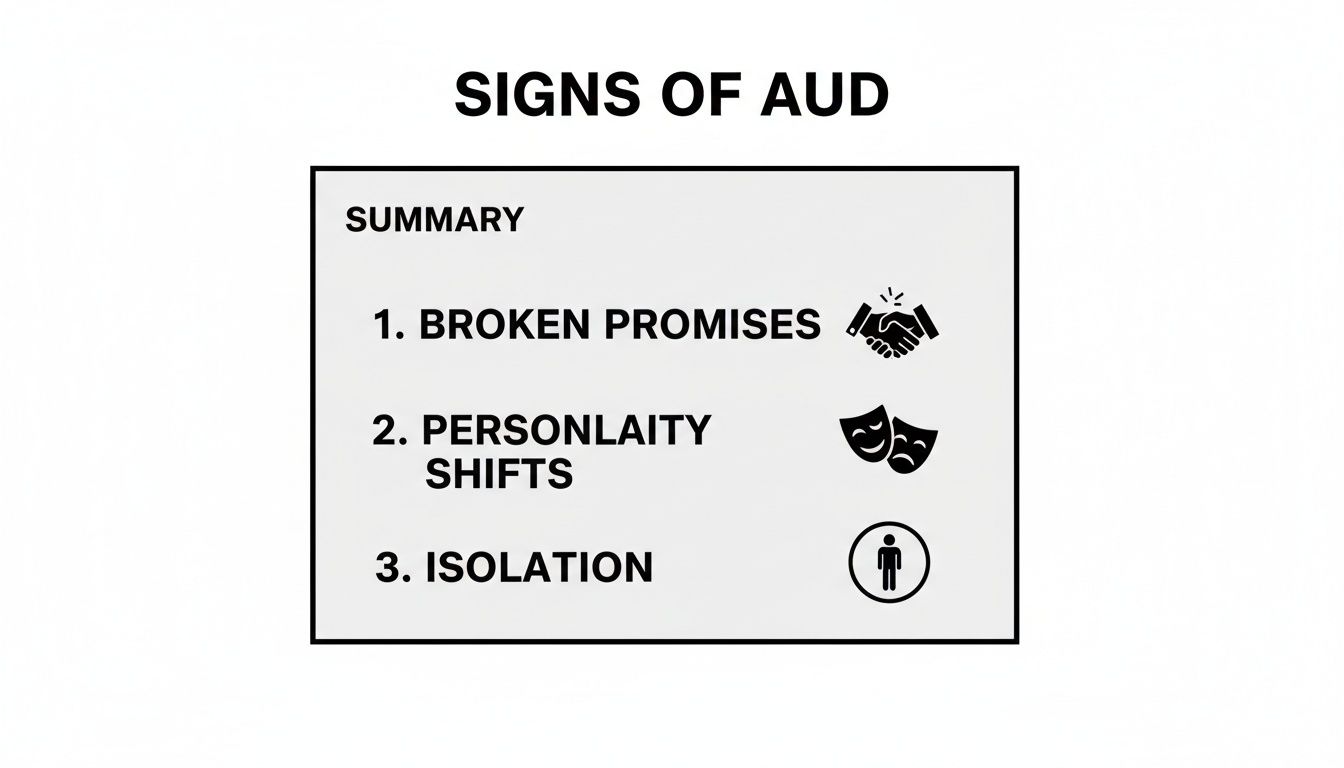
As you can see, the issue isn't just about the act of drinking. It's about the relational damage—the unreliability, the emotional volatility, and the isolation that come with it.
To help clarify the difference, let’s break down what these patterns can look like side-by-side.
Recognizing Alcohol Use Disorder (AUD) vs. Heavy Drinking
| Behavioral Sign | What It Looks Like (Heavy Drinking) | What It Looks Like (Potential AUD) |
|---|---|---|
| Control | Can stop after a few drinks; knows their limit most of the time. | Frequently drinks more than intended; unable to cut back despite trying. |
| Priorities | Social life includes non-drinking activities; drinking is an addition, not the focus. | Social life revolves around drinking; skips hobbies or responsibilities to drink. |
| Consequences | Experiences an occasional hangover but learns from it. | Continues drinking despite recurring problems with work, health, or relationships. |
| Emotional State | Mood is generally stable; drinking is for enjoyment or relaxation. | Experiences mood swings, irritability, or anxiety, which may drive the drinking. |
| Promises | Generally keeps commitments; an occasional slip-up is rare. | Makes and breaks promises about drinking regularly, causing a loss of trust. |
This table isn't for diagnosing your partner, but it can help you see the patterns more clearly and trust your gut when something feels fundamentally wrong.
Acknowledging the Impact on Your Life
When your spouse has a drinking problem, the consequences ripple through every corner of your world. It's more than just emotional stress; it can create serious financial strain and take a heavy toll on your own mental health. Many partners in this situation find themselves struggling with intense anxiety, even wondering if their spouse's drinking can cause panic attacks.
The strain on the marriage itself is immense. In fact, mismatched drinking habits are a huge predictor of divorce. Research from a nine-year study of 634 couples found that when one partner is a heavy drinker and the other is not, the couple faces a staggering 50% divorce rate. The study showed that this dynamic creates far more tension than when both partners drank heavily or neither did.
Acknowledging the problem isn't about placing blame. It’s about seeing the situation for what it is so you can start protecting yourself and making clear-headed decisions. This is the first, most critical step toward getting your own life back.
How to Protect Your Own Safety and Well-Being First
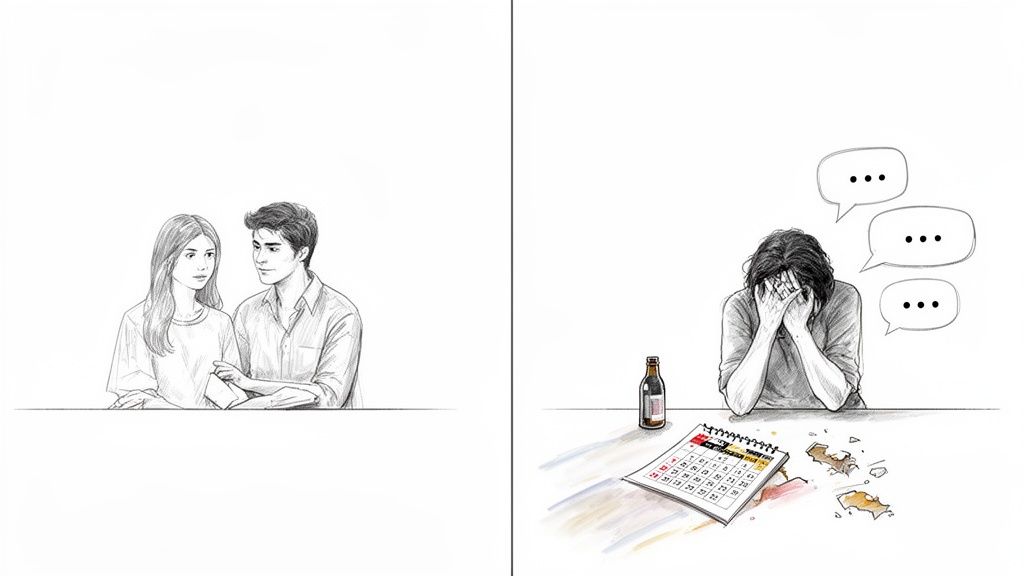
When you're living with a spouse who has an alcohol problem, your first instinct is almost always to focus on them—their drinking, their excuses, their next crisis. It feels like the right thing to do, but it's like trying to be a lifeguard when you can't swim yourself.
Before you can offer any meaningful help, you have to secure your own life raft. This isn't selfish; it's survival. The chaos of addiction can pull you under, too, draining your mental health, your finances, and your physical safety. Protecting yourself first is the only way to stay afloat for the long haul.
Create a Physical and Emotional Safety Plan
Alcohol can make a person’s behavior dangerously unpredictable. When drinking leads to verbal tirades, aggression, or erratic behavior, you need a clear, pre-planned strategy to protect yourself and any children in the home. Just hoping things won't get "that bad" is not a plan.
A safety plan is a set of concrete steps you can take in a crisis. It’s about creating stability for yourself when everything feels like it's spinning out of control.
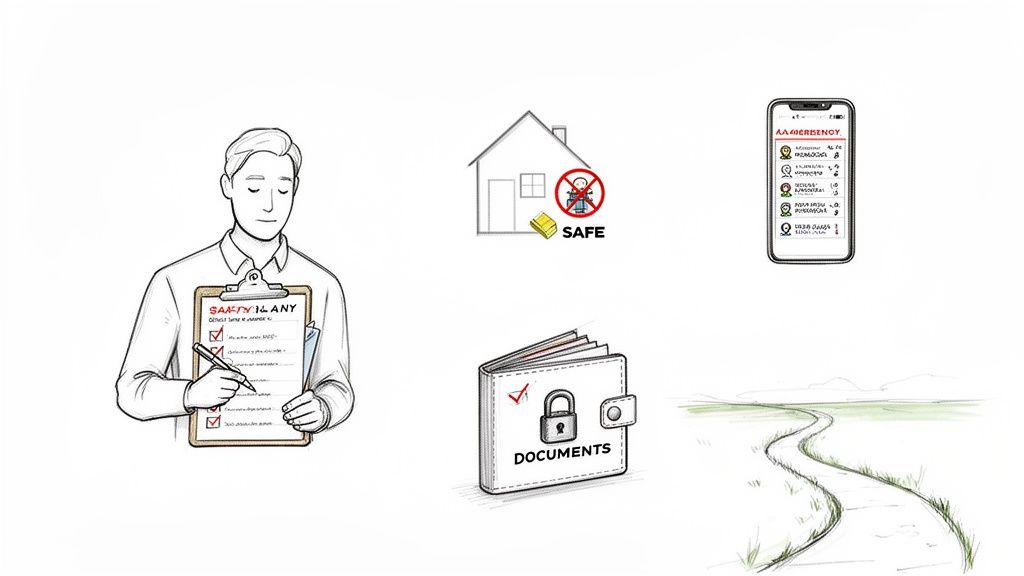
Your plan should have a few key pieces:
- Identify a Safe Space: Where can you go, day or night, if you have to leave fast? This could be a trusted friend's house, a family member's home, or even a hotel you've looked up in advance.
- Prepare an Emergency Bag: Keep a small bag packed and hidden somewhere accessible. Include essentials like a change of clothes, toiletries, cash, car keys, and a phone charger.
- Have Key Contacts Ready: Program the numbers of supportive friends or relatives into your phone. It's a good idea to let them know what's going on beforehand, so a late-night call from you won't come as a complete shock.
You should also secure your important documents. Make copies of birth certificates, passports, social security cards, bank statements, and any deeds or titles. Store these copies somewhere safe outside the home, like a safe deposit box or with a family member you trust implicitly.
Your safety is non-negotiable. If you ever feel physically threatened, do not hesitate to call 911 or the National Domestic Violence Hotline at 800-799-7233. Creating a safety plan is an act of empowerment. It gives you options when you feel like you have none.
Protect Your Financial Health
Active addiction is incredibly expensive. It can drain a family’s finances through impulsive spending, job loss, or legal bills. You have to take steps to protect your financial stability—it's directly tied to your ability to care for yourself and your kids.
Start by getting a crystal-clear picture of your shared finances. If you have joint bank accounts, you need to monitor them closely for unusual withdrawals or spending sprees.
Consider these protective financial moves:
- Open a Separate Bank Account: Set up a checking or savings account in your name only. Start directing your paycheck or a portion of any shared funds into it to build an emergency cushion.
- Secure Joint Credit Cards: Look into removing your spouse as an authorized user or lowering the credit limits on shared cards. This can prevent them from racking up debt that you'll be responsible for.
- Consult a Financial Advisor: A professional can offer objective advice on how to legally and ethically separate your finances, protecting your assets and credit score from the fallout of your spouse's addiction.
Taking control of the money gives you a critical degree of independence and security. It means you'll have the resources to leave an unsafe situation or just pay the mortgage without worrying that the funds have vanished.
Practice Emotional Detachment With Love
This is one of the hardest—and most important—skills you can learn. Emotional detachment doesn't mean you stop loving your spouse. It means you learn to separate their addiction-fueled behaviors from the person you care about. It’s about refusing to let their choices destroy your own emotional well-being.
Think of it as the opposite of enabling. You stop making excuses for them. You stop cleaning up their messes. You stop letting their emergencies hijack your life. For instance, instead of calling their boss with a story about the "flu" after a binge, you let them face the natural consequences of their actions.
This takes setting firm internal boundaries. You have to constantly remind yourself: You are not responsible for their drinking, and you cannot control it. Your responsibility is to yourself. This shift in mindset is freeing. It gets you off the exhausting rollercoaster of blame, guilt, and control, allowing you to make decisions from a place of clarity instead of chaos.
Setting Boundaries That Actually Work
If emotional detachment is the internal mindset shift, then healthy boundaries are its voice in the real world. Boundaries aren't about trying to control your spouse’s drinking—you already know that’s a losing battle. Instead, they’re about taking control of your life and defining what you will and will not accept.
Think of them not as threats or punishments, but as clear, calm statements of your personal limits. They are designed to protect your safety, sanity, and well-being. When done right, effective boundaries interrupt the cycle of enabling, forcing the consequences of drinking back onto the person doing the drinking.
From Vague Hopes to Concrete Actions
Saying "I wish you wouldn't drink so much" is a plea, not a boundary. A real boundary is a statement of action. The key is to make it specific, measurable, and entirely within your control. You can’t control if they drink, but you absolutely can control your response when they do.
Here’s what powerful, actionable boundaries actually sound like:
- “I will not get in the car with you if you have been drinking. I will find another way home for myself and the children.” This protects your physical safety.
- “I will no longer call your boss to make excuses for you when you are too hungover to work.” This stops you from shielding them from natural consequences.
- “If you start raising your voice or becoming verbally aggressive, I will leave the room.” This protects your emotional well-being.
- “We will not have alcohol in the house. If you choose to bring it home, I will pour it out.” This establishes a clear rule for your shared living space.
Notice the pattern? Every single one starts with "I will." This is the foundation of a strong boundary. It puts the focus squarely on your actions, which you can control, rather than their behavior, which you cannot.
Setting a boundary means deciding what you will do to protect yourself when a line is crossed. It’s a shift from asking them to change to declaring how you will act. This is where your power lies.
Having Productive Conversations About Drinking
The very idea of talking about the drinking or your new boundaries can be terrifying. It's a conversation that's often met with denial, anger, and blame. With the right approach, however, you can dramatically increase the chances of being heard without things escalating into another fight.
The most important rule is timing. Never try to have a serious conversation when your spouse is intoxicated or hungover. It’s a complete waste of emotional energy. Choose a moment when they are sober, things are calm, and you both have time without distractions. This gives your words the best possible chance of landing.
When you do talk, it's all about how you frame it.
Use “I” Statements to Express Your Feelings
Instead of launching attacks like, "You're always drunk!" or "You ruined another family dinner," you need to use "I" statements. Accusations immediately put the other person on the defensive. An "I" statement, on the other hand, focuses on how their behavior impacts you, which is much harder for them to argue with.
Let's compare the two approaches:
| Blaming Statement ("You") | Productive Statement ("I") |
|---|---|
| "You never think about anyone but yourself." | "I feel hurt and alone when you continue drinking after promising to stop." |
| "Your drinking is tearing this family apart." | "I am scared for our children's future when I see them exposed to the fighting." |
| "You don't care about our finances at all." | "I feel anxious when I see large amounts of money being spent on alcohol." |
This shift in language isn't about being soft; it's about being strategic. "You" statements slam the door on a real conversation. "I" statements crack it open.
The strain of alcohol use disorder on a marriage is immense, often creating a devastating cycle. Research shows that not only does heavy drinking increase divorce risk, but the act of divorcing can predict even heavier drinking in the future. This two-way street highlights how substance abuse can erode everything from work performance to intimacy, creating a trap that feels impossible to escape. You can explore more of the complex relationship between divorce and alcohol consumption on wf-lawyers.com.
Consistently setting and upholding these boundaries is hard work, but it's an essential part of dealing with an alcoholic spouse. It's how you start to reclaim your own life from the chaos of their addiction, protecting yourself and creating the necessary space for potential change.
Encouraging Your Spouse to Seek Professional Help
Once you’ve started setting and holding firm boundaries, the dynamic begins to shift. You’re no longer just reacting to daily crises; you’re creating space to talk about a real, long-term solution. Bringing up professional help is a delicate conversation, but it's a necessary one. This isn't about delivering an ultimatum. It’s about framing treatment as a hopeful, supportive path forward—an act of profound love for them and your family.
The goal is to approach this talk with both compassion and a clear plan. When you arm yourself with knowledge about real treatment options, the conversation changes from a vague, emotional plea into a concrete proposal. Instead of just saying, "You have to get help," you can say, "I found some options that could actually work for us, and I want to go through this with you."
Demystifying Treatment Options
For many people, the word "rehab" brings up images of a 30-day inpatient facility, totally cut off from work, family, and the outside world. While that intensive level of care is absolutely right for some situations, it’s far from the only choice available. Modern addiction treatment has become much more flexible, designed to integrate into a person's life rather than completely halting it.
Accessible outpatient programs are often a fantastic starting point, especially for a spouse who is resistant to the idea of upending their entire life. These programs deliver structured, evidence-based care while allowing your partner to keep living at home and managing their work or family duties.
Two of the most common and effective outpatient options are:
- Partial Hospitalization Program (PHP): This is a highly structured choice, often seen as a step down from a residential stay. A person in PHP will typically attend therapy for several hours a day, five days a week, but they return home each evening.
- Intensive Outpatient Program (IOP): An IOP offers a bit more flexibility. Therapy sessions usually run for a few hours at a time, three to five days a week. This setup is perfect for someone who needs to keep up with a work or school schedule while still getting solid, consistent support.
It’s important to remember these programs aren’t just about stopping the drinking. They’re about building a completely new foundation for living.
What Happens in Outpatient Treatment
Knowing what these programs actually involve can help you explain them to your spouse in a way that feels less scary and overwhelming. Quality treatment is a multi-layered process designed to heal the whole person, not just put a bandage on the symptom of drinking.
The core parts of a good outpatient program usually include:
- Individual Therapy: Private, one-on-one sessions with a licensed therapist to dig into the root causes driving the addiction.
- Cognitive-Behavioral Therapy (CBT): A powerful, practical approach that helps people identify and rewire the negative thought patterns and behaviors fueling their drinking.
- Family Systems Therapy: This brings you and other family members into the process, helping to heal broken communication and rebuild the trust that’s been damaged.
- Relapse Prevention Planning: This is all about real-world strategy. Your partner will learn how to manage triggers, navigate cravings, and build healthy coping skills for lasting success.
It’s also very common for people struggling with alcohol to have an underlying mental health condition like anxiety or depression. When that’s the case, it is critical to find one of the best dual diagnosis treatment centers that can treat both issues at the same time for a recovery that actually sticks.
Approaching your spouse with specific, researched options shows that you are serious, supportive, and invested in a real solution. It moves the conversation from a place of conflict to one of collaboration.
Framing the Conversation with Compassion
When you feel ready to have the conversation, pick a time when things are calm and your spouse is sober. Begin by reaffirming your love and concern, using the "I" statements you've been practicing.
For instance, you could say, "I love you, and it's been breaking my heart to watch you struggle. I've been doing some research, and I found a program that I really think could help us get our life back."
Present the information you've gathered not as a list of demands, but as a shared opportunity. Focus on the positive outcomes—waking up without a hangover, rebuilding trust with the kids, feeling healthier and more in control again. By offering concrete, manageable solutions, you give your spouse a realistic path forward. This makes the idea of getting help feel less like a terrifying unknown and more like a hopeful new beginning for both of you.
Shielding Your Children From the Impact of Addiction
When you're living with an alcoholic spouse, your children are often the silent casualties caught in the chaos. Their world can feel unpredictable and scary, and your most important job becomes creating a pocket of safety and normalcy for them. Protecting their emotional and physical well-being isn't just a priority—it’s everything.
The first step is to build a fortress of stability. Kids don't just like routine; they need it to feel secure. When a parent’s behavior is all over the place, simple, predictable schedules become a lifeline. Sticking to consistent meal times, bedtimes, and school routines gives them a powerful sense of order. It silently tells them that even when one part of their world feels broken, other parts are still safe and reliable.
Having Age-Appropriate Conversations
Talking to your kids about their other parent's drinking is a conversation no one ever wants to have. But saying nothing is often far more damaging. Kids are incredibly perceptive. They know something is wrong, and if they don't have an explanation, their minds often jump to the worst possible conclusion: that it's their fault.
You have to frame the conversation in a way that’s honest but doesn't overwhelm them. For a younger child, you might explain it as a type of sickness that makes their parent act strangely.
- For young children (ages 4-7): "Mommy/Daddy has an illness called addiction. Sometimes it makes them grumpy or very tired. It’s not your fault, and I am always here to keep you safe."
- For older children (ages 8-12): "I know you've noticed that Mom/Dad acts differently when they drink alcohol. They have an illness called alcoholism, which makes it very hard for them to stop, even when it hurts the people they love. It's like a sickness in their brain, not a problem with their heart."
The core message, no matter their age, has to be crystal clear: It is not their fault, they cannot fix it, and they are loved and safe. Reassuring them of these truths can lift a massive weight of guilt and fear they never should have had to carry.
Helping Them Build a Support System
As much as you want to be, you can't be their only source of support. It's vital that your children have other trusted adults they can talk to when they feel scared or confused. Encouraging these connections gives them more than one outlet for their feelings, ensuring they don't bottle everything up inside.
This external support system could include:
- A school counselor or a favorite teacher.
- A therapist who specializes in working with children from families with addiction.
- A close relative they trust, like an aunt, uncle, or grandparent.
- Support groups specifically for kids, such as Alateen.
Encourage them to talk, but never push. Sometimes, just knowing these people are available is a huge relief. The goal isn't to force a confession; it's to give them the tools and resources to process what they're going through in a healthy way.
Unfortunately, the impact of a parent's addiction can cast a long shadow. Children of alcoholics bear a heavy burden, and the disease can echo for generations. Studies show it can make them less likely to marry and more prone to divorce and substance use themselves. This intergenerational cycle often gets worse after a divorce, putting them at an even higher risk. You can find more insights on the link between substance abuse and divorce on silverridgerecovery.com. By providing stability, support, and honesty now, you're doing the hard work of breaking that cycle for their future.
Common Questions About Living With an Alcoholic Spouse

Living with a spouse who has an alcohol use disorder is a journey filled with constant uncertainty. Even when you have a solid plan and clear boundaries, moments will come up that leave you feeling completely lost and overwhelmed.
This last section tackles some of the toughest questions that come up along the way. Think of it as a quick-reference guide for those moments when you need direct answers and actionable next steps.
What Should I Do When They Flat-Out Deny They Have a Problem?
Denial is easily one of the most powerful and maddening symptoms of addiction. It’s a brick wall. When your partner insists they’re fine despite all the evidence, getting into an argument is almost always a dead end. It just creates more conflict and drives you further apart.
Instead of trying to force them to admit they have a problem, you have to pivot. Shift your focus to the real, tangible impact their drinking is having on you and your family. You will never win a debate over the label "alcoholic," but you can speak the truth about your own reality.
This is where those "I" statements we talked about become your most effective tool.
- "I feel scared when I don't know where you are late at night."
- "I'm worried about our finances when I see how much we're spending on alcohol."
- "I feel sad that we don’t connect like we used to."
These aren't accusations they can argue with; they are facts about your life. By grounding the conversation in your feelings and the specific consequences of their actions, you sidestep the denial. You keep the focus on reality, not a label they refuse to accept.
You cannot break through their denial for them. What you can do is hold up a mirror to the consequences of their drinking and continue to enforce the boundaries you’ve set to protect yourself and your family.
How Should I Handle a Relapse?
A relapse can feel absolutely devastating. It can feel like all the progress you've made and the hope you've built up has been completely erased. The most important thing to remember is that relapse is a very common part of the recovery process for many people—it is not a sign of total failure or a reflection on your support.
Your first priority is always safety. Make sure you and any children are physically and emotionally safe. If their behavior becomes unpredictable or aggressive, re-engage your safety plan immediately. During a relapse, your boundaries become more critical than ever.
Your response needs to be supportive but firm. This is not the time for lectures, shaming, or "I told you so." Instead, lead with compassion while holding your ground.
- Acknowledge the setback without enabling it: "I can see you're struggling, and I'm sorry you're in so much pain. My boundary about not having alcohol in our home still stands."
- Encourage them to reconnect with their support system: "Have you reached out to your sponsor or therapist? Now would be a really good time to connect with them."
- Focus on your own self-care: A relapse is incredibly draining. Lean hard on your own support network—friends, family, or groups like Al-Anon—to process what you're feeling.
Think of a relapse as a clear signal that the current recovery strategy needs adjustments. It's a chance for your spouse to learn more about their triggers and strengthen their coping skills. Your role isn't to fix it, but to maintain a stable environment and encourage them to get back on their recovery path.
Is It Okay to Consider Leaving?
Absolutely, yes. The choice to end a marriage is deeply personal and unbelievably hard, but choosing to protect your own well-being is never, ever selfish. For many, it becomes a necessary act of self-preservation. You cannot sustain a life in a relationship that is constantly chipping away at your mental, emotional, financial, or physical health.
Take some time to honestly reflect on these questions:
- Have you clearly and consistently communicated your boundaries, only to see them violated again and again?
- Is your spouse's behavior creating an unsafe or unstable home for you or your children?
- Have you completely lost your own sense of self in the constant chaos of managing their addiction?
- Does your partner show any genuine interest in seeking or staying in treatment, despite the mounting negative consequences?
If you're answering "yes" to these, it might be a sign that separating is a healthy and necessary step. Sometimes, the act of leaving is the only consequence powerful enough to finally break through their denial and motivate them to get help. But whether they do or not, your primary responsibility is to create a safe and healthy life for yourself and your children. You can find excellent local resources by looking for addiction recovery programs near me, which often provide family support services that are invaluable during such a difficult transition.