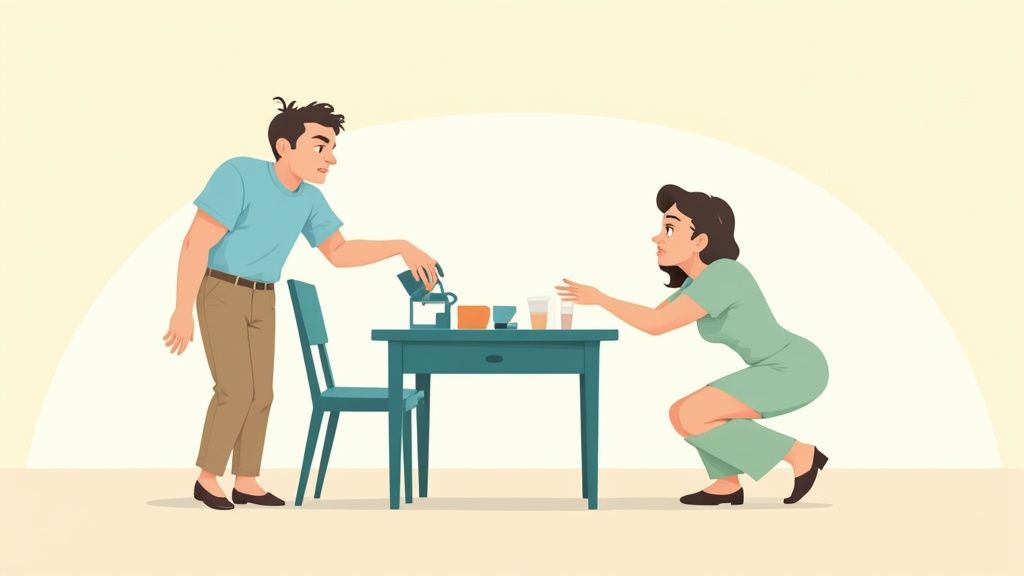
When you’re living with a spouse who struggles with alcoholism, it feels like your entire world is spinning out of control. The constant chaos, the broken promises, the walking on eggshells—it's utterly exhausting. It’s natural to feel a mix of anger, fear, and profound sadness. You’ve probably spent countless nights wondering how to fix this, how to make them see what their drinking is doing to you, to them, to your family.
But the most important thing to understand right now is that this isn't about fixing them. It's about saving yourself.
Your First Steps When a Spouse Is Alcoholic

The feelings you're wrestling with—the confusion, the heartbreak, the sheer frustration—are completely valid. Living in the orbit of active alcoholism is an incredibly isolating experience, and it’s easy to get lost in a cycle of crisis management where your own needs are always last on the list.
The turning point for many of us comes with a powerful realization, often summed up by the three C's:
You didn't cause it. You can't control it. And you can't cure it.
Let that sink in for a moment. This isn't about giving up on your spouse. It's about giving up the unwinnable fight to control their disease so you can reclaim your own life and sanity. The only thing you truly have power over is how you choose to respond.
Creating an Initial Roadmap
When you're drowning in overwhelm, even thinking about a "plan" can feel impossible. But creating a simple, actionable roadmap isn't about solving everything at once. It's about finding solid ground for yourself in the middle of a storm. The goal is to shift from being constantly reactive to proactively protecting your own well-being.
Your first moves should center on these core areas:
Get Educated. Start learning everything you can about Alcohol Use Disorder (AUD). When you understand it as a complex brain disease—not a moral failing or a lack of willpower—it helps depersonalize the hurtful behavior. This knowledge is your armor, allowing you to react with strategy instead of just raw emotion.
Find Your People. You cannot, and should not, do this alone. It’s a heavy burden to carry. Look for support groups like Al-Anon, which is designed specifically for the families and friends of alcoholics. Finding a therapist who specializes in addiction can also be a game-changer. Hearing from others who get it is one of the most powerful and validating experiences you can have.
Put Safety First. This is non-negotiable. If your spouse's drinking ever leads to behavior that is dangerous, abusive, or frighteningly unpredictable, your immediate priority is your safety and the safety of your children. This might mean having a bag packed and a plan to leave the house at a moment's notice. Your well-being comes first, period.
This isn't just about surviving; it's about building the strength and clarity you need to make healthy, empowered decisions for yourself and your future, no matter what path your spouse chooses.
To help you get started, here's a simple table summarizing these crucial first steps. Think of it as your initial game plan for reclaiming stability.
Your Initial Roadmap to Regain Stability
| Action | Why It Matters | First Thing to Try |
|---|---|---|
| Educate Yourself | Knowledge replaces fear and anger with understanding, helping you respond better. | Read one article about Alcohol Use Disorder (AUD) as a brain disease from a reputable source like the National Institute on Alcohol Abuse and Alcoholism (NIAAA). |
| Seek Support | Isolation fuels despair. Connection provides perspective, validation, and hope. | Find a local or virtual Al-Anon meeting and just listen. You don't have to speak. The goal is to hear from others who are walking the same path. |
| Establish Boundaries | Boundaries protect your mental health and stop you from enabling the disease. | Identify one behavior you will no longer tolerate (e.g., being yelled at, cleaning up their messes). Clearly state your boundary: "If you speak to me that way, I will leave the room." Then, follow through every single time. |
| Prioritize Safety | Your physical and emotional safety are the absolute top priority. | Create a simple safety plan. This could involve telling a trusted friend about your situation, having a bag packed in your car, or saving the number for a local domestic violence hotline in your phone under a different name. Know your options before you need them. |
| Focus on Self-Care | You can't pour from an empty cup. You need strength to navigate this journey. | Schedule 15 minutes of uninterrupted time for yourself today. It could be a walk, listening to music, or just sitting in silence with a cup of tea. Make this a non-negotiable appointment with yourself. |
This roadmap isn’t a magic fix, but it is a powerful start. By focusing on these five areas, you begin to shift the dynamic. You stop being a passive victim of the chaos and start becoming an active agent in your own well-being. Each small, intentional step builds on the last, creating a foundation of strength and clarity from which you can move forward.
Understanding Alcoholism as a Disease

It’s almost impossible to get through this without taking the hurt personally. When your spouse breaks another promise, starts another fight, or just doesn't show up, it feels like a direct reflection of their feelings for you. It's a natural, human reaction to think, “If you really loved me, you would just stop.”
But Alcohol Use Disorder (AUD) isn't a choice or a moral weakness; it's a recognized medical condition. Addiction literally rewires the brain’s circuits for reward, motivation, and memory. This neurological hijacking is what drives the compulsive need to drink, even when it’s costing them everything—including you.
Understanding AUD as a disease doesn’t excuse the behavior, but it does explain it. This knowledge is your first real tool for shifting from reacting with emotional pain to responding with a clear-headed strategy.
This biological perspective helps reframe what’s happening. The constant lying isn't always a malicious attempt to deceive you; it's often a symptom of the disease protecting its own survival. The inability to follow through on promises to quit isn’t a sign that they don't care. It’s a terrifying reflection of the brain's altered priorities, where alcohol has become essential for survival in their distorted reality.
The Brain Under the Influence
Think of your brain’s reward system like a well-worn hiking trail. Healthy things—a good meal, a hug from your kid, a finished project—create this path. Alcohol, on the other hand, is a bulldozer. It carves a deep, muddy trench that reroutes all motivation and desire straight toward drinking.
Over time, the brain adapts so much that it becomes physically dependent on alcohol's presence. At this stage, stopping can trigger severe and even life-threatening withdrawal symptoms, which only reinforces the cycle. It's not a matter of willpower. It's a brutal fight against altered brain chemistry.
The strain this puts on a marriage is immense and well-documented. Research paints a stark picture: couples where one partner has a history of AUD face a divorce rate of 48.3%, compared to 30.1% for other couples. This statistic isn't just a number; it shows how the progressive nature of this disease can systematically dismantle a relationship. You can read the full research about AUD's impact on marriage to better understand these dynamics.
Why This Perspective Is a Game-Changer
Looking at alcoholism through a medical lens empowers you to do three critical things:
- Depersonalize Their Actions: You can finally start to see the disease as the true culprit, creating a crucial separation between the person you love and their destructive behaviors.
- Set Smarter Boundaries: Instead of making emotional pleas that go nowhere, you can create logical boundaries that protect you and your family from the chaos of the illness.
- Focus on What You Can Actually Control: You can stop pouring your energy into trying to "fix" them and redirect it toward your own well-being, safety, and sanity.
This shift in perspective isn't about making excuses for your spouse. It's about arming yourself with the clarity and strength needed to navigate an impossible situation, so you can start making informed decisions for your future.
Ditch the Enabling and Start Communicating
It's one of the most painful paradoxes when you love someone with an alcohol problem: your instinct to help can actually make things worse. We call this enabling, and it almost always comes from a place of deep love and fear. You might make excuses for a missed work day, pay a bill they forgot, or lie to family members to keep the peace. You're trying to prevent a crisis.
But here’s the hard truth I've seen play out time and time again: these well-intentioned actions accidentally build a safety net under the addiction. When you're always there to cushion the fall, your spouse never feels the true, painful impact of their drinking. That rock-bottom moment they need to realize they have a problem gets pushed further and further away.
Recognizing these patterns is your first, most powerful step toward changing the dynamic. This isn't about abandoning them. It's about choosing to stop participating in the illness.
The Power of “I” Statements
Your most effective tool is communication, but it has to be done right. Forget lectures, blame, or shame—that approach just throws up a defensive wall and shuts the conversation down before it even starts.
Instead, the key is using “I” statements. This simple shift in language moves the focus from their character (which they'll defend) to your feelings (which are impossible to argue with).
For instance, instead of an accusation like, "You're so reckless when you drink and drive," try this: "I feel terrified when you get behind the wheel after drinking." See the difference? One is an attack, the other is an undeniable expression of your own emotional reality.
Let’s look at a couple more.
Instead of: “You broke another promise.”
Try: “I feel so hurt and let down when we have to cancel plans because of drinking.”
Instead of: “You’re destroying our finances.”
Try: “I get really worried about our family’s security when I see how much money is being spent on alcohol.”
This isn't about being soft; it's about being strategic. It anchors the conversation to the real-world impact of their actions, making it much harder for them to dismiss your concerns. For a deeper dive, you can find more strategies on how to help an alcoholic husband that build on this foundation.
To help you spot the subtle difference between helping and hurting, here’s a quick comparison.
Enabling Behaviors vs. Supportive Actions
This table breaks down common patterns to help you shift from actions that unintentionally fuel the addiction to ones that genuinely support recovery for both of you.
| Enabling Behavior (Avoid This) | Supportive Action (Do This Instead) |
|---|---|
| Making excuses for their behavior or calling in sick for them. | Allowing them to face the natural consequences of their actions. |
| Paying their bills or giving them money when they're in a jam. | Helping them create a budget while insisting on financial boundaries. |
| Ignoring or downplaying the drinking to avoid conflict. | Expressing your feelings calmly and honestly using "I" statements. |
| Drinking with them to "keep an eye on them" or feel closer. | Suggesting alcohol-free activities and setting an example. |
| Taking on all their household chores and responsibilities. | Asking them to fulfill their share of duties, even if it's uncomfortable. |
By consciously choosing supportive actions, you stop propping up the disease and start creating an environment where change becomes possible.
Timing Your Conversations Is Everything
Just as important as what you say is when you say it. Let me be blunt: trying to have a serious talk while your spouse is drunk is a waste of your time and emotional energy.
Their judgment is gone, their emotions are all over the place, and they likely won't even remember the conversation accurately the next day. It’s a losing battle.
The only time for these conversations is when they are 100% sober, you're both calm, and you have total privacy. This is the only way to create a space where they can actually hear you and engage in a real dialogue instead of a defensive, circular argument.
Choosing your moments carefully and using non-confrontational language is how you shift from getting stuck in arguments to starting productive dialogues. It saves your sanity and gives your message the best possible chance of landing.
The road ahead requires a multifaceted approach, combining professional help for them with robust self-care for you.
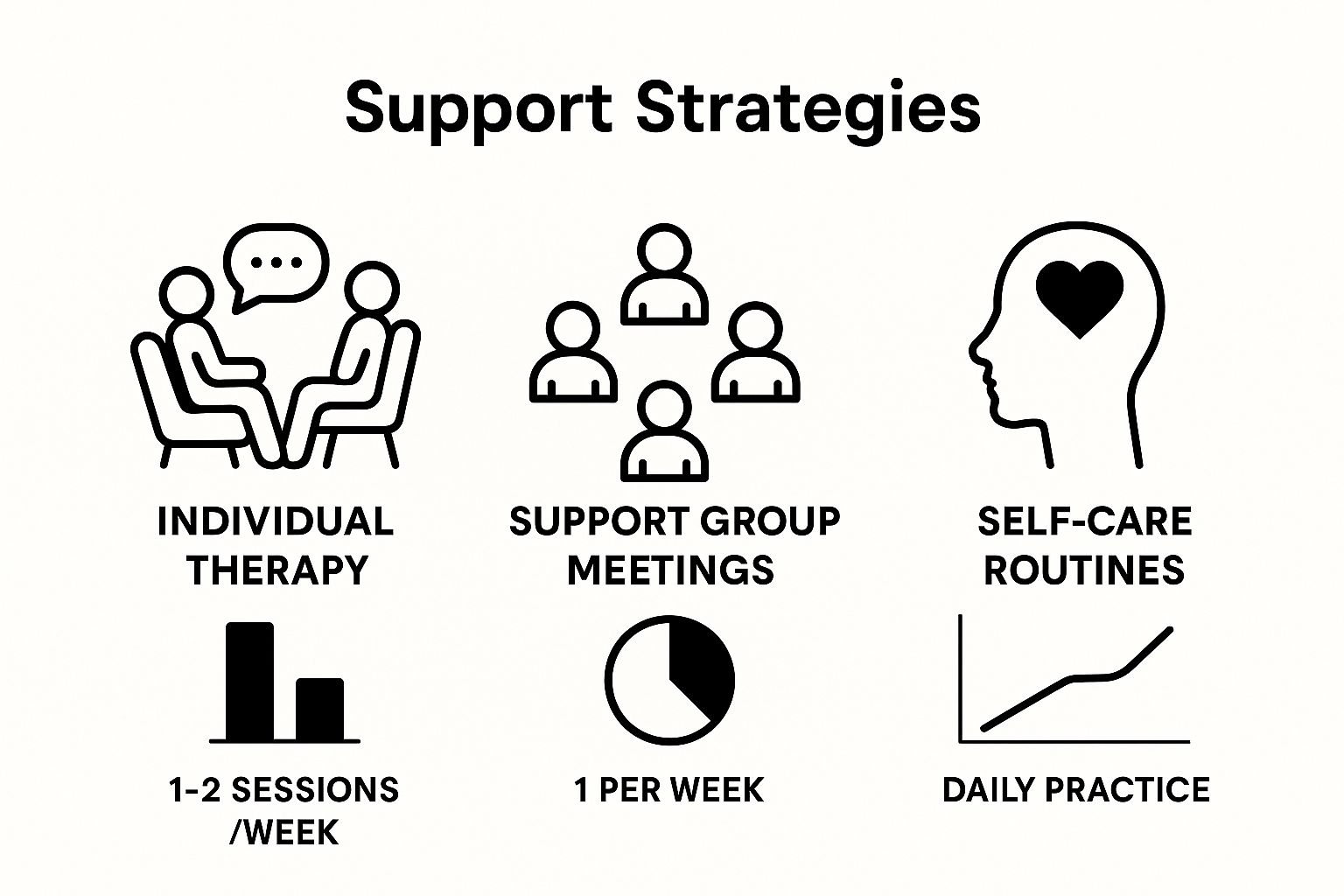
As the infographic shows, building a strong foundation involves therapy, finding your own support systems, and making your well-being a non-negotiable priority. You can't pour from an empty cup, and your own health is the bedrock of this entire process.
How to Set Boundaries That Actually Work

Let’s get one thing straight: when you’re dealing with a spouse’s alcoholism, boundaries are not punishments. They aren’t threats or ultimatums, either. They are clear, firm rules you put in place to protect your own safety, sanity, and well-being.
Think of them as a fence you’re building around yourself. The goal isn’t to lock your partner out forever, but to stop the chaos of their addiction from completely overrunning your life.
This is a profound shift. It moves you from constantly reacting to their behavior to proactively defining what you will and will not accept. It’s how you start to take back control.
Defining Your Non-Negotiables
For a boundary to work, it has to be specific, actionable, and focused entirely on what you will do. Vague statements like, "You need to drink less," just don't cut it. They’re requests, not boundaries, and they are incredibly easy to ignore.
Effective boundaries sound completely different. Here are a few real-world examples:
- "I will not lie to your boss or make excuses for you anymore."
- "If you bring alcohol into the house, I will take the kids and go to my sister's for the night."
- "I am no longer going to clean up your vomit or find your lost wallet."
- "I will not argue with you when you’ve been drinking. If you raise your voice, I will walk away."
See the pattern? Every single one starts with "I will" or "I am." They’re about your actions, not theirs, because your actions are the only thing you can truly control. This isn’t just a word game; it's a fundamental power shift. For a deeper dive, check out our article on https://alturarecovery.com/blog/setting-boundaries-in-recovery.
Handling the Backlash and Guilt
Setting a boundary is one thing. Holding it is a whole different ballgame. Expect resistance. Your spouse might get angry, burst into tears, or try to manipulate you emotionally. They may accuse you of being selfish or unloving. This is a predictable reaction from the addiction itself, which feels threatened when its old support systems get pulled away.
This is also where the guilt monster rears its head. It’s completely normal to feel conflicted, especially when you still deeply love the person underneath the disease.
Remember: The guilt you feel is temporary, but the damage from having no boundaries is long-term and devastating. Your well-being is not up for negotiation.
The emotional turmoil caused by alcoholism is a massive factor in why marriages break down. In fact, research shows that 34.6% of people cite substance abuse as a major reason for their divorce, often tangled up with conflict and financial stress.
Consistency is your best friend here. Every time you enforce your boundary, you are teaching your spouse—and, just as importantly, yourself—that you are serious. You're showing that the old rules no longer apply. This is a critical step in learning how to set healthy boundaries and creating a new, healthier reality for yourself, one firm line at a time.
Putting Your Own Well-Being First
You’ve probably heard the phrase, “You can’t pour from an empty cup.” When you’re living with an alcoholic spouse, that simple saying becomes a lifeline. The constant stress, the worry, and the emotional gymnastics required just to get through the day are absolutely draining, mentally and physically.
Prioritizing your own well-being isn't a selfish act—it's the most critical survival strategy you have.
This is your foundation. When you’re emotionally depleted, it’s impossible to make clear decisions, hold firm boundaries, or offer any kind of meaningful support. Taking care of yourself is the single most important thing you can do to bring some stability and clarity back into your life.
Building Your Personal Support System
You cannot weather this storm alone. Let me say that again: you shouldn’t have to. Assembling a dedicated support network isn't just a nice idea; it's a non-negotiable step. This isn't about finding people to complain to. It’s about connecting with resources that can genuinely help you process everything you’re going through and find a way forward.
A strong support system should include a mix of professional and peer-based help:
- Find a qualified therapist. Look for a counselor with specific experience in addiction and its impact on families. This gives you a confidential space to unload everything you're feeling and get equipped with practical coping skills.
- Join a support group. Organizations like Al-Anon were created specifically for people in your exact situation. The power of sharing your story with others who truly get it is incredible. You'll feel less alone almost instantly.
- Lean on trusted friends. It's time to reconnect with the friends who lift you up. You don't have to tell everyone, but be honest with a few close confidants about what's going on.
You are not responsible for your spouse's disease, but you are responsible for your own health and sanity. Building a support network is a tangible act of taking that responsibility seriously.
Reclaiming Your Identity and Peace
Living with addiction has a way of erasing you. Your hobbies, your interests, your friendships—they all get pushed to the back burner. Intentionally reclaiming these parts of yourself is one of the most vital forms of self-care. It's a powerful reminder that you are a whole person outside of this incredibly difficult situation.
Make a real effort to schedule time for activities that bring you joy and peace. It doesn't have to be a huge commitment; even 15 minutes a day can make a difference. This could be reading a book, spending time in the garden, going for a walk, or dusting off an old hobby you once loved.
As you focus on your own well-being during this tough time, things like mindfulness can be a game-changer for managing stress. There are many simple mindfulness activities for adults that you can easily weave into even the busiest schedule.
The chronic stress of this environment can lead to serious mental health challenges, including anxiety and depression. By actively building your resilience through therapy, support groups, and personal time, you empower yourself to make clear, healthy decisions from a place of strength, not desperation. Your well-being is the anchor that will keep you steady, no matter what happens next.
Planning Your Next Steps and Finding Help
Sooner or later, living with an alcoholic spouse brings you to a crossroads. A point where you have to stop reacting and start thinking about the future—your future. This isn't about giving up or failing. It’s about making clear, empowered choices for your own safety and well-being, no matter what path your partner takes.
This phase is tough. It means having difficult conversations, making contingency plans, and facing some hard truths. But you don't have to do it alone. In fact, you shouldn't.
Seeking Professional Guidance
Getting professional help is one of the most powerful first steps you can take. This isn't just about your spouse; it's about getting the support you need to navigate this storm. Your mental health has to be the priority.
Consider a few different avenues:
- Individual Therapy: A therapist gives you a confidential space to unload all the frustration, fear, and confusion you've been holding in. They can equip you with real-world coping strategies that actually work.
- Addiction-Specialized Counseling: Finding a marriage counselor who truly understands the dynamics of addiction is critical. They can provide targeted guidance for you and, if your spouse is willing, for both of you as a couple.
- Support Groups: There is incredible power in connecting with people who just get it. You can explore a variety of support groups for spouses of alcoholics to find a community that feels right.
Facing Difficult Realities
Part of this process involves looking at the possibility of separation or divorce. It’s an uncomfortable thought, but ignoring it doesn’t make it go away. This isn't about throwing in the towel; it's about acknowledging that your health and safety are non-negotiable.
The statistics are sobering. Alcoholism dramatically increases the risk of a marriage ending. In the United States, it’s a factor in about 40% of all divorce cases, and marriages with a partner struggling with AUD are far more likely to end in dissolution.
If there's any history of aggression or volatility, your immediate priority is creating a safety plan. This means identifying a safe place you can go on a moment's notice and making sure you have access to important documents. Start thinking through the financial and logistical steps you'd need to take, just so you're prepared for any outcome. As you map out these potential changes, looking into strategies to set and achieve personal goals can provide a solid framework for building the future you deserve.
Ultimately, this is all about taking your power back. It's about shifting from a constant state of reaction to a place of intentional, proactive decision-making. You are building a stable and healthy life for yourself, and that is a courageous and necessary step.
Answering the Tough Questions About Life With an Alcoholic Spouse
When you're living with an alcoholic spouse, your mind is a minefield of difficult questions. They’re the kind of thoughts that keep you up at night, full of doubt and fear. Let's tackle some of the most common ones head-on, with direct answers that build on the strategies we've discussed.
Can My Spouse Ever Just Drink Normally Again?
This is the hope that so many partners cling to, and it's completely understandable. You miss the person you fell in love with and the life you had before alcohol took over.
The hard truth is that for someone with a diagnosed Alcohol Use Disorder (AUD), returning to moderate, controlled drinking is almost unheard of. Addiction creates profound changes in the brain's reward and control circuits. For the vast majority, complete abstinence is the only path to a stable, healthy future. Shifting your focus from a return to "normal" drinking to a focus on recovery is a far more realistic—and genuinely supportive—approach.
Am I an Enabler if I Stay in the Marriage?
This question is loaded with guilt, but the answer is simple: staying in your marriage does not automatically make you an enabler.
Enabling isn’t about your marital status; it’s about your actions. It’s about making excuses for their behavior, calling them in sick to work when they’re hungover, or shielding them from the natural consequences of their choices. You can absolutely remain married while setting firm boundaries and refusing to participate in the chaos the addiction creates. Your commitment can shift from protecting the addiction to supporting their potential for recovery. That's a crucial distinction you can explore further while navigating recovery and relationships.
Key Takeaway: You can love your spouse without enabling their disease. The healthiest love involves clear boundaries and a commitment to your own well-being, regardless of their choices.
Your primary focus must always be on creating a safe and stable environment for yourself and your children. In the end, that is the most powerful and loving stance you can take.
At Altura Recovery, we understand the immense weight families carry. If you need guidance on setting boundaries, finding support for yourself, or exploring treatment options for your spouse, our compassionate team is here to help. Visit us at https://www.alturarecovery.com to learn about our family-focused programs.