It often starts with a quiet, heartbreaking thought: the man I love has a problem he can't control, and it's tearing our life apart. If you're feeling lost, confused, and utterly alone, know that this is a valid and common starting point. The first real step toward getting your life back is understanding the nature of the issue—seeing it not just as a series of bad choices, but as the serious health condition it truly is.
Understanding the Reality of Your Situation
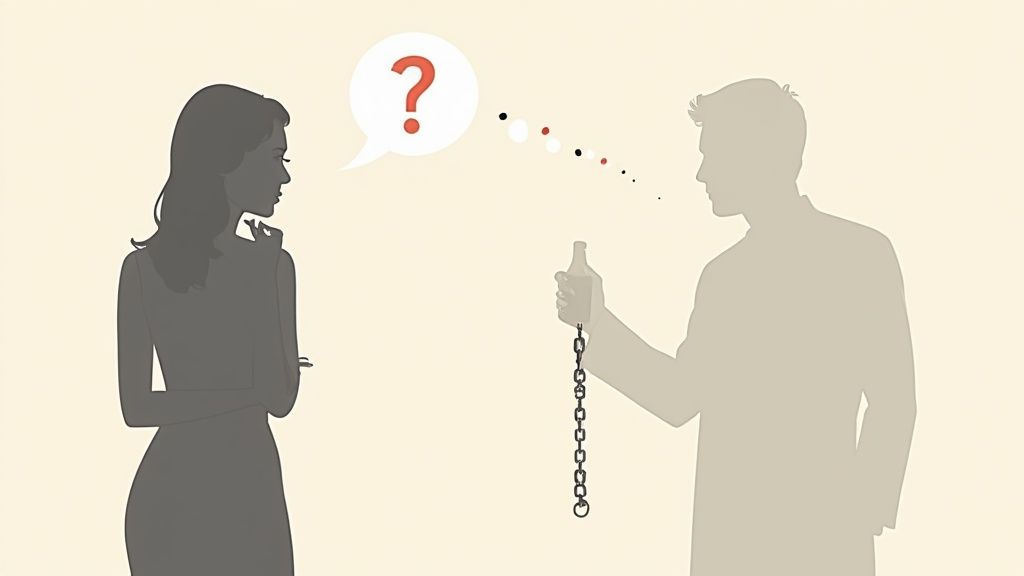
It’s easy to second-guess yourself. One of the biggest hurdles is figuring out the difference between what society often dismisses as "letting off steam" and the clinical reality of an alcohol use disorder (AUD). You might wonder if you're overreacting, especially when heavy drinking in men is so often normalized or even celebrated.
But certain patterns are red flags, signaling a problem that runs much deeper than just having a few too many. This is where your focus needs to shift—from his individual drinks to the consistent, negative fallout they create for you and your family.
Moving from Confusion to Clarity
Seeing the problem for what it is—a medical condition, not a moral failure—can be incredibly empowering. It allows you to start detaching from the blame, shame, and responsibility you've likely been carrying.
And you are far from alone. Alcohol use disorders are shockingly common, and about three-quarters of all people with alcohol use disorders are male. This means countless partners are standing in your exact shoes, trying to figure out what to do next.
Once you start looking for patterns, the picture becomes painfully clear. Ask yourself:
- Have his behaviors changed? Is he defensive, irritable, or secretive when it comes to his drinking?
- Are promises constantly broken? Does he swear he'll cut back or quit, only to fall back into the same habits?
- Are responsibilities being dropped? Is he neglecting work, finances, chores, or time with the kids because he's drinking or hungover?
To help you distinguish between concerning drinking habits and a clinical disorder, this table outlines some key differences. It can provide clarity on when professional help is truly necessary.
Key Differences Heavy Drinking vs Alcohol Use Disorder
| Behavioral Indicator | Typical Heavy Drinking | Potential Sign of AUD |
|---|---|---|
| Control | Can stop or moderate after a few drinks if needed. | Has trouble stopping once started; often drinks more than intended. |
| Priorities | Drinking is an activity, not the main focus of life. | Social, work, or family activities are missed or given up due to drinking. |
| Cravings | Does not experience strong physical or mental urges to drink. | Spends significant time thinking about drinking; experiences strong cravings. |
| Consequences | Acknowledges and regrets negative outcomes (e.g., hangover). | Continues to drink despite clear negative health, social, or legal consequences. |
| Tolerance | The effects of alcohol remain relatively consistent. | Needs to drink more to get the same effect (tolerance has built up). |
Seeing these behaviors laid out can be a stark wake-up call, but it's a necessary one. This clarity helps you move from a place of emotional reaction to one of informed action.
Acknowledging the truth of your situation isn't an act of betrayal; it's an act of self-preservation. It is the necessary foundation upon which you can build a strategy for your own well-being and safety.
Understanding the full scope of the situation, including potential long-term issues like the legal considerations for children affected by substance abuse, provides a more complete picture of your reality. Identifying the specific warning signs of alcohol addiction is crucial. This knowledge is your first tool, equipping you to face what's ahead with your eyes wide open.
Communicating Effectively Without Enabling Him
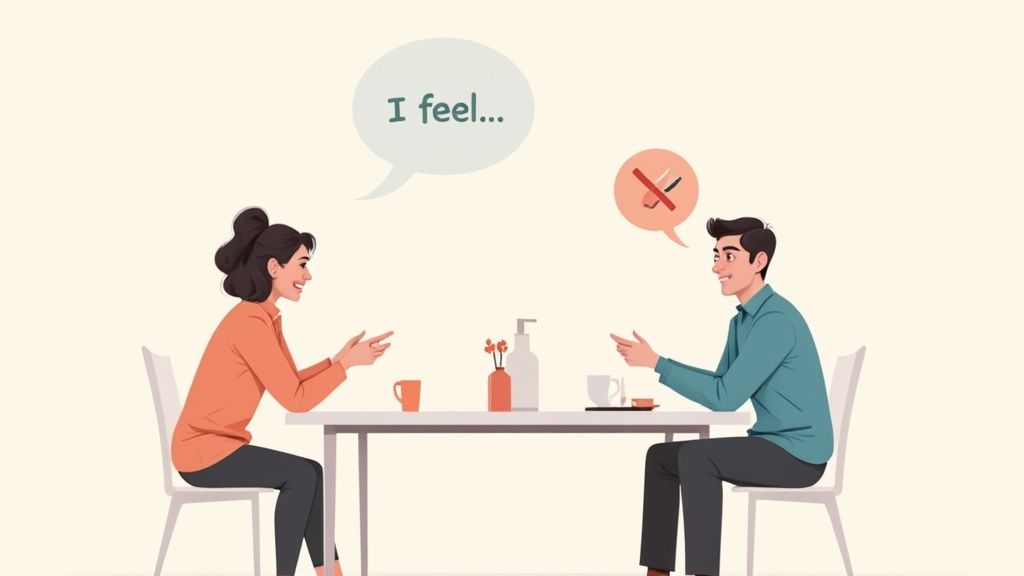
Talking to your husband about his drinking probably feels like walking into a storm you know is coming. Conversations escalate into fights, defenses shoot up, and absolutely nothing changes. It's a painful cycle.
The key to breaking it is to shift your entire approach. Stop focusing on his behavior and start talking honestly about its impact on you. This isn't about winning an argument; it's about opening a small window for him to see this reality through your eyes. To do that, you have to drop the blame and shame, which are guaranteed to slam that window shut.
Timing and Tone Make All the Difference
One of the biggest mistakes I see is trying to have this conversation while he's been drinking or is nursing a hangover. It’s a non-starter. He's either not rational or he's drowning in defensiveness. The conversation is doomed before you say a word.
Instead, you have to be strategic. Choose a time when he is sober, calm, and you have total privacy. This might be a quiet Saturday morning or a peaceful weeknight with no other stressors competing for attention. Keep your tone serious but compassionate. This isn't an attack; it's a plea.
Using 'I' Statements to Share Your Reality
When you start a sentence with "You," it sounds like an accusation. "You always drink too much." "You ruined the party." It triggers an instant defensive reaction, and the conversation derails into an argument about his actions.
The fix? Reframe every concern using 'I' statements. This tactic isn't about semantics; it's about shifting the focus to your feelings and experiences. He can argue about whether he "drank too much," but he can't argue with how you feel.
From Blame to Impact: A Few Examples
| Instead of This (Blaming) | Try This ('I' Statement) |
|---|---|
| "You never help with the kids because you're always passed out." | "I feel so overwhelmed and alone when I have to handle the kids' bedtime by myself." |
| "You embarrass me when you drink around my friends." | "I feel anxious and embarrassed when I see how our friends react to the situation." |
| "Your drinking is going to get you fired." | "I am terrified about our finances and what might happen with your job." |
This approach isn't manipulative; it's radically honest. You're showing him your vulnerability and the real-world fallout his drinking has on the person he loves. It changes the dynamic from a fight he can win or lose to a problem that's hurting both of you.
Unpacking and Stopping Enabling Behaviors
Your intentions are rooted in love and protection, but you may be unknowingly making it easier for him to keep drinking. This pattern is called enabling, and it’s one of the hardest things to see in yourself. Enabling insulates him from the natural consequences of his choices, which robs him of a powerful reason to change.
Enabling isn't helping. It's participating in the sickness. It’s like tying his shoes for him when he desperately needs to learn how to stand on his own two feet.
Recognizing these behaviors is the first, most crucial step. Take an honest look. Are you…
- Making excuses for him? Calling his boss to say he's "sick" when he's hungover?
- Taking over his responsibilities? Paying the bills he forgot, finishing his chores, or handling all the childcare alone?
- Minimizing the problem? Telling yourself or others "it's not that bad" just to avoid a fight?
- Protecting him from consequences? Bailing him out of trouble or lying to family to cover up an incident?
Stopping these behaviors will feel incredibly uncomfortable, maybe even cruel. He will almost certainly get angry when he suddenly has to face the music. That’s a necessary part of this process.
Letting him experience the consequences isn't a punishment; it's allowing reality to become his teacher. Just as importantly, it's critical for your own mental health. You have to stop carrying burdens that are not yours to bear. As you make these shifts, learning how to support someone in recovery can offer a healthier roadmap for the future.
Setting Firm Boundaries to Protect Yourself
When you're living with an alcoholic husband, your own well-being almost always gets pushed to the back burner. It's a slow erosion of your own needs. But protecting your mental and emotional health isn’t selfish—it’s a matter of survival. This is where boundaries come in, but probably not in the way you've thought about them before.
Most people think boundaries are rules meant to control his drinking. The truth is, effective boundaries have nothing to do with controlling him and everything to do with what you will and will not accept in your own life. They are clear, firm lines you draw to protect your sanity, your safety, and your self-respect.
What Real Boundaries Look Like
Boundaries aren't threats or ultimatums yelled in the middle of a fight. They are calm, pre-planned actions you commit to taking in response to specific behaviors. Think of them as your personal policies for self-preservation.
You have to communicate these boundaries clearly—ideally when he's sober—and then, most importantly, enforce them every single time. Without that follow-through, a boundary is just an empty threat that teaches him your limits are negotiable.
Here are a few practical examples of what this looks like in the real world:
- You stop covering for him. If he's too hungover to go to work, you will not call his boss with a made-up excuse. The boundary is your refusal to participate in the lie. The natural consequence? He has to face his employer on his own.
- You create alcohol-free zones or times. You might decide, "I will no longer have alcohol in the house during our family dinners," or "I'm not comfortable with liquor being stored in the living room anymore." This action reclaims a part of your shared home as a safe, sober space.
- You protect your own peace. One of the most powerful boundaries is simply refusing to engage when he’s intoxicated. You can calmly say, "I can tell you've been drinking, and I'm not going to have this conversation right now. I'm going to our bedroom to read." Then, you must physically leave the room.
Boundaries are a statement of what you need to feel safe and respected. They are about honoring yourself, not controlling him. The focus shifts from his actions to your reactions.
The Power of Consistency
The hardest part of setting boundaries is sticking to them. He will almost certainly test them, whether he realizes it or not. He might get angry, try to lay on the guilt, or promise he'll change if you just bend the rule "this one time." This is the moment your resolve is tested.
Every single time you follow through, you send a clear message that this new boundary is real. You are teaching him, through your actions, where your new limits are. This consistency is what builds a foundation of respect—first from yourself, and eventually, maybe, from him. To dive deeper into this topic, our guide on how to set healthy boundaries offers additional strategies and insights.
Navigating the Guilt
When you first start enforcing these new rules, guilt is almost guaranteed to show up. You might feel like you're being mean, cruel, or that you're abandoning him in his time of need. This is an incredibly common and difficult feeling to push through.
It helps to reframe what you're actually doing. You are not abandoning him; you are abandoning the chaotic, unhealthy dynamic his addiction has created. You are simply choosing to stop participating in a cycle that is hurting everyone involved—including him.
Strategies for Managing Guilt
| Feeling | Reframe | Actionable Step |
|---|---|---|
| "I feel selfish." | "I am prioritizing my mental health so I can be a stable parent/partner." | Spend 15 minutes doing a self-care activity you enjoy. |
| "I'm abandoning him." | "I am detaching from the addiction, not the person I love." | Connect with a friend or a support group like Al-Anon. |
| "This is too harsh." | "Allowing the chaos to continue is more harmful than setting a clear limit." | Write down the specific negative impacts his drinking has had this week. |
Remember, enabling his behavior doesn't help him. It just cushions him from the very consequences that might finally motivate him to seek real help. Setting a boundary is one of the most compassionate things you can do for yourself and, in the long run, for him. It's a declaration that you will no longer allow his addiction to call the shots in your life. It is the first, crucial step toward reclaiming your own peace.
Prioritizing Your Safety and Self-Care
Living with an alcoholic husband is a marathon of chronic stress. It quietly drains your emotional, mental, and physical reserves until you might not even recognize yourself anymore. Over time, it's easy to realize your own needs have become a distant afterthought.
Making your well-being a priority isn't just a good idea—it's an absolute necessity for survival. It's how you stay stable in a deeply chaotic environment.
Self-care in this context isn't about bubble baths and spa days, though those can help. It's a deliberate strategy to counteract the constant tension. This means actively carving out time for yourself, even when it feels completely impossible. Reconnecting with a hobby you once loved, like painting or gardening, can be a powerful mental escape and a reminder of who you are outside of the marital struggle.
Remember, self-care isn't selfish. It might involve setting aside time for activities that explore ways to alleviate stress and promote overall wellness. Seeking your own individual therapy is another powerful act of self-preservation, giving you a confidential space to process everything and build a support system that's entirely yours.
Creating a Concrete Safety Plan
Your physical safety and the safety of your children are non-negotiable. While not every person with an alcohol use disorder is violent, alcohol is a huge risk factor in domestic disputes. It lowers inhibitions and seriously impairs judgment, turning disagreements into dangerous situations.
The statistics are sobering. The World Health Organization reported that in 2019, alcohol was responsible for 2.6 million deaths globally. A staggering 2 million of those deaths were men. This means men accounted for over 75% of all alcohol-attributable deaths, leaving countless families to cope with the fallout.
The first step toward safety is recognizing escalating behaviors. This could be a subtle shift in his tone, increased agitation, unpredictable moods, or outright verbal threats. Trust your gut. If a situation feels dangerous, it is dangerous.
"Your safety is more important than his feelings. If you feel threatened, the priority is to get yourself and your children to a safe place immediately, not to de-escalate the situation."
Having a pre-arranged safety plan isn't an overreaction; it's a critical precaution. This isn't just a vague idea in your head—it needs to be a concrete, actionable plan you can execute at a moment's notice.
The infographic below shows a simple process for setting boundaries, which is a key part of maintaining both your emotional and physical safety.
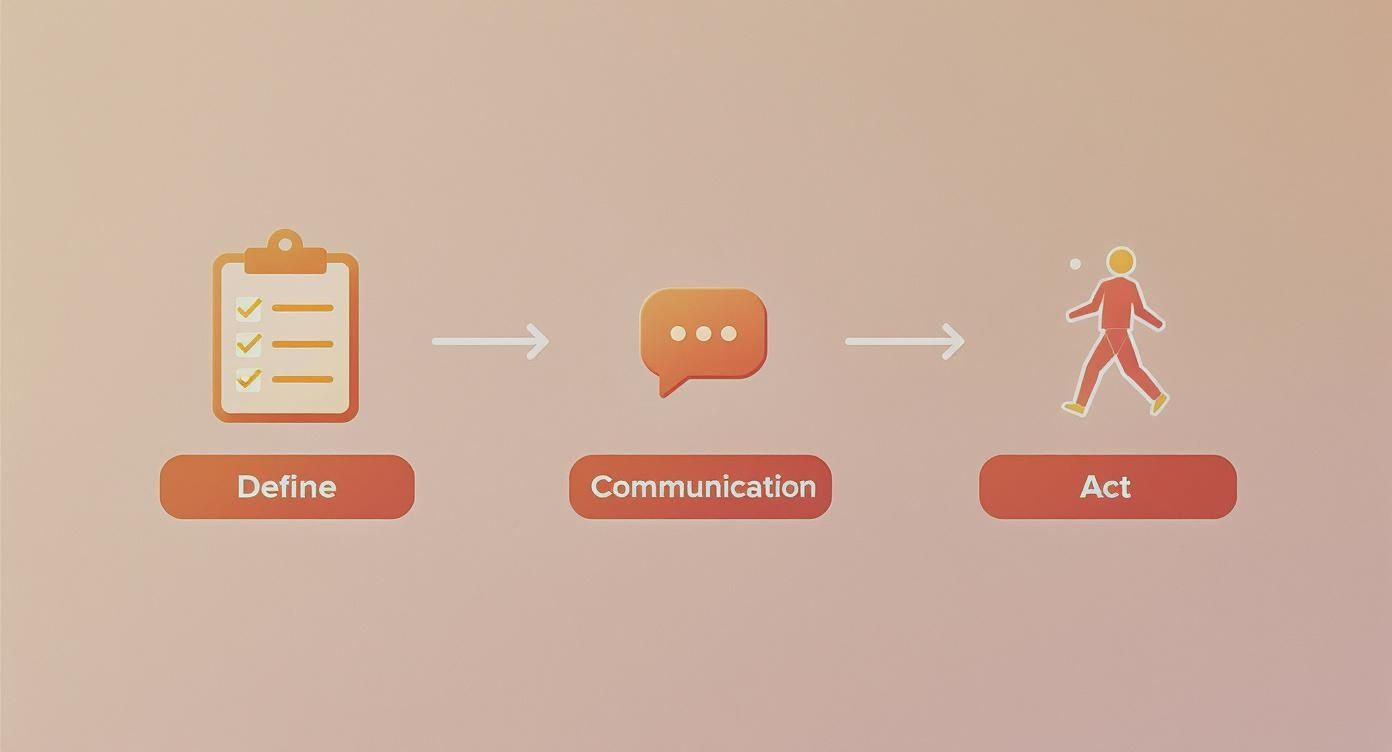
This process—defining the boundary, communicating it clearly, and acting on it consistently—is fundamental to creating a safer, more predictable environment for yourself.
Key Components of Your Safety Plan
A solid plan should cover several key areas, ensuring you can act quickly if you need to. Don't wait for an emergency to figure these things out.
- Identify a Safe Location: Know exactly where you will go. This could be the home of a trusted friend or family member, a local shelter, or a hotel. Make sure the person whose home you plan to go to is aware of the situation and on board to help.
- Pack an Emergency Bag: Keep a "go-bag" packed with essentials in a discreet but accessible place, like the trunk of your car or at a friend's house. Include copies of important documents (IDs, birth certificates, social security cards), cash, spare keys, medications, and a change of clothes for you and any children.
- Establish a Code Word: If you have children old enough to understand, create a simple code word or phrase. This word is the signal that it's time to leave immediately, without questions or arguments.
- Memorize Key Contacts: Have the phone numbers of your support person, a local domestic violence hotline, and emergency services memorized or stored somewhere besides just your phone, in case you have to leave it behind.
Preparing this plan is an act of empowerment. It gives you back a degree of control in a situation that often feels completely out of your hands, ensuring you have a clear path to safety when you need it most.
Finding Support Systems and Professional Help
One of the most destructive myths about living with an alcoholic husband is that you have to navigate this storm by yourself. The loneliness is real and profound, but it's a feeling, not a fact. Building a network of support isn't just a nice idea; it's an essential lifeline for your own recovery and well-being.
Trying to manage this alone is like trying to lift an impossible weight. It’s completely unsustainable and a fast track to burnout. Reaching out isn't a sign of weakness—it's a powerful, strategic move to reclaim your life and find some stability in the middle of the chaos.
The Unique Power of Peer Support
There’s a special kind of comfort that comes from talking to someone who just gets it without needing a long, drawn-out explanation. That's the real strength of support groups designed for families of alcoholics.
Al-Anon is the most well-known of these groups for a reason. It offers a safe, totally confidential space for people affected by someone else’s drinking to share what they're going through. The focus isn't on fixing your husband; it’s about you.
In these meetings, you'll hear stories that could be your own, which instantly cuts through that feeling of isolation. You’ll learn practical coping strategies from people who have been exactly where you are—things like detachment with love, setting firm boundaries, and finding your own sense of peace, whether he decides to stop drinking or not.
Finding a community that validates your reality is life-altering. You stop questioning your sanity and start building your strength. It's a place where you are understood on a fundamental level.
Exploring Professional Guidance
While peer groups provide solidarity, professional help offers clinical expertise and a structured path forward. Working with therapists or counselors who specialize in addiction can give you tools and perspectives that are incredibly hard to find on your own.
Types of Professional Help to Consider
- Individual Therapy: This is your private space to process the anger, grief, and exhaustion you've been carrying. A therapist can help you manage your anxiety, rebuild your self-esteem, and navigate tough decisions with more clarity.
- Family Therapy: Addiction is often called a "family disease" for good reason—it pulls everyone into its orbit. Family therapy, led by a specialist trained in addiction, can help restore healthier communication and address codependent patterns.
- Marriage Counseling: This can be a game-changer, but with one critical condition: the counselor must have specific experience with substance use disorders. Standard marriage counseling often backfires when a therapist doesn't grasp the complexities of addiction. It’s most effective when your husband is also actively working on his own recovery.
Finding the right professional is key. Look for credentials like Licensed Addiction Counselor (LAC) or therapists who list addiction as a specialty. Don't be afraid to have a consultation with a few different people to find someone you truly connect with.
When Your Husband Considers Treatment
If your husband finally says he's ready for help, it's a huge moment. Understanding the treatment landscape can empower you both to take the next step. Rehab isn't a one-size-fits-all fix; different levels of care are designed for different needs. Taking a look at a guide on how does rehab work can demystify the process for both of you, showing what a structured path to recovery actually looks like.
Knowing what to expect from detox, inpatient programs, or outpatient services allows you to be an informed partner in his journey—without taking ownership of it.
Building Your Personal Support Network
Beyond formal groups and therapy sessions, your personal support system is your daily lifeline. This is the team you intentionally build for yourself.
This network should include trusted friends or family members you can be brutally honest with—people who will listen without judgment and support your decisions. Be selective here. Confide in those who empower you, not those who offer unsolicited advice or pressure you to "just leave" or "just stick it out."
Your support system is your foundation. Whether it's a weekly Al-Anon meeting, a therapy session every other week, or a quick daily call with a friend who gets it, these connections are what will hold you up. You don't have to do this alone. In fact, you shouldn't.
Answering the Hard Questions
When you're living with an alcoholic husband, you're faced with some of the toughest questions imaginable. The answers are rarely straightforward, and the path forward can feel incredibly isolating. Here are some direct, experience-based answers to the questions we hear most often.
Can I Force My Husband to Go to Rehab?
This question comes from a place of deep love and desperation, but the short answer is almost always no. You can't legally force a competent adult into treatment against their will. The only exception is if a court deems him an imminent danger to himself or others, which is a very high legal standard to meet.
But that doesn't mean you're powerless. The most powerful tool you have is a professionally guided intervention. Forget the dramatic scenes you've seen on TV; a real intervention is a structured, compassionate conversation. It’s a chance for family and friends to calmly explain how his drinking is affecting them and to lay out clear, firm consequences if he refuses help. The goal isn't to force him but to motivate him to choose treatment for himself. Real, lasting recovery has to start with that personal commitment.
What if He Completely Denies He Has a Problem?
Denial is one of the core symptoms of addiction. It’s the disease’s built-in defense mechanism, and trying to argue with it is like wrestling with smoke—you’ll just end up exhausted and frustrated. No amount of logic, evidence, or pleading will break through it.
So, stop trying to win the argument. Instead, shift your focus to the concrete, undeniable impact his actions have on you and your family. Stick to the facts.
- "When you were drinking last Saturday, you missed our son's soccer game. He kept looking for you in the stands, and it broke my heart."
- "The mortgage was late again last month because that money was spent on alcohol. I'm scared about losing our home."
By holding firm to your boundaries, you let the natural consequences of his drinking do the teaching. The reality of his situation will become far more convincing than any argument you could make. Groups like Al-Anon are invaluable for learning how to handle a partner's denial while protecting your own sanity.
Your reality is not up for debate. Even if he denies the problem, he cannot deny the consequences you experience. Holding firm to that truth is your anchor.
Is It Possible for Our Marriage to Survive This?
Yes, a marriage can absolutely survive alcoholism. In fact, many couples find that the process of recovery builds a stronger, more honest relationship than they ever had before. But this isn't a given; it requires a massive commitment from both of you.
His recovery has to be the non-negotiable priority. And that means more than just putting down the bottle. It means active, consistent work—like attending AA meetings, participating in therapy, and making fundamental lifestyle changes. Just as important is your own recovery. You'll need to heal from the trauma, fear, and codependency that have built up over the years, which you can do through your own therapy or by attending Al-Anon meetings. Rebuilding trust is a slow process, often best guided by a marriage counselor who has experience with addiction recovery.
When Is It Time to Leave?
This is the most personal and painful question of all, and there is no one-size-fits-all answer. Only you can decide when enough is enough, but there are some clear lines that, once crossed, signal that leaving is necessary for your safety and well-being.
Your physical and emotional safety—and that of your children—is paramount. If there is any form of abuse (verbal, emotional, or physical), the priority must immediately shift to creating a safety plan and getting out.
Other signs that it might be time to seriously consider leaving include:
- He persistently refuses to even acknowledge the problem, even after facing severe consequences.
- There's a repeating cycle of failed recovery attempts with no genuine, sustained effort on his part.
- The situation is causing severe damage to your own mental, physical, or emotional health, or that of your children.
Making this decision is agonizing. Talking it through with a therapist can provide the non-judgmental support you need to gain clarity and choose the right path for you and your family.
At Altura Recovery, we know that addiction impacts the entire family system. If you're lost and don't know where to turn, our compassionate experts can offer guidance for you and evidence-based outpatient treatment for your husband. We're here to help you both find a path toward healing and freedom. Learn more about our approach at https://www.alturarecovery.com.