To get a handle on alcohol cravings, the first thing to understand is that they’re a predictable biological response, not a sign of weakness. Cravings come from very real changes in your brain’s reward system after it's been exposed to alcohol for a while. Learning to manage them is the first step toward taking back control.
Why Alcohol Cravings Feel So Overwhelming
That intense, almost unstoppable urge for a drink can feel like a personal failing, but it’s really just brain science at work. When you drink regularly, your brain physically adapts by changing its reward pathways. Dopamine, the “feel-good” chemical, gets released when you drink, forging a powerful link between alcohol and pleasure.
Before long, your brain starts to anticipate this chemical reward. When you stop drinking, it sends out powerful signals—what we call cravings—demanding the substance it’s grown used to. This isn't just a psychological "want"; it's a deep-seated physiological demand.
The Power of Triggers
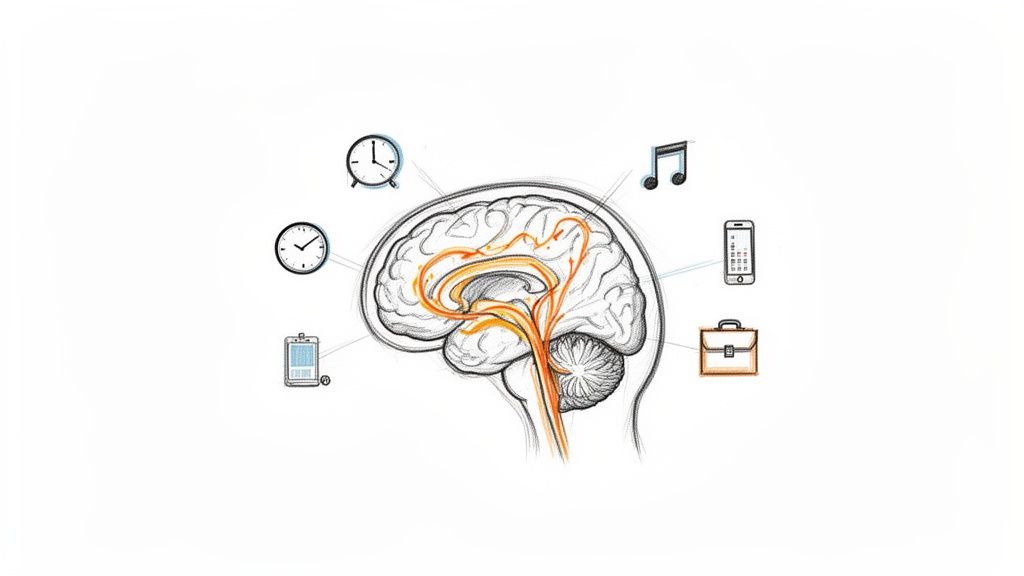
This biological process gets supercharged by environmental and emotional cues, which we call triggers. Your brain becomes incredibly efficient at linking certain situations with the reward of alcohol, and a trigger can be anything your mind has learned to associate with drinking.
Common examples include:
- Specific Times: Like the moment you walk in the door after work.
- Emotional States: Feeling stressed after a tough meeting or sad after an argument.
- Social Settings: Being at a party, a restaurant, or even just seeing friends you used to drink with.
- Sensory Cues: The smell of a particular drink, the sound of a bottle opening, or a song that was always on in the background.
When you run into one of these triggers, your brain anticipates the dopamine hit it has come to expect and unleashes a powerful craving. It’s an almost automatic response, which explains why cravings can feel so sudden and forceful.
Understanding your personal triggers is the bedrock of managing cravings. Once you know what sets off the urge, you can see it coming and prepare a different response instead of getting caught off guard.
Cravings Are a Manageable Part of Recovery
Recognizing that cravings are a biological and psychological reaction is incredibly empowering. It reframes the whole experience from a battle of willpower to a challenge of strategy. This shift in perspective is critical, especially when you consider the scale of the problem.
Globally, alcohol contributes to 2.6 million deaths every year, making effective craving management a public health priority. National data shows relapse rates for substance use are between 40% and 60%—similar to other chronic conditions like asthma. This highlights that recovery is an ongoing process of management, not a one-time fix. You can read more about the global impact of alcohol use from the World Health Organization.
Here’s the key takeaway: cravings are a normal, though uncomfortable, part of the recovery journey. They will lessen in intensity and frequency over time as your brain heals and you build new, healthier neural pathways. By learning to identify your triggers and put coping strategies into action, you can navigate these urges without giving in, proving to yourself that you are in control.
Immediate Tactics to Defuse Cravings in Real Time
When a craving hits, it can feel like a sudden, overwhelming storm. Your immediate response in those first few minutes is crucial. Instead of gritting your teeth and relying on sheer willpower, a toolkit of practical, on-the-spot strategies can disrupt the craving cycle before it ever gains momentum.
The good news is that most acute cravings are surprisingly temporary. They typically peak in intensity and then start to fade within about 15 to 20 minutes. The whole game is just navigating that window without giving in. The goal isn't to pretend the craving isn't there, but to actively engage with it differently and ride it out.
Ride the Wave with Urge Surfing
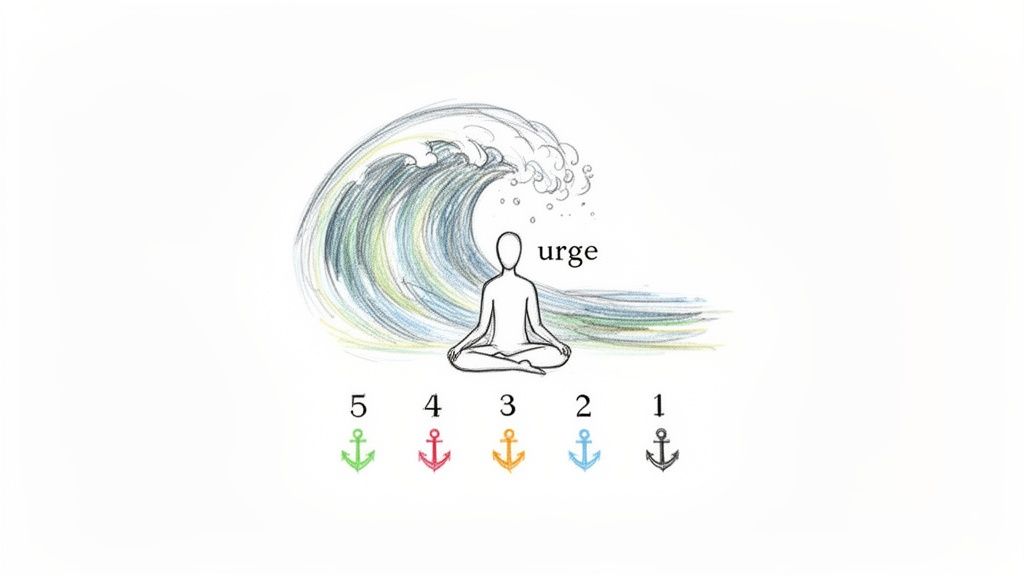
One of the most powerful techniques is something we call urge surfing. Imagine the craving is an ocean wave. You can't command the ocean to be still, but you can learn to ride the wave until it crests and breaks on the shore. Instead of fighting it, you mindfully observe it.
Pay attention to the physical sensations. Is your heart rate climbing? Do you feel that familiar tension in your neck or shoulders? Just acknowledge these feelings without judging them as good or bad. By simply observing the urge as a temporary physical and mental event, you strip away its power and turn it into something you can manage.
Ground Yourself in the Present Moment
When a craving pulls at your focus, your mind is often racing with thoughts about drinking. A good grounding technique can yank you back to the present moment, breaking that obsessive thought loop. The 5-4-3-2-1 method is a simple but incredibly effective way to do this.
Just pause and identify:
- 5 things you can see: Look around and name five distinct objects. Notice their color, shape, and even the texture.
- 4 things you can feel: Bring your attention to physical sensations. It could be the solidness of the chair beneath you, your feet flat on the floor, or the fabric of your shirt.
- 3 things you can hear: Listen for three specific sounds. Maybe it's a clock ticking, traffic outside, or just the sound of your own breathing.
- 2 things you can smell: Try to identify two distinct scents in the air, like coffee brewing or the clean scent of soap on your hands.
- 1 thing you can taste: Focus on the taste in your mouth or take a slow sip of water and really notice its flavor.
This exercise forces your brain to shift its attention from the internal noise of the craving to your immediate, real-world sensory experience. It's a much-needed mental reset.
A craving is just a thought, and you don't have to act on every thought you have. These immediate tactics create a crucial pause between the urge and the action, giving you the space to make a different choice.
Play the Tape Forward
Another potent mental exercise is to "play the tape forward." When a craving hits, your brain loves to romanticize the immediate relief of a drink, conveniently editing out the aftermath. This technique involves consciously and vividly walking through the entire sequence of events that would follow if you were to drink.
Don't just think, "I'll feel bad." Get specific. Imagine the taste of that first drink, then the second. What happens next? The fuzzy thinking? The argument with your partner? The crushing hangover tomorrow morning? The feelings of shame, anxiety, and regret that always follow?
By mentally connecting the craving with its real, painful outcomes—not just the temporary illusion of relief—you break the spell. This reinforces your motivation to stay sober by reminding you, in detail, what you're fighting for. For more ideas, check out this guide on practical steps to regain control over alcohol cravings.
When a craving hits hard and fast, having a few go-to moves ready can make all the difference. Think of these techniques as your personal rapid-response team.
Here's a quick summary to keep in mind:
Your In-The-Moment Craving Response Toolkit
| Technique | Core Principle | When to Use |
|---|---|---|
| Urge Surfing | Observation without judgment. Acknowledge the craving as a temporary wave of sensation and let it pass naturally. | When the craving feels intense and physical, and you're tempted to fight it head-on. |
| 5-4-3-2-1 Grounding | Sensory engagement. Pull your focus out of your head and into the present moment by naming things you see, feel, hear, smell, and taste. | When your mind is racing with obsessive thoughts about drinking and you feel disconnected from your surroundings. |
| Play the Tape Forward | Consequence visualization. Mentally walk through the entire negative sequence of events that would follow if you were to drink. | When your brain is romanticizing alcohol and conveniently forgetting the hangover, shame, and regret. |
These immediate tactics are your first line of defense. They are skills, and just like any other skill, they become stronger and more automatic with practice. Combining them with your support system—like a quick call to a trusted friend or sponsor—can make you that much more resilient when navigating these challenging moments.
Rewiring Your Brain with Behavioral Therapy
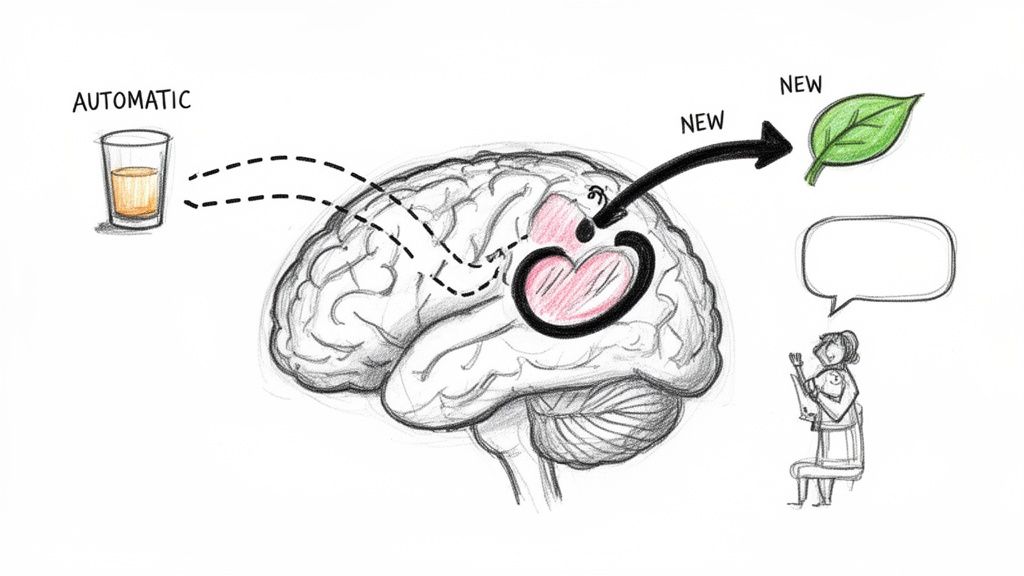
While in-the-moment tactics are essential for getting through a tough urge, real, lasting recovery comes from changing the underlying thoughts that spark the craving in the first place. Cravings often feel like they come out of nowhere, but they’re usually kicked off by deeply ingrained, automatic mental scripts.
Behavioral therapies like CBT and DBT give you a proven blueprint for spotting, challenging, and rewriting these scripts. It’s not about ignoring your thoughts—it's about actively engaging with them. Think of it like training a muscle. The more you practice new ways of thinking, the stronger those neural pathways get, making it easier to curb alcohol craving impulses over time.
Challenging Automatic Thoughts with CBT
Cognitive Behavioral Therapy (CBT) is a game-changer in addiction treatment because it zeroes in on the direct link between what you think, how you feel, and what you do. The core idea is simple: it’s not the trigger itself that causes the craving, but the meaning you attach to it.
A stressful day at work, for example, doesn't automatically equal a craving. The craving is ignited by the automatic thought that follows: “This day was awful. I need a drink to feel better.” CBT teaches you to catch that thought right in its tracks.
Once you’ve spotted it, you can start to pick it apart. Is a drink really the only thing that will help? What actually happened the last time you drank after a hard day? By questioning these automatic beliefs, you create just enough space to let a more balanced, realistic perspective sink in.
The point of CBT isn't to force "positive thinking." It’s about cultivating balanced thinking. It helps you see the cognitive distortions that fan the flames of a craving and replace them with thoughts that are actually grounded in reality.
A Real-World CBT Scenario
Let’s say you get an email with some tough, unexpected feedback from your boss. The old, automatic thought might be, "I completely failed. I need a drink to forget this."
A CBT-based approach helps you slow down and reframe it.
- Identify the thought: "I'm a failure, and I need a drink."
- Examine the evidence: "Is this one piece of feedback proof that I'm a total failure? What about the praise I got last month? And does drinking actually solve anything, or does it just push the problem to tomorrow and add a hangover?"
- Create a new response: "This feedback is hard to hear, but it doesn't define my worth. A drink will just make me more anxious tomorrow. Instead, I’ll go for a run to clear my head and then make a plan to address the feedback."
This process feels methodical at first, but with practice, it becomes second nature. You’re effectively rewiring your brain to find healthier, more constructive ways to handle stress instead of defaulting to alcohol.
Managing Intense Emotions with DBT
Sometimes, cravings aren’t driven by a specific thought but by an overwhelming wave of emotion—anger, loneliness, anxiety. This is where skills from Dialectical Behavior Therapy (DBT) are incredibly powerful. DBT gives you practical tools for distress tolerance and emotional regulation, getting to the root of many intense urges to drink.
These skills are designed for those high-stakes emotional moments. Instead of reaching for a drink to numb a difficult feeling, DBT teaches you how to sit with the emotion without letting it dictate your actions.
Key DBT skills that help curb alcohol craving include:
- Distress Tolerance: This is about getting through a crisis without making it worse. It could mean using self-soothing techniques (like holding a warm mug or listening to calming music) or distracting yourself with a positive activity for a short time.
- Mindfulness: Staying grounded in the present, observing your emotions and urges without judgment—a lot like the urge surfing technique we talked about earlier.
- Emotional Regulation: Understanding what your emotions are telling you and actively reducing your vulnerability to negative states by taking care of your physical and mental health.
By building these skills, you develop true emotional resilience. You learn that you can survive uncomfortable feelings without needing alcohol as a crutch, which gives you a profound sense of confidence and control. Ultimately, you create a life where you are in charge of your emotions, not the other way around.
Addressing Co-Occurring Mental Health Conditions
For so many people, the urge to drink isn't just a physical craving—it's tangled up with their entire emotional world. If you've ever reached for a drink to quiet anxious thoughts, numb the sting of depression, or just escape from old memories for a few hours, you know exactly how tight that knot can be.
When these underlying issues aren't addressed, they become powerful internal triggers. It makes the path to sobriety feel like a constant, draining uphill battle.
Trying to treat addiction without looking at a co-occurring mental health condition is like patching a leaky pipe while ignoring the dangerously high water pressure that caused the burst in the first place. It’s only a matter of time before another leak springs. That’s why a dual-diagnosis approach—treating both the substance use and the mental health disorder at the same time—is so essential for a recovery that actually lasts.
The Cycle of Self-Medication
Untreated mental health symptoms can make drinking feel less like a choice and more like a survival tool. Someone battling social anxiety might feel an overwhelming craving before a party, driven by the belief that alcohol is the only way they can possibly "loosen up" and connect with people. In the same way, a person wrestling with depression might see alcohol as the one reliable escape from feelings of hopelessness.
This pattern of self-medication creates a vicious feedback loop. While alcohol might offer a moment of relief, it almost always makes symptoms of anxiety and depression worse in the long run. This, in turn, fuels even more intense cravings, locking you into a cycle that feels impossible to break without the right kind of integrated support.
Understanding this link is empowering. Your cravings aren't just a random weakness; they are often a signal that an underlying emotional need is not being met. Addressing that need is the key to reducing their power.
Why Integrated Care Is a Non-Negotiable
The link between mental health and addiction isn’t just a theory; the data is overwhelming. Integrated treatment is the only way to effectively curb alcohol craving because these co-occurring conditions dramatically increase the risk of both drinking and relapse.
In a single year, an estimated 21.2 million adults were living with both a mental health disorder and a substance use disorder. This dual-diagnosis group often faces more intense cravings and is far more likely to return to alcohol when their mental health symptoms flare up. You can find more details on co-occurring disorders to see the full scope of the statistics.
An integrated care plan provides a complete solution by treating the whole person, not just the addiction in a vacuum.
This kind of comprehensive support typically weaves together several key elements:
- Individual Therapy: Using methods like CBT or EMDR to process trauma and challenge the negative thought patterns that fuel both the mental health condition and the substance use.
- Psychiatric Support: Providing evaluations and medication management to stabilize mood or reduce anxiety, which directly dials down the intensity of cravings.
- Addiction Counseling: Offering specialized guidance on relapse prevention, managing triggers, and building practical sober coping skills.
- Group Therapy: Creating a safe, supportive community where you can share experiences related to your dual diagnosis, breaking the sense of isolation.
By blending these elements, an integrated program like the outpatient services at Altura Recovery helps you build a strong, stable foundation for your life. You're not just learning to say no to a drink; you're developing the emotional resilience and healthy coping tools needed to manage your mental health, which ultimately starves the cravings at their source.
Building a Craving-Resistant Lifestyle
Managing cravings in the moment is a critical skill, but the real endgame is building a life where those cravings barely get a foothold. It’s about moving from a defensive crouch—constantly swatting away urges—to an offensive strategy where your daily habits and environment starve those urges at the source.
This isn’t about chasing some impossible standard of perfection. It’s about making small, consistent choices that build a strong foundation for recovery. Over time, this transforms sobriety from a constant battle into a natural, positive way of life. You become less vulnerable to cravings by design, not just by willpower.
Fuel Your Body to Stabilize Your Mind
What you eat has a surprisingly direct line to your brain's craving signals. One of the biggest, most overlooked triggers is unstable blood sugar. When you're running on processed foods or skipping meals, the resulting energy crash can create the same irritability and agitation your brain has learned to associate with needing a drink.
A balanced diet is your first line of defense, keeping your mood and energy on an even keel.
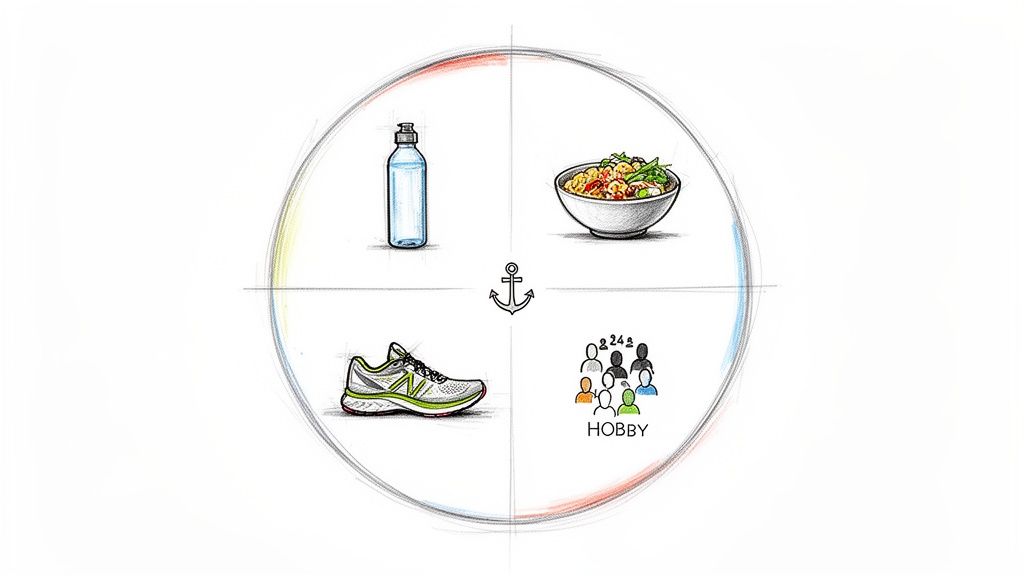
- Prioritize Protein and Fiber: These are your slow-burn fuels. Think lean meats, beans, whole grains, and lots of vegetables. They prevent the sharp blood sugar spikes and crashes that can make a craving feel ten times stronger.
- Stay Hydrated: It sounds simple, but it’s huge. Thirst often masquerades as hunger or even an alcohol craving. Keep a water bottle handy and sip all day to maintain both physical and mental balance.
- Get Moving: Exercise is one of the most powerful natural stress-busters available. It floods your brain with mood-boosting endorphins and gives you a healthy outlet for the nervous energy that might otherwise send you reaching for a bottle.
Redesign Your Social Life and Set Boundaries
Let’s be honest: the social side of recovery can be a minefield. Old friends, familiar places, and ingrained routines all require a game plan and the confidence to protect your sobriety. This is where setting firm boundaries becomes non-negotiable.
It is perfectly okay to say "no" to invitations that feel too risky, especially in early recovery. It’s also vital to have a simple, firm response ready for when someone offers you a drink. A straightforward, "No thanks, I'm not drinking tonight," is all you need. You don’t owe anyone a lengthy explanation.
Your recovery has to come first. Period. Filling the space left by old drinking activities with new hobbies and sober connections creates a social life that supports your new lifestyle instead of threatening it.
Find Purpose Beyond Sobriety
A truly craving-resistant life often begins when you get clear on your deeper motivations. When your daily actions align with what you genuinely care about, alcohol starts to lose its shine. Learning how to identify your core values provides the clarity you need to make choices that support a life free from alcohol's grip.
This personal shift is happening against a backdrop of changing social norms. With growing public awareness and better access to treatment, the stigma around sobriety is slowly fading. A July 2025 Gallup poll even found that only 54% of U.S. adults now drink alcohol—the lowest figure in nearly 90 years. This evolving climate makes it easier than ever to find sober networks and support.
Connecting with others who share your goals is a powerful way to stay motivated. Exploring different addiction topics for groups can help you find discussions that resonate with your own journey, building a strong community to stand with you.
Knowing When to Seek Professional Support
Sometimes, even with the best intentions and a solid self-help plan, cravings just don't let up. Hitting that wall isn’t a sign of failure—far from it. Recognizing that you need to bring in reinforcements is a sign of incredible strength and self-awareness. It’s the moment you decide to fight smarter, not just harder.
But how do you know when you've reached that point? It can be tricky, but there are some clear signals. If your own efforts to manage or curb alcohol cravings keep falling short, that’s a big one. You might feel like the battle is taking up all your mental real estate, leaving you exhausted and discouraged.
Signs You May Need a Higher Level of Care
Pay close attention to these patterns. They often mean that the cravings are a symptom of a deeper issue that needs a structured, professional game plan to resolve.
- Cravings Dominate Your Thoughts: Your mind is constantly preoccupied with drinking or getting your next drink, making it hard to focus on work, hobbies, or the people you love.
- You Keep Trying to Quit, But Can't: You’ve made sincere promises to yourself to cut back or stop, but you always end up back in the same cycle, even when it’s causing problems.
- You Experience Withdrawal Symptoms: Trying to stop brings on physical or emotional distress—like shakiness, anxiety, sweating, or nausea. This is a clear indicator of physical dependence.
- Your World Is Getting Smaller: You find yourself dodging social events or giving up activities you used to enjoy, either because they don’t involve alcohol or because you’re afraid they'll trigger a craving.
If these scenarios sound all too familiar, it's time to seriously consider structured outpatient support. Reaching out connects you with clinical experts and a community of people who get exactly what you’re going through.
Seeking professional help isn't giving up; it's leveling up your strategy. It means you’re ready to use every tool available to build a life where you are in control, not the cravings.
Understanding Your Outpatient Options
Outpatient programs, like the ones we offer at Altura Recovery, provide different levels of care designed to fit into your life while giving you the structure you need. They are built to support you without forcing you to press pause on your job, school, or family responsibilities.
Two of the most common options are:
Intensive Outpatient Program (IOP): This level of care usually involves several hours of therapy and group sessions a few days a week. It’s a great fit for people who need substantial support and skill-building but have a stable home life. IOP is laser-focused on developing coping skills, understanding your triggers, and creating a solid relapse prevention plan.
Partial Hospitalization Program (PHP): This is a more immersive option, often seen as a step down from residential treatment or a way to prevent it. PHP involves treatment for most of the day, five days a week, but you return home in the evenings. It’s designed for those who need a high degree of care and medical monitoring but don’t require 24/7 supervision.
Choosing the right level of support takes the guesswork out of recovery. It connects you with licensed clinicians who can deliver evidence-based therapies, manage medication if necessary, and create a personalized plan to help you take your life back from alcohol.
Common Questions About Alcohol Cravings
When you’re new to sobriety, cravings can feel like the biggest, scariest unknown. Everyone wonders about them. Getting straight answers demystifies the experience, turning a terrifying monster into a manageable challenge. Let’s tackle some of the most common questions people have.
How Long Do Alcohol Cravings Last?
When you're in the thick of it, an intense craving feels like it will last forever. But the reality is, the peak is surprisingly short. Most acute urges hit their high point and start to fade within 15-20 minutes. The whole game is about learning how to ride out that brief, difficult window without giving in.
That said, you might also feel longer, less intense waves of cravings for weeks or even months. This is often part of Post-Acute Withdrawal Syndrome (PAWS). Think of these later-stage cravings as your brain slowly healing—they’re much weaker and pop up far less often than those early, overwhelming urges.
Can Certain Foods Help Curb an Alcohol Craving?
Yes, absolutely. What you eat plays a huge role in managing cravings, and it’s an angle people often overlook. Unstable blood sugar is a major trigger for the kind of irritability and restlessness that can easily morph into an urge to drink.
- Stabilize with balanced meals: Make sure you're getting enough protein, fiber, and healthy fats. This keeps your energy levels steady and helps prevent the kind of mood swings that can make you reach for a drink.
- Stay hydrated: It's incredibly common to mistake thirst for a craving. Simply sipping on water or a cup of herbal tea can satisfy that physical hand-to-mouth habit while also keeping your body in balance.
The goal isn't to erase every single craving for the rest of your life. It's about building such effective coping skills that cravings lose their power over you and your decisions. That’s where true freedom is found.
For many people, cravings might never disappear completely, but they can fade into quiet background noise. With the right strategies and consistent practice, what once felt like an urgent, screaming demand becomes a minor distraction that no longer has the power to derail your recovery or your life.
At Altura Recovery, we provide the expert guidance and supportive community you need to build a craving-resistant lifestyle. If you're ready to take control, learn more about our outpatient programs.