Facilitating an addiction recovery group requires more than just a safe space; it demands compelling, relevant, and transformative conversations. The right topics can unlock profound insights, foster connection, and provide the practical tools necessary for sustained sobriety. Stale, repetitive discussions can lead to disengagement, but a well-curated list of themes breathes life into the group process. This article provides a comprehensive roundup of essential addiction recovery group topics, moving beyond the surface to explore the core challenges and opportunities of the recovery journey.
Each entry in this list is designed to be a practical blueprint for a powerful group session. You will find:
- Specific Discussion Prompts: Questions designed to spark meaningful dialogue and personal reflection.
- Actionable Facilitation Tips: Guidance on how to navigate sensitive subjects and keep the conversation productive.
- Fresh Perspectives: Unique angles to help participants explore familiar concepts in a new light.
This guide is for anyone looking to deepen the therapeutic experience, from professional facilitators to peer support leaders and group members themselves. By focusing on structured, impactful discussions about concepts like triggers, relapse prevention, and identity, these topics will help build a strong foundation for lasting change and real healing.
1. Triggers and Coping Mechanisms
This foundational topic explores the internal and external stimuli that can prompt cravings or lead to relapse. It's a cornerstone of any list of addiction recovery group topics because it provides participants with the essential tools for self-awareness and proactive management. The goal is to identify unique trigger patterns, understand the resulting physiological and psychological responses, and build a toolkit of healthy coping mechanisms to replace substance use.

This topic is crucial for long-term sobriety, as successfully navigating triggers is a daily practice in recovery. It moves participants from a reactive state to a proactive one, empowering them to take control of their environment and responses.
How It Works in a Group Setting
A facilitator guides the group to explore common and personal triggers, ranging from people and places to emotions like stress, loneliness, or even boredom. Participants share their experiences in a supportive environment, which normalizes the challenge and fosters collective problem-solving. For example, one member might identify that driving past their old bar is a major trigger, leading to a group discussion about creating new, safer routes home. Another might recognize that work-related stress is their primary vulnerability, sparking a brainstorm on healthy workplace stress-management techniques. The focus is on creating tangible, personalized action plans.
Actionable Tips for Implementation
- Create a Trigger Inventory: Have each member create a written list of their triggers, rating each one's intensity (e.g., on a scale of 1-10). Start by developing plans for the lowest-rated triggers to build confidence.
- Practice Grounding Techniques: Introduce and practice the '5-4-3-2-1' sensory grounding technique (5 things you see, 4 things you feel, etc.) for immediate, in-the-moment craving management.
- Build a "First Aid Kit": Encourage members to create a physical or digital "kit" with items to help them through a trigger, like a specific playlist, a comforting scent, or a list of support contacts.
- Use the HALT Method: Promote the daily practice of checking in with Hungry, Angry, Lonely, and Tired, as these basic needs can be powerful, often overlooked triggers. Developing these kinds of coping skills for substance abuse is a vital part of the recovery journey.
2. The Cycle of Addiction and Breaking Patterns
This topic provides a crucial educational framework, examining the neurological and behavioral patterns that define addiction. It is a vital part of any list of addiction recovery group topics because it demystifies the disease, reducing shame and self-blame. The goal is to help participants understand the science behind their compulsive behaviors, map their personal cycle of use, and identify key points where they can intervene to break free.
Understanding addiction as a brain disease, rather than a moral failure, empowers individuals by giving them a new perspective on their struggles. This session moves participants from confusion and guilt toward a more objective, science-based approach to interrupting ingrained habits and building new, healthy neural pathways.
How It Works in a Group Setting
A facilitator typically uses visual aids, like a circular diagram, to illustrate the cycle: preoccupation, substance use, withdrawal, and the resulting negative emotions that restart the cycle. Group members then apply this model to their own lives, sharing how the cycle manifested for them. For instance, one person might identify that boredom leads to preoccupation, while another might recognize that withdrawal-induced anxiety is what perpetuates their use. This shared exploration helps members see that their experiences, while unique, are part of a predictable and understandable pattern. The discussion focuses on pinpointing the weakest links in their personal cycles where new behaviors can be introduced.
Actionable Tips for Implementation
- Map the Personal Cycle: Have each member draw their own addiction cycle, labeling each stage with their specific thoughts, feelings, and actions. This visual exercise makes the abstract concept tangible.
- Identify Intervention Points: After mapping the cycle, ask the group to identify the earliest possible point where they could have made a different choice. Brainstorm specific actions for those moments.
- Use Accessible Neuroscience: Share simplified information, such as how addiction affects the prefrontal cortex (decision-making) and limbic system (reward). Connect this science directly to members' lived experiences.
- Create a "Pattern Interrupt" Plan: Encourage members to develop a short, written plan for interrupting their cycle. This could include calling a sponsor, engaging in a hobby, or practicing a mindfulness exercise the moment a familiar craving pattern begins.
3. Building a Support Network and Healthy Relationships
This topic focuses on the critical role of social connection in recovery, teaching participants how to identify supportive relationships, set boundaries with toxic connections, and actively build a recovery-oriented community. Since isolation and damaged relationships are often both causes and consequences of addiction, reconstructing a healthy social network is essential. The discussion covers communication skills, conflict resolution, rebuilding trust with family, and finding sober social activities.

This is one of the most vital addiction recovery group topics because strong, quality relationships are among the most powerful predictors of sustained recovery. It helps shift a person’s identity from one centered on substance use to one built on connection, mutual support, and shared positive experiences.
How It Works in a Group Setting
The facilitator encourages an honest evaluation of current relationships, guiding participants to distinguish between those who support their recovery and those who enable past behaviors. The group becomes a safe space to practice new social skills. For instance, members might role-play declining an invitation to a bar with confidence or having a difficult conversation with a family member about their recovery needs. A member could share their success in joining a sober hiking group, inspiring others to seek out similar communities. The focus is on practical steps for pruning unhealthy connections and nurturing supportive ones.
Actionable Tips for Implementation
- Create a Relationship Map: Have members draw a 'relationship circle' diagram, placing their closest, most supportive contacts in the center and others in outer rings. This visual tool helps identify who to lean on.
- Practice Setting Boundaries: Use "I statements" (e.g., "I feel uncomfortable when…") to set boundaries without placing blame. Role-play these conversations in the group to build confidence.
- Schedule Social Connection: Encourage each member to schedule at least one sober social activity or a check-in with a supportive friend each week to combat isolation proactively.
- Utilize Accountability Partners: Pair members up as accountability partners who can provide immediate support during moments of craving or emotional distress, strengthening their network within the group itself.
4. Shame, Guilt, and Self-Forgiveness
This emotionally intensive topic confronts the heavy burdens of shame and guilt that many individuals carry throughout their addiction and into recovery. It is a critical part of any list of addiction recovery group topics because it differentiates between productive guilt, which is remorse over one's actions, and toxic shame, the belief that one is fundamentally flawed. The objective is to help participants understand how shame fuels the addiction cycle and to guide them toward self-forgiveness and compassion.
Addressing shame is transformative because this powerful emotion thrives in secrecy and isolation, preventing authentic connection and healing. By bringing it into a safe, supportive space, participants can begin to dismantle its power and open the door to genuine self-acceptance and lasting behavioral change. This process is essential for building a resilient foundation for sobriety.
How It Works in a Group Setting
A facilitator creates a highly secure and non-judgmental environment for exploring these vulnerable emotions. The group distinguishes between "I did a bad thing" (guilt) and "I am bad" (shame). Participants are encouraged to share experiences where shame kept them silent or pushed them toward substance use as an escape. For example, a member might discuss the profound shame of neglecting their children during active addiction, receiving empathy and validation instead of judgment. Another might explore how shame related to their sexuality or a past trauma contributed to their substance use, allowing the group to see the common threads that connect them. The focus is on normalizing these feelings and collectively developing strategies for self-compassion.
Actionable Tips for Implementation
- Create a Shame Inventory: Encourage members to privately write down specific memories or beliefs that cause them shame. They can then choose to share one small piece with a trusted individual or the group to experience the power of voicing it.
- Practice Self-Compassion Breaks: Introduce Dr. Kristin Neff's technique: Acknowledge the feeling ("This is a moment of suffering"), normalize it ("Suffering is a part of being human"), and offer kindness ("May I be kind to myself in this moment").
- Use Mirror Work: Suggest a daily practice where members look themselves in the eyes in a mirror and say something affirming, such as "I forgive you" or "You are worthy of love."
- Distinguish Forgiveness from Apathy: Emphasize that self-forgiveness is not about ignoring accountability for past actions. It's about letting go of self-punishment to create the emotional space needed to make meaningful amends and move forward constructively.
5. Co-Occurring Mental Health Issues
This critical topic examines the deeply intertwined relationship between addiction and other mental health conditions, such as anxiety, depression, bipolar disorder, or PTSD. Addressing co-occurring disorders is a non-negotiable part of a robust list of addiction recovery group topics, as nearly half of all individuals with a substance use disorder also have a co-occurring mental health condition. The goal is to dismantle the stigma and help participants understand how these conditions influence each other, often in a "chicken-or-egg" cycle.
This discussion is vital because treating addiction in isolation while ignoring underlying mental health issues can set a person up for relapse. A comprehensive recovery plan must address both dimensions of a person’s well-being to be effective long-term, creating a stable foundation for lasting sobriety.
How It Works in a Group Setting
A facilitator creates a safe space to discuss the complexities of dual diagnosis. Participants can share how their substance use may have started as a way to self-medicate symptoms of anxiety or depression. For example, one member might reveal their drinking escalated to cope with social anxiety, while another may recognize that their depressive episodes didn't disappear with sobriety, prompting them to seek therapy. This shared vulnerability helps members see that addressing their mental health is a sign of strength, not a failure in their recovery. It's natural to question the potential for new treatments to be addictive, and a common concern for individuals in recovery is whether therapies like ketamine for depression treatment pose such a risk. The discussion can also cover the role of medication and evidence-based therapies like EMDR or CBT.
Actionable Tips for Implementation
- Seek a Dual Diagnosis Evaluation: Encourage members to get a comprehensive mental health assessment from a specialist experienced in co-occurring disorders to ensure an accurate diagnosis.
- Track Moods and Symptoms: Recommend journaling or using a mood-tracking app for several months into sobriety to distinguish between post-acute withdrawal symptoms and underlying mental health patterns.
- Create a Crisis Plan: Guide participants in developing a plan that addresses both addiction and mental health vulnerabilities, outlining steps to take and people to call during a crisis.
- Find Informed Support: Stress the importance of finding a recovery community that is supportive of members who take prescribed psychiatric medications. Learning about integrated dual diagnosis treatment can empower individuals to advocate for the comprehensive care they need.
6. Relapse Prevention and Warning Signs
This proactive topic equips participants with strategies to recognize and respond to the early warning signs of relapse. It's a critical inclusion in any list of addiction recovery group topics because it reframes relapse not as a sudden failure, but as a process that often begins long before substance use resumes. The goal is to identify the emotional, mental, and physical stages of relapse and create a personalized prevention plan to interrupt the cycle.
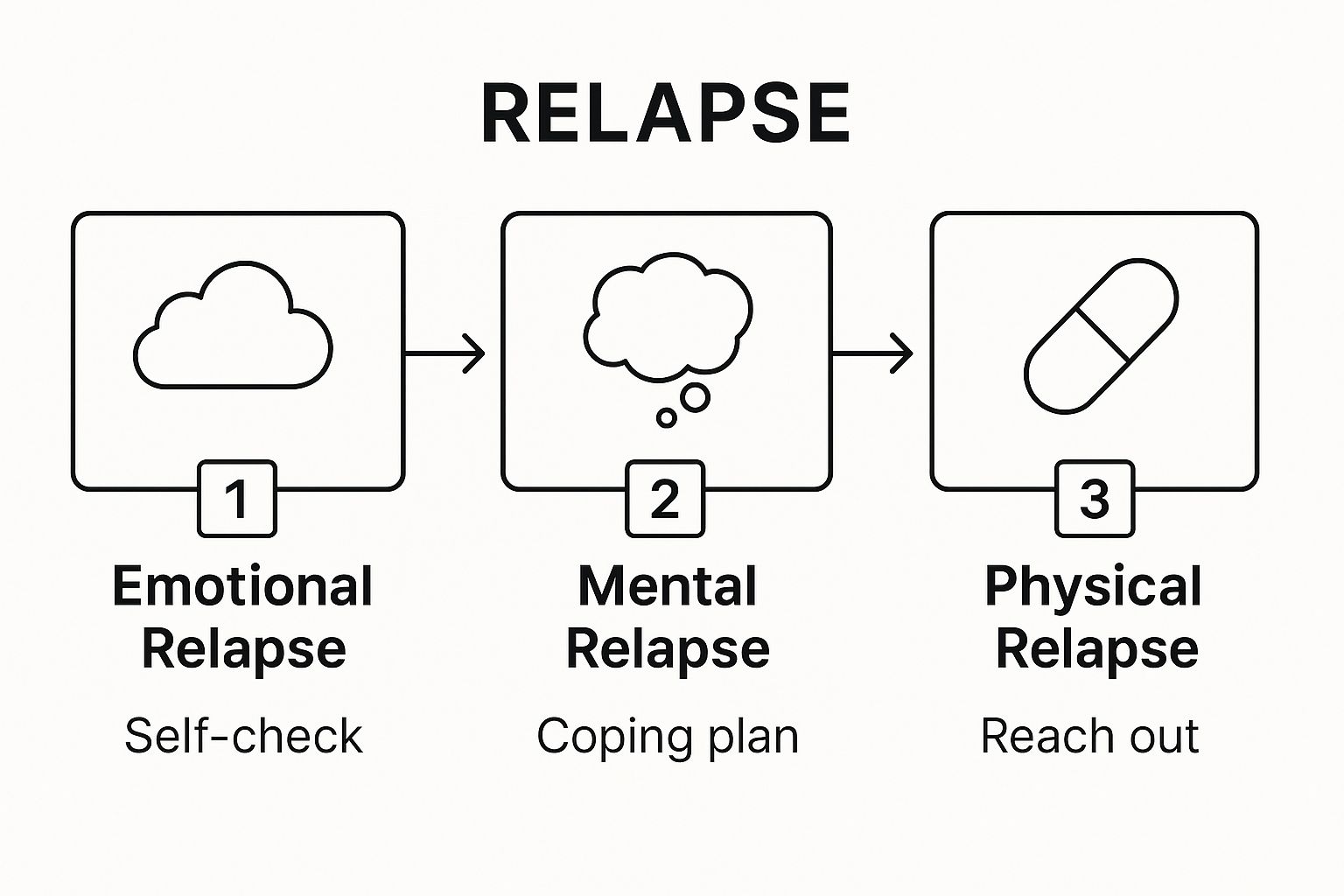
This topic empowers individuals to move from a place of fear to one of preparedness. By understanding the predictable stages of relapse, as illustrated in the process flow above, members can take specific actions at each point to steer themselves back toward safety and stability. The visualization shows that by intervening early, individuals can prevent the progression from emotional distress to physical substance use.
How It Works in a Group Setting
A facilitator guides the group through the three stages of relapse and helps members identify personal warning signs for each. The discussion is focused on creating practical, actionable plans. For example, a member might realize that isolating themselves and neglecting meetings is an emotional relapse warning sign. The group can then brainstorm proactive solutions, like committing to call a support person when the urge to isolate appears. Another member might identify glamorizing past use as a sign of mental relapse, leading to a discussion on thought-stopping techniques and "playing the tape forward" to remember the negative consequences. The focus is on creating a clear roadmap for what to do when a warning sign appears.
Actionable Tips for Implementation
- Create a Written Plan: Have each member draft a detailed relapse prevention plan, listing their top five warning signs, key support contacts, and specific coping strategies. This should be a living document, reviewed monthly.
- Practice 'If-Then' Scenarios: Develop specific 'if-then' plans for high-risk situations. For example: "If I feel overwhelmed at a holiday party, then I will step outside and call my sponsor immediately."
- Identify 'Seemingly Irrelevant Decisions': Discuss how small, seemingly harmless choices (like driving down a certain street or connecting with an old friend) can lead back to substance use.
- Promote Self-Care as Prevention: Emphasize that relapse prevention is rooted in daily self-care. This includes proper sleep, nutrition, exercise, and addressing basic needs using tools like the HALT (Hungry, Angry, Lonely, Tired) check-in. Understanding what relapse means in mental health is a key part of building a resilient recovery.
7. Life Purpose, Meaning, and Identity Beyond Addiction
This transformative topic explores the existential questions that arise in recovery: 'Who am I without substances?' and 'What is my purpose now?' For many, addiction consumed their identity and time, leaving a significant void when removed. This discussion helps participants rediscover their values, strengths, and life purpose, shifting from a negative identity (fighting addiction) to a positive one (building a meaningful life).
Exploring meaning is essential for long-term recovery because sustainable sobriety requires something to live for, not just something to avoid. It addresses the core human need for purpose, making it one of the most powerful addiction recovery group topics for building a resilient and fulfilling future.
How It Works in a Group Setting
A facilitator initiates a dialogue about the loss of identity in addiction and the opportunity to rebuild it in recovery. The group becomes a space for exploration, where members share abandoned dreams, newfound interests, and sources of inspiration. For instance, one member might discuss how returning to school to pursue a deferred dream career gives them motivation. Another might share how volunteering at an animal shelter provides a new sense of purpose and responsibility. The group can complete a values card sort to identify what truly matters to each person, sparking conversations about aligning their daily actions with those core values.
Actionable Tips for Implementation
- Complete a Values Assessment: Use guided exercises or card sorts to help members identify and prioritize their core personal values, which will serve as a compass for decision-making.
- Set SMART Goals: Encourage members to set specific, measurable, achievable, relevant, and time-bound goals in multiple life domains like health, career, and personal growth.
- Journal on Purpose-Driven Questions: Prompt journaling with questions like, "What did I love before addiction?" or "What would I do if I knew I couldn't fail?" to uncover latent passions.
- Explore Service Work: Discuss how using one's recovery story to help others, through volunteering or advocacy, can provide profound meaning. For many, this connects deeply with broader ideas of spirituality in recovery.
- Define a Personal Mission: To further articulate a clear path forward, individuals can benefit from resources on defining a personal mission statement that aligns with their newfound values.
8. Anger Management and Emotional Regulation
This essential topic addresses the challenge of managing intense emotions in recovery, particularly anger, which many people previously numbed with substances. It is a vital part of any list of addiction recovery group topics because it teaches that emotions are not the problem; the issue is the lack of skills to experience and express them healthily. The discussion covers the physiology of anger, the difference between feeling and acting, and the broader skill of emotional regulation.

Many individuals in recovery never learned healthy emotional management, making this a foundational life skill that supports both sobriety and overall mental health. Developing these skills helps prevent emotional buildup that can trigger a relapse, empowering individuals to navigate life's challenges without resorting to substance use.
How It Works in a Group Setting
A facilitator creates a safe space for members to explore their relationship with anger and other powerful feelings. The group can discuss the physical warning signs of escalating anger, such as a clenched jaw or a feeling of heat. For instance, a member might share how they used the 'STOP' skill (Stop, Take a breath, Observe, Proceed mindfully) when they felt overwhelmed, preventing an outburst. Another discussion could focus on identifying the primary emotion beneath anger, like hurt or fear. Role-playing assertive communication using "I feel" statements helps participants practice expressing their needs directly and respectfully, a skill many find challenging. This collective learning process demystifies anger and equips everyone with practical tools.
Actionable Tips for Implementation
- Use a Feelings Wheel: Encourage members to use a feelings wheel to identify the specific emotions hiding beneath general anger, such as "betrayed," "insecure," or "overwhelmed."
- Practice a "Cool-Down" Period: Teach the group to take a 20-minute timeout when feeling escalated. This allows the stress hormone cortisol to decrease, making rational thought possible again.
- Develop Physical Release Practices: Brainstorm healthy physical outlets for intense energy, such as vigorous exercise, progressive muscle relaxation, or intentional breathwork techniques.
- Keep an Anger Journal: Suggest members log instances of anger to identify patterns, common triggers, and recurring underlying issues that need to be addressed.
- Practice Assertive Communication: Regularly practice using "I" statements to express needs clearly and calmly, differentiating this from passive or aggressive communication styles.
Addiction Recovery Topics Comparison Table
| Topic | Implementation Complexity 🔄 | Resource Requirements ⚡ | Expected Outcomes 📊 | Ideal Use Cases 💡 | Key Advantages ⭐ |
|---|---|---|---|---|---|
| Triggers and Coping Mechanisms | Moderate – requires ongoing practice and skill building | Low to Moderate – primarily personal/team facilitation | Increased self-awareness; improved relapse prevention | Early to mid recovery; relapse prevention | Empowers proactive coping; practical daily tools |
| The Cycle of Addiction and Breaking Patterns | Moderate – involves neuroscience education and reflection | Moderate – needs skilled facilitation and visual aids | Reduced shame; better understanding of addiction cycle | Psychoeducation; motivation for change | Frames addiction medically; fosters hope |
| Building a Support Network and Healthy Relationships | Moderate – relational skill development and boundary setting | Moderate – group activities and social engagement | Stronger social support; reduced isolation | All recovery stages; rebuilding social connections | Enhances accountability; heals relationships |
| Shame, Guilt, and Self-Forgiveness | High – emotionally intensive, requires careful facilitation | Moderate – safe group environment and skilled facilitation | Emotional liberation; increased self-worth | Mid recovery or when addressing emotional barriers | Breaks secrecy; promotes authentic healing |
| Co-Occurring Mental Health Issues | High – complex dual diagnosis and integrated treatment | High – requires mental health professionals and specialized programs | Comprehensive wellbeing; reduced relapse risk | Dual diagnosis cases; integrated treatment planning | Addresses root causes; normalizes medication use |
| Relapse Prevention and Warning Signs | Moderate – requires personalized planning and monitoring | Low to Moderate – planning tools and support involvement | Proactive relapse response; reduced relapse severity | All recovery stages; high-risk periods | Normalizes relapse; actionable prevention steps |
| Life Purpose, Meaning, and Identity Beyond Addiction | Moderate – reflective and exploratory exercises | Low to Moderate – coaching, journaling, and group work | Increased motivation; renewed life direction | Mid to long-term recovery; identity rebuilding | Positive motivation; fosters hope and meaning |
| Anger Management and Emotional Regulation | Moderate – skill acquisition and emotional practice | Low to Moderate – coaching and self-practice resources | Improved emotional control; reduced conflict | Early to mid recovery; emotional stability | Enhances emotional intelligence; prevents relapse |
Putting It All Together: Your Path to Real Growth
The journey from active addiction to sustainable recovery is not a single event but a continuous process of growth, learning, and self-discovery. The addiction recovery group topics we've explored provide a comprehensive roadmap for this journey. They are more than just items on a checklist; they represent the core pillars of a resilient, fulfilling life free from substance dependence. Engaging with these themes consistently is the key to transforming sobriety from a daily struggle into a natural way of life.
From identifying personal triggers and crafting effective coping mechanisms to breaking the deeply ingrained cycle of addiction, each topic builds upon the last. Addressing the heavy burdens of shame and guilt through self-forgiveness creates the emotional space needed to build a robust support network. Simultaneously, understanding the interplay of co-occurring mental health issues and mastering emotional regulation provides the stability required to navigate life’s inevitable challenges without resorting to old, destructive habits.
From Survival to a Thriving Life
The ultimate goal of recovery is not just to survive without substances but to thrive. This is where the concepts of relapse prevention and finding a new life purpose become so critical. These aren't abstract ideas; they are practical frameworks for building a future that is more compelling than the past.
By proactively addressing these key areas, you transform your approach to sobriety:
- Reactive vs. Proactive: Instead of merely reacting to cravings, you learn to anticipate challenges and build defenses through a solid relapse prevention plan.
- Isolation vs. Connection: You move from the isolation that often fuels addiction to the deep, meaningful connections that sustain recovery.
- Shame vs. Self-Worth: You replace the cycle of shame with a foundation of self-compassion, forgiveness, and a renewed sense of identity.
- Aimlessness vs. Purpose: You shift from a life dictated by addiction to one driven by your own values, goals, and passions.
Mastering these addiction recovery group topics empowers you to become an active architect of your life. You learn not just to cope with triggers but to understand their roots. You don't just avoid relapse; you build a life so rich and meaningful that relapse becomes a less appealing option. This is the essence of real, lasting freedom. The work done in a supportive group setting accelerates this process, offering shared wisdom, accountability, and the powerful reminder that you are not alone on this path. Each discussion, every shared story, and all the learned skills are a step toward not just recovery, but a complete personal transformation.
Ready to take the next step in your recovery with expert guidance and a supportive community? At Altura Recovery, we facilitate group sessions centered on these essential topics, providing the structure and evidence-based care needed for profound healing. Discover our outpatient programs and start building your path to lasting freedom by visiting Altura Recovery today.