To make amends means going far beyond a simple "I'm sorry." It’s an active, ongoing process of taking full responsibility for the harm you've caused, demonstrating through your actions that you've changed, and making a genuine effort to repair the damage. This isn't just about words; it’s about meaningful action.
Unpacking the Meaning of Making Amends
We’ve all been in situations where a quick apology felt necessary, but have you ever had that nagging feeling that "sorry" just wasn't enough? That's the heart of what it means to make amends. It’s the difference between acknowledging a mistake and actively working to fix what you broke.
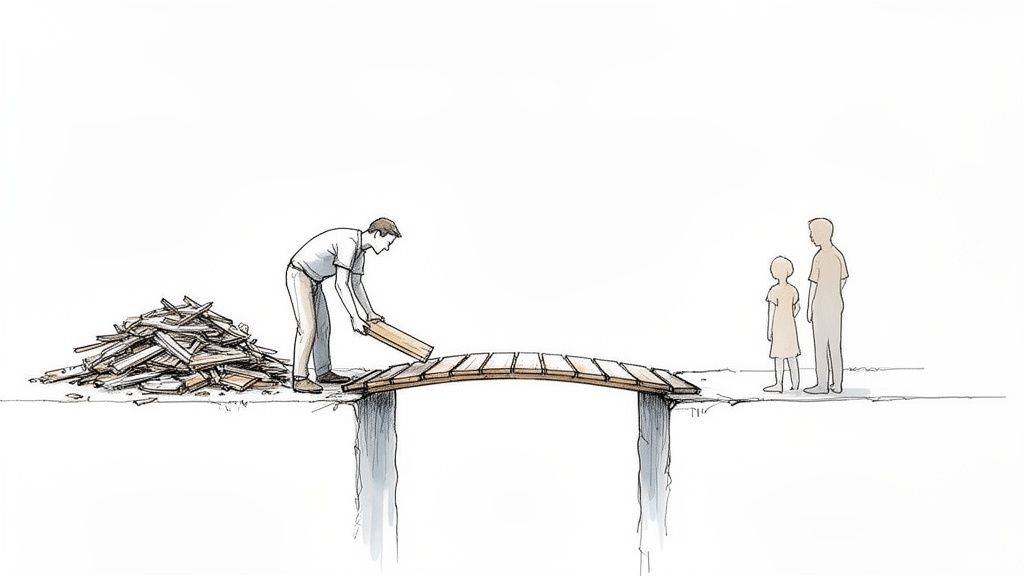
Think of it as rebuilding a bridge you burned down. Shouting "sorry about the fire!" from across the canyon is an apology. Showing up with lumber, tools, and a plan to rebuild it, piece by piece, is making an amend. This concept moves beyond simple regret and into the realm of true accountability and restorative action. It takes courage, honesty, and a real commitment to change.
More Than Words: Action and Accountability
The real difference lies in the follow-through. An apology can be over in seconds, but a true amend unfolds over time through consistent, changed behavior. It’s about proving with your actions that you understand the impact of your choices and are dedicated to never causing that harm again.
The process isn't designed to win forgiveness, either. It’s about restoring your own integrity and, as they say in 12-step programs, "cleaning your side of the street," regardless of the outcome.
Making an amend is a powerful act of accountability. It shifts the focus from your own feelings of guilt to the healing of the person you have harmed. This is where real change begins.
How Apologies and Amends Differ
To really get a handle on this, it helps to see a direct comparison. While both are important tools for navigating relationships, they serve very different purposes when it comes to healing deep wounds.
An apology is often the first step, but an amend is the long walk that follows. Here’s a table that breaks down the fundamental differences between just saying sorry and the action-oriented process of making a true amend.
Apology vs Amends: A Practical Comparison
| Characteristic | Simple Apology | Meaningful Amend |
|---|---|---|
| Focus | Often centered on relieving the apologizer's guilt. | Focused on addressing the other person's pain and repairing the damage. |
| Nature | Primarily verbal ("I'm sorry."). | Action-oriented, involving behavior change and restorative acts. |
| Ownership | May include excuses or justifications ("I'm sorry, but…"). | Takes full, unconditional responsibility for one's actions. |
| Goal | To get forgiveness and move on quickly. | To rebuild trust and demonstrate long-term commitment to change. |
This side-by-side view makes it clear: one is a quick fix, while the other is a deep repair. An amend is a humble, active process that can mend relationships, rebuild self-respect, and create a solid foundation for a more honest life. It plays an especially vital role in addiction recovery, where rebuilding trust is paramount.
Why Amends Are Essential in Addiction Recovery
In addiction treatment and most 12-step fellowships, making amends isn't just a suggestion—it's a cornerstone of building a life in recovery that actually lasts. This practice marks a profound shift. It’s the moment you move from simply not using to actively repairing the emotional and relational wreckage left behind by active addiction.
Why is this so critical? Because it directly confronts the toxic cycle of guilt and shame that keeps so many people stuck. That shame is heavy, and it often becomes a primary trigger to use again.
Think of the harm caused during active addiction as a trail of debris blocking your path forward. Every broken promise, missed birthday, or cruel word is another rock in the way. Making amends is the work of clearing that path, stone by stone, so you can build a new life on solid ground. This isn't just some lofty spiritual exercise; it's a powerful tool for rebuilding the self-worth that addiction eroded.

The Role of Steps 8 and 9
The journey of making amends gets its clearest roadmap from the 12 Steps, found in programs like Alcoholics Anonymous. These steps provide a concrete structure for what can otherwise feel like a hopelessly overwhelming task.
Step 8: "Made a list of all persons we had harmed, and became willing to make amends to them all." This is all about preparation. It requires an unflinching look at the past to identify who was hurt and how, without excuses or justifications. The key word here is "willing"—it's about building the courage to face what happened.
Step 9: "Made direct amends to such people wherever possible, except when to do so would injure them or others." This is where the action happens. Step 9 is about taking that list and starting the work of repair, always guided by the crucial principle of "do no further harm."
This two-step process transforms a vague desire to "make things right" into a tangible, actionable plan for healing. For countless people, it's an absolutely essential part of finding long-term freedom.
Making amends is not about begging for forgiveness. It’s about restoring your own integrity. It's about taking full responsibility for your actions and, in doing so, freeing yourself from the weight of the past so you can finally move forward.
From Shame to Self-Respect
You really can't overstate the therapeutic power of this process. Guilt and shame are crushing burdens, and they are notorious relapse triggers. By methodically and honestly addressing past wrongs, you actively dismantle those corrosive feelings.
This is where evidence-based therapies like Cognitive Behavioral Therapy (CBT) can work beautifully alongside the principles of the 12 Steps. CBT gives you the practical skills to challenge the distorted, shame-based thinking that fuels addiction and helps you navigate these incredibly sensitive conversations in a constructive way. This combined approach helps build genuine self-respect, which is a far more reliable foundation for sobriety than the fleeting relief a substance provides.
For people wrestling with what feel like the hardest addictions to quit, this internal shift from shame to integrity is fundamental.
The impact of this work shows up in the data. While relapse rates can be high in the first year, studies show they drop to under 15% after five years of continuous sobriety. This remarkable improvement is largely credited to sustained recovery practices—like making amends—that systematically repair relationships and rebuild self-esteem.
Ultimately, this process isn’t just about cleaning up the past. It’s about building a future where you can live with honesty, integrity, and peace.
Knowing When You Are Ready to Make Amends
When it comes to making amends, timing is everything. The urge to fix past mistakes is a powerful driver, but jumping into these conversations without being fully prepared can backfire, causing more harm than good. Genuine readiness isn't just about feeling guilty; it’s about being in a stable enough place to show up with honesty, humility, and strength.
Think of it like a surgeon getting ready for a delicate operation. They wouldn't just rush in. They'd sterilize their tools, review the patient’s chart, and have a clear, step-by-step plan. In the same way, you have to prepare yourself emotionally and mentally to make sure your amend is a healing step, not just another wound for you or the other person.
Assessing Your Stability and Intentions
First things first: you need to be grounded in your own recovery. That means having some sober time under your belt and a clear head on your shoulders. If you’re still on an emotional rollercoaster or wrestling with the raw challenges of early sobriety, it's almost impossible to approach an amend without getting defensive or making it all about you. Part of this journey involves understanding the difference between psychological vs physical dependence, which clarifies the internal work you have to do before you can effectively clean up external messes.
Your true intention is also a huge piece of the puzzle. Are you doing this to genuinely own the harm you caused and take full responsibility? Or is there a part of you that’s just hoping for forgiveness, validation, or a way to unload your own guilt?
A genuine amend is a gift you give, not something you do to get a specific reaction. Your readiness hinges on your ability to offer it freely, without expecting anything in return.
Working with a Guide
You should never, ever walk this path alone. Working closely with a sponsor, therapist, or a trusted mentor is non-negotiable. They act as an objective third party, helping you see your part in past conflicts clearly, without the skewed perspectives of guilt or self-justification.
This guided process usually involves a few key steps:
- Clearly Identify the Harm: With your guide, you'll get specific about your actions and the direct harm they caused. Vague apologies like "I'm sorry for everything" just don't cut it. You need to be able to say, "When I did X, it caused Y."
- Prepare Your Words: This isn't about memorizing a script, but about organizing your thoughts. The goal is to be concise, honest, and laser-focused on your actions and their impact. Blame and excuses have no place here.
- Manage Expectations: Your sponsor or therapist will help you get ready for any possible outcome. The other person might be angry. They might be dismissive. They might not want to talk to you at all. Being ready means accepting that their reaction is valid and that you have no control over it.
By taking this structured and supported approach, you make sure that when you finally step up to make an amend, you're coming from a place of strength, sincerity, and true accountability. This careful preparation is what turns a potentially risky move into a powerful act of healing.
How to Make a Genuine and Healthy Amend
Knowing what a genuine amend looks like in the real world is the key to making this process healing rather than harmful. It’s not just about what you say, but how you say it and the intention behind your words. The goal is to take complete ownership of your actions without shifting blame or demanding forgiveness.
A healthy amend is clean and direct. It focuses entirely on your behavior and its impact on the other person. An ineffective attempt, on the other hand, often gets tangled in justifications, minimization, or your own need for emotional relief, which can unintentionally cause even more pain.
Taking Full Ownership
The core of a successful amend is unconditional accountability. This means you have to fight the urge to explain why you did something. Adding a "but" or a "because" immediately turns your apology into an excuse and puts the other person right back on the defensive.
Instead, the formula is simple: "When I did [specific action], it caused [specific harm]." This structure keeps the focus exactly where it belongs—on your responsibility.
A genuine amend is about clearing your side of the street, not telling the other person how to clean theirs. The focus is on your actions and their impact, period.
Before you even think about having this conversation, you need to be sure you're ready. The process flow chart below shows the key steps to determine if you're truly prepared.
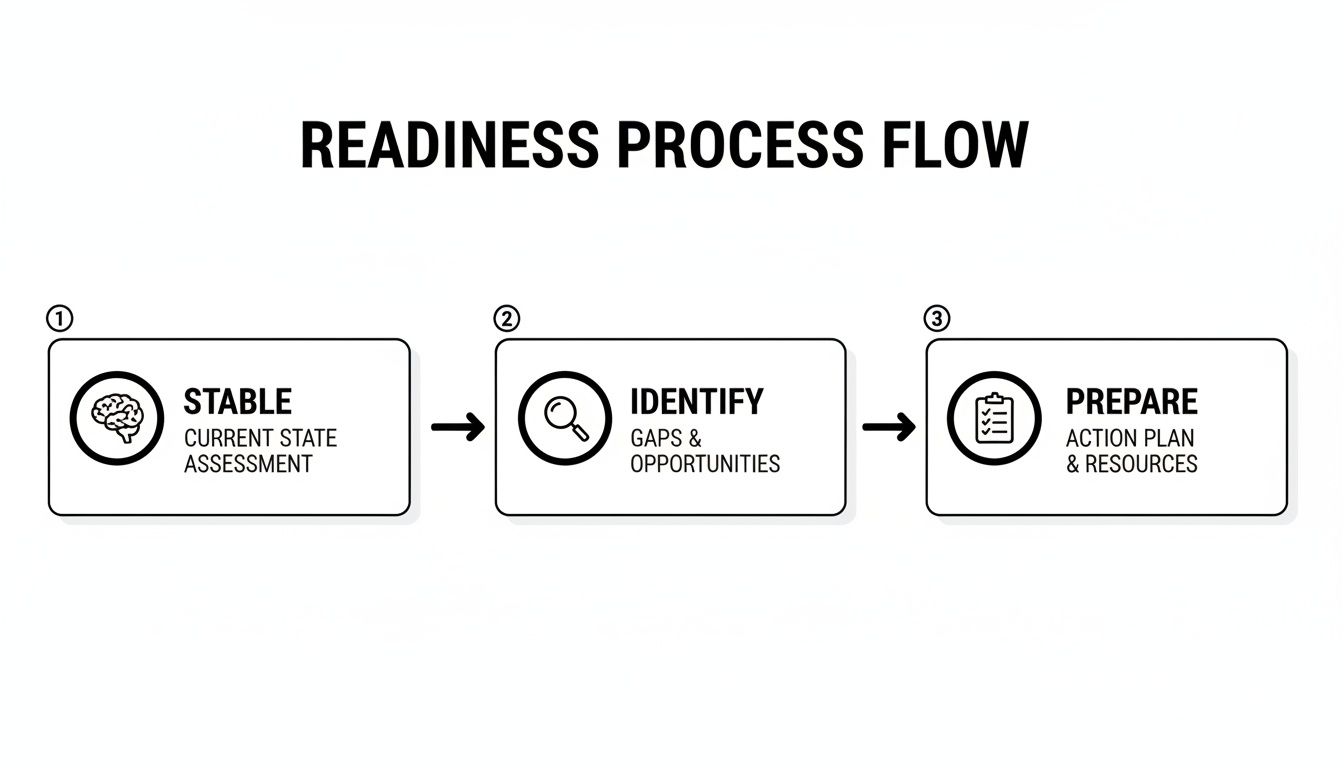
This visual breaks down readiness into three critical phases: being stable in your recovery, identifying the specific harm you caused, and preparing what you'll say, ideally with a therapist or sponsor.
Examples of Effective vs Ineffective Amends
Understanding what making amends means in practice is much easier when you can see clear examples side-by-side. The key difference usually comes down to whether you're taking responsibility for your actions or just trying to manage the other person's feelings—or your own guilt.
This table is a practical guide, contrasting effective, healing approaches with common mistakes that can derail the entire conversation and cause more damage.
| Do Say Or Do This (Effective Amend) | Don't Say Or Do This (Ineffective Amend) |
|---|---|
| "When I lied about my drinking, I broke your trust. I am truly sorry for the pain and uncertainty that caused you." | "I'm sorry I lied, but I was just so ashamed and didn't want you to get mad." |
| "I want to take full responsibility for missing your birthday. My actions were selfish, and I am sorry for making you feel unimportant." | "You know how things were back then. It wasn’t like I was trying to hurt you." |
| "Is there anything I can do to help repair the damage I’ve caused?" | "I really need you to forgive me so we can move on." |
| Listen quietly and validate their feelings, even if they are angry. Say, "I hear you," or "You have every right to feel that way." | Defend yourself or argue about their perception of events. Say, "That's not exactly how it happened." |
Notice how the effective examples are clean, focused, and don't ask for anything in return. They are about giving, not taking. The ineffective ones are loaded with self-justification and place an emotional burden back on the person who was already harmed.
Making Amends with Family and Close Relationships
The deepest wounds are often closest to home. When addiction takes hold, it acts like a corrosive acid, slowly eating away at the foundations of trust, respect, and safety within a family. For this reason, making amends with loved ones is often the most delicate—and most important—part of the recovery journey.
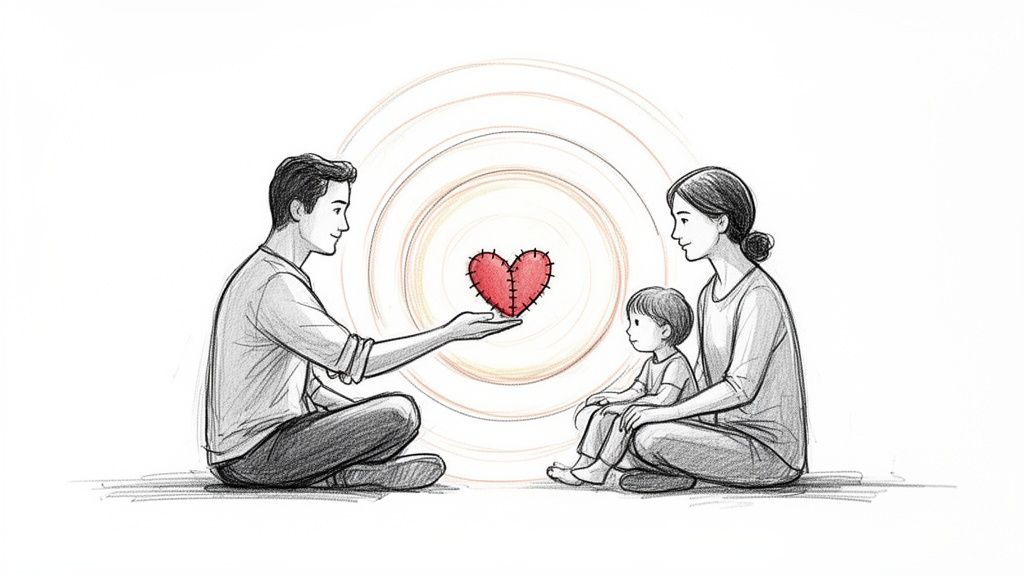
These aren't simple conversations. They carry the immense weight of years of broken promises, fear, and hurt. That's why a supported environment, like the one found in family therapy sessions, is so crucial. A neutral, trained professional can help guide the conversation, ensuring everyone feels heard and respected without falling back into old, painful patterns of blame and defensiveness.
A Journey for the Whole Family
It’s essential to remember that healing is a process for everyone involved, not just the person in recovery. Family members often carry their own trauma from the experience. They need space to work through their own feelings of anger, betrayal, or grief.
This is where the concept of making amends becomes so powerful, offering a structured way to begin mending that damage. The impact of this process is visible in large-scale recovery statistics. Even as global drug addiction cases swelled to 53 million between 1990 and 2021, a remarkable 74.8% of U.S. adults who have dealt with a substance use problem are now in recovery. That success often hinges on repairing the social fabric torn apart by addiction—a process where making amends is absolutely central. You can learn more about these global addiction and recovery trends from News-Medical.net.
Healing doesn't mean forgetting what happened. It means learning to rebuild on a new foundation of honesty, accountability, and clearly defined boundaries that protect everyone's well-being.
Rebuilding Trust and Setting Boundaries
Rebuilding trust isn't a one-time event; it’s a slow, deliberate process built on consistent, reliable, and honest actions over time. Think of it like building a wall one brick at a time—each kept promise, each honest conversation, each moment of accountability adds another layer of stability.
A critical part of this new dynamic is establishing healthy boundaries. For the person in recovery, this might mean limiting contact with people or situations that are triggering. For family members, it could mean learning to stop enabling behaviors and refusing to accept empty promises.
These boundaries aren't punishments. They are essential guidelines for creating a new, healthier relationship dynamic. They create the safety needed for genuine reconciliation to even begin. The path forward involves several key steps:
- Consistent Action: Proving change through daily actions, not just words.
- Open Communication: Committing to honest, respectful dialogue, often with the help of a therapist.
- Mutual Respect for Boundaries: Understanding that boundaries protect the well-being of the entire family system.
- Patience and Grace: Recognizing that healing is not a straight line and setbacks may happen.
Approaching these relationships with patience, structure, and professional support gives families the best chance to move beyond the pain of the past and build a stronger, more resilient future together.
Answering the Tough Questions About Making Amends
Stepping into the world of making amends can feel like navigating a minefield. The concept might make sense in theory, but when you apply it to messy, real-life relationships, the questions start piling up. It's one thing to understand the goal; it’s another thing entirely to know how to handle the tricky situations that are bound to come up.
This section tackles the most common questions we hear from clients and their families. Our goal is to give you clear, practical answers that reinforce the core lessons of this guide, so you can walk this path with confidence and integrity. Just remember the main principle: this is about cleaning up your side of the street, not controlling how anyone else reacts to it.
Is Making Amends the Same As Saying Sorry?
This is easily the biggest point of confusion, and the answer is a hard no. An apology is made of words, like "I'm sorry for what I did." It's often a necessary first step, but it stops there—it doesn’t actually require you to do anything.
Making an amend, on the other hand, is all about action. It’s a process with three distinct parts:
- Specifically acknowledging the harm your actions caused.
- Taking 100% ownership of your part, without any "buts" or excuses.
- Demonstrating through your actions—today and tomorrow—that you are committed to never causing that harm again.
An amend is about repairing what you broke, not just admitting you're the one who broke it. Think of it this way: saying you’re sorry for breaking a window is an apology. Showing up with a new pane of glass and installing it—that’s an amend.
What if I Cannot Contact the Person I Harmed?
Sometimes, a direct, face-to-face amend is either impossible or would be a genuinely bad idea. The person may have passed away, moved with no forwarding address, or reaching out could realistically cause them (or others) even more pain.
In these sensitive cases, the focus shifts to making an indirect amend. This isn’t a loophole to get out of being accountable. It’s a way to honor the spirit of the amend by putting positive, healing action back into the world to balance out the harm you caused.
An indirect amend is a living amend. It’s about transforming your regret into positive action that benefits others, thereby honoring the person you cannot reach directly.
Examples of indirect amends might include:
- Volunteering your time for a cause related to the harm you caused.
- Writing a long letter detailing your accountability that you never send.
- Donating to a charity that the person you harmed was passionate about.
- Becoming a sponsor or mentor to help someone else avoid the mistakes you made.
A therapist or sponsor can be an incredible resource here, helping you find a meaningful action that fosters your own healing without creating new wreckage.
What Should I Do if My Amend Is Not Accepted?
This is one of the toughest but most important realities of the process: you have absolutely no control over how the other person will react. They are under no obligation to forgive you or accept what you have to say.
The entire purpose of making amends is to take full responsibility for your part—to, as they say in 12-step rooms, "clean your side of the street." That's it. If you make a sincere effort and it gets rejected, you must respect their feelings and their boundaries. Arguing, pleading, or getting defensive only proves that your amend wasn't really about them; it was about trying to make yourself feel better.
The real healing for you comes from the sincere attempt to set things right, no matter the outcome. Over time, the most powerful amend you can possibly make is to just keep living an honest, sober, and accountable life. Your consistent, changed behavior becomes the ultimate proof of your sincerity.
How Does Making Amends Help with Self-Forgiveness?
Guilt and shame are incredibly heavy burdens to carry. They keep people stuck in a miserable loop of self-hatred, which is often one of the most powerful triggers for relapse. Making amends is the direct antidote to that toxic shame.
When you take courageous, concrete action to repair the damage you've done, you're dragging those feelings out of the dark and dealing with them head-on. The process gives you tangible proof that you are no longer the person who caused that harm. You are now someone who is actively committed to integrity and making things right. Taking responsibility is almost always the first and most vital step toward being able to genuinely forgive yourself.
At Altura Recovery, we understand that making amends is a foundational part of building a new life. Our evidence-based outpatient programs in Houston provide the therapeutic support and family systems therapy needed to navigate these conversations with skill and integrity. If you or a loved one are ready to take the next step toward lasting recovery, learn how our compassionate team can help you build a future based on Real Healing and Real Growth. Visit us at https://www.alturarecovery.com.