Motivational interviewing isn't about lecturing someone into recovery. It’s a collaborative, respectful style of conversation designed to help a person find their own reasons to change. Instead of pushing, it guides them toward strengthening their personal motivation and commitment to a healthier life, resolving the internal tug-of-war that so often keeps people stuck.
What Is Motivational Interviewing and How Does It Work

Think about the last time you tried to convince a friend to break a bad habit. If you came at them with lectures or demands, they probably dug their heels in and got defensive. Motivational Interviewing (MI) flips that script entirely. It's a counseling approach built on partnership, where a therapist helps you explore the gap between your current behaviors and the values you hold dear.
The core idea is both simple and powerful: the motivation to change already exists within you. An MI-trained therapist’s job isn’t to install motivation, but to help you find and amplify it. This is especially effective for substance abuse, where feeling torn between stopping and continuing—a state called ambivalence—is the central struggle.
How Does It Compare to Traditional Methods?
For decades, many treatment approaches were confrontational, operating on the idea that you had to "break down denial" for change to occur. MI emerged from the realization that this often created more resistance. The two philosophies are worlds apart.
Here’s a quick look at how they differ:
Traditional vs Motivational Interviewing Approaches
| Aspect | Traditional Confrontational Approach | Motivational Interviewing (MI) Approach |
|---|---|---|
| Therapist's Role | Expert, director, confronter | Partner, guide, collaborator |
| Source of Motivation | External (therapist's arguments) | Internal (client's own values and goals) |
| View of Resistance | Seen as denial; must be confronted | A signal to change strategy; "roll with it" |
| Core Goal | Get the client to accept a diagnosis and prescribed solution | Help the client resolve their own ambivalence and find their path |
| Communication Style | Directing, arguing, persuading | Asking, listening, reflecting, affirming |
This shift from a power struggle to a partnership creates a fundamentally different environment—one where it feels safe to be honest about the pros and cons of substance use without fear of judgment.
Resolving the Internal Conflict
MI works by gently navigating this ambivalence. When a person expresses resistance, the therapist doesn't push back. Instead, they "roll with it," acknowledging the person's perspective. This simple act of validation creates a safe space to talk honestly, which often leads to a natural shift in how someone views their own behavior.
Ultimately, the process empowers you to become the expert on your own life. This client-centered philosophy is a cornerstone of many successful treatment programs today. For instance, when you explore https://alturarecovery.com/blog/what-is-intensive-outpatient-therapy, you see how flexible, empowering approaches are integrated into a person's daily life, echoing the core principles of MI.
"MI is a particular way of talking with people about change and growth to strengthen their own motivation and commitment.”
The therapist uses specific skills—like asking open-ended questions and offering reflections—to draw out your own arguments for change. This focus on internal drive is what makes the commitment to recovery feel genuine and sustainable.
Building a Foundation of Trust and Support
By prioritizing empathy and respect, MI builds a strong therapeutic alliance. For many people, especially those with past trauma, simply feeling heard and understood is a critical first step toward healing. In this way, the principles of MI align with broader initiatives designed to support people through difficult challenges.
Learning about different approaches, like what you might find in mental health first aid training, highlights the immense value of compassionate, person-centered communication. This supportive foundation is often the key that unlocks lasting change.
The Four Core Principles of MI Conversations

Motivational Interviewing isn't about following a rigid script. It’s more like learning a new language of collaboration, built on four foundational communication skills. These are the tools that allow a therapist to move beyond giving advice and instead create a space for you to discover your own motivation to change.
Clinicians often remember these four core skills using the handy acronym OARS:
- Open-Ended Questions
- Affirmations
- Reflective Listening
- Summarizing
Let's break down what each of these looks like in a real conversation about substance use.
Asking Open-Ended Questions
The goal here is to spark a real conversation, not conduct an interrogation. Closed-ended questions—the kind you can answer with a simple "yes" or "no"—tend to shut things down quickly.
For instance, asking, "Do you want to stop drinking?" puts a person on the defensive. It corners them into a simple answer without exploring the complex feelings behind it.
An MI practitioner flips the script. They might ask something like, "What are some of the things you don't like about how alcohol is affecting your life?" This kind of open-ended question invites you to tell your story, to think out loud, and to connect with your own reasons for wanting something different. It opens the door to deeper self-exploration.
Offering Genuine Affirmations
Affirmations are not about handing out generic praise like "You're doing great!" They are specific, genuine acknowledgments of a person's strengths, efforts, and positive qualities. When you’re wrestling with substance use, feelings of shame or failure can be overwhelming, which makes this skill especially powerful.
An affirmation is about noticing and naming the good. Instead of empty compliments, it sounds like: "It took a lot of courage to come here today and talk so openly about this. That shows a real commitment to yourself."
This kind of statement validates the hard work of showing up and reinforces the idea that you are capable of making a change. It builds confidence from the ground up.
Using Reflective Listening
This is arguably the most critical skill in the entire MI toolkit. Reflective listening goes way beyond just hearing words; it’s about guessing at the underlying meaning and gently offering that reflection back to the person.
Think of the therapist as a mirror, showing you what you just expressed. This simple act does two things: it proves they are truly listening, and it lets you hear your own thoughts from a slightly different angle.
- You might say: "I know I should cut back, but all my friends drink, and I don't want to be left out."
- A reflection could be: "So on one hand, you see the benefits of changing your drinking habits, but on the other, you're worried about how it will impact your social life."
This doesn't judge or push. It just acknowledges the internal conflict, which helps clarify your own thinking and reduces the need to be defensive. When used in motivational interviewing for substance abuse, this technique is key to building a strong, trusting therapeutic relationship.
Summarizing the Conversation
Finally, summarizing ties everything together. A good summary collects the key points of the conversation, with a special focus on any "change talk"—the statements you've made that lean toward making a change.
It’s like a mini-recap that reinforces your own insights and strengthens your motivation. The summary often ends with an open-ended question that invites you to think about what's next.
For example: "So, you've mentioned feeling healthier and having more energy as reasons to change, but you're also concerned about social pressure. Given all that, what do you see as a possible next step?"
By skillfully using OARS, the therapist doesn't force a path on you. Instead, they help you navigate your own thoughts and feelings until you find a way forward that feels both authentic and achievable.
Understanding the Spirit of Motivational Interviewing
While specific techniques like OARS give a therapist the tools for Motivational Interviewing, the real power comes from its underlying philosophy—what experts call the "spirit" of MI. This isn't just about what a therapist does; it's about the entire mindset they bring to the conversation.
This spirit is what creates a safe, respectful space where you feel empowered to explore change, not pushed into it. It’s built on four connected ideas, easily remembered with the acronym PACE:
- Partnership
- Acceptance
- Compassion
- Evocation
Seeing how these pieces fit together is the key to understanding why motivational interviewing for substance abuse works so well for creating genuine, lasting change.
The Foundation of Partnership and Acceptance
Everything starts with Partnership. Forget the old image of an all-knowing expert telling a client what to do. MI is a collaboration—a therapist works with you, not on you. They're a skilled guide, but you are the only true expert on your own life, your experiences, and what you value most.
This kind of teamwork can only flourish in an atmosphere of Acceptance. This means the therapist recognizes your inherent value as a person, no matter what your current behaviors are. It's a deeply non-judgmental stance that allows you to be totally honest about your substance use without fearing shame or criticism, creating the safety needed for true self-exploration.
The Driving Forces of Compassion and Evocation
With that safe foundation in place, Compassion becomes the active ingredient. A compassionate therapist genuinely prioritizes your well-being and always acts in your best interest. It’s a real commitment to understanding your struggles and supporting your journey toward health. This focus on caring for the whole person is a common thread in many successful recovery models, and learning about holistic treatments for addiction often reveals a similar emphasis.
The most unique element of the MI spirit is Evocation. Instead of trying to install something that's missing (like motivation), the therapist's job is to draw out what is already there. The core belief is that you already have the wisdom, resources, and motivation you need for recovery.
The therapist's role is simply to help you find it, unlock it, and give it a voice. Through skillful conversation, they help you discover your own reasons for wanting a different future. This process of evoking your own internal drive is what makes the commitment to sobriety feel authentic and powerful, paving the way for sustainable recovery from substance abuse.
The Four Processes of Motivational Interviewing in Action
Motivational Interviewing isn't just one conversation; it's a structured journey that moves through four distinct, overlapping processes. Think of it as a roadmap for a conversation, guiding you from building initial rapport all the way to creating a concrete action plan.
This flow keeps the discussion both collaborative and purposeful, helping you move from a place of uncertainty toward confident action.
These four processes are Engaging, Focusing, Evoking, and Planning. They build on each other, creating a natural progression that respects your own pace and readiness for change.
This infographic shows how the foundational spirit of MI—Partnership, Acceptance, Compassion, and Evocation—underpins the entire therapeutic journey.
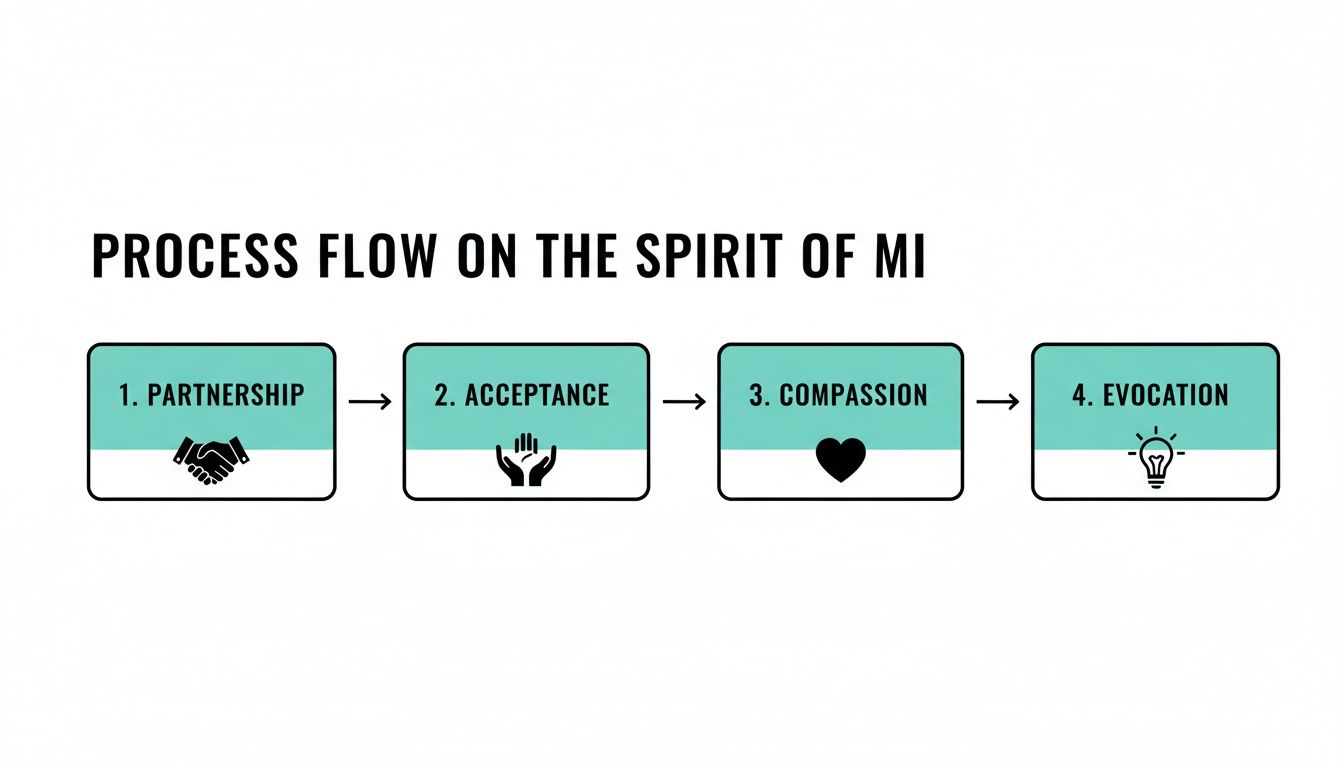
Each element works together to create the safe, non-judgmental space needed for honest self-exploration and sustainable change in substance abuse treatment.
Engaging: The Foundation of Trust
The first step, Engaging, is all about building a solid, trusting connection. Before any real work can happen, you have to feel understood, respected, and comfortable.
A therapist uses active listening and genuine empathy to establish a working partnership, creating a safe space completely free of judgment. This phase is non-negotiable—a strong therapeutic relationship is the bedrock upon which all future progress is built.
Focusing: Finding a Clear Direction
Once that connection is established, the conversation transitions into Focusing. Here, the goal is to work together to narrow down the broad topic of "change" into a specific, agreed-upon target. It’s about finding a clear direction.
For someone dealing with substance abuse, this might mean moving from a general feeling of unhappiness to zeroing in on their drinking patterns or another particular behavior. This process makes sure you and the therapist are both pulling in the same direction.
Evoking: Drawing Out Your Reasons for Change
The Evoking process is the true heart of motivational interviewing. This is where the therapist skillfully draws out your own arguments for change, often called "change talk."
Instead of telling you why you should change, they ask questions that help you say it for yourself. You explore your own values, your strengths, and your hopes, connecting them to the possibility of a different future.
This stage is all about uncovering and strengthening your own motivation. The therapist's role isn't to give you the reasons for change, but to help you find the ones that are already there inside you.
This internal drive is far more powerful than any lecture or outside pressure. It's the "why" that fuels your commitment to recovery. For instance, exploring how to curb alcohol cravings becomes much more powerful when it’s tied to your own stated goals, like being more present for your family.
Planning: Charting the Path Forward
Finally, once your motivation is clear and strong, the process shifts to Planning. This is the practical bridge between talking about change and actually taking action.
Together, you and your therapist map out a specific, achievable plan. This isn't a pre-made plan handed to you; it’s one you co-create, making sure it fits your life and feels completely manageable.
Research consistently shows the power of this structured approach in motivational interviewing for substance abuse. A key 2008 trial found that just one MI session before starting standard group therapy significantly improved treatment retention at 28 days. This early engagement sets a critical foundation for long-term success. This collaborative planning empowers you, making you an active architect of your own recovery journey.
Why MI Is So Effective for Substance Abuse Recovery
So, what makes motivational interviewing such a cornerstone of modern addiction treatment? Its power lies in a simple but profound shift away from confrontation. Instead of telling you what to do, MI helps you discover your own reasons to change, making recovery feel like a personal choice, not a top-down directive.
This client-centered approach skillfully reduces the resistance and defensiveness that almost always pop up when people feel pressured. Think about it—when someone argues with you, your natural instinct is to argue right back. MI sidesteps this entire dynamic by validating your feelings and respecting your autonomy. It creates a safe space to explore the deep-seated ambivalence that so often comes with substance use.
Fostering Intrinsic Motivation
The real magic of MI is its ability to foster intrinsic motivation—that powerful desire for change that comes from within. A therapist doesn’t just hand you motivation; they help you uncover the motivation that already exists inside you, even if it's buried under layers of conflict and uncertainty.
This internal drive is far more sustainable than any change made because of external pressure from family, employers, or the legal system. When you connect sobriety to your own core values and life goals, the commitment becomes genuine and lasting.
MI operates on the belief that you are the expert on your own life. By empowering you to find your own answers, it builds a foundation of self-trust and confidence that is essential for long-term recovery.
Motivational Interviewing stands as a prime example of effective care within the broader field of Evidence Based Addiction Treatment that Works, offering robust support for individuals seeking lasting change.
Proven Results Across the Board
The effectiveness of using motivational interviewing for substance abuse isn't just a good theory; it's backed by decades of solid data. Extensive research from SAMHSA shows that MI consistently reduces the misuse of alcohol, tobacco, and other drugs, while also boosting engagement in further treatment. This makes it an ideal starting point for people who are still on the fence about making a change.
This sense of empowerment is also crucial for building a strong support network beyond the therapy room. When you feel in control of your journey, you're better equipped to navigate the challenges of daily life and build a stable future. Learning about the structure provided by a sober living house can be a logical next step, offering a community-focused environment where these newfound skills can be practiced and reinforced.
By putting you in the driver’s seat, MI doesn't just prepare you for treatment—it prepares you for life.
Your Questions About Motivational Interviewing Answered
Navigating the world of addiction treatment can feel overwhelming, and it's natural to have questions. Motivational Interviewing (MI) is a powerful approach, but how does it actually work in a real-world recovery plan? This section cuts through the clinical jargon to give you clear, direct answers about using motivational interviewing for substance abuse.
Each answer is designed to help you see exactly how this collaborative method fits into a successful journey toward healing and lasting sobriety.
Is Motivational Interviewing a Standalone Treatment?
While MI is incredibly effective, it’s best viewed as a powerful catalyst within a complete treatment plan, not always a standalone cure. Its greatest strength is sparking engagement and strengthening a person's own resolve to change. This makes it a perfect starting point or a therapy to run alongside other methods.
For instance, MI is often paired with other evidence-based practices like Cognitive Behavioral Therapy (CBT). This combination creates a much more robust and personalized recovery strategy. It addresses the full picture of addiction—from finding the internal "why" for changing to building the practical "how" with new coping skills.
Think of MI as the key that unlocks the door to change. Other therapies then provide the tools to walk through that door and build a new life on the other side.
This layered approach ensures that once a person is ready and willing to make a change, they have all the support and skills needed to make that change stick.
How Long Does Motivational Interviewing Take to Work?
One of the most encouraging things about MI is that its positive effects often show up quickly. Research has shown that even one or two sessions can significantly boost a person's readiness to change and improve how well they engage with the rest of their treatment.
But MI isn't a quick fix; it's a way of communicating that helps create a deep, internal shift in perspective. The timeline for that shift is different for everyone. The process is intentionally flexible and tailored to your unique pace and needs, ensuring the journey feels authentic and unforced.
How Is MI Different From Talking to a Supportive Friend?
A supportive friend offers priceless encouragement, and that connection is vital for recovery. But an MI-trained therapist uses specific, evidence-based skills to strategically guide the conversation toward resolving your internal conflict about substance use. It's a purposeful clinical process, not just a comforting chat.
Here’s a simple way to see the difference:
- A supportive friend might: Offer advice, share their own opinions ("you should just quit"), or simply listen and offer a shoulder to cry on.
- An MI practitioner will: Use techniques like reflective listening and targeted open-ended questions to help you uncover your own reasons for changing.
The goal isn't just to make you feel better in the moment. It's to help you build a solid, internal foundation for a lasting recovery. It’s a directed conversation designed to untangle ambivalence and empower you to move forward with confidence.
At Altura Recovery, we integrate Motivational Interviewing into our evidence-based programs to help you find your own path to sobriety. Our compassionate, client-centered approach ensures you are the architect of your own recovery. Learn more about our outpatient services and start your journey toward real healing and lasting freedom at https://www.alturarecovery.com.