In today's fast-paced world, stress can feel like a constant companion, especially for those navigating the path of recovery. The relentless pressure can wear down your resilience, impact your mental health, and even trigger cravings or relapse. But what if you had a toolkit of practical, evidence-based strategies to manage stress effectively? This guide explores eight powerful mindfulness exercises for stress relief, designed to ground you in the present moment and cultivate a sense of inner peace.
We will move directly into actionable techniques you can use immediately. Each method is presented with clear, step-by-step instructions and specific benefits for both mind and body. You will discover practical modifications tailored for co-occurring conditions like anxiety or substance use, ensuring these practices are accessible and supportive of your unique journey.
This is more than just a list; it's a practical roadmap. We provide concrete tips for weaving these exercises into your daily outpatient recovery routine, helping you build a sustainable foundation for long-term well-being. Whether you are new to mindfulness or looking to deepen your practice, these exercises offer a direct path toward managing stress, enhancing self-awareness, and reinforcing your commitment to a healthier, more balanced life.
1. Body Scan Meditation
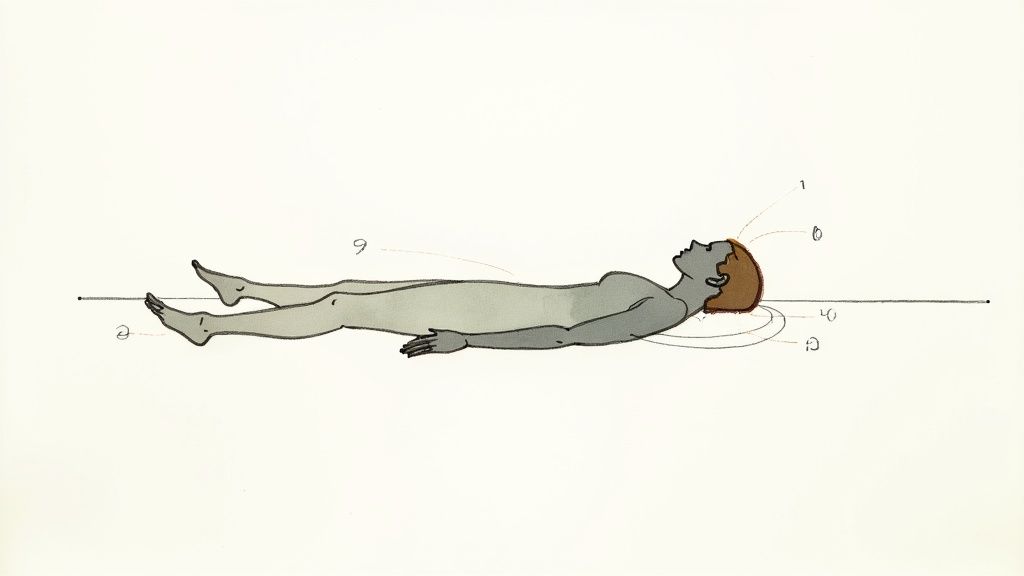
The Body Scan Meditation is a foundational mindfulness exercise for stress relief that involves bringing sequential, focused attention to various parts of the body. You systematically guide your awareness from your toes up to your head, simply noticing any sensations like warmth, tingling, pressure, or even numbness without judgment. This practice anchors you firmly in the present moment, interrupting the cycle of anxious thoughts and physical tension that often fuels stress and substance cravings.
Popularized by Jon Kabat-Zinn in his Mindfulness-Based Stress Reduction (MBSR) program, this technique is now a staple in clinical settings, including chronic pain management and addiction recovery centers. By methodically scanning the body, you cultivate a greater awareness of where you hold physical stress, allowing for a conscious release of that tension.
How to Practice Body Scan Meditation
- Find a Comfortable Position: Lie on your back on a mat or bed with your arms at your sides, palms up. If lying down makes you drowsy, you can also practice while seated upright in a chair.
- Begin with the Breath: Take a few slow, deep breaths to settle in. Bring your attention to the physical sensation of breathing.
- Scan Systematically: Start by bringing your focus to the toes of your left foot. Notice any sensations without needing to label them as "good" or "bad." Then, slowly move your awareness up through your foot, ankle, calf, and thigh before repeating on the right side.
- Continue Upward: Progressively scan your pelvis, abdomen, chest, back, hands, arms, neck, and finally your face and head. Spend 30 seconds to a minute on each area.
- Acknowledge Distractions: If your mind wanders, gently acknowledge the thought and guide your attention back to the part of the body you were focusing on.
Modifications for Recovery
For those experiencing heightened anxiety or the physical discomfort of withdrawal, lying still can be challenging. Try a standing body scan instead, which can feel more grounding. If certain body parts are sources of pain or trauma, it is okay to skip them or to broaden your focus to a larger, more neutral area nearby. A shorter, 5-minute scan focusing only on the hands and feet can also be an accessible starting point.
2. Breath Awareness Meditation
Breath Awareness Meditation is a fundamental mindfulness exercise for stress relief that centers on observing the natural rhythm of your breathing. The core of this practice is to simply pay attention to the sensation of the breath entering and leaving your body, using it as an anchor for the present moment. By focusing on this vital, automatic process, you can gently interrupt patterns of rumination and anxiety that feed stress.
Originating from ancient Buddhist traditions, breath awareness is now a cornerstone of modern therapeutic practices, taught in anxiety disorder treatment protocols and integrated into high-stress workplace programs. Its accessibility and power to regulate the nervous system make it an indispensable tool for managing stress triggers and maintaining emotional balance during recovery.
How to Practice Breath Awareness Meditation
- Find a Stable Position: Sit comfortably in a chair with your feet flat on the floor or on a cushion on the ground. Keep your spine straight but not rigid.
- Settle Your Attention: Gently close your eyes or lower your gaze. Start by noticing the physical sensation of your breath where it is most prominent, perhaps at the tip of your nose or the rise and fall of your abdomen.
- Observe Without Control: Your only task is to watch the breath as it is. There is no need to change it, deepen it, or force it. Simply observe its natural pace and depth.
- Handle Distractions with Kindness: When your mind inevitably wanders to thoughts, plans, or worries, gently notice where it went. Then, without judgment, guide your focus back to the sensation of your breath.
- Start Small: Begin with just three to five minutes of practice each day, gradually increasing the duration as you become more comfortable with the technique.
Modifications for Recovery
During periods of high anxiety or agitation, the simplicity of breath awareness can feel challenging. If you find your thoughts racing, try silently counting each exhale up to ten and then starting over. For sustained focus, a physical object like a mindful breathing tool can serve as a helpful external anchor. If you feel overwhelmed, try the 4-7-8 technique, a structured breathing exercise developed by Dr. Andrew Weil: inhale for four counts, hold for seven, and exhale slowly for eight.
3. Loving-Kindness Meditation (Metta)
Loving-Kindness Meditation, also known as Metta, is a powerful practice focused on cultivating unconditional compassion and positive emotions. The exercise involves silently repeating a series of phrases to direct feelings of goodwill, kindness, and warmth toward yourself and others. This technique directly counteracts negative thought patterns and emotional reactivity, making it one of the most transformative mindfulness exercises for stress relief.
Popularized in the West by teachers like Sharon Salzberg and Thich Nhat Hanh, this practice is used in therapeutic settings to address anger management, social anxiety, and shame. By methodically generating feelings of benevolence, you can rewire your brain's response to stress, replacing judgment and hostility with acceptance and empathy.
How to Practice Loving-Kindness Meditation
- Find a Comfortable Position: Sit upright in a chair or on a cushion in a comfortable, relaxed posture. Allow your eyes to gently close.
- Start with Yourself: Begin by directing the kind phrases toward yourself. Silently repeat: “May I be happy. May I be healthy. May I be safe. May I live with ease.”
- Expand Your Circle: After several minutes, extend this goodwill to a loved one, then a neutral person (like a store clerk), and eventually to a difficult person in your life. Use phrases like, “May you be happy. May you be healthy.”
- Include All Beings: Finally, radiate these wishes of well-being outward to all living beings everywhere, without exception.
- Return Gently: When you feel complete, bring your awareness back to your breath and gently open your eyes.
Modifications for Recovery
For individuals in recovery, directing kindness inward can be the most challenging step due to feelings of guilt or low self-worth. If this is too difficult, start by directing loving-kindness toward a pet or a beloved mentor. The goal is to generate the feeling, and the target can be adjusted. This practice can be a vital component of healing, connecting you to a sense of purpose and compassion that supports long-term wellness. Discover more about the connection between spirituality and recovery and how practices like Metta can help.
4. Progressive Muscle Relaxation (PMR)
Progressive Muscle Relaxation (PMR) is a powerful mindfulness exercise for stress relief that involves methodically tensing and then releasing different muscle groups. This active process of creating and then letting go of physical tension makes you acutely aware of what physical stress feels like, empowering you to consciously induce deep relaxation throughout your body. By focusing on this physical contrast, you interrupt the feedback loop between mental anxiety and muscle tightness.
Developed by physician Edmund Jacobson in the 1920s, PMR has become a cornerstone of stress management and is widely used in clinical settings, from Veterans Affairs PTSD treatment programs to protocols for managing insomnia and chronic pain. The technique directly targets the body's physiological stress response, making it a highly effective tool for grounding yourself when feeling overwhelmed.
How to Practice Progressive Muscle Relaxation
- Prepare Your Space: Find a quiet place where you can sit or lie down comfortably without being interrupted. Close your eyes and take several slow, deep breaths to begin.
- Tense and Release: Start with your feet. Inhale and tense the muscles in your feet and toes, curling them tightly for 5-7 seconds. Feel the tension. Then, exhale and completely release the tension, noticing the feeling of relaxation for 20-30 seconds.
- Move Systematically: Continue this tense-and-release sequence up through your body: lower legs, thighs, buttocks, abdomen, chest, back, hands, arms, shoulders, neck, and finally your face.
- Focus on the Contrast: The key is to pay close attention to the difference between the feeling of tension and the subsequent feeling of deep release and warmth in each muscle group.
- Conclude with Stillness: After tensing and releasing all major muscle groups, remain still for a few minutes, enjoying the state of total body relaxation you've created.
Modifications for Recovery
For individuals with chronic pain or physical injuries, tensing certain muscle groups may be painful. In this case, you can simply visualize tensing and releasing that area without actually contracting the muscles. Alternatively, you can use a much lighter tension, holding for only 2-3 seconds. If the full 15-20 minute sequence feels too long, start with a "mini" PMR session focusing only on commonly stressed areas like the hands, shoulders, and jaw.
5. Mindful Walking Meditation
Mindful Walking Meditation is an active form of mindfulness that merges gentle movement with present-moment awareness. Instead of focusing on a destination, you bring your full attention to the physical experience of walking, noticing the rhythm of your steps, the contact of your feet with the ground, and the sights and sounds of your surroundings. This practice is one of the most accessible mindfulness exercises for stress relief, especially for those who find sitting still for long periods to be a challenge.
Popularized in the West by Zen masters like Thich Nhat Hanh, this technique grounds you in the physical reality of your body and the environment. It is a core component of many retreat centers and therapeutic programs, including Japanese forest bathing (shinrin-yoku), which leverages nature to reduce stress. By synchronizing mind and body through movement, you interrupt ruminating thoughts and release accumulated tension.
How to Practice Mindful Walking Meditation
- Find a Safe Space: Choose a quiet path, a room, or even a hallway where you can walk back and forth without many distractions. A natural setting can enhance the experience.
- Set Your Pace: Begin walking at a slower-than-usual pace. This isn't about exercise; it's about observation. You can sync your steps with your breath, taking one or two steps per inhalation and exhalation.
- Focus on Sensations: Bring your awareness to your feet. Notice the sensation of lifting one foot, moving it through the air, and placing it back down. Feel the pressure, texture, and temperature of the ground beneath you.
- Engage All Senses: Expand your awareness to include the sights, sounds, and smells around you. Observe them without judgment, simply as part of your present experience.
- Gently Return Focus: When your mind wanders, as it inevitably will, gently acknowledge the thought and guide your attention back to the sensation of walking.
Modifications for Recovery
During periods of high anxiety or restlessness common in early recovery, the urge to rush can be strong. Use a very short path, like 10-15 steps, and walk back and forth. This contained space can feel less overwhelming. If you feel agitated, you can start at a normal pace and gradually slow down as you settle into the practice. For those with mobility challenges, this can be adapted to a mindful wheelchair roll, focusing on the movement of the hands and the feeling of the wheels moving across a surface.
6. Guided Visualization and Imagery
Guided Visualization and Imagery is a mindfulness technique where you use your imagination to create a detailed, tranquil mental scene. By engaging all your senses to construct this peaceful environment, you can evoke a physical relaxation response, effectively shifting your nervous system from a state of stress to one of calm. This practice harnesses the mind's powerful ability to influence the body, making it an effective tool for managing stress and intrusive thoughts.
This method has gained significant traction in various therapeutic and performance settings, from cancer treatment centers for pain management to sports psychology programs for enhancing focus. Authors like Shakti Gawain and guided imagery pioneers like Belleruth Naparstek have popularized its use. By creating a mental sanctuary, you provide yourself with an immediate escape from external stressors, which is invaluable for navigating difficult moments in recovery.
How to Practice Guided Visualization
- Choose a Calm Setting: Find a quiet place where you won't be interrupted. Sit or lie down comfortably and close your eyes.
- Begin with Your Breath: Take several deep, calming breaths to signal to your body that it's time to relax.
- Imagine Your Safe Place: Begin to build a peaceful scene in your mind. It could be a beach, a forest, or a childhood memory. Focus on engaging all your senses: What do you see? What sounds do you hear? Are there any smells? What does the air feel like on your skin?
- Explore the Details: Spend several minutes immersing yourself in this environment. Walk around, interact with your surroundings, and allow the feelings of peace and safety to grow.
- Gently Return: When you are ready, slowly bring your awareness back to your physical body and the room you are in. Open your eyes when you feel grounded.
Modifications for Recovery
For individuals dealing with trauma or intense anxiety, some mental images can be triggering. It is crucial to choose a scene that feels genuinely safe and neutral. If a beach scene brings up negative feelings, pivot to a mountain trail or a quiet library. Start with short, 3-minute visualizations and use pre-recorded guided imagery scripts from a trusted source to avoid the pressure of creating a scene from scratch. This can prevent the mind from drifting to more distressing thoughts.
7. Mindful Eating
Mindful Eating is a powerful practice that transforms the routine act of eating into an opportunity for stress reduction and self-awareness. It involves bringing your full, non-judgmental attention to the entire experience of food, from your initial hunger cues to the sensations of taste, texture, and satiety. This exercise anchors you in the present, interrupting impulsive or emotionally-driven eating habits that often escalate stress and can be linked to substance use.
Pioneered by figures like Jon Kabat-Zinn and Thich Nhat Hanh, this technique is a core component of many therapeutic programs for eating disorders and weight management. By slowing down and engaging all your senses, you cultivate a healthier relationship with food, improve digestion, and become more attuned to your body’s true needs, which is a crucial skill in recovery.
How to Practice Mindful Eating
- Remove Distractions: Turn off the TV, put your phone away, and sit at a table. Create a calm environment dedicated solely to your meal.
- Engage Your Senses: Before taking a bite, look at your food. Notice the colors, shapes, and textures. Inhale its aroma.
- Chew Slowly and Deliberately: Take a small bite and aim to chew it 20-30 times. Try to identify all the individual flavors as the food breaks down.
- Pause and Check In: Midway through your meal, put your fork down for a moment. Take a breath and assess your hunger and fullness levels. Are you satisfied?
- Practice Gratitude: Acknowledge the journey your food took to get to your plate. Expressing gratitude can shift your mindset from stress to appreciation.
Modifications for Recovery
For individuals whose relationship with food is complicated by past substance use or an eating disorder, starting small is key. Begin by practicing with a single snack or one meal per day rather than feeling pressured to be mindful every time you eat. If tracking intake is triggering, focus solely on the sensory experience. To truly transform your eating habits and cultivate a deeper connection with your food, mastering how to keep a food journal that actually works by focusing on feelings and sensations rather than calories can be an empowering, non-judgmental tool.
8. Mindfulness-Based Cognitive Therapy (MBCT) / Thought Observation
Mindfulness-Based Cognitive Therapy (MBCT), often practiced as Thought Observation, is a powerful hybrid approach that merges mindfulness meditation with core principles of cognitive therapy. Instead of trying to change or stop stressful thoughts, this exercise teaches you to observe them as temporary mental events, much like watching clouds pass across the sky. This practice creates crucial space between you and your thoughts, preventing you from getting entangled in cycles of worry, rumination, or craving that amplify stress.
Developed by Zindel Segal, Mark Williams, and John Teasdale, MBCT is a gold-standard, evidence-based treatment for preventing depressive relapse and is widely used in anxiety disorder clinics and substance abuse recovery programs. By learning to recognize and de-center from stress-inducing thought patterns, you can effectively reduce their emotional impact and regain control over your mental state.
How to Practice Thought Observation
- Find a Quiet Space: Sit comfortably in a chair or on a cushion with your back straight. Close your eyes or maintain a soft, unfocused gaze.
- Anchor with the Breath: Begin by bringing your awareness to the sensation of your breath for a few minutes to ground yourself in the present moment.
- Shift to Observing Thoughts: Gently shift your attention to your mind. Notice any thoughts, images, or memories that arise without judgment. You are not the thinker; you are the observer of the thoughts.
- Label and Let Go: As a thought appears, you can mentally label it "thinking" or "worrying" and then gently guide your attention back to your breath. Avoid following the thought's storyline.
- Use Visual Metaphors: Imagine your thoughts are leaves floating down a stream or cars driving past on a road. Acknowledge their presence and watch them go without getting attached.
Modifications for Recovery
During early recovery, thoughts related to substance use or anxiety can be particularly intense and overwhelming. If observing them feels too activating, start with a very short practice of 1-2 minutes. Instead of focusing on specific thoughts, you can broaden your awareness to the general "sound" of your mind without dissecting individual words. For those needing more structured support, a formal 8-week MBCT course, often available through outpatient or partial hospitalization programs, provides a comprehensive framework and group accountability for mastering this skill.
8-Method Mindfulness Comparison for Stress Relief
| Technique | 🔄 Implementation complexity | ⚡ Resource requirements & accessibility | ⭐ Expected outcomes | 📊 Ideal use cases | 💡 Key advantages / tip |
|---|---|---|---|---|---|
| Body Scan Meditation | Low–Moderate: guided or self-led; 10–45 min | Minimal equipment; quiet space or lying surface; moderate time commitment | ⭐⭐⭐⭐ — reduces muscle tension, improves body awareness and sleep | Physical tension release, insomnia, recovery settings | 💡 Start with 10 min and use guided recordings for consistency |
| Breath Awareness Meditation | Low: simple, portable; 5–20 min | No equipment; can be done anywhere; very short practice windows | ⭐⭐⭐⭐ — fast parasympathetic activation, acute stress/anxiety relief | Immediate stress relief, first-responder/ workplace tools | 💡 Begin with 5 minutes daily; notice breath without forcing it |
| Loving‑Kindness Meditation (Metta) | Moderate: emotionally demanding; 15–30 min | Quiet space; guided phrases helpful; requires regular practice | ⭐⭐⭐⭐ — improves emotional resilience, reduces anger/resentment | Emotional healing, relationship stress, social anxiety | 💡 Start toward yourself, use traditional phrases, practice 2–3 weeks for shifts |
| Progressive Muscle Relaxation (PMR) | Moderate: active physical sequence; 15–30 min | Space to move, guided audio recommended; avoid if injured | ⭐⭐⭐⭐⭐ — rapid, tangible reduction in muscle tightness and arousal | Physical tension, insomnia, rehab, pre-performance relaxation | 💡 Tense 5–7s then release 30s; follow feet→head sequence |
| Mindful Walking Meditation | Low: active format; flexible duration | Safe walking area; indoor/outdoor; adaptable time | ⭐⭐⭐ — integrates movement with mindfulness; supports activity | ADHD-friendly practice, nature connection, daily integration | 💡 Start slow (1–2 steps per breath) and focus on each foot contact |
| Guided Visualization & Imagery | Low–Moderate: guided recordings improve outcome; 10–30 min | High-quality recordings or therapist; quiet, eyes-closed | ⭐⭐⭐⭐ — immediate relaxation, useful for pain and performance | Pain management, performance prep, anxiety reduction | 💡 Engage all senses; use well-produced scripts or recordings |
| Mindful Eating | Low–Moderate: behavioral change; integrated into meals | Time for slower meals; distraction-free environment | ⭐⭐⭐ — reduces stress-eating, improves digestion and satisfaction | Eating-disorder therapy, weight management, diabetes care | 💡 Start with one meal/day, eliminate distractions, chew slowly |
| MBCT / Thought Observation | High: structured 8–12 week program with instruction | Trained facilitator, group sessions, homework; significant time | ⭐⭐⭐⭐⭐ — prevents depression relapse, reduces rumination, builds resilience | Chronic stress, depression relapse prevention, clinical anxiety | 💡 Enroll in an 8-week course; practice thought diffusion and journaling |
Integrating Mindfulness Into Your Daily Recovery Journey
You’ve explored a diverse toolkit of mindfulness exercises for stress relief, from the grounding stillness of the Body Scan Meditation to the active engagement of Mindful Walking. We’ve journeyed through the gentle compassion of Loving-Kindness Meditation, the physical release of Progressive Muscle Relaxation, and the sensory awareness of Mindful Eating. Each technique, whether it's observing thoughts with MBCT or creating a mental sanctuary with Guided Imagery, offers a unique pathway to the same destination: a more centered, resilient, and aware version of yourself.
The core takeaway is not that you must master every single exercise. Instead, the goal is to discover which practices resonate most deeply with you and your specific needs, particularly within the context of recovery. The true power of mindfulness isn't found in a single, perfect meditation session but in the cumulative effect of consistent, compassionate practice.
Making Mindfulness a Sustainable Habit
The journey toward integrating these practices is a personal one. What works for a working professional managing anxiety might differ from what a college student in early recovery finds most effective. The key is to approach this with curiosity rather than judgment.
- Start Small: Don't overwhelm yourself. Commit to just five minutes a day. Perhaps you practice Breath Awareness before your morning coffee or use Progressive Muscle Relaxation before sleep.
- Be Patient: Some days will feel easy and focused; others will be filled with distractions. This is normal. The practice isn't about eliminating thoughts; it's about noticing when you're distracted and gently guiding your attention back. This act of returning is the core of the exercise.
- Anchor Your Practice: Link a mindfulness exercise to an existing daily habit. For example, practice Mindful Eating during your lunch break or do a quick Body Scan as soon as you sit down at your desk.
The True Value: Building Resilience for Recovery
Mastering these concepts is about more than just managing stress in the moment. It’s about fundamentally changing your relationship with your internal world, which is a cornerstone of lasting recovery. When you can observe a craving, an anxious thought, or a difficult emotion without immediately reacting, you create a crucial space. In that space, you have a choice.
Mindfulness gives you the power to pause between a trigger and your response. This pause is where you reclaim your power and make choices that align with your recovery goals, rather than falling back into old patterns.
By regularly engaging in these mindfulness exercises for stress relief, you are not just calming your nervous system; you are actively rewiring your brain. You are building the mental and emotional muscles needed to navigate triggers, cope with co-occurring anxiety, and build a life grounded in self-awareness and intention. This is the foundation upon which sustainable well-being and long-term recovery are built. Take the first step today, and remember that every moment you practice is a step toward a calmer, more empowered you.
If you are looking for a structured environment where evidence-based therapies are integrated with practical skills like these, consider reaching out. The outpatient programs at Altura Recovery are designed to help you build a strong foundation for lasting well-being by combining clinical support with powerful mindfulness techniques. Learn more about our approach at Altura Recovery.