
Getting sober is one thing. Staying sober is another beast entirely.
When you first step out of treatment, the world can feel like a minefield. You're armed with new coping skills and a fragile sense of hope, but the silence and the old routines can be deafening. This is where your support system comes in. It’s not just a nice-to-have; it’s the scaffolding that holds your recovery together while you rebuild.
A well-built network acts as your safety net, your sounding board, and your personal cheerleading squad. It’s about intentionally surrounding yourself with people who get it—people who can call you out, lift you up, and remind you why you started this journey in the first place.
This guide will walk you through exactly how to assemble that team and make it work for you.
Why Your Support System Is Your Recovery Lifeline
Leaving the structured environment of a treatment facility often feels like walking a tightrope without a net. The path forward is there, but it’s narrow, and the potential for a fall feels very real. This is precisely why a hand-picked support system is non-negotiable.
It’s the group text that gets you through a tough craving. It’s the sponsor who answers the phone at midnight. It’s the therapist who helps you untangle the "why" behind your addiction.
A strong network turns recovery from an abstract goal into a shared, daily practice. It grounds you in reality and provides the stability and accountability needed to navigate the inevitable bumps in the road.
More Than Just Friends
While your friends and family are crucial, a true recovery support system is more intentional and structured than a casual friend group. Think of it less like a social club and more like a personal board of directors for your well-being.
Each person on your team plays a distinct and vital role.
- Clinical Support: These are the pros—your therapist, psychiatrist, or doctor. They provide the evidence-based treatment and medical oversight that form the bedrock of your recovery.
- Peer Support: This is your sponsor, your home group, and the friends you make in recovery meetings. They offer the kind of practical, been-there-done-that wisdom you can't get from a textbook.
- Personal Support: These are your trusted family members and old friends who have your back. They provide love, encouragement, and a vital link to a life beyond meetings and therapy sessions.
A therapist can help you work through deep-seated trauma, while a sponsor can give you immediate, actionable advice for handling a trigger right now. You need both. You can learn more about finding your people in both 12-step and alternative recovery programs to see how these different communities offer unique strengths.
Let's break down these essential roles.
The Pillars of a Strong Recovery Support System
Here’s a quick look at the core roles that create a balanced and effective support network.
| Component | Their Role in Your Recovery Journey |
|---|---|
| Clinicians | Provide evidence-based therapy, medication management, and professional guidance. They address underlying issues like trauma and co-occurring disorders. |
| Peers | Offer lived experience, daily accountability, and a sense of belonging. Your sponsor and recovery groups provide practical, in-the-moment support. |
| Family & Friends | Provide emotional encouragement, practical help (like childcare or a ride), and help you reintegrate into a healthy, sober social life. |
| You | Act as the CEO of your recovery. Your job is to communicate your needs, set boundaries, and actively engage with your team. |
Each component brings a unique perspective and strength, creating a well-rounded foundation for your new life.
A Foundation for Lasting Wellness
The power of this network isn't just about feeling good; it has a measurable impact on your health. Solid social connections are a powerful predictor of long-term wellness.
In fact, research shows that people with strong social ties have a 50% greater likelihood of survival from all causes compared to those with weaker connections. That's a staggering statistic from Mental Health America that underscores just how critical these relationships are.
A support system transforms recovery from a solitary battle into a collective mission. It’s the difference between navigating a storm alone and having a skilled crew to help you manage the sails, watch for hazards, and keep the ship on course.
Ultimately, building a support system is about designing a life where you are never truly alone with your struggles. It gives you the resilience to face triggers, the community to celebrate milestones, and the structure to build a future defined not by past mistakes, but by connection and growth.
Assembling Your Personal Recovery Team
Building a support system is a lot like casting for the most important movie of your life—your recovery. You wouldn't hire one person to be the director, lead actor, and stunt double. Instead, you'd find the right person for each specific job. That's exactly how this works. A well-rounded team provides stability from all angles, making sure you have the right kind of help for every kind of challenge.
Let's break down the three crucial roles you need to fill on your personal recovery team.
The Clinical Foundation
This is the professional backbone of your support system. Think of your therapist, counselor, psychiatrist, and primary care doctor as the architects and engineers of your recovery plan. They bring the evidence-based strategies and medical oversight needed to get to the root of addiction and mental health struggles.
For instance, a therapist trained in trauma-informed care can help you work through past experiences that might be fueling substance use. At the same time, a psychiatrist can manage medications for co-occurring conditions like depression or anxiety, which often walk hand-in-hand with addiction.
Their role isn't to be your friend; it's to offer objective, expert guidance. When you're looking for clinical support, make sure you find professionals who:
- Specialize in addiction and your specific situation (like dual diagnosis or trauma).
- Use proven methods like Cognitive Behavioral Therapy (CBT) or EMDR.
- Make you feel heard and respected, creating a safe space for total honesty.
This professional layer is non-negotiable. The World Health Organization reports that over one billion people live with a mental health condition, yet government spending on mental health averages just 2% of total health budgets. This massive gap makes it incredibly hard to find care, so securing your clinical team is a critical first move.
The Power of Peer Support
While clinicians provide the "why," your peers provide the "how-to." This group includes your sponsor, people in your recovery groups (like AA or SMART Recovery), and sober friends you connect with along the way. They’re the ones in the trenches with you, offering practical wisdom that you just can't get from a textbook.
A sponsor isn’t a therapist; they're a mentor who has already walked the path you're on now. They're the one you can call with immediate, real-world advice when a trigger hits you at 10 PM on a Tuesday. Your peers in a support group offer that deep sense of belonging, reminding you that you are not fighting this battle alone.
Think of your peer network as your 24/7 hotline. These are the people who get the internal struggle on a personal level and can offer the exact empathy and validation you need, right when you need it.
When building this part of your team, look for people who are consistent in their own recovery and who model the kind of sober life you aspire to live.
This diagram shows how these different pillars come together to form a complete and resilient support system.
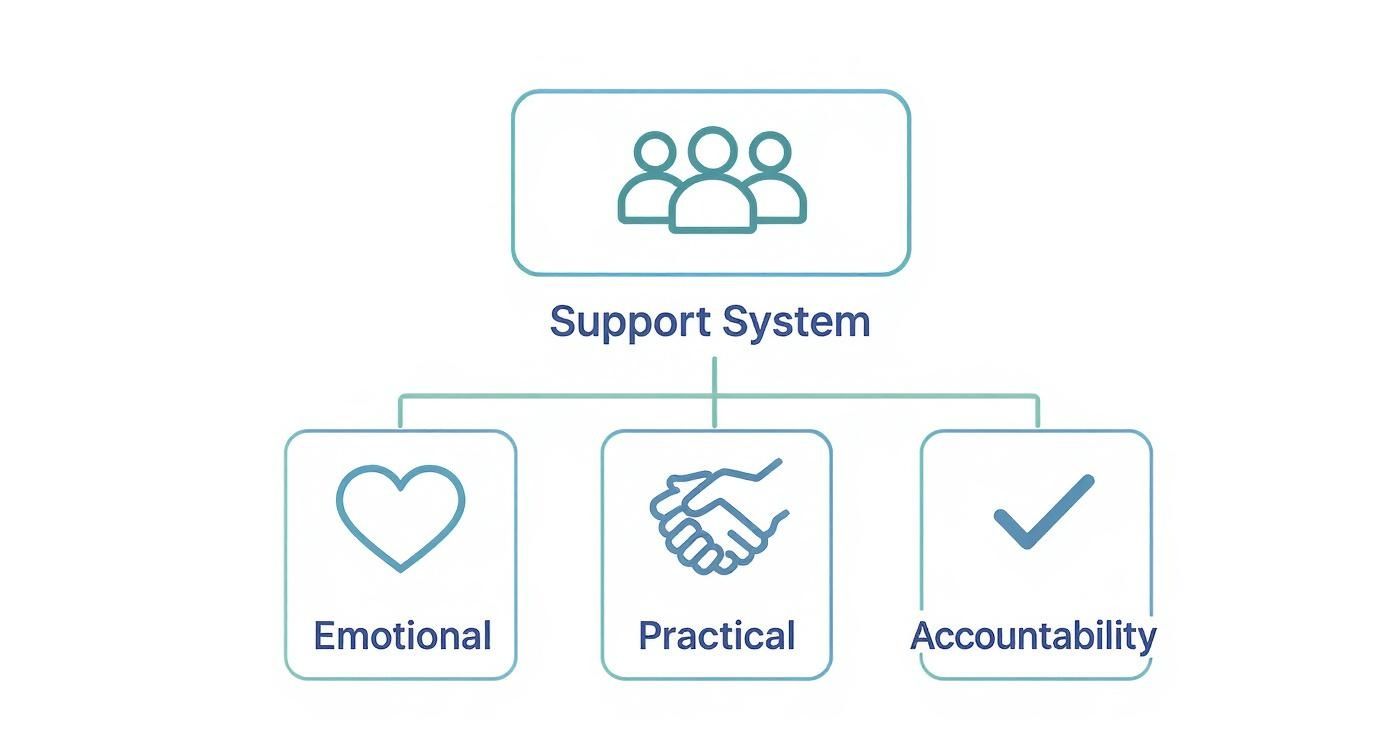
It’s all about creating a strong foundation with emotional, practical, and accountability support working in harmony.
Your Personal Circle of Trust
Finally, you have your personal support system—the trusted friends and family who knew you before recovery and are committed to supporting the new you. Their role is to offer love, encouragement, and a vital connection to a life outside of meetings and therapy sessions.
But this is where things can get tricky. Loved ones often want to help but have no idea how, sometimes blurring the line between supporting and enabling. It's up to you to define their roles clearly. For example, a parent might provide practical help, like a ride to a meeting, while a best friend offers emotional support by just being a listening ear.
A common mistake is turning a loved one into your counselor. It puts an unfair burden on them and keeps you from getting the professional guidance you actually need. Instead, invite them to be part of your journey in healthy, defined ways. You can find some great advice on breaking the stigma and building support with family to help them understand their role better.
Assembling your team is an active process, not a passive one. By carefully choosing people for these distinct clinical, peer, and personal roles, you create a multi-layered safety net that’s strong enough to handle the inevitable tests of long-term recovery.
How to Ask for Help and Start the Conversation
Knowing you need a support system is one thing. Actually asking for it? That’s a whole different ballgame.
The fear can be paralyzing—fear of being judged, rejected, or just being a burden. But pushing through that fear is the single most important step toward building the network you need to sustain your recovery.
The good news is, you don't need some grand, dramatic speech. Most of the time, the simplest, most direct approach works best. It all comes down to being honest, clear, and specific about what you need from the other person. Think of it as a skill. It feels awkward at first, but with practice, you'll get better at tailoring your approach for everyone, from a potential sponsor who already speaks the language of recovery to a family member who's still trying to understand.
Crafting Your Ask with Clarity
Vague requests get vague responses. If you say, "I just need you to be there for me," what does that actually mean? Your friend or family member is left guessing, and that’s a recipe for frustration on both sides.
Instead, get specific. What does "being there" look like in a practical sense? Is it a weekly check-in call? Someone you can bring to a meeting? Or just a person you can text when you’re having a tough moment? Being clear helps them understand exactly what their role is, which makes it much easier for them to say yes.
Here are a few scripts you can tweak to fit your own voice:
- For a Potential Sponsor: "I'm really committed to my recovery and I admire your perspective and how you work your program. Would you be open to sponsoring me?"
- For a Trusted Friend: "I'm being intentional about building a support system, and our friendship is really important to me. Would you be willing to be one of my go-to people I can call for a reality check if I'm having a hard day?"
- For a Family Member: "I’m working hard on my health, and I'm learning to be more direct about what I need. It would mean a lot if we could schedule a quick 15-minute phone call every Sunday just to connect."
Overcoming the Fear of Rejection
Let’s be honest: the biggest hurdle is the fear of hearing "no." It’s so important to reframe what that "no" actually means. It’s almost never a personal rejection of you.
More often than not, it’s a reflection of the other person's own capacity. They might not have the emotional bandwidth, or they might honestly feel like they aren't equipped to give you the kind of support you deserve.
Hearing 'no' isn't a failure—it's a crucial part of the sorting process. It helps you find the people who are not just willing, but genuinely able to show up for you in the way you need. Every 'no' gets you closer to a committed 'yes'.
If someone can’t commit, just thank them for their honesty and keep moving. Your goal isn’t to convince everyone to join your team; it's to assemble the right team. Remember, your story is powerful. Learning how sharing your mental health story can change your life can give you the confidence to speak your truth without shame.
And remember, support is a two-way street. Being a good support for others strengthens your own network. Learning skills like how to support a grieving friend builds the kind of deep, reciprocal relationships that last.
Starting these conversations is an act of profound self-advocacy. It's you, taking charge of your recovery and intentionally designing a life that supports long-term wellness. Each conversation, regardless of the outcome, is a step toward building a foundation strong enough to hold the future you deserve.
Setting Healthy Boundaries to Protect Your Progress
A support system is supposed to be your fortress in recovery, but without clear rules of engagement, it can sometimes feel like the source of the attack. Well-meaning advice can land like judgment, and constant check-ins can feel more like an interrogation.
This is where boundaries come in. They are the non-negotiable guidelines that protect your recovery and keep your relationships healthy.
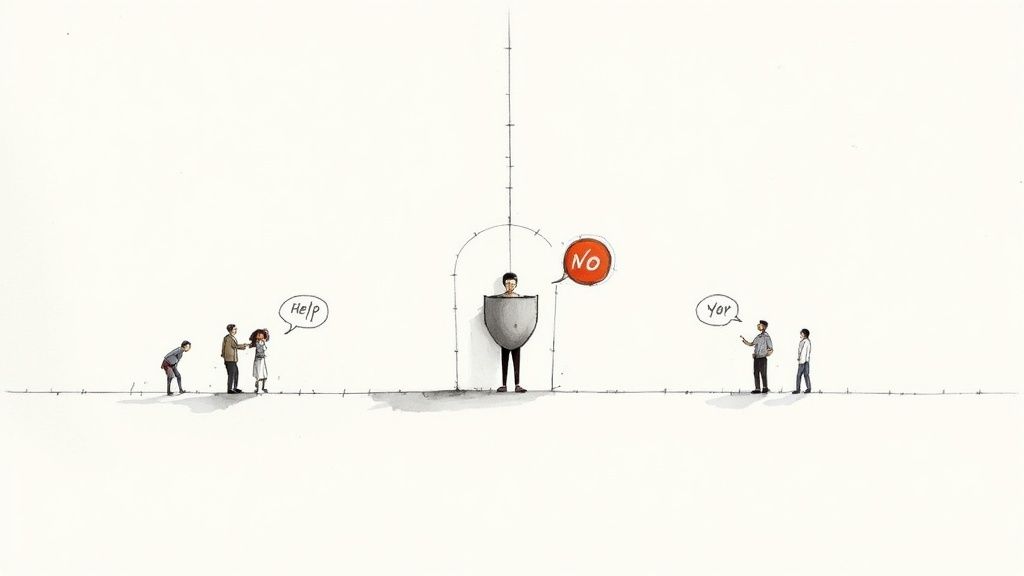
It helps to think of boundaries not as walls to keep people out, but as fences that define your property. They show others how to interact with you safely and respectfully. Setting them isn't selfish; it's a fundamental act of self-care and a critical skill for anyone learning how to build a support system that actually lasts.
Defining Your Lines
Boundaries in recovery come in different forms, each one protecting a different part of your well-being. It’s useful to get specific about what you need in each area of your life.
- Emotional Boundaries: This is all about protecting your mental and emotional energy. It might sound like telling a friend, "I really appreciate you caring, but right now I just need you to be my friend, not my therapist. I can get into the heavy stuff with my counselor."
- Practical Boundaries: These involve tangible things—your time, energy, and finances. For instance, you might need to say to a family member, "I can't lend you any money right now, as I need to focus on my own stability. I'd be happy to help you look for financial resources, though."
- Time Boundaries: Protecting your schedule is absolutely crucial for self-regulation. This could be as simple as letting people know you can’t take calls after 9 PM because you need that time to wind down for a healthy night's sleep.
These limits aren’t about punishing other people. They're about preserving your own resources so you have the strength to keep moving forward. You can find more practical tips in our complete guide on setting boundaries in recovery.
Scripts for Those Difficult Conversations
Knowing you need a boundary is one thing; actually communicating it is another. The fear of sounding harsh, ungrateful, or confrontational can be a huge roadblock.
Having a few simple, respectful scripts ready to go can make all the difference.
"A boundary is simply telling someone what is okay and what is not okay for you. It's a statement of your needs, delivered with respect for yourself and the other person."
Having a few go-to phrases makes it much easier to hold your ground in the moment. You can adapt these word-for-word examples to communicate your needs with clarity and respect.
Boundary-Setting Scripts for Common Recovery Scenarios
| The Situation | A Healthy Way to Respond |
|---|---|
| A friend invites you to a bar. | "Thank you so much for the invite! I'm not going to places like that right now to protect my sobriety, but I'd love to grab coffee next week." |
| A parent gives unsolicited advice. | "I know you're coming from a place of love, and I appreciate it. My recovery team and I have a plan I'm sticking to, and I need you to trust me with that." |
| Someone asks invasive questions. | "I'm not comfortable talking about that right now, but I'm happy to share what I'm learning in my group sessions if you're interested." |
The key is to be clear, kind, and firm. You don't owe anyone a long explanation or an apology for protecting your well-being. A simple, direct statement is usually best.
When Boundaries Are Repeatedly Crossed
Unfortunately, not everyone will respect the limits you set. Sometimes, no matter how clearly you communicate, a person may continue to push your boundaries.
This is a critical moment. It forces you to choose between protecting someone else’s feelings and protecting your own sobriety.
As painful as it is, this is a necessary part of building a genuinely supportive network. It might mean limiting contact with that person or, in some cases, deciding to step away from the relationship for a while. Framing this as an act of self-preservation, rather than punishment, is key. Your sobriety has to come first.
The fragility of support networks is an issue that extends far beyond our personal circles. For example, historical data shows a 21% decline in Development Assistance for Health—driven largely by a reduction in U.S. financing—which weakened crucial global programs. This funding drop disproportionately hit health advocacy organizations, which saw a 23% decrease in their own funding, highlighting how easily even large-scale support systems can be compromised.
How to Nurture Your Support System for the Long Haul
You’ve done the hard work of building your support system. That’s a huge first step, but it’s just the beginning. A network isn't something you assemble once and then stick in a closet; it's a living, breathing part of your recovery that needs consistent care to thrive.
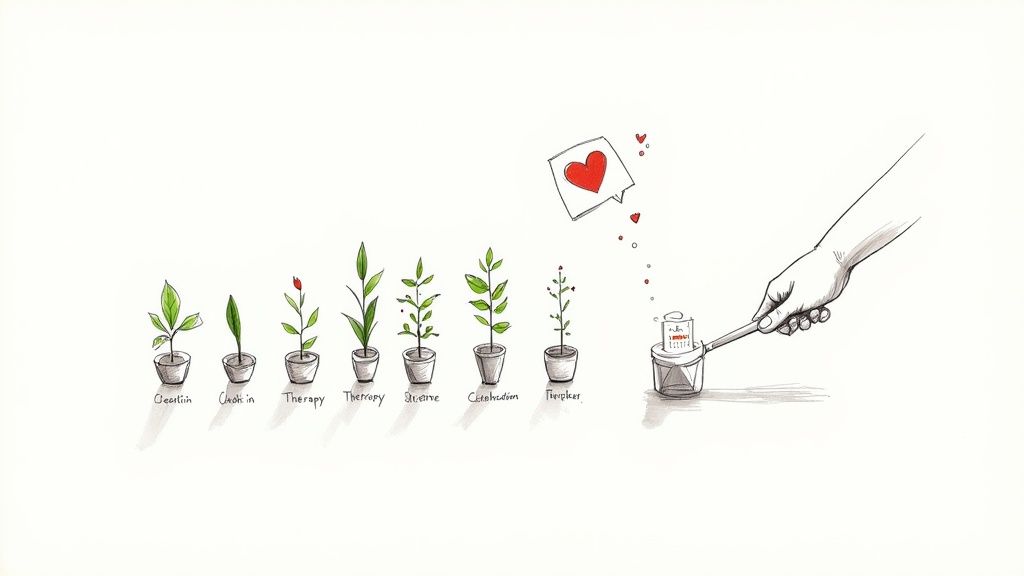
Think of it like a garden. You can’t just toss some seeds in the ground and walk away expecting a harvest. You have to water it, pull the weeds, and give it attention for it to grow strong and actually bear fruit when you need it.
Nurturing your network is all about shifting from crisis-only communication to a sustainable rhythm of connection. This ongoing effort is what transforms a simple list of contacts into a resilient, reliable safety net that can support you through every single stage of your recovery journey.
Establish a Rhythm of Connection
Consistency is the bedrock of a strong support system. If you only reach out when you’re in the middle of a crisis, it puts immense pressure on your relationships and can leave you feeling isolated when you need help most. The key is to create a regular cadence for connecting with the different people on your team.
This doesn't have to be a major production. A sustainable rhythm might look something like this:
- Daily Check-ins: A quick text to a peer or your sponsor can make a world of difference. It could be as simple as, "Feeling good today" or "Struggling a bit, but hanging in there."
- Weekly Appointments: These are your scheduled sessions with a therapist or counselor at Altura Recovery. This creates a dedicated, professional space for deep guidance and unpacking the tough stuff.
- Monthly Social Outings: Plan a sober activity with a trusted friend or family member, like going for a hike or grabbing coffee. The focus here is on connection, not just recovery talk.
This rhythm keeps the lines of communication wide open. It makes reaching out during a tough time feel much more natural because it’s no longer an emergency flare, but just a normal part of your relationship.
Practice Reciprocity and Gratitude
A support system is a two-way street. While your own well-being is the priority—especially in early recovery—your network grows stronger when you contribute to it, too. Honestly, being a supportive friend in return is one of the most powerful ways to nurture your connections.
This means actively listening when a friend needs to talk, celebrating their wins, and offering a hand when you have the capacity. It shifts the dynamic from one of dependency to one of mutual respect and care.
A simple "thank you" can go a surprisingly long way. Acknowledging the time and emotional energy people give you reinforces how much you value their support. It’s not just polite; it’s an essential investment in the health of your relationships.
Remembering a friend's important anniversary or sending a text to see how their stressful week is going shows that you care about them as a whole person, not just as a member of your recovery squad.
Conduct an Annual Network Check-Up
Your needs will absolutely change as you grow in your recovery. The support system that was perfect for your first year of sobriety might not be the right fit for your fifth. That's exactly why it's a great idea to schedule an annual "network check-up" for yourself.
Set aside some quiet time to reflect on your current support system with a few key questions:
- Who have I consistently leaned on in the past year?
- Are there any relationships that feel draining or unsupportive right now?
- What areas of my life feel a little shaky or unsupported (e.g., career, new hobbies, parenting)?
- Is my current team helping me move toward my future goals, or just maintaining the status quo?
This assessment isn't about cutting people off. It’s about making intentional adjustments. You might realize you need to find a new sponsor who has experience with a specific challenge you're now facing, or maybe you want to join a group focused on a sober hobby you've picked up. It ensures your network evolves with you, providing relevant and effective support for the person you are today.
At Altura Recovery, our clinicians can help you navigate this process, ensuring your professional support always aligns with your long-term goals. By regularly tending to these vital connections, you are actively participating in how to build a support system that is not only strong but also adaptable and sustainable for the long haul.
Common Questions About Building Your Support System
When you first commit to recovery, figuring out how to build a support system can feel overwhelming. A lot of "what if" scenarios probably pop into your head. That's completely normal.
Getting clear answers to these common worries can help you move forward with confidence and take the next right step. Let's tackle some of the most frequent questions that come up.
What if I Feel Like I Have No One to Ask?
This is probably the single most common fear, especially in the early days. It's an isolating feeling, but the solution is straightforward: start with professionals and peers first, then worry about personal connections.
Your first move should be exploring different support groups. Check out a few meetings for AA, NA, or SMART Recovery until you find one that clicks. These groups are designed to be welcoming, and they're filled with people who get what you're going through on a level most can't. While you're doing that, make it a priority to find a therapist or counselor who specializes in addiction or your specific mental health needs.
These clinical and peer relationships become the bedrock of your new support system. Once you start building confidence and stability on that foundation, you'll naturally meet other people and can be much more intentional about who you invite into your inner circle.
How Do I Deal with a Family Member Who Makes Things Worse?
It’s a tough spot to be in when a loved one's attempts to "help" are actually counterproductive. The key here is to set firm but loving boundaries while giving their good intentions a new, more helpful direction.
You have to be specific. Instead of just getting frustrated, try saying something like, "I really appreciate how much you care about me. But when you ask me every day if I've used, it actually spikes my anxiety. What would be incredibly helpful is if you could join me for a family therapy session so we can learn how to talk about this stuff in a better way."
This approach does three things: it validates their concern, clearly identifies the problem behavior, and offers a concrete solution. Suggesting resources like Al-Anon can also be a game-changer. It gives them their own support network, which takes pressure off of you and ultimately strengthens your recovery.
Navigating tricky family dynamics is part of the work of recovery. The goal isn't to push people away—it's to teach them how to show up for you effectively. Clear, direct communication is your best tool.
Can Old Friends Be Part of My Support System?
This is a question that demands caution and radical honesty with yourself. The safest, most standard advice for early recovery is to create serious distance from the people, places, and things tied to your past substance use. The risk of relapse is just too high in the beginning.
Down the road, the answer might change. If an old friend is genuinely all-in on supporting your new life and respects your boundaries without exception (like a strict no-use-around-me policy), then a healthy, renewed friendship might be possible. But this is a major decision that should only be made slowly, carefully, and with guidance from your therapist or sponsor once you are very secure in your recovery.
How Many People Do I Really Need?
Think quality over quantity. A tight, reliable network of three to five deeply committed people is far more powerful than a superficial network of twenty.
Your goal is to have balanced coverage across the key areas: clinical, peer, and personal. A solid setup might look like one therapist, one sponsor or mentor, and two trusted friends or family members. This structure ensures you have multiple people to call, which prevents any one person from getting burned out. If you want to dive deeper into these concepts, you can find more on building a support system.
At the end of the day, the only metric that matters is how you feel. Your team is the right size when you feel safe, heard, and genuinely supported by every single person on it.
Building a support system isn't a one-time task; it's an ongoing process of connection and growth. At Altura Recovery, we provide the clinical foundation to help you assemble and nurture a network for lasting wellness. Our compassionate professionals are ready to help you take the next step. Contact us to learn more about our outpatient programs.