

When you're trying to figure out treatment options, the financial side is almost always the first, and most pressing, concern. Let's be upfront about it: the cost of a partial hospitalization program can swing quite a bit, but a good ballpark figure without insurance is somewhere between $300 and $450 per day.
If you have insurance, that daily cost often drops to a more manageable $100 to $300, but this will hinge on your specific plan's deductible and copay.
What Is the Real Cost of a Partial Hospitalization Program?
To really wrap your head around the cost, you first have to understand what a Partial Hospitalization Program (PHP) actually is. Think of it as a powerful middle ground in treatment. It’s far more intensive and structured than weekly therapy sessions, but it also allows you to return home each evening—a key difference from residential inpatient care.

This unique structure is exactly why the cost is what it is. You're investing in several hours of high-level clinical care, five days a week, which bundles together a whole suite of therapeutic services. The price tag reflects this comprehensive, immersive level of support. Getting a clear handle on the financial commitment from the start can make the path forward feel much less overwhelming.
A Clear Look at the Numbers
To put these numbers into a real-world context, let’s compare what you might expect to pay. The table below gives a quick snapshot of the financial difference between using an insurance plan versus paying entirely out-of-pocket for a typical 20-day program.
Estimated PHP Cost Comparison: Insured vs. Uninsured
| Payment Method | Estimated Daily Cost | Estimated Total Cost (20-Day Program) |
|---|---|---|
| With Insurance | $100 – $300 | $2,000 – $6,000 (after deductible) |
| Uninsured / Out-of-Pocket | $300 – $450 | $6,000 – $9,000 |
While these are estimates, they provide a solid baseline for planning. For example, right here in the Dallas-Fort Worth area, the total out-of-pocket expense for a 20-day PHP often falls somewhere between $7,000 and $9,000.
It's helpful to view this not just as a cost, but as an investment.
A PHP is an investment in your long-term well-being. The goal is to provide a high level of care that stabilizes symptoms, teaches coping skills, and builds a foundation for lasting recovery, potentially preventing the need for more costly inpatient stays later.
The real value is packed into the program's intensity and the wide range of services you receive. Everything is designed to create meaningful, tangible progress in a relatively short amount of time. Learning about the specific benefits of a partial hospitalization program rehab can help clarify why this level of care is such a strategic and effective step for so many people on their recovery journey.
What Really Drives the Price of a PHP
Trying to pin down the price of a partial hospitalization program can feel like a moving target. That’s because a PHP isn’t a single product with a universal price tag. Think of it more like building a custom treatment plan; the final cost reflects exactly which services, specialists, and resources are needed for a person's unique recovery journey.
The base cost covers the essentials, but just like any specialized service, adding more intensive support or specific therapies will adjust the final price. This isn't about upselling—it's about matching the level of care to the level of need. The final partial hospitalization program cost is a direct reflection of the time, expertise, and clinical resources dedicated to you.
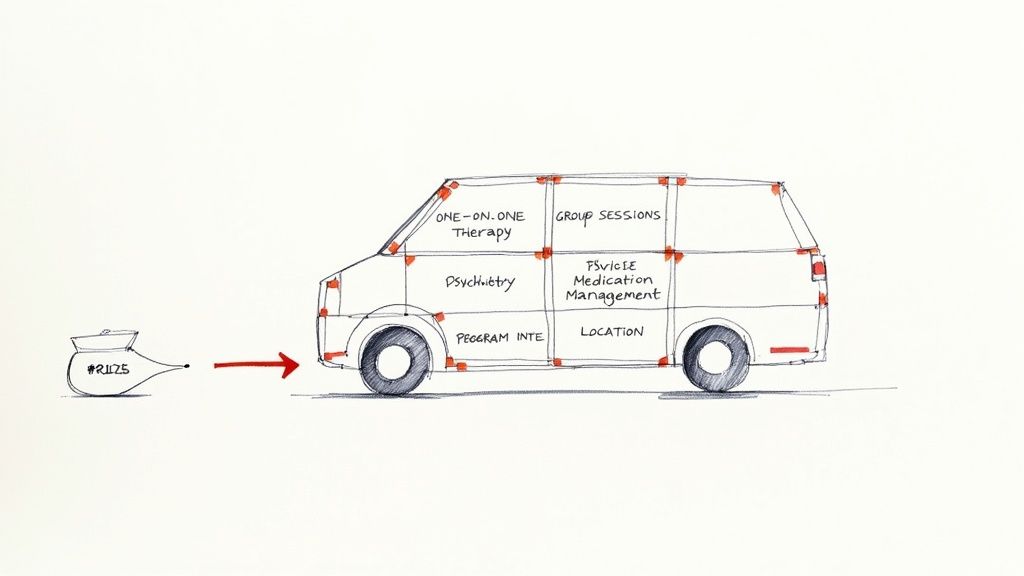
Core Services That Shape the Cost
So, what are you actually paying for? The most significant cost drivers are the clinical services that form the backbone of any effective PHP. These aren't optional add-ons; they are the therapeutic engine of the program.
- Individual Therapy: One-on-one sessions with a licensed therapist are the cornerstone of personalized care, requiring dedicated clinical time and resources.
- Group Therapy: These structured sessions offer powerful peer support and targeted skill-building. Understanding the difference between individual therapy vs group therapy helps clarify why both are so valuable and how they contribute to the overall plan.
- Psychiatric Care and Medication Management: Having regular access to a psychiatrist for evaluations and medication adjustments is a critical medical service that factors into the cost.
- Specialized Treatments: If a program offers advanced therapies like EMDR for trauma or DBT for emotional regulation, it means they’ve invested in staff with specialized training, which naturally influences the price.
At the end of the day, the more comprehensive and specialized the care, the higher the investment. These services are delivered by highly trained professionals, and their expertise is a major part of what you’re paying for.
Program Intensity and Location
Beyond the specific therapies offered, two other big-picture elements play a role: the program's intensity and its physical location.
Intensity is all about the time commitment. A program that runs 6 hours a day, 5 days a week is far more resource-heavy—requiring more staff hours, facility use, and materials—than one with a lighter schedule.
Location matters, too. A treatment center in a major city with a high cost of living will have much higher operational expenses for things like rent, utilities, and competitive staff salaries. These background costs are baked into the price you see.
To get a better sense of how this works, it’s useful to see how organizations account for their overhead. Learning how to calculate indirect costs sheds light on how these necessary background expenses are built into the final price of a service.
By breaking down these different components, you can start to see beyond the sticker price. It allows you to evaluate a program based on the actual quality and depth of care it provides, ensuring you find one that delivers real value for your investment in health and recovery.
How Insurance Actually Impacts Your PHP Costs
Insurance is your single most powerful tool for managing the cost of a partial hospitalization program, but trying to figure out its rules can feel like learning a new language. The best way to think about your insurance plan is as a financial partner in your recovery. Once you understand what they’re saying, you can unlock your benefits and sidestep those dreaded unexpected bills.
The good news? The vast majority of modern insurance plans consider mental health services, including PHPs, to be essential health benefits. This means coverage is almost always available, but the specifics of how much your plan will actually pay depend entirely on your individual policy.
Demystifying Key Insurance Terms
Before you can make sense of your coverage, you have to know the lingo. To really get how insurance affects your PHP costs, it helps to start by defining health insurance premiums, which is simply the fixed amount you pay regularly to keep your plan active. After that, a few other key terms will determine your final out-of-pocket expenses:
- Deductible: This is the amount you have to pay for covered services before your insurance company starts paying anything. For instance, if you have a $2,000 deductible, you are responsible for the first $2,000 of your PHP costs.
- Copayment (Copay): This is a flat fee you pay for a specific service after you’ve met your deductible. You might have a $50 copay for each day you attend the program.
- Coinsurance: This is your share of the bill, calculated as a percentage. If your plan has 20% coinsurance, it means that after your deductible is met, you pay 20% of the cost and your insurer pays the other 80%.
Getting a handle on how these pieces fit together is a game-changer. Our guide on insurance coverage for addiction treatment dives even deeper into how to make these benefits work for you.
In-Network vs. Out-of-Network Care
The difference between an “in-network” and an “out-of-network” provider is one of the biggest factors that will swing your final bill. An in-network facility has a contract with your insurance company, which means they’ve already agreed on lower, pre-negotiated rates for you.
Going out-of-network means picking a facility that doesn’t have a contract with your insurer. While you might still get some level of coverage, your deductible will almost certainly be higher, and your coinsurance percentage will be greater. The bottom line: always confirm a facility is in-network to keep your partial hospitalization program cost as low as possible.
Pre-Authorization Is Non-Negotiable
Before you ever start a PHP, the treatment facility absolutely must get pre-authorization from your insurance company. This is the process where they prove that the care is medically necessary. If they skip this step, your insurer can deny the entire claim, leaving you on the hook for the full cost.
Government Plans Like Medicare and Medicaid
Medicare and Medicaid also offer coverage for PHPs, as both systems recognize how valuable this level of care is for mental health. In fact, Medicare spending on PHPs grew massively over the years, showing just how accepted they've become as an effective treatment model. Between 1993 and 1997, Medicare payments for these programs jumped by 482%, a clear sign of their vital role in community-based mental health care.
The coverage rules for these government plans can be very specific, so it’s always a good idea to work closely with a treatment center’s admissions team to verify your eligibility and understand all the requirements.
Calculating Your True Out-of-Pocket Expenses
Moving from ballpark estimates to your actual numbers is the most empowering step you can take. The final partial hospitalization program cost isn't some unknowable figure; it's a straightforward calculation. Once you gather a few key details from your insurance plan, you can forecast what you’ll really pay with surprising accuracy.
Think of it like putting together a simple financial puzzle. The main pieces you need are your plan's deductible, coinsurance percentage, and out-of-pocket maximum. With these three numbers in hand, you can map out your financial responsibility and move forward with confidence, not questions.
The relationship between you, your insurance, and the treatment facility is a critical one to understand.
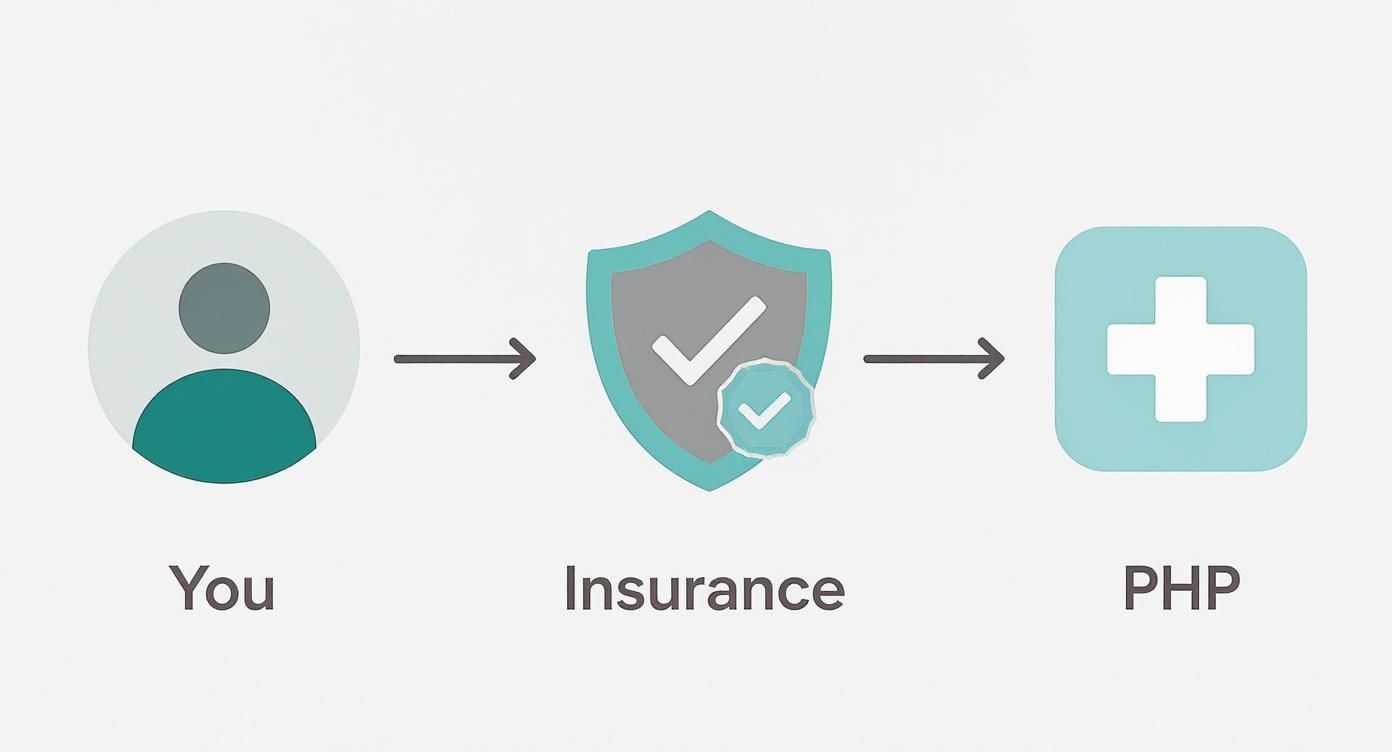
This flow shows why verifying your benefits is always the essential first move before you commit to a program.
A Practical Scenario
Let's walk through a clear, real-world example. Imagine the total approved cost for your PHP comes to $8,000. Your insurance plan has a $1,500 deductible, 20% coinsurance, and a $5,000 out-of-pocket maximum.
Here’s how the math breaks down:
- Meet Your Deductible: First things first, you’re responsible for the initial $1,500 of the bill.
- Calculate Coinsurance: With the deductible paid, the remaining balance is $6,500. Your 20% share of this amount is $1,300. Your insurance covers the other 80%, which is $5,200.
- Find Your Total: Add your deductible and your coinsurance payment together to find your final cost: $1,500 + $1,300 = $2,800.
Since $2,800 is well below your $5,000 out-of-pocket max, this is your final bill. This exact structure is a key differentiator when exploring outpatient vs inpatient rehab, as the total cost of inpatient care is often much higher, meaning you're more likely to hit your maximum faster.
Your out-of-pocket maximum is a crucial safety net. It's the absolute most you will have to pay for covered services in a plan year. Once you hit this number, your insurance pays 100% of all approved costs for the rest of the year.
How Different Plans Change the Equation
The numbers can shift dramatically depending on your insurance plan's design. A high-deductible plan might mean more upfront costs, while a low-deductible plan usually has higher monthly premiums but requires less out of pocket when you need care.
To make this crystal clear, the table below shows how that same $8,000 PHP bill could look across a few different insurance scenarios.
Sample Out-of-Pocket Cost Calculation Across Insurance Plans
This table breaks down how your share of an $8,000 PHP bill changes based on the structure of your insurance plan.
| Insurance Plan Feature | Plan A (High Deductible) | Plan B (Low Deductible) | Plan C (No Insurance) |
|---|---|---|---|
| Total Program Cost | $8,000 | $8,000 | $8,000 |
| Your Deductible | $3,000 | $500 | N/A |
| Your Coinsurance (20%) | $1,000 (20% of $5k) | $1,500 (20% of $7.5k) | N/A |
| Your Final Cost | $4,000 | $2,000 | $8,000 |
As you can see, the same treatment can result in very different personal costs. This is why a quick call to your insurance provider to confirm your specific benefits is one of the most important steps in the process.
Worried about the partial hospitalization program cost? Take a deep breath. If the price tag feels out of reach, it’s important to know you have options. High-quality care shouldn’t be a luxury, and there are many pathways designed to bridge the financial gap beyond just tapping into your savings.
Treatment centers want you to succeed, and that means helping you find a way to pay for it. The first step is always an open, honest conversation with the admissions or billing department. They’re your best inside source for understanding every single option available at that specific facility.
Exploring Your Payment Support Options
Before you write off a program that seems too expensive, do a little digging into these common financial lifelines. You might be surprised by how much help is available once you start asking the right questions.
- Sliding-Scale Fees: Some centers will adjust the daily cost of the program based on your annual income. This makes the program more manageable for people with lower earnings, ensuring the price fits what you can realistically afford.
- Payment Plans: Instead of demanding one huge lump sum, many facilities offer in-house financing. This breaks the total cost into a series of predictable monthly installments, turning an overwhelming bill into something you can budget for.
- Healthcare Financing: There are also companies that specialize in medical loans. These third-party lenders can cover the full cost of treatment upfront, and you repay them over a longer period. Just be sure to pay close attention to the interest rates and repayment terms.
Finding financial assistance can feel like one more heavy thing to deal with when you're already stressed. But remember, a treatment center’s financial counselors are experts at this. They navigate these systems every day and can guide you to the best solution for your unique situation.
Don’t forget to look for help outside the treatment center, too. Many non-profit organizations and private foundations offer scholarships or grants specifically for mental health and substance use treatment. These funds are created to help people access care they couldn't otherwise afford and can dramatically lower what you pay out-of-pocket. A little research here can unlock some serious support.
When you see the daily rate for a Partial Hospitalization Program (PHP), it's easy to get sticker shock. But thinking of it purely as an expense misses the whole point. A better way to frame it is as an investment in long-term health—a strategic choice designed to pay dividends in your well-being for years to come.
The most obvious comparison is with a full inpatient hospital stay. Both offer intensive, structured care, but a PHP delivers a similar level of therapeutic support during the day at a much lower cost, simply because you go home at night. This makes it a powerful, cost-effective option for anyone who needs serious support but doesn’t require 24/7 medical monitoring.
A Smarter Investment Than Inpatient Care
The price difference between inpatient and partial hospitalization is huge. One analysis from 2010 pegged a single four-hour PHP session at around $275, while just one night of psychiatric inpatient care cost about $1,121. Even though those numbers are a bit dated, the ratio holds up: a PHP provides intensive treatment without the massive overhead of an overnight stay. You can dig into more research on PHP cost-effectiveness to see the full breakdown.
And when you stack it up against standard outpatient therapy—which is usually just one or two hours a week—a PHP’s value is just as clear. The focused, multi-hour daily schedule is built to accelerate progress, create real momentum, and install strong coping skills much faster than a weekly check-in ever could.
A Partial Hospitalization Program is an upfront investment in stability. The goal of this intensive approach is to dramatically reduce the chances of a relapse, which in turn helps prevent far more costly interventions—like emergency room visits or future inpatient stays—down the road.
Focusing on Long-Term Returns
Ultimately, a PHP is about building a solid foundation for a stable future. By dedicating a concentrated block of time to intensive therapy, skill-building, and psychiatric oversight, you're investing in your future health and your ability to function day-to-day.
This proactive approach leads to better long-term outcomes, making it a wise and strategic move for yourself or someone you love. The real return isn't just measured in dollars saved, but in lasting well-being.
Common Questions About PHP Costs
When you’re trying to figure out the financial side of treatment, a lot of specific, practical questions come up. Getting straight answers is key to planning your next steps with confidence. This section cuts right to the chase, tackling the most common concerns people have about the cost of a partial hospitalization program.
Think of these as the final, important pieces of the puzzle. We’ll give you clear, direct answers to help you understand the smaller details that can make a big difference for your budget and your peace of mind.
Does My Insurance Have to Approve a PHP Before I Start?
Yes, absolutely. In nearly every case, getting pre-authorization from your insurance company is a mandatory first step before you begin a Partial Hospitalization Program.
The treatment facility you choose is responsible for this. They’ll submit all the necessary clinical information to your insurer to demonstrate that this level of care is medically necessary for you. If you jump into the program without that official green light, your insurance provider can legally deny the entire claim, which could leave you on the hook for the full cost. Always work closely with the admissions team to make sure this is handled before day one.
What Is the Cost Difference Between a PHP and an IOP?
A PHP will always cost more per day than an Intensive Outpatient Program (IOP) because it’s a higher and more intensive level of clinical care. The biggest difference boils down to the time you spend in treatment each week.
- Partial Hospitalization Program (PHP): This typically involves 4-6 hours of therapy and other services per day, 5 days a week.
- Intensive Outpatient Program (IOP): This is a step-down level of care, usually requiring about 3 hours of therapy, 3-4 days a week.
Since an IOP involves fewer hours, the total cost is naturally lower. But the choice between them should never be about the price tag alone—it has to be based on the clinical needs identified in your professional assessment.
A clinical team recommends a specific level of care to give you the best possible shot at a solid, long-term recovery. Opting for a lower level of care just to save money can end up being a much costlier decision down the road if it doesn’t provide the support you truly need to get well.
Are Meals and Transportation Included in the PHP Cost?
This really varies from one facility to the next, so you can’t make any assumptions here. Some higher-end or specialized PHPs might include lunch or even offer transportation services as part of their daily rate.
Many programs, however, do not. In those cases, you’ll need to budget for your own meals and figure out your own way to and from the facility each day. It’s crucial that you ask the admissions staff for a clear, detailed list of what is and isn’t included in the program fee. This will help you avoid any unexpected expenses later on.
At Altura Recovery, we believe the path to recovery should be as clear and manageable as possible—and that includes the financial side of things. Our team is ready to help you understand all your options and find a plan that works for you. Learn more about how we can support your journey at https://www.alturarecovery.com.