
When your spouse is an alcoholic, your focus has to shift. Instead of trying to control their addiction—an impossible task—the path forward is about protecting your own well-being and setting firm boundaries. It starts with learning to detach with love, finding your own support system, and taking concrete steps to bring peace and stability back into your life. This change in perspective is the single most important step you can take.
The Reality of an Alcohol-Affected Marriage

Living with an alcoholic spouse isn’t just about the drinking. It’s about surviving the emotional chaos that comes with it. Your life can feel like a never-ending cycle of broken promises, constant unpredictability, and deep, profound loneliness.
You might find yourself walking on eggshells, constantly putting out fires, and shoving your own needs aside just to keep things from completely falling apart. It's an exhausting way to live. This environment creates an unhealthy dynamic where your entire life begins to revolve around their addiction, a condition that poisons the whole family, not just the person drinking.
Recognizing the Impact on Your Life
When your partner is struggling with alcohol, it's normal to feel a tidal wave of emotions. Acknowledging them is the first step toward protecting your own mental and physical health. You might be dealing with:
- Emotional Exhaustion: The constant worry and stress can lead to severe burnout, anxiety, and even deep depression.
- Financial Strain: Addiction often brings financial instability through job loss, reckless spending, or mounting legal troubles.
- Erosion of Trust: Repeated lies, broken promises, and erratic behavior slowly chip away at the very foundation of your relationship.
- Social Isolation: It's common to pull away from friends and family out of shame or simply to avoid having to explain the chaos.
It is critical to understand that these are not your failings. They are the predictable consequences of addiction’s ripple effect. Addiction is a complex disease, a tangle of both physical vs psychological dependence that you can't cure for them.
The most powerful realization you can have is that you cannot control their drinking. But you can absolutely control how you respond to it. This is where your healing begins.
The Sobering Statistics
The strain that alcoholism puts on a marriage isn't just a feeling; the numbers back it up. Research shows a dramatically higher risk of divorce for couples where one partner has an alcohol use disorder.
In fact, somewhere between 50-60% of marriages impacted by alcohol dependence end in divorce—a rate that dwarfs that of the general population. Some data suggests that if the husband is the one with the addiction, the marriage is 3.3 times more likely to fail. You can see more about how alcoholism impacts divorce rates on Zipdo.co.
This isn't meant to discourage you. It's meant to validate the immense pressure you're under and reinforce why taking care of yourself isn't selfish—it's essential for survival.
To help you get started, here is a quick summary of the first few actions you can take to regain a sense of control and create a safer emotional space for yourself.
Immediate Steps for Your Well-Being
| Action | Why It's Important | First Step Example |
|---|---|---|
| Seek Personal Support | You need a safe space to process your feelings without judgment. Isolation fuels the problem. | Find a local Al-Anon meeting or schedule a session with a therapist who specializes in addiction's family impact. |
| Establish a Boundary | Boundaries protect your well-being. They define what you will and will not tolerate. | "I will not have conversations with you about important topics when you have been drinking." |
| Prioritize Self-Care | The chronic stress of this situation depletes your physical and mental health. | Schedule 30 minutes each day for an activity you enjoy, like walking, reading, or listening to music. |
| Secure Finances | Financial instability is a common side effect of addiction. Protecting your resources is crucial. | Open a separate bank account in your name and have your paycheck deposited there. |
Taking even one of these small, concrete steps can feel like a massive victory. It's about shifting the focus from fixing them to protecting you, which is the only part of this equation you truly have power over.
Why Alcoholism Is a Family Disease
It’s completely natural to see your spouse's drinking as their problem. You find yourself thinking, "If they would just stop, everything would be fine again." But addiction is rarely that simple. It doesn't live in a vacuum; it’s more like a gravitational force, pulling the entire family into its orbit and quietly rewriting the rules of how everyone interacts.
Alcoholism gets called a family disease not because anyone else is to blame for the drinking, but because absolutely everyone is affected by it. Spouses, children, and even close friends unconsciously change their behaviors to cope with the stress and chaos. This creates an unhealthy family system that, without anyone meaning to, ends up protecting the addiction.
The Unspoken Roles in an Addicted Family
To keep some sense of balance in a chaotic home, family members often slide into predictable, unhealthy roles. These aren't conscious choices—they're survival tactics that develop over time. Spotting them is the first real step toward breaking free.
Do any of these feel familiar?
- The Enabler: This is often the spouse's role. It looks like calling their boss with a fake illness when they're hungover. It sounds like making excuses for their behavior at a family dinner. You take on their responsibilities, shielding them from the natural consequences of their drinking.
- The Hero: Often an older child, this person tries to fix the family's pain by being perfect. They get straight A's, excel in sports, and never cause a problem, secretly hoping their achievements will somehow make the drinking stop.
- The Scapegoat: This family member becomes the "problem." They act out, get into trouble at school, and draw all the negative attention. This allows the family to focus on their behavior instead of the much bigger, scarier issue of addiction.
- The Lost Child: This person just tries to disappear. They become quiet and withdrawn, making themselves as small as possible to avoid adding any more stress to the family. They escape into books, video games, or their own imagination.
These roles are born from a desperate need to control a situation that feels completely out of control. It’s not about blame. It’s about recognizing the pattern you’ve fallen into so you can finally choose to step out of it.
Understanding Codependency and Enabling
For the spouse of an alcoholic, two patterns are incredibly common: enabling and codependency. They’re closely related, but they’re not the same thing. Both, however, pour fuel on the fire of addiction.
Enabling is any action you take that cushions your spouse from the negative results of their drinking. It’s almost always motivated by love or fear, but it sends a clear message: "Don't worry, I'll handle the consequences for you."
A few classic examples include:
- Lying to friends or family to cover up an embarrassing, drunken incident.
- Paying their legal fees after a DUI or bailing them out of jail.
- Cleaning up their vomit or putting them to bed when they pass out.
- Carefully avoiding any conversation that might lead to a fight about their alcohol use.
Codependency, on the other hand, is a much deeper emotional pattern. It’s when your own self-worth gets tangled up with your spouse’s addiction. You might feel a powerful sense of purpose from trying to "fix" or "rescue" them, and your mood for the day depends entirely on whether they are drinking or sober.
In a codependent relationship, your identity is wrapped up in being the caretaker. The focus shifts so completely onto the other person that you lose sight of your own needs, dreams, and well-being.
This dynamic is exhausting. It leaves you feeling drained, resentful, and utterly alone. Recognizing these behaviors isn't about shaming yourself—it’s about seeing the system clearly for the first time. It’s the essential first step toward detaching with love, where you can still care for your spouse without carrying the weight of their disease. When you shift the focus back to your own healing, you start to dismantle the very system that has kept everyone sick.
How to Set Boundaries That Actually Work
When you're trying to figure out how to live with an alcoholic spouse, the whole idea of "setting boundaries" can sound like you're gearing up for a fight. But a boundary isn't a weapon or an ultimatum. It’s more like a shield—something you hold up to protect your own sanity and well-being.
The secret to making them work is a small but powerful shift in perspective. Boundaries are clear statements about what you will do, not angry demands about what they must do. Instead of a reactive, "Don't you dare come home drunk again," a boundary sounds like, "If you come home drunk, I will be sleeping in the guest room."
See the difference? This approach puts the control right back in your hands. You're no longer stuck waiting for them to change their behavior. You're simply deciding how you'll respond to keep yourself safe and stable.
Defining Your Non-Negotiables
Before you can communicate a boundary, you have to get crystal clear on what it actually is. Vague limits are just too easy to ignore. Start by pinpointing the specific behaviors that cause you the most chaos, distress, or danger.
Think about the different parts of your life that addiction has touched. Your non-negotiables will likely fall into a few key categories:
- Emotional Safety: "I will not get into arguments when you've been drinking. If one starts, I am going to leave the room."
- Financial Security: "I will no longer pay your credit card bills or hand you cash for alcohol. Our finances need to be separate to protect our family."
- Physical Space: "I have to get a full night's sleep to function. If you're stumbling around and making noise late at night, I will sleep in the other bedroom."
- Social Interactions: "I will not lie to our friends and family to cover for your drinking anymore. If they ask why we missed an event, I will be honest."
Making these boundaries specific and actionable is the first real step in taking back the parts of your life that addiction has worn away. These aren't punishments; they are acts of self-preservation.
The infographic below outlines a simple, effective flow for setting and maintaining these crucial personal limits.
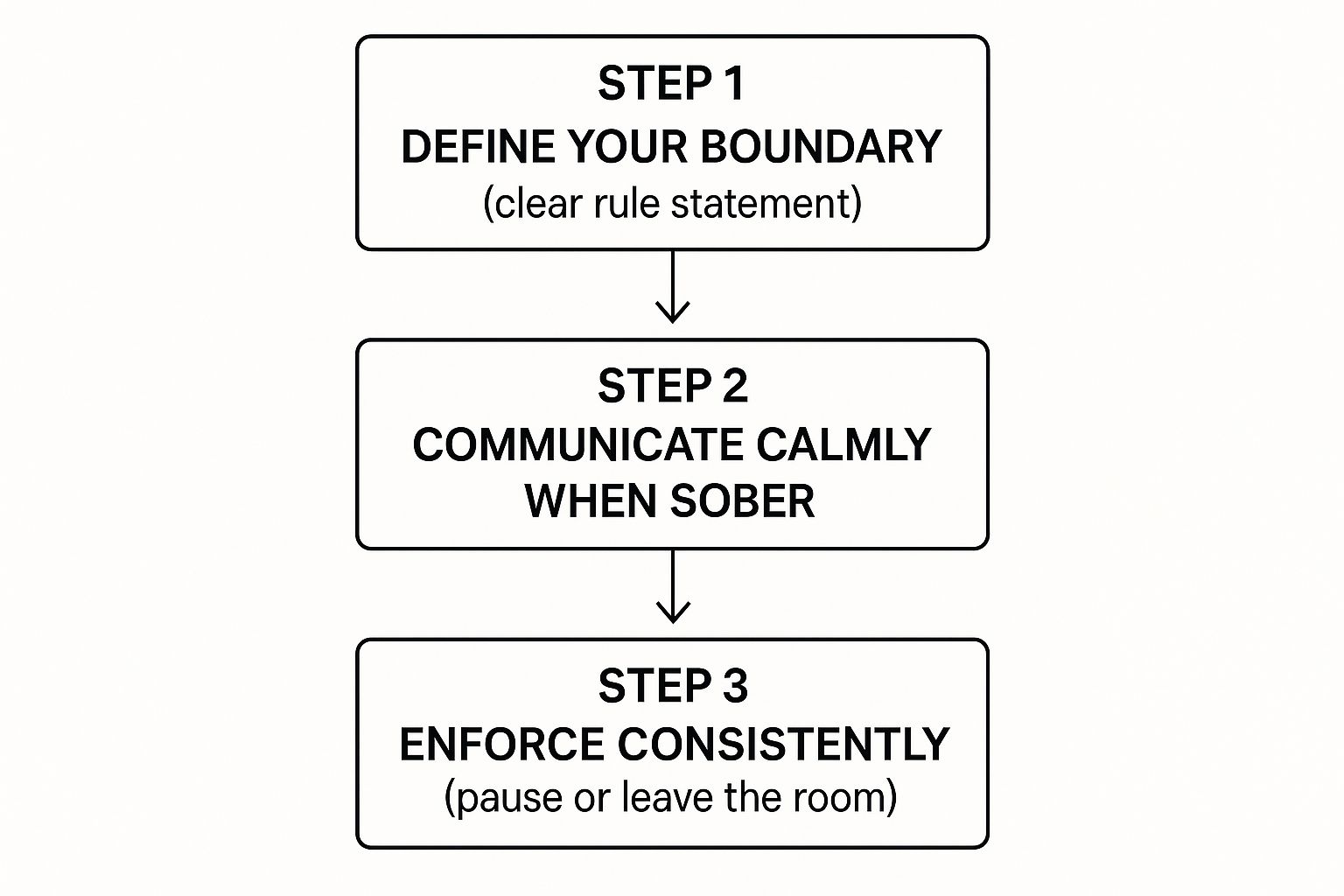
This process shows that a successful boundary isn't just a single statement you make once. It's a consistent practice of defining, communicating, and then holding your ground.
Communicating Boundaries Without Starting a War
How you deliver the message is just as important as the message itself. The goal is to be firm and clear, not aggressive or accusatory. The absolute best time for this conversation is when your spouse is sober and you are both as calm as possible.
Start by using "I" statements to express your own feelings and needs without pointing fingers. For example, say "I feel scared and unsafe when you drive after drinking," instead of "You're so irresponsible for driving drunk." The first statement is about your experience; the second is an attack that's almost guaranteed to be met with defensiveness.
Key Takeaway: Communicate your boundary calmly, state the consequence clearly, and then stop talking. Don't get sucked into a debate, a negotiation, or an argument about whether your boundary is "fair."
Once you've stated it, brace yourself for pushback. Your spouse is used to a certain dynamic, and you're changing the rules of the game. They might get angry, try to guilt-trip you, or make promises they have no intention of keeping. This is a totally normal reaction. Your job isn't to convince them to like the boundary; it's simply to uphold it.
The Power of Consistency
A boundary that's only enforced sometimes isn't a boundary at all—it's just a suggestion. This is the hardest part, but it's also the most critical: you have to be consistent. Every single time the line gets crossed, you must follow through with the consequence you laid out.
This is where your resolve will truly be tested. It will feel difficult, and you might even feel guilty at first. But consistency is what teaches your spouse that you're serious. It recalibrates the relationship and shows them that their drinking will no longer happen without natural consequences from you.
Holding these lines is about protecting the marriage from more damage and, just as importantly, safeguarding your own health. The strain of living with an alcoholic partner significantly increases the risk of the relationship ending. A large-scale national survey showed that individuals with a lifetime alcohol use disorder had marital dissolution rates of 48.3%, a huge jump from the 30.1% for those without. These findings highlight the intense pressure addiction puts on a partnership. You can read the full research about these marital outcomes and see just how critical this kind of self-preservation is.
Prioritizing Your Own Mental and Physical Health

When you're constantly in crisis mode, your own needs don't just take a backseat—they often feel like they've been kicked out of the car entirely. Living with an alcoholic spouse is an incredibly taxing experience, and it's essential to protect your own well-being and learn effective strategies to maintain work-life balance and prevent burnout.
This is your permission slip to put yourself first. Self-care isn't a luxury in this situation; it's a non-negotiable survival tool. Strengthening your own foundation is the only way you can continue to function and make clear-headed decisions for yourself and your family.
Reclaiming Small Pockets of Peace
You don't need grand gestures or expensive spa days to start feeling better. The goal here is to weave small, consistent actions into your day that restore your energy and give you a moment of mental quiet.
This might look like:
- A 10-Minute Reset: Just step outside for a short walk around the block. Focus only on the feeling of your feet on the pavement and the air on your face. This simple act can break a painful cycle of anxious thoughts.
- Rediscovering a Lost Hobby: Did you used to love reading, painting, or gardening? Dedicate just 15 minutes a day to reconnecting with something that is yours alone and brings you a little joy.
- Guarding Your Sleep: Chronic stress absolutely wreaks havoc on sleep. Try to make your bedroom a sanctuary and prioritize a consistent bedtime, even if that means sleeping in a separate room to escape disruptions.
These small acts of self-preservation build resilience over time. They are a quiet but powerful way of telling yourself, "My well-being matters, too."
The Lifeline of Professional Support
While personal coping skills are vital, the emotional weight of living with an alcoholic spouse often requires professional support. Seeking therapy for yourself is one of the most powerful steps you can take.
A therapist provides a confidential, non-judgmental space where you can finally unpack the trauma, frustration, and grief that you can't share with anyone else. It's a place to learn practical skills for managing the intense stress and emotional toll.
Therapy isn’t about fixing your spouse. It’s about equipping you with the tools to navigate your reality, process your pain, and build a healthier future, regardless of the choices your partner makes.
The constant stress of this environment can easily lead to serious mental health challenges. For many, this includes developing significant anxiety or depression. Learning specific coping strategies for anxiety and depression is a proactive way to protect your mental health before it deteriorates.
Why Your Health Is Non-Negotiable
Prioritizing your health isn't selfish; it’s a necessary boundary. The chronic stress of living with addiction can have severe physical consequences, leading to everything from high blood pressure to a weakened immune system.
One of the hardest but most crucial shifts is learning to stop absorbing the consequences of their drinking. This often means changing your own automatic reactions.
Consider this table comparing harmful responses that enable the addiction versus helpful ones that prioritize your well-being.
Harmful vs. Helpful Responses to an Alcoholic Spouse
| Situation | Harmful (Enabling) Response | Helpful (Boundary-Setting) Response |
|---|---|---|
| Spouse is too hungover to attend a family event. | "I'll call and say we both have the flu. You just rest." | "I am going to the event with the kids. I hope you feel better." |
| Spouse starts an alcohol-fueled argument. | Engaging in the fight, trying to reason with them for hours. | "I will not have this conversation when you've been drinking. We can talk tomorrow when you're sober." |
| Spouse spends bill money on alcohol. | Covering the bill from your own savings to avoid a crisis. | "The phone bill is your responsibility. I have paid my half of the household expenses." |
Each helpful response protects your emotional and financial health. By refusing to absorb the fallout from their drinking, you preserve your own resources.
You are not abandoning them; you are simply refusing to let their disease completely sink you, too. This shift is fundamental to learning how to live with an alcoholic spouse in a way that doesn't destroy you in the process.
Navigating Difficult Conversations and Conflict
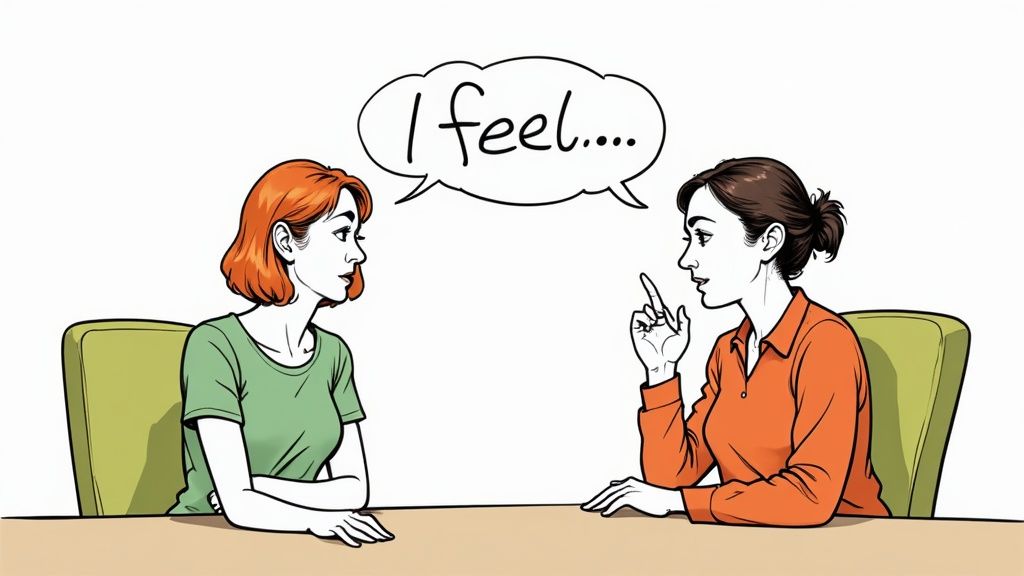
Trying to have a real conversation with an alcoholic spouse can feel like walking through a minefield. You find yourself constantly on edge, choosing every word carefully to avoid an explosion, but the fight seems to happen anyway.
This communication breakdown is one of the most painful parts of living with addiction. It leaves you feeling unheard, dismissed, and deeply frustrated.
But you're not powerless here. There are specific tools you can learn to change this dynamic. The goal isn’t to “win” or force them to agree with you. It’s about protecting your own emotional energy, de-escalating arguments, and creating small windows where your needs can actually be heard.
Choose Your Moment Wisely
The single most important rule is timing. Trying to talk about anything serious—finances, the kids, or their drinking—when your spouse is intoxicated is a guaranteed recipe for disaster. Alcohol scrambles judgment, tanks inhibitions, and usually fuels anger and defensiveness.
You have to consciously wait for a window of sobriety. This might be in the morning before they start drinking or during a rare sober stretch. A clear-headed conversation is the only kind that has a chance of being productive.
The Power of "I" Statements
When tensions are high, it’s so easy to fall into accusatory “you” statements. "You always ruin our plans," or "You never listen to me." While those words come from a place of real pain, they instantly put your spouse on the defensive and slam the door on any real discussion.
A much more effective approach is using "I" statements. This simple technique reframes the issue around your feelings and experiences—which are undeniable—instead of their actions, which they can (and will) argue about. It's a fundamental skill for anyone trying to figure out how recovery and relationships can coexist.
Look at the difference:
- Instead of: "You're so selfish for spending all our money on alcohol."
- Try: "I feel scared and anxious when I look at our bank account and see how much is missing."
- Instead of: "You embarrassed me in front of my friends again."
- Try: "I felt hurt and humiliated at the party last night when the conversation got so heated."
This small shift is incredibly powerful. It lets you express your pain without launching an attack, which makes it far more likely they’ll actually hear what you’re saying.
Key Takeaway: An "I" statement communicates the impact of their behavior without assigning blame. It keeps the focus on your emotional reality—something they can't argue with.
Learn When to Disengage
Knowing when to walk away is one of the most critical skills you can develop. You are not required to participate in every argument you’re invited to, especially not one fueled by alcohol.
These fights are circular, illogical, and absolutely draining. They go nowhere and only serve to escalate tension and cause more emotional damage. The moment you realize a conversation is turning into a drunken argument, your best move is to disengage.
You can say something calm and neutral, like:
- "I can see you're upset, but I’m not having this conversation right now."
- "We can talk about this tomorrow when we are both calm."
- "I'm going for a walk."
Then, physically leave the room or the house. This isn’t about punishment; it’s about setting a boundary that protects your sanity. By refusing to engage in pointless conflicts, you stop feeding the cycle of chaos and start reclaiming pockets of peace for yourself.
Where to Find Your Support System
Trying to figure out how to live with an alcoholic spouse is one of the most isolating experiences a person can go through. Addiction wants you to feel alone; it convinces you that the chaos, the broken promises, and the unpredictability are a private shame you have to manage by yourself.
But you don’t. The single most powerful thing you can do to reclaim your sanity is to build a support system that is focused entirely on you.
You cannot walk this path alone, and you shouldn't have to. Reaching out isn’t a sign of weakness—it's the first real step toward protecting yourself. Finding people who genuinely get what you're living through provides validation, perspective, and the strength you need to stop just surviving and start living again.
Al-Anon and Peer Support Groups
For decades, Al-Anon has been a lifeline for families completely worn down by a loved one’s drinking. It’s a peer-run group where you can finally say the things you’ve been holding in and listen to people who are in the exact same boat. The relief that comes from realizing you aren’t alone is almost impossible to describe.
Walking into that first meeting can feel like a huge, intimidating step. Just remember a few key things:
- Your privacy is sacred. Anonymity is a core principle. You share only what you’re comfortable sharing, and what’s said in the room, stays in the room.
- The focus is on your recovery. This isn't a workshop on how to “fix” your spouse. The entire program is designed to help you heal from the very real effects their drinking has had on your life.
- It’s support, not therapy. You’ll hear practical, real-world coping strategies and gain wisdom from others who have been where you are now.
There are all kinds of meetings out there—some for women, some co-ed, some online. It's worth exploring different support groups for spouses of alcoholics to find one that feels right for you.
Finding the Right Therapist
While peer groups are invaluable, working one-on-one with a mental health professional offers a different, crucial kind of guidance. A therapist who specializes in how addiction impacts families can give you a completely confidential space to unpack the trauma and grief you’ve been carrying.
A good therapist can help you:
- Pinpoint and change codependent behaviors.
- Learn how to set strong, healthy boundaries that actually stick.
- Create a safety plan if the situation at home is unstable.
- Process incredibly complex emotions without any judgment.
The goal here isn't just to have a place to complain about your spouse. It's to arm yourself with the specific tools and emotional resilience you need to protect yourself and make clear-headed decisions about your own future.
Talking to Friends and Family
Opening up to friends or family can feel like a gamble. You might worry they'll judge you, blame your spouse, or offer a ton of unsolicited advice that just makes you feel worse. The trick is to be strategic about who you confide in and crystal clear about what you need from them.
Instead of just unloading all your frustrations at once, try being direct. You could say something like, "I'm going through something really tough right now, and what I need more than anything is just for someone to listen without trying to solve it. Can you be that person for me?" This sets a clear boundary and lets them know exactly how to give you the support you actually need.
The connection between alcohol use disorder and marital problems is incredibly complex. Research using Swedish national registry data suggests the strong link between alcoholism and divorce is influenced by both environmental and shared genetic factors. Studies on twins and siblings point to a partly heritable predisposition that contributes to both the risk of developing an alcohol use disorder and a higher chance of divorce. You can learn more about these genetic and environmental findings and see how they add another layer of complexity to these relationships.
Common Questions, Honest Answers
When you're living with an alcoholic partner, your mind is a minefield of painful, circular questions. Below are some of the most common ones we hear, with direct answers that reinforce the strategies we've discussed.
Can I Force My Alcoholic Spouse to Get Help?
The short answer is no. You can't force another person into recovery, no matter how much you love them.
While a firm ultimatum can sometimes be the wake-up call that sparks change, the internal decision to get sober has to be theirs. Your most powerful move isn't to control their choices, but to take back control of your own.
When you set firm boundaries, stop enabling destructive behavior, and get your own support from a therapist or a group like Al-Anon, you change the entire family dynamic. Often, it's that fundamental shift that motivates someone with an alcohol use disorder to finally admit they need help.
How Do I Protect My Children from This Situation?
Your number one job is to create as much safety and stability as you can in a deeply unstable environment. Start with the basics: maintain consistent daily routines for meals, homework, and bedtime. That predictability is an anchor for them in a chaotic sea.
Talk to them in an age-appropriate way. You can explain that their parent has an illness that sometimes makes them act in confusing or hurtful ways. The most critical message you can ever give them is this: it is not their fault.
Look into resources like Alateen or family counseling. These give your kids a confidential space to untangle their complicated feelings with others who get it. And above all, model what healthy coping looks like by taking care of your own mental and emotional health. They learn more from what you do than what you say.
This is a deeply personal decision with no universal right answer. However, your immediate physical and emotional safety—and that of your children—is the absolute top priority. If any form of abuse is present, your focus must shift to creating a safety plan to leave.
Beyond immediate safety, you have to consider the long-term toll this is taking on your well-being. Ask yourself, honestly, if you can build a fulfilling life for yourself within this relationship, even if your spouse never stops drinking. A therapist is an invaluable partner in finding clarity on this impossibly difficult choice.
If you or your spouse are ready to take the first step toward recovery, the compassionate team at Altura Recovery is here to guide you. We provide evidence-based outpatient programs that offer real healing and support for the entire family. Learn more about our flexible treatment options at alturarecovery.com.