

When addiction gets a foothold in a family, it’s like a storm hitting a ship—everyone on board feels the impact, not just the person at the helm. Family therapy for substance abuse is the approach that repairs the entire vessel, not just one broken part. It treats the family as a single, interconnected unit, focusing on healing the whole system to give individual recovery the best possible chance to succeed.
Why Family Therapy Is a Game Changer in Addiction Recovery

Addiction is so often misunderstood as a solitary struggle, but its effects radiate outward, straining relationships and throwing the entire family ecosystem off balance. Think of it like a single unhealthy tree that affects the soil and all the plants around it; one person's substance use disorder can disrupt the emotional well-being of everyone.
That’s why family therapy for substance abuse shifts the focus away from placing blame and toward finding solutions together.
This approach isn’t about pointing fingers or figuring out who’s at fault. Instead, it creates a safe, professionally guided space to untangle the complex knots of miscommunication, resentment, and broken trust that addiction almost always leaves in its wake. The goal is to transform the family from a source of stress into a powerful, unified support network.
Building a Foundation for Sobriety
Lasting recovery almost never happens in a vacuum. A strong, healthy support system is one of the most reliable predictors of long-term sobriety, and family therapy actively builds this system from the ground up.
It equips everyone with healthier ways to communicate and cope. It also helps family members truly understand the disease of addiction, which is critical for replacing frustration with empathy.
By getting to the root of the family dynamics, this therapy achieves several key things:
- It repairs broken lines of communication, teaching members how to speak and listen in a constructive way.
- It re-establishes trust through guided, honest conversations backed by consistent actions.
- It helps everyone set healthy boundaries, which stops enabling behaviors from derailing progress.
- It educates the whole family on the role each person plays in creating a home environment where recovery can actually take root.
The ultimate aim is to create a resilient family unit where recovery can thrive. By healing together, families not only help their loved one but also strengthen their own bonds for a healthier, more connected future.
Learning how to give encouragement without enabling is a skill, and it's one of the most important ones a family can develop. For more practical advice, you can explore our detailed guide on how to support someone in recovery and become a more effective ally. This shared journey is often the missing piece in making change stick for good.
The Ripple Effect of Substance Abuse on Family Dynamics
Substance abuse never happens in a vacuum. Like a stone dropped in a still pond, its effects ripple outward, disrupting the entire family system and creating immense emotional, psychological, and financial strain for everyone involved. The stress becomes a constant hum in the background, and relationships often stretch to their breaking point.
Under this intense pressure, family members often fall into predictable—but unconscious—roles just to cope with the chaos. These roles might feel like a survival necessity, but they often end up perpetuating the very cycle of addiction they're meant to manage. Seeing these patterns for what they are is the first step toward breaking free.
Common Roles in a Family with Addiction
To keep the family unit functioning, however precariously, members often adopt specific behaviors:
- The Enabler: This person, almost always with the best of intentions, shields the individual from the consequences of their substance use. They might make excuses for missed work, pay their overdue bills, or lie to cover for them, which unintentionally removes the negative feedback needed for change.
- The Hero: Often an older child, the hero works tirelessly to prove the family is “okay” through overachievement. Their success becomes a welcome distraction from the turmoil at home, but it saddles them with immense pressure to be perfect.
- The Scapegoat: This individual, frequently another child, acts out and gets into trouble. Their behavior draws all the negative attention, effectively making them the family's "identified problem" and diverting focus from the substance use.
- The Lost Child: This person copes by trying to become invisible. They are quiet, withdrawn, and require almost no attention, hoping that by staying out of the way, they can avoid adding any more stress to an already overloaded system.
These aren't conscious choices; they are survival tactics developed in a high-stress, unstable environment. The problem is, they create a dysfunctional balance that makes it incredibly difficult for real, sustainable change to happen, leaving everyone feeling stuck.
The impact on children, in particular, is profound. An estimated 7.5 million children live in homes with at least one parent struggling with an alcohol use disorder, while another 2.1 million live with a parent who has an illicit drug use disorder. You can learn more about the impact of parental substance use on children from SAMHSA.
Recognizing these hidden dynamics is crucial. When a family can finally see how these roles keep the system locked in place, they can begin the difficult work of dismantling them. This is where professional family therapy for substance abuse becomes essential, offering a guided path toward healthier interactions and collective healing.
How Involving Family Creates a Path to Lasting Sobriety

A strong, united family can be one of the most powerful and consistent tools against relapse. When a treatment plan includes family therapy for substance abuse, it moves beyond just treating the individual’s symptoms. It starts reinforcing the very foundation they will rely on for long-term sobriety.
This collaborative approach creates a shared sense of purpose, turning what may have been a fractured household into a dedicated healing team. The benefits aren't just emotional; they are practical and measurable.
Guided therapy sessions provide a structured, safe space to start rebuilding the trust that addiction has systematically eroded. It’s here that families learn to replace damaging interaction styles—like codependency, constant conflict, or enabling—with healthier, more supportive communication skills.
From Blame to Empowerment
One of the most profound shifts in family therapy is moving from a culture of blame to a mindset of collaboration. Addiction often leaves family members feeling confused, angry, and helpless. Therapy provides education on the science of addiction, helping everyone understand it as a disease rather than a moral failing.
This knowledge transforms family members into informed allies who can offer empathy instead of judgment. When a family learns to work together, they create a home environment that actively supports recovery—not one that contains hidden triggers and unresolved resentments.
This process equips the entire family with essential tools for the journey ahead:
- Practical Communication Skills: Learning how to express needs and set boundaries respectfully.
- Conflict Resolution Techniques: Gaining strategies to navigate disagreements without letting them escalate.
- Shared Relapse Prevention Planning: Working together to identify triggers and create a unified plan of action.
A vital aspect of this is fostering open and effective communication. For more general insights into strengthening these interpersonal connections, you can explore strategies for improving family communication.
The core idea is simple: a healthy family system fosters individual health. By repairing relationships and improving the home environment, therapy significantly boosts the chances of achieving and maintaining lasting sobriety.
Evidence-Based Hope for Families
The effectiveness of involving loved ones isn’t just a nice idea; it’s backed by extensive research. A growing body of evidence shows that family therapy for substance abuse plays a crucial role in reducing substance use while improving overall family dynamics.
One systematic review confirmed that these interventions consistently lead to significant benefits in both areas, highlighting just how important a unified approach really is. This collective effort creates a powerful buffer against the challenges of recovery.
Of course, for partners navigating this difficult path, finding their own dedicated support is equally important. Read our guide on finding support groups for spouses of alcoholics to discover resources that can provide strength and understanding. By healing together, families don’t just help their loved one—they build a more resilient future for everyone.
Understanding Different Models of Family Therapy for Addiction
When it comes to family therapy for substance abuse, there's no magic bullet. Every family has its own history, communication style, and set of challenges, so treatment has to be flexible. Therapists draw from several evidence-based models, each with a different angle for tackling the problem.
Think of it like hiring a contractor to fix a foundation. One might focus on reinforcing the existing structure, while another might need to excavate and rebuild from the ground up. Both aim for a stable house, but they start in different places. The right approach depends on factors like the age of the person with the SUD, the specific conflicts at play, and what the family hopes to achieve.
A skilled therapist’s first job is to figure out which toolkit is the best fit for your family's unique situation.
Key Therapeutic Approaches Explained
Several well-researched models have proven highly effective for treating addiction within the family unit. Each one offers a unique lens for resolving conflict, rebuilding trust, and creating a home environment that actively supports sobriety.
Here are a few of the most common approaches:
Multidimensional Family Therapy (MDFT): This is an all-hands-on-deck strategy, primarily built for adolescents. MDFT looks beyond the living room, pulling in the individual, parents, and even key community figures like teachers or mentors. The goal isn't just to stop substance use, but to improve the teen's entire world—at home, at school, and with friends.
Behavioral Couples Therapy (BCT): This model zeroes in on the couple's relationship as the core engine for recovery. It's a great fit for partners where one or both are struggling with substance use. BCT helps them improve communication, manage conflict without escalating, and create a shared "recovery contract" that outlines specific, supportive behaviors.
Family Behavior Therapy (FBT): Effective for families with either teens or adults, FBT is very hands-on. It blends behavioral contracting with contingency management—a fancy way of saying the family learns to reward positive, recovery-focused actions. It’s practical, teaching concrete skills for problem-solving and communication that can lower household stress.
Many of these models borrow techniques from other therapeutic frameworks. For a closer look at a common method for changing the unhelpful thought patterns that often fuel addiction, check out our guide on what is cognitive behavioral therapy?
This image shows how these therapies work from the inside out—starting with better communication to build a foundation for recovery and emotional healing.
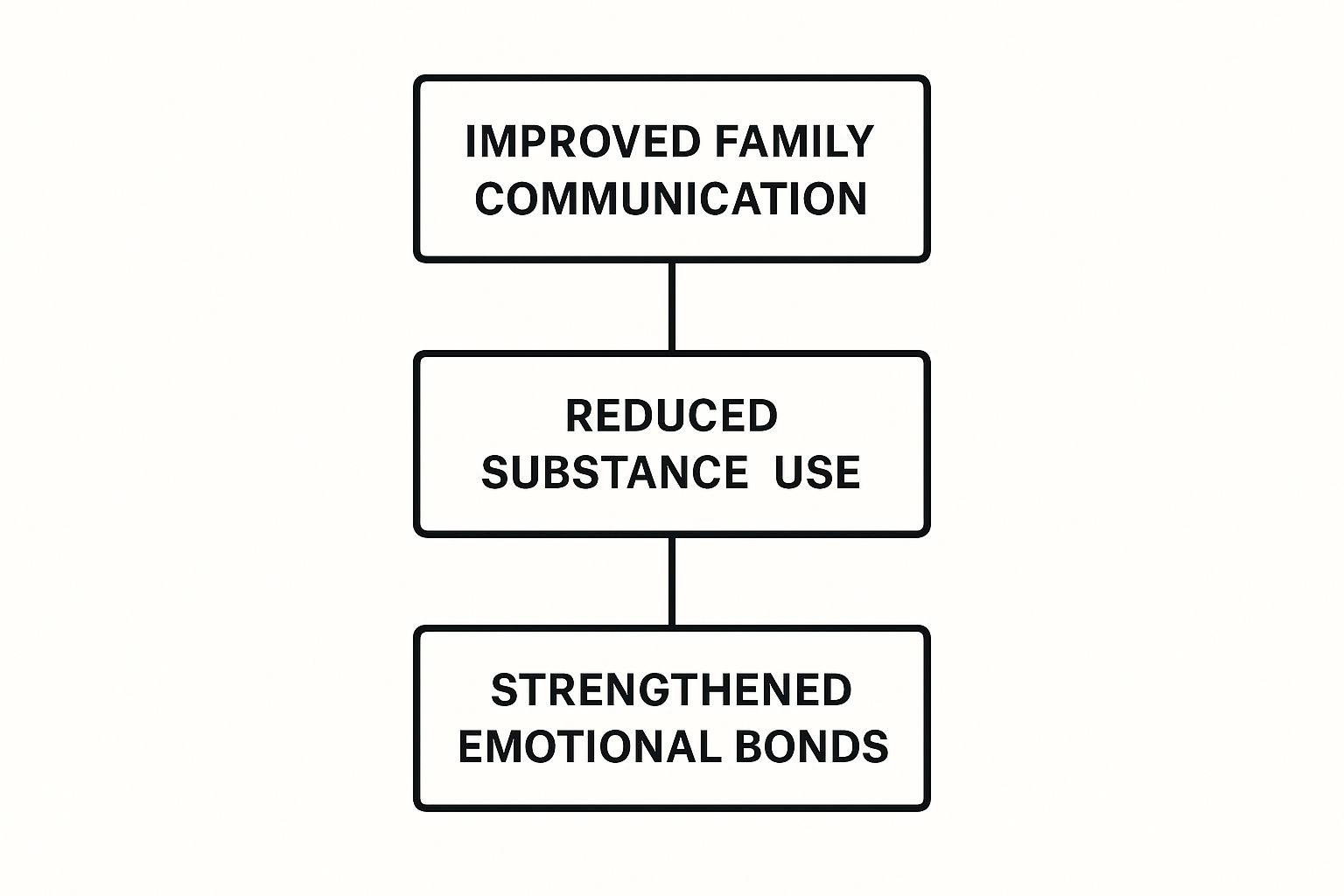
As you can see, it all starts with changing how a family talks and listens. That single shift makes everything else—from sobriety to stronger bonds—possible.
Comparing Key Family Therapy Models for Substance Abuse
Seeing these therapies side-by-side can make it clearer which one might be right for your family. While they all share the same ultimate goal, their focus and methods are distinct.
| Therapy Model | Primary Focus | Best Suited For | Example Technique |
|---|---|---|---|
| MDFT | The adolescent's entire social network (family, school, community) | Families with teens facing substance use and behavioral problems | A therapist joins a parent-teacher conference to create a unified support plan. |
| BCT | The couple's dynamic and shared commitment to sobriety | Committed partners where substance use is damaging the relationship | The couple creates a daily ritual to rebuild trust around sobriety goals. |
| FBT | Practical skills training and positive behavior reinforcement | Families with teens or adults who need structured tools for coping | Setting up a rewards system for consistent negative drug tests. |
No matter which model is used, the core mission is the same: to help the family system transform from one that might unconsciously enable addiction into one that actively nurtures and protects long-term recovery.
To learn more about the core concepts that guide these approaches, you can explore the foundational principles of family therapy. Ultimately, a treatment provider like Altura Recovery can help assess your family's specific needs to find the most effective path forward.
What to Expect in Your First Family Therapy Sessions
Walking into that first family therapy session can feel pretty nerve-wracking for everyone. That’s completely normal. The good news? Those initial meetings are designed to be a gentle entry point—a time for creating safety, understanding the landscape, and figuring out where you're all headed.
The first step isn't about dredging up old conflicts. Instead, the therapist acts as a neutral guide, making sure every single person in the room feels heard and respected. This session is all about setting ground rules for communication so that honesty becomes possible without fear of judgment.
Establishing a Foundation for Change
In these early stages, the main goal is simply assessment and goal-setting. The therapist needs to understand the family’s history, how the substance use progressed, and the way it’s impacted each person. This isn't about pointing fingers; it’s about mapping out the problem from everyone’s unique perspective.
From there, the family works with the therapist to decide what “getting better” actually looks like. The goals are almost always concrete and achievable, not vague hopes.
- Initial Goals Might Include:
- Improving Communication: Agreeing to simple rules, like speaking without interrupting or raising voices.
- Setting Boundaries: Defining clear, healthy limits around behaviors and expectations.
- Educational Understanding: Learning about the science of addiction as a team.
This process ensures everyone is on the same page and pulling in the same direction. It starts to transform a group of disconnected individuals into a unified team with a common purpose.
Moving From Theory to Practice
Once those goals are set, the real work begins. Family therapy for substance abuse is an active process, not just a place to talk. Therapists introduce practical, hands-on skills you can use right away. For example, they might teach everyone to use "I feel" statements instead of the usual accusatory "you always" language.
Families get to practice these new skills right there in the session, with the therapist providing real-time coaching. This safe, structured environment makes it possible to have productive conversations that would likely blow up at home.
The therapist's role is to be a facilitator, ensuring that emotionally charged topics are navigated constructively. They help the family build a new communication toolkit, replacing old, damaging habits with ones that foster connection and support recovery.
Over time, these sessions will also involve creating a practical relapse prevention plan together. By identifying triggers as a family and agreeing on a supportive response plan, you become a proactive, essential part of maintaining long-term sobriety. This collaborative effort makes the entire healing process feel more manageable—and a lot more hopeful.
Finding the Right Family Therapy Program for Your Needs

Taking that next step toward healing means finding professional support that fits your family's unique situation. It's crucial to understand that not all therapy programs are created equal, especially when you're dealing with the complexities of addiction. The absolute key is to find a licensed therapist or a program that specializes in both family systems and substance use disorders.
This dual expertise is non-negotiable. Think about it: a therapist who understands family dynamics is great at navigating conflict, but without a deep knowledge of addiction, they won't have the right tools to guide you effectively. Likewise, an addiction specialist needs to know how to manage the family’s powerful role in recovery.
Key Questions to Ask Potential Providers
When you're vetting a program, you’re essentially interviewing them for one of the most important jobs in your family's life. Come prepared with a list of questions to help you make a clear-headed, informed decision.
Here are some essential questions to get you started:
- What is your specific experience with families dealing with substance abuse?
- Which therapeutic models do you primarily use, and why do you find them effective?
- How do you involve every family member who wants to participate in the process?
- What does a typical session look like for a family like ours?
- How do you measure progress and define success with your clients?
Asking these questions gives you a real feel for a provider's approach and philosophy. It helps you gauge whether their style aligns with your family’s needs and comfort level.
Finding the right therapist is about more than just credentials; it's about connection. Your family should feel safe, respected, and understood by the person guiding you through this vulnerable process. Trust your instincts during these initial conversations.
Practical Considerations for Your Family
Beyond the therapeutic approach, you'll need to sort out the practical logistics. Take a moment to think about your family’s schedule, your budget, and any specific needs you might have.
For instance, it’s common for substance abuse to co-occur with other mental health conditions like anxiety or depression—a situation known as a dual diagnosis. It's vital to find a provider equipped to handle these complex layers. You can learn more about how professionals approach this by reading our guide on integrated dual diagnosis treatment.
You’ll also want to clarify session formats—do they offer in-person, virtual, or a mix of both? And be sure to verify your insurance coverage upfront to avoid any surprises. Answering these practical questions early on frees you up to focus on what matters most: healing together.
Common Questions About Family Therapy for Addiction
Stepping into family therapy often brings up a handful of important questions. Getting clear answers can ease any uncertainty and help you move forward with confidence. Here are some of the most common concerns we hear from families just like yours.
Can We Start Therapy if Our Loved One Refuses to Join?
Absolutely. It’s a tough reality, but sometimes the person struggling with addiction just isn’t ready for treatment. That doesn't mean the rest of the family has to wait in limbo. In fact, you can and should still get support.
These sessions become your space to learn about the mechanics of addiction, process the heavy emotions you're carrying, and build practical coping skills. You’ll also learn how to set healthy boundaries and spot unintentional enabling behaviors—changes that can sometimes be the very thing that nudges your loved one toward finally seeking help.
How Long Does Family Therapy Usually Take?
There’s no magic number here. The length of therapy depends entirely on your family’s unique situation, the dynamics at play, and the goals you set together. It’s not a one-size-fits-all timeline.
Some families make incredible progress in just a few months. Others, dealing with more deep-seated issues, might work with a therapist for a year or more. The process is always goal-oriented, aimed at creating real change like better communication and a rock-solid relapse prevention plan. Your therapist will help you set realistic expectations right from the start.
A key takeaway: The focus isn’t on hitting a certain number of sessions. It's about making meaningful, sustainable changes that support not just the individual's long-term recovery, but the healing of the entire family unit.
Is Everything We Discuss Kept Confidential?
Yes, without a doubt. Confidentiality is the bedrock of any therapeutic relationship. Licensed therapists are bound by both law and professional ethics to protect your privacy. What you say in session, stays in session.
This creates the safe, trusting environment needed to have honest and vulnerable conversations about difficult topics. There are a few rare exceptions, mainly involving threats of harm to yourself or others, which your therapist will explain clearly during your first meeting. This commitment to privacy is what allows families to truly open up and start healing.
At Altura Recovery, our experienced clinicians specialize in guiding families through the complexities of addiction with compassion and expertise. If you're ready to start the healing process, learn how our family therapy programs can provide the support and structure your family needs to build a foundation for lasting recovery.