
Starting your search for a local addiction therapist is a huge step—and often the hardest one. You've made the decision, and that takes incredible strength. The good news is, you don't have to figure out the rest alone. Trusted resources are available right now to help you find qualified, local support to begin your recovery.
Starting Your Search for Local Addiction Support

Where to Start Your Search for Local Therapy
When you're ready to find help, knowing where to look can cut through the confusion. This table gives a quick rundown of reliable starting points, each with its own strengths.
| Resource | Best For | Things to Consider |
|---|---|---|
| SAMHSA National Helpline | Confidential, 24/7 referrals and crisis support from a trusted government source. | Provides referrals but doesn't vet individual therapist quality. |
| Primary Care Doctor | A personalized referral from a professional who already knows your medical history. | Your doctor's network might be limited to larger hospital systems. |
| Trusted Personal Network | Emotional support and potential word-of-mouth recommendations from people you trust. | Recommendations are based on personal experience, not clinical expertise. |
| Online Directories | Filtering therapists by specialty, insurance, and location to create a shortlist quickly. | Profiles are written by the therapists themselves; you'll still need to do your own vetting. |
Ultimately, using a mix of these resources often yields the best results, giving you both professional guidance and personal support.
Leveraging Trusted Online Resources
Typing "addiction help near me" into a search engine can unleash an avalanche of results, making it hard to know who to trust. The best way to cut through the noise is to start with platforms designed specifically to connect people with care.
The Substance Abuse and Mental Health Services Administration (SAMHSA) is an excellent, government-run starting point. Their National Helpline (1-800-662-HELP) is free, confidential, and available 24/7 to provide referrals to local treatment centers, support groups, and community organizations.
Another great tool is Psychology Today's therapist finder. It lets you filter your search by location, insurance, the specific issues you're facing, and the type of therapy you want. This makes it easy to shrink a huge list down to a few manageable options that fit your practical needs. As you begin, remember that support comes in many forms, and you might want to look into specialized help like groups that can help you Join Smoking Cessation Support Groups.
Consulting Your Primary Care Doctor
Your family doctor can be a powerful and confidential ally in this process. They have a deep understanding of your medical history and can provide a professional referral to a trusted addiction specialist or treatment center in your area.
A conversation with your doctor is protected by patient confidentiality. It's a safe space to ask for help without judgment and get a recommendation grounded in medical expertise, not just an online search.
Talking with your primary care physician also ensures your physical health is woven into your recovery plan from day one. They can help coordinate your care, making the transition into therapy feel smoother and more connected to your overall wellness.
Seeking Support from Your Personal Network
It can feel incredibly vulnerable, but reaching out to a trusted friend, family member, or spiritual advisor can be a source of immense comfort and practical help. You don't have to share every detail.
Sometimes, just saying, "I'm looking for some help and could really use your support," is enough to open the door. They might know someone who had a good experience with a local therapist or can simply offer the encouragement you need to pick up the phone. The goal right now is just to gather names and possibilities—you're building a preliminary list to research later.
And you're not alone in this. In the United States, around 48.5 million people aged 12 or older had a substance use disorder in the past year. That number highlights just how critical accessible, local support really is.
This initial search might also get you thinking about your living environment. A supportive home is a key part of recovery, which is why we put together a guide on finding sober living near me. Combining therapy with a stable, recovery-focused living situation can make all the difference.
Vetting Therapists and Treatment Programs
You've got a shortlist. Now, the real work begins—looking past the slick websites and polished bios to figure out which therapist or center is the right fit for you.
This part of the process is less about finding a convenient location and more about finding a genuine connection. Think of it like an interview, but you're the one in charge. Your goal is to get a feel for their approach, their qualifications, and whether their philosophy clicks with your own goals for recovery. Choosing wisely now builds a rock-solid foundation for everything that comes next.
Decoding Therapist Credentials
When you search for "substance abuse therapy near me," you'll see a jumble of acronyms after therapists' names. Those letters aren't just for show; they represent years of specific training, education, and state licensing that tell you a lot about a professional's expertise.
Here are a few of the most common ones you’ll run into:
- LPC (Licensed Professional Counselor): These are pros with a master's degree in counseling, trained to diagnose and treat a wide range of mental and emotional health issues.
- LCSW (Licensed Clinical Social Worker): An LCSW also holds a master's degree and can provide therapy, but they often bring a unique focus on connecting you with community resources and support systems.
- CADC (Certified Alcohol and Drug Counselor): This certification signals specialized, hands-on training specifically in addiction. While the requirements vary by state, a CADC is an expert in substance use disorders.
- LMFT (Licensed Marriage and Family Therapist): These therapists are specialists in relationship dynamics, which can be incredibly helpful when family stress and substance use are tangled together.
Ultimately, the specific letters are less important than what they stand for: a commitment to professional standards. Never hesitate to ask a potential therapist what their credentials mean and how their training will help you.
Understanding the Treatment Philosophy
Every single treatment center and therapist operates from a core philosophy of care. This belief system shapes everything they do, from the types of therapy they offer to the structure of their daily programs. It is absolutely crucial that you find a program with a worldview that feels supportive and compatible with yours.
Some programs, for example, are built around the 12-step model you’d find in Alcoholics Anonymous. Others take a more secular, evidence-based path focused on teaching cognitive skills. There's no single "best" philosophy—the right one is simply the one that resonates with you and makes you feel motivated, not misunderstood.
A program’s philosophy should empower you, not alienate you. Ask directly during your initial call: "Can you tell me about your core approach to addiction recovery?" Their answer will tell you a lot about whether you'll feel at home there.
The demand for quality care is growing. The global substance abuse treatment market was valued at around USD 11.82 billion in 2025 and is projected to hit USD 21.33 billion by 2032. This isn't just a number; it reflects a growing understanding that effective, lasting recovery combines medical support with robust, personalized counseling. You can discover more insights about the substance abuse treatment market on coherentmarketinsights.com.
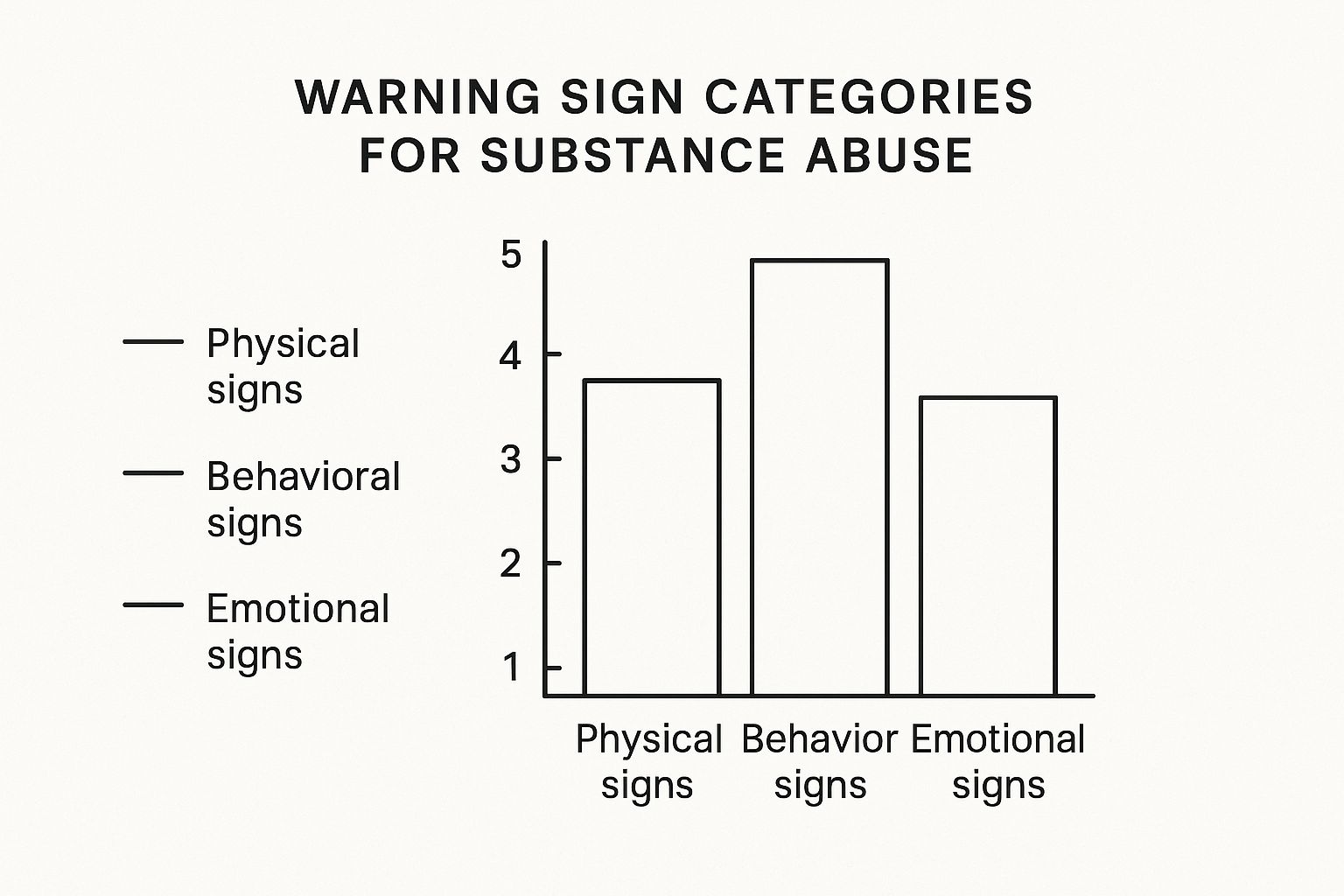
As this image shows, the warning signs of substance abuse often appear in our behaviors first. This is why therapy that helps you understand and change those behaviors is so fundamental to recovery.
Exploring Common Therapy Models
As you dig deeper, you'll start hearing terms like CBT, DBT, or EMDR. These are just names for different types of therapy, each with a unique angle for tackling the thoughts and behaviors that drive addiction. Getting the basics down can help you find a program that offers the right tools for your specific challenges.
Many treatment centers use a blend of these approaches, as different people respond to different methods. The table below breaks down some of the most effective and widely used models.
Comparing Common Therapeutic Approaches
| Therapy Model | What It Focuses On | Especially Helpful For… |
|---|---|---|
| Cognitive Behavioral Therapy (CBT) | Identifying and changing the negative thinking patterns and behaviors that lead to substance use. | Individuals who need practical, structured tools to manage cravings and triggers in real-world situations. |
| Dialectical Behavior Therapy (DBT) | Building skills in mindfulness, distress tolerance, emotional regulation, and interpersonal effectiveness. | People who struggle with intense emotions, self-harm, or have a dual diagnosis like borderline personality disorder. |
| Eye Movement Desensitization and Reprocessing (EMDR) | Processing traumatic memories that may be contributing to substance use as a coping mechanism. | Individuals whose addiction is closely linked to past trauma, PTSD, or deeply distressing life events. |
| Motivational Interviewing (MI) | A collaborative conversation style designed to strengthen a person's own motivation and commitment to change. | Those who feel ambivalent or unsure about making significant life changes and need support exploring their reasons for recovery. |
Finding a program that can tailor its methods to you isn't just a bonus—it's a hallmark of high-quality, personalized care.
Many people find that a combination of therapy settings, like individual and group sessions, gives them the best results. To learn more about how these two formats work together, check out our guide on individual therapy vs. group therapy.
Figuring Out Insurance and Treatment Costs
Worrying about how to pay for treatment should never be the thing that stops you from getting help. The money side of finding "substance abuse therapy near me" can feel like a tangled mess, but a little bit of information goes a long way.
Let’s walk through exactly how to check your insurance benefits, figure out what the jargon means, and find solid options if you don't have insurance. The goal here is clarity, so you can put your energy where it really belongs—on your recovery.
Decoding Your Insurance Benefits
The most practical first step is to pick up the phone and call the member services number on the back of your insurance card. Seriously, this one call can prevent a world of headaches and surprise bills later on.
When you get someone on the line, you're not just asking if therapy is covered. You need specifics. Grab a pen and paper, and get ready to ask some direct questions about your behavioral health or mental health benefits, as this is almost always where substance use treatment is categorized.
Here’s what you need to ask:
- Do I have coverage for outpatient substance abuse therapy? Use those exact words so there’s no confusion.
- What’s my annual deductible, and have I met any of it yet this year? The deductible is what you have to pay out-of-pocket before your insurance kicks in.
- What is my copay or coinsurance for each therapy session? A copay is a flat fee (like $40 per visit), while coinsurance is a percentage of the total bill.
- Do I need a pre-authorization or a referral from my primary care doctor first? Some insurance plans require this extra step before they’ll agree to pay.
- Is there a cap on how many sessions I can have per year? This is a critical detail to know upfront.
Getting straight answers to these questions transforms vague financial stress into a concrete plan you can work with.
When Insurance Isn't an Option
If you don't have insurance, or your plan's coverage is minimal, please do not give up. Many quality treatment centers are deeply committed to making sure people get help, regardless of their financial situation. You have options.
Look for community-based clinics and non-profit organizations that offer a sliding-scale fee. This just means they adjust the cost of each session based on your income, which can make professional therapy affordable. When you call a potential center, a great first question is, "Do you offer a sliding-scale payment option?"
Cost should not be the final barrier to recovery. Many state and local governments fund substance abuse programs specifically for residents who are uninsured or underinsured. A great first step is to check your state's Department of Health and Human Services website for a list of funded providers.
These programs exist for a reason: to ensure everyone gets a fair shot at healing. For a better sense of what these programs offer, our guide explaining what is rehab gives a helpful overview of different treatment settings.
Managing Out-of-Pocket Expenses
Even with good insurance, you'll likely have some out-of-pocket costs, like meeting that deductible or paying your copays. Don't be afraid to talk about this directly with the intake coordinator at any facility you're considering.
Many centers are more than willing to set up a payment plan, which lets you pay your share in smaller, more manageable chunks over several months. This can make a high deductible feel a lot less overwhelming. It's also worth asking if the center can provide a "superbill" that you can send to your insurance for partial reimbursement if you're using an out-of-network provider.
Being proactive and asking about these financial tools shows you're serious and helps the center find a way to work with you.
Choosing the Right Outpatient Program for You

Not all outpatient care is created equal. The term actually covers a wide spectrum of support, from minimal check-ins to a commitment that’s almost a full-time job. Finding the right intensity level is a crucial step in building a recovery path that fits your life without overwhelming it.
When you start searching for "substance abuse therapy near me," you'll run into a bunch of acronyms. Getting a handle on what they mean ahead of time helps you ask better questions and find a structure that truly works for you, instead of trying to squeeze into a program that’s a bad fit from the start.
Standard Outpatient Programs (OP)
Think of a standard Outpatient Program (OP) as the most flexible level of care. It’s designed for people who already have a solid support system and a stable home life but need that ongoing professional guidance to stay on track.
This level of care is light on hours, typically involving just a few hours of therapy per week. Your schedule might look like one individual therapy session and maybe one group session. It’s a structure that lets you fully keep up with work, school, and family while still having a professional to help you process challenges and sharpen your coping skills.
OP is often a perfect "step-down" for someone who has just finished a more intensive program, like residential treatment or an IOP. It’s all about providing that continuity of care as you ease back into your daily routine.
Intensive Outpatient Programs (IOP)
Moving up the ladder, an Intensive Outpatient Program (IOP) offers a more structured and immersive experience—but without requiring you to live at the facility. This is a powerful middle ground for anyone who needs more support than a weekly therapy session can offer but is still able to manage their home life.
An IOP requires a real time commitment, usually 9 to 15 hours per week, spread across three to five days. A typical week involves multiple group therapy sessions, one-on-one counseling, and often educational workshops on topics like relapse prevention or emotional regulation. This environment helps build a strong sense of community and accountability with peers who get what you're going through. You can learn more about what an intensive outpatient program entails in our detailed guide.
An IOP is ideal for individuals who are medically stable but need to build a robust set of recovery skills. It provides the structure of a daily program while allowing you to go home each night, practice what you've learned in the real world, and talk about how it went in your next session.
Partial Hospitalization Programs (PHP)
At the highest level of outpatient care, you have Partial Hospitalization Programs, or PHPs. This is the most intensive option you can get outside of a residential setting, offering a level of support that’s a lot like having a full-time job focused on your recovery.
A PHP demands a substantial commitment, usually around 20 to 30 hours per week, five days a week. Participants spend their days at the treatment facility engaged in a variety of therapeutic activities, including individual therapy, group processing, psychiatric check-ins, and skills training.
This level of care is best for people who need significant daily structure and monitoring but have a safe, supportive home to return to each evening. It's often recommended for those with co-occurring mental health conditions or for individuals stepping down from inpatient care who aren't quite ready for the looser structure of an IOP.
The need for these different levels of care is reflected in the growing addiction treatment market, which was valued at about USD 9.44 billion in 2024 and is projected to expand significantly as more people seek help.
You’ve done the heavy lifting—researching, vetting options, and finally choosing a therapist or program. Making that first call is a huge win. Now, let's turn any leftover nerves into confidence so you can walk into that initial session feeling ready.
Think of this first meeting less like a final commitment and more like a final confirmation. It’s your chance to see if the connection you felt online or over the phone holds up in person. The goal is simple: to walk out feeling seen, heard, and hopeful.
The First Phone Call: Your Gut Check Moment
Before you even step into an office, you'll probably have a quick chat with a therapist or an intake coordinator. This isn't just a formality—it's your first real opportunity to get a feel for their communication style and the overall vibe of the practice.
Pay close attention to how they talk to you. Do they sound rushed, or do they actually listen to your questions? A good therapist will make you feel respected from the first minute, creating a sense of safety before you’ve even shared your story.
Listen for a few key things:
- Warmth and Compassion: Do they seem to genuinely care about what you're going through?
- Clarity: Can they clearly explain their process, fees, and what happens next?
- Patience: Do they give you space to ask questions without making you feel like you're on a timer?
Remember, this conversation is a two-way street. You’re interviewing them just as much as they're gathering information about you. If the call leaves you feeling dismissed or weird, trust that instinct. It's a clear sign this might not be the right fit, and it is 100% okay to keep looking.
Getting Your Information Together
To make that first appointment as smooth as possible, it helps to have a few key things on hand. You won’t need to have your entire life story memorized, but being prepared keeps you from feeling flustered or put on the spot.
What to bring:
- Your photo ID and insurance card.
- A list of any current medications you're taking, including the dosages.
- Contact info for your primary care doctor or any other specialists.
Your first session is mostly an information-gathering meeting for the therapist. They need to understand your history to build a treatment plan that actually works. Being open and honest, even when it’s hard, is the first step toward real healing.
They’ll likely ask about your substance use history—what you use, how often, and for how long. They’ll also ask about your family background, medical history, and any past therapy experiences. This is a confidential, judgment-free space designed for exactly these kinds of conversations.
Smart Questions to Ask Your Potential Therapist
That first session is your best chance to ask direct questions that will help you decide if this is the right partnership for your recovery. Asking good questions shows you’re an active participant in your own care and helps get everyone on the same page from the start.
Don't be shy about asking what's on your mind. A good therapist will welcome your questions and see them as a sign of your commitment.
Questions to Confirm It's a Good Fit:
- What does a typical session with you look like? This gives you a feel for their style—are they structured and goal-oriented, or more conversational?
- How will we measure progress? Knowing how you'll both track your growth helps set clear, achievable goals.
- What is your experience with [mention your specific substance or co-occurring issue, like anxiety]? This confirms they have the specialized expertise you need.
- What’s your policy on communication between sessions? It’s good to know the boundaries around calls or emails for urgent situations.
- How do you involve family in the process, if at all? If family therapy is important to you, this clarifies their approach right away.
Walking into that first appointment for substance abuse therapy near me is a profound step. By preparing beforehand, you're not just organizing paperwork; you're setting the stage for a successful and empowering start to your recovery.
Got Questions? Let's Get Them Answered
Searching for "substance abuse therapy near me" is bound to bring up some real-world questions. It's totally normal to wonder about the practical stuff—cost, logistics, and what to expect. Getting straight answers to these common hurdles makes it easier to move forward with confidence.
Let’s tackle some of the most frequent concerns that come up during the search.
What Are My Options Without Insurance?
Seeing the potential cost of therapy without insurance can feel like hitting a brick wall, but it doesn’t have to be. Plenty of high-quality treatment providers offer a sliding-scale fee structure, which just means the cost per session is adjusted based on your income.
Don’t stop there. Also, look into:
- Community Mental Health Centers: These are often state-funded and set up specifically to provide affordable care for local residents.
- Non-Profit Organizations: Many non-profits get grants and donations to offer low-cost or even free addiction counseling.
- University Training Clinics: If a university with a psychology or counseling program is nearby, its clinics might offer therapy at a reduced cost with supervised graduate students.
Never assume you can’t afford help. The very first question to ask any potential provider is, "What options do you have for someone paying out-of-pocket?" You’ll often be surprised at what’s available.
How Do I Know If a Therapist Is a Good Fit?
The connection you build with your therapist is one of the single most important factors in your recovery. But how can you really tell if it’s a good match after just one or two conversations? A lot of it comes down to trusting your gut and watching for a few key signs.
After your first meeting, ask yourself these questions:
- Did I feel heard and respected, or did I feel judged?
- Did they explain their approach in a way that made sense to me?
- Do I feel even a small sense of hope or optimism after talking with them?
A good therapist should create a feeling of safety and collaboration. If you leave the session feeling worse, confused, or like you weren't taken seriously, that’s a strong signal to keep looking. It is perfectly okay to "shop around" until you find a professional you genuinely connect with.
What's the Difference Between Therapy and a Support Group Like AA?
While both are incredibly valuable tools, professional therapy and peer support groups play different roles. Understanding how they differ helps you build a more complete, well-rounded recovery plan.
Therapy is a clinical treatment. It's provided by a licensed professional who uses evidence-based techniques to help you dig into the root causes of addiction, manage co-occurring conditions like anxiety, and build personalized coping strategies.
Support groups like Alcoholics Anonymous (AA) or Narcotics Anonymous (NA), on the other hand, are peer-led fellowships. They offer a powerful sense of community, shared experience, and a structured program for staying sober. They aren't, however, a substitute for professional mental health care.
Many people find that the combination of both—the clinical guidance from therapy and the community connection of a support group—creates the strongest possible foundation for long-term recovery.
How Long Does Outpatient Treatment Actually Last?
This is a big one, and the honest answer is: it's different for everyone. The duration of outpatient therapy is highly individual and depends on your unique needs, the severity of the substance use disorder, and how you're progressing. There's no one-size-fits-all calendar.
Your treatment plan is a living document. It should be reviewed and adjusted regularly by you and your therapist to reflect your progress and changing needs. The goal isn't to stay in therapy forever but to build the skills for a lifetime of recovery.
Generally speaking, an Intensive Outpatient Program (IOP) might run for several weeks to a few months. Afterward, you might "step down" to a standard outpatient program with weekly sessions for continued support. The focus is always on your progress, not the clock.
At Altura Recovery, we know these questions are just the beginning. Our team is here to give you clear, straightforward answers and guide you toward a treatment plan that fits your life and your goals. Learn how our flexible outpatient programs can support your journey by visiting us at https://www.alturarecovery.com.